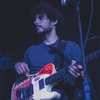
Larry Mullen, Jr.
Larry Mullen, Jr.'s Gear



From Mullen's drum tech Sam O’Sullivan: "Larry’s kit is called the PHX, the Phoenix. It’s an amazing Yamaha kit which is a hybrid of different woods - maple, ash, kapur, jatoba - from different countries, and the sound is absolutely phenomenal. The kick drum is a 24", so it’s a big baby, 14" rack and two 16" floor toms and the Ludwig Black Beauty which is 14"x6.5".
Find it on:


Started on Tama. Also in the early studio recordings Larry was using the Tama kits. Late on he also was seen on the Premier Olympic kit
Find it on:

Larry Mullen, Jr. used a Premier Olympic Drum Kit, as evidenced by the images from the 1976-1980 period on the Zootopia Community website.
Find it on:

According to this transcription of a February 1982 issue of U2 Magazine, "Larry has a somewhat unusual drum set up. Not that the kit itself was unusual, but it was arranged in an unusual manner and had several unusual extras. The basic kit is a very impressive all black Tama Fiberstar - all single headed, and including a 24" kick drum, 16" and 18" floor toms, and a selection of rather deep rack toms. The snare was a Ludwig 14"x61 " steel shell and he also has a pair of Latin Percussion Timbale. The cymbals comprised Zildjian 18" thin ride; 18" thin crash; 18" medium crash; 18" pang and 21" ride, with Paiste 14" hi-hats on a Premier Trilock pedal. The rest of the stands are Tama. The kit is miked using Sennheiser 421's for the kick and the floor toms, Shure SM57's for rack toms and snare, Electro-voice RE10 on the hi-hat and AKG D190's on the rest. No overhead mikes."
Find it on:


-m.webp?v=1784333712)
According to this transcription of a February 1982 issue of U2 Magazine, "Larry has a somewhat unusual drum set up. Not that the kit itself was unusual, but it was arranged in an unusual manner and had several unusual extras. The basic kit is a very impressive all black Tama Fiberstar - all single headed, and including a 24" kick drum, 16" and 18" floor toms, and a selection of rather deep rack toms. The snare was a Ludwig 14"x61 " steel shell and he also has a pair of Latin Percussion Timbale. The cymbals comprised Zildjian 18" thin ride; 18" thin crash; 18" medium crash; 18" pang and 21" ride, with Paiste 14" hi-hats on a Premier Trilock pedal. The rest of the stands are Tama. The kit is miked using Sennheiser 421's for the kick and the floor toms, Shure SM57's for rack toms and snare, Electro-voice RE10 on the hi-hat and AKG D190's on the rest. No overhead mikes."
Find it on:

According to Larry Mullen, Jr.'s Paiste artist page, he uses the 14" Signature Heavy Hi-Hat.
Find it on:

According to the website U2: Stage And Studio, Larry Mullen, Jr. used a "Yamaha 10" Peter Erskine model snare drum" during U2's 360° Tour
Find it on:

According to the website U2: Stage And Studio, Larry Mullen, Jr. used a "14" Ludwig (hammered) Black Beauty snare drum" during U2's 360° Tour.
Find it on:


Used for the iNNOCENCE + eXPERIENCE Tour.
For in-ear monitors the band is trying something different—the JH Audio JH-16s for everyone except for The Edge and his engineer Richard Rainey, who opted for the JH Roxanne in-ears.
Find it on:

Used as overheads on the iNNOCENCE + eXPERIENCE tour.
“We have a fairly traditional mic setup for Larry [Mullen’s] drums, from Shure 421s on toms, to 57s on top and bottom snare, and Audio-Technica 4050s for overheads,” says monitor engineer CJ Eiriksson. “We keep the mics fairly close and tight on everything, which helps keep the arena bleed out of drums as much as possible.
Find it on:

Used for the snare on "Get On Your Boots", as stated by producer Declan Gaffney.
"Most of 'Get On Your Boots' was recorded in Dublin by Richard Rainey, and the basic backing tracks were done live, by the whole band together. There was an [Electro-Voice] RE20 inside the bass drum, with an SE Electronics Titan on the outside, a [Shure] 57 underneath the snare, and Richard had his own Heil mic on top, which he alternated with a Beyer M201; the toms were [Sennheiser] 421, overheads Coles 4038; ride cymbal was sometimes a 57, sometimes a [AKG] 451. Everything went through the Neve 1091 or 1093 mic pres."
Find it on:


He uses this drum heads on all his toms. You can see all his gear on this site
Find it on:


Used for the rack toms and snare drum, as mentioned in this transcription of a February 1982 issue of U2 Magazine.
Larry has a somewhat unusual drum set up. Not that the kit itself was unusual, but it was arranged in an unusual manner and had several unusual extras. The basic kit is a very impressive all black Tama Fiberstar - all single headed, and including a 24" kick drum, 16" and 18" floor toms, and a selection of rather deep rack toms. The snare was a Ludwig 14"x61 " steel shell and he also has a pair of Latin Percussion Timbale. The cymbals comprised Zildjian 18" thin ride; 18" thin crash; 18" medium crash; 18" pang and 21" ride, with Paiste 14" hi-hats on a Premier Trilock pedal. The rest of the stands are Tama. The kit is miked using Sennheiser 421's for the kick and the floor toms, Shure SM57's for rack toms and snare, Electro-voice RE10 on the hi-hat and AKG D190's on the rest. No overhead mikes.
The SM57 was later used for the snare drum and ride cymbal on "Get On Your Boots", as stated by producer Declan Gaffney in this Sound on Sound interview.
"Most of 'Get On Your Boots' was recorded in Dublin by Richard Rainey, and the basic backing tracks were done live, by the whole band together. There was an [Electro-Voice] RE20 inside the bass drum, with an SE Electronics Titan on the outside, a [Shure] 57 underneath the snare, and Richard had his own Heil mic on top, which he alternated with a Beyer M201; the toms were [Sennheiser] 421, overheads Coles 4038; ride cymbal was sometimes a 57, sometimes a [AKG] 451. Everything went through the Neve 1091 or 1093 mic pres."
Find it on:

According to Larry Mullen, Jr.'s Paiste artist page, he uses the 17" Signature Power Crash.
Find it on:
-m.webp?v=1784890988)
Used for the toms on "Get On Your Boots", as stated by producer Declan Gaffney.
"Most of 'Get On Your Boots' was recorded in Dublin by Richard Rainey, and the basic backing tracks were done live, by the whole band together. There was an [Electro-Voice] RE20 inside the bass drum, with an SE Electronics Titan on the outside, a [Shure] 57 underneath the snare, and Richard had his own Heil mic on top, which he alternated with a Beyer M201; the toms were [Sennheiser] 421, overheads Coles 4038; ride cymbal was sometimes a 57, sometimes a [AKG] 451. Everything went through the Neve 1091 or 1093 mic pres."
The 421 was later used for the same purpose on the iNNOCENCE + eXPERIENCE tour, as stated in this Mix Online article.
“We have a fairly traditional mic setup for Larry [Mullen’s] drums, from Shure 421s on toms, to 57s on top and bottom snare, and Audio-Technica 4050s for overheads,” says monitor engineer CJ Eiriksson. “We keep the mics fairly close and tight on everything, which helps keep the arena bleed out of drums as much as possible.
Find it on:


As stated by producer Declan Gaffney, the L2007 was used for "Get On Your Boots".
Declan Gaffney incorporated extensive master processing into his mix. Dynamic control was provided by the Waves SSL Master Bus Compressor and Massey L2007 limiter, while Waves' VEQ4 added tonal changes.
An image of the settings can be found here.
Find it on:

Larry Mullen Jr's stick of choice, at least since The Unforgettable Fire tour, have been Pro-Mark Oak 5A, with wood tip. It was thought that the stick he used previous to these contributed to his tendonitus issues. While a long time endorser, there is no "Larry Mullen Jr." signature model available from Pro-Mark, at this time. But to use the same sticks as Larry, simply buy the Pro-Mark Oak 5A, with wood tip.
Find it on:

Larry Mullen Jr's stick of choice, at least since The Unforgettable Fire tour, have been Pro-Mark Oak 5A, with wood tip. It was thought that the stick he used previous to these contributed to his tendonitus issues.
Find it on:

Larry Mullen, Jr. uses the Yamaha HS850 Hi-Hat Stand, as shown in a photo featured by Futurecdn.
Find it on:

You can see this snare on 4:00. This drum was used during the October tour and perhaps before.
Find it on:

Used for the bass drum on Achtung Baby and Pop, as explained by engineer Robbie Adams in this July 1997 Sound on Sound interview.
DECONSTRUCTING DRUMS
Three years ago, U2 engineer Robbie Adams explained in SOS how he recorded Larry Mullen's drums with just three mics, an approach he had picked up from Flood, who, said Adams, "is bored with all this traditional, big stereo nonsense." Flood explained that his way of recording drums was partly born from necessity, and partly from reading Mark Lewisohn's classic book on The Beatles' recording sessions: "When we were working on Achtung Baby, we had two drum kits set up, and I had very few channels on the desk, so that was a bit of a problem. I noticed from the photographs in the Beatles book how there was always one mic parked just above the drum kit. I thought it was maybe just for the photo or something, but then I saw it in other studio shots as well, and so, because of the problem I had with too few channels, I decided to try it out on one of the two kits. I put one mic on the bass drum -- an AKG D12 or Neumann U47 -- a Shure SM57 on the snare, and an SM58 as the overhead just above the kit.
"What started to happen was that people would prefer that drum sound, even though it's virtually mono. I also noticed that with Larry, who is a powerful drummer, when you put the drums in stereo you have to have the levels up higher on playback, whereas the mono drums were more powerful, even at lower levels. When I thought about it, I realised that if you're standing in front of a drum kit, you hear it in mono -- you don't hear the toms panning neatly from left to right in your ears. Also, a mic just above the kit compresses the sound. And that's the same effect that happens in the ears of a drummer or when you stand close to the kit; the sound is compressing in your ears because of the level of air pressure. So when you have a cheap, lo-fi overhead mic in that position, and add compression on a mic that's already compressing, it brings out the excitement, the same feel and natural balance that the drummer is getting."
"I've used the three-mic approach as a starting point ever since. You can do all sorts of things with it. For example, if the room you're recording in is rather dead, you can add a bit of room reverb just on the mad-sounding compressed mic. That will give the illusion of the drums having space, and yet the physical punch still comes from the middle. I will sometimes add two more overheads, like a 414 or 87, placed a bit higher up, or at the same height as the drummer's ears. A lot of the times we end up monitoring kick, snare and these higher overheads, and then if the track sounds a bit lame, we'll feed that extra low overhead mic in, which can bring out all the reflections that the drummer gets and that you may not hear normally. It's always good to experiment and listen to the sound the drummer gets in the room. When we were working on Pop in Miami, we were in a room that had very little character, so we put the two ambient mics right in the corner, pointing towards the ceiling, away from the drum kit, thus deliberately creating a woolly, booming drum sound that went well with the brightness of the drum kit. We were always pushing for character, and trying to stay as far away as possible from a generic rock drum sound."
Find it on:

Used for the bass drum on Achtung Baby and Pop, as explained by engineer Robbie Adams in this July 1997 Sound on Sound interview.
DECONSTRUCTING DRUMS
Three years ago, U2 engineer Robbie Adams explained in SOS how he recorded Larry Mullen's drums with just three mics, an approach he had picked up from Flood, who, said Adams, "is bored with all this traditional, big stereo nonsense." Flood explained that his way of recording drums was partly born from necessity, and partly from reading Mark Lewisohn's classic book on The Beatles' recording sessions: "When we were working on Achtung Baby, we had two drum kits set up, and I had very few channels on the desk, so that was a bit of a problem. I noticed from the photographs in the Beatles book how there was always one mic parked just above the drum kit. I thought it was maybe just for the photo or something, but then I saw it in other studio shots as well, and so, because of the problem I had with too few channels, I decided to try it out on one of the two kits. I put one mic on the bass drum -- an AKG D12 or Neumann U47 -- a Shure SM57 on the snare, and an SM58 as the overhead just above the kit.
"What started to happen was that people would prefer that drum sound, even though it's virtually mono. I also noticed that with Larry, who is a powerful drummer, when you put the drums in stereo you have to have the levels up higher on playback, whereas the mono drums were more powerful, even at lower levels. When I thought about it, I realised that if you're standing in front of a drum kit, you hear it in mono -- you don't hear the toms panning neatly from left to right in your ears. Also, a mic just above the kit compresses the sound. And that's the same effect that happens in the ears of a drummer or when you stand close to the kit; the sound is compressing in your ears because of the level of air pressure. So when you have a cheap, lo-fi overhead mic in that position, and add compression on a mic that's already compressing, it brings out the excitement, the same feel and natural balance that the drummer is getting."
"I've used the three-mic approach as a starting point ever since. You can do all sorts of things with it. For example, if the room you're recording in is rather dead, you can add a bit of room reverb just on the mad-sounding compressed mic. That will give the illusion of the drums having space, and yet the physical punch still comes from the middle. I will sometimes add two more overheads, like a 414 or 87, placed a bit higher up, or at the same height as the drummer's ears. A lot of the times we end up monitoring kick, snare and these higher overheads, and then if the track sounds a bit lame, we'll feed that extra low overhead mic in, which can bring out all the reflections that the drummer gets and that you may not hear normally. It's always good to experiment and listen to the sound the drummer gets in the room. When we were working on Pop in Miami, we were in a room that had very little character, so we put the two ambient mics right in the corner, pointing towards the ceiling, away from the drum kit, thus deliberately creating a woolly, booming drum sound that went well with the brightness of the drum kit. We were always pushing for character, and trying to stay as far away as possible from a generic rock drum sound."
Find it on:

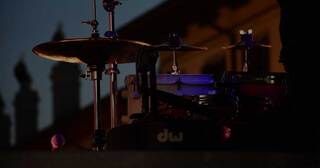
In this photo, Larry Mullen Jr. is seen using a DW 5000 Single Bass Drum Pedal in his B-Stage kit setup for the Joshua Tree 2017 tour.
Find it on:

According to this transcription of a February 1982 issue of U2 Magazine, "Larry has a somewhat unusual drum set up. Not that the kit itself was unusual, but it was arranged in an unusual manner and had several unusual extras. The basic kit is a very impressive all black Tama Fiberstar - all single headed, and including a 24" kick drum, 16" and 18" floor toms, and a selection of rather deep rack toms. The snare was a Ludwig 14"x61 " steel shell and he also has a pair of Latin Percussion Timbale. The cymbals comprised Zildjian 18" thin ride; 18" thin crash; 18" medium crash; 18" pang and 21" ride, with Paiste 14" hi-hats on a Premier Trilock pedal. The rest of the stands are Tama. The kit is miked using Sennheiser 421's for the kick and the floor toms, Shure SM57's for rack toms and snare, Electro-voice RE10 on the hi-hat and AKG D190's on the rest. No overhead mikes."
Find it on:

According to Larry Mullen, Jr.'s Paiste artist page, he uses the 16" Signature Power Crash.
Find it on:

According to Larry Mullen, Jr.'s Paiste artist page, he uses the 18" Signature Power Crash.
Find it on:

According to Larry Mullen, Jr.'s Paiste artist page, he uses the 18" Signature Full Crash.
Find it on:

According to Larry Mullen, Jr.'s pre-2021 Paiste artist page, he used the 22" Signature Power Ride.
Find it on:

According to the website U2 Atomic, Larry Mullen, Jr. used a Shure Beta 52 to mike his B-stage bass drum during U2's Joshua Tree tour.
Find it on:

Used on the iNNOCENCE + eXPERIENCE tour.
“The DiGiCo SD7 I’m using is extremely powerful and reliable. It can do anything we throw at it,” says Bono monitor engineer Alastair McMillan, pictured at left with monitor engineer CJ Eiriksson (Larry Mullen, Adam Clayton) and monitor engineer Richard Rainey (the Edge), each of whom also has an SD7. “We’re using all of the available processing power, which is quite impressive for a four piece band! I’m a big fan of the new classic EQ option and especially the multiband compressors. With those two features I have everything I need so I decided not to opt for the Waves grid. We’re all running at 96k. I am hooked up to Pro Tools via two Madi bridges which are able to sample convert in real time. This way we can run our Pro Tools sessions at 48k, making them a much more manageable size.”
Find it on:
This is a community-built gear list for Larry Mullen, Jr..
- Find relevant music gear like Drum Sets, Cymbals, Snare Drums, Drumsticks, and other instruments and add it to Larry Mullen, Jr..
- The best places to look for gear usage are typically on the artist's social media, YouTube, live performance images, and interviews.
- To receive email updates when Larry Mullen, Jr. is seen with new gear, follow the artist.