
andrabian's Reviews
15 reviews Back to andrabian's Equipboard

180
Ugly but Tasty
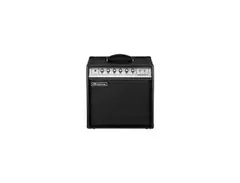
This is my fifth amp and second gigging amp currently. I have small practice amps that I use most, and a Peavey Classic 30, which I drive at the few occasions I play live on stages. Recently I only have the opportunity to play in pubs and cafes, where 5 watter practice amps fail and the C30 may be too much to carry and drive. I was negotiating on a used Super Champ, that I knew well, than I changed my mind and ordered a new GVT for the same price. I cannot comment on its live performance yet, but I feel like sharing my first impression. 1. It's HUUGE for a 15 watter amp.Take the Super Champ, and double it in weight and size. May be due to the shape, closed back and dimensions but it even feels harder to carry around than the C30. 2. The design is very functional and robust, with minimal effort to look nice, if any. Apart from using the tipo and colors typical of Ampegs, I don't see they tried to make it look like a vintage amp either, which is, in a way, good. But the quality of the materials and the assembly is so high level you hardly see in mass produced units manufactured n China. It looks like a Custom Shop amp. 3. Features are more than outstanding. I don't think I'd use the effect loop, I prefer serial, but the various options to add external speakers are tempting to experiment with them. No experience with vintage Fenders but to my ears the reverb is beautiful. I've never heard such a spacey reverb in a combo amp, sounds like fresh mountain air. An onboard trem could come handy too, but it may not be an Ampeg thing 4. Both the clean and the dirt sound, and all the shades in between, which you can fine tune with the volume, gain and EQ are very pleasing to my ears. The clean is like how I imagine blackface clean, bright, without being harsh. That's the only option I'm missing from my PV Classic 30. I never use the dirt sound from the PV, which start to sound natural only at breakup after a certain volume, and also needs some equalization, so it's hard to switch back to clean without fiddling with the controls. I believe that's what Neil Young does with his Whizzers. Pedals give me more flexibility, but the higher gain sound of the GVT is so musical that I can't wait to try it live, or just by boosting it.
Summary: the only downer is the weight and size, which are kinda disappointment to me. I think if I had the opportunity to see it before ordering, I may not have bought it. But on the other hand, it appears to be a much better quailty amp, than I expected, capable of sounds that make a lot of fun to play and hear.
180
Collectible and surprisingly playable
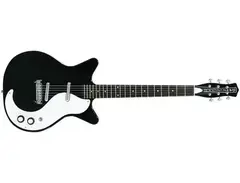
Mine is the 2nd generation reissue Chinese made one with asymmetric headstock, and non-stacked pots. It has a burgundy color that made me call it the Dr. Pepper guitar. It came for a price I could not resist, and thought I’d keep it in the trunk for the worst scenario. Surprisingly, after some cleaning and setup, the thing not only looks good, but plays good and sounds well enough for a 200 $ axe.The straight maple neck has a comfortable profile depth , maybe at its width some more real estate could come handy, which makes it a twang guitar, rather than a two note-bend guitars. Has a nice sustain with a flat fretboard, that makes it highly suitable for slide. I tend to tune it to open G and fiddle with Muddy Waters riffs for hours. The bridge PU alone sound a bit thin, the neck a bit too dark, but the two provide a nice balanced sound when engaged together. A blend wiring could be very useful for this kind of guitar. It has a unique sound without any added effects, I believe it will serve me well as an open mike / backup or canyoulenda guitar.
180
Feature paralysis
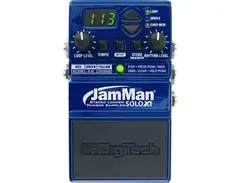
“The JamMan Solo is a really great pedal—its playback sounds fantastic, it couldn’t be easier to use and its build quality is top-notch. It allows me to create really interesting sonic textures and atmospheres,” sayeth Josh Lattanzi, Norah Jones sideman according to an article published on Harman's website. I seriously challenge that. The Solo XT may be great, but clearly a usability disaster. Ironically, that's one of the reasons I got it. Not only because it came out as a winner in several reviews of products of its category, but also because the seller reduced the price with 20% in panic, witnessing my hesitation as he was unable to show me even the basic functions after 10 minutes of a mad fight to mute the annoying preset drum patterns. Since then I manged to have some fun with it, and I still feel it was a good deal, but I cannot provide a full review on it yet, since I only have it for a week now. I'd only provide a list of issues to consider for those getting hooked on it, like me.
Firstly. Reviewers seem to be divided on this issue, but I can confirm, yes, it IS possible to get rid of the fucking drum presets, when you understand that they are not related to the rhythm section, but factory recorded as loop samples into the first few presets for some weird reason. Who wants that? Who wants to RECORD drum samples on a looper stompbox, only to feed it into a guitar amp? A mystery content, but at least it's not hardwired.
Secondly: If you previously owned any basic looper pedal, you'd expect that "deleting a loop" by press holding the pedal, means deleting a loop phrase entirely. Wrong, in the case of the Solo XT. Press hold only erases the last recorded layer, not the entire loop. It means, that if you intentionally or accidentally entered into "overdub" mode, erase will only erase the overdub, even if it's only 2 seconds of pickup noise. Provided that you previously stored the loop...
If you had more basic loop pedals (like the TC Electronics's Ditto) you'd expect that recording a loop means storing the loop. Again, false. When you go into record mode, and finish your phrase and hear it looped, even dub it, it's not actually STORED with the loop until you hit the separate, finger-only "store" function. Until then, it can be undone or cleared hands-free, but AFTER that, you need to knee down to your pedal again and finger the "erase loop" function.
To store or erase a loop, you need to use the very same, tiny, black, non-illuminated, non-clicking button. If you have glasses, you'll need them. This will require a single click for storage, and a hold-click, a single click, and another hold click for erasing the loop. It's obvoius, when your are Josh Lattanzi, but if you're not, only a few days of practice, and you don't need the manual anymore. You may still fail, but at least you'll know the process in theory.
When you're done with learning how to "erasa the loop", you'd better think about what does that mean. Erasing the loop phrase? Yes, and even more. It erases all settings of the actual loop, and reset them to factory settings. I seriously don't understand why this is necessary, even if the factory settings would not suck. I'd be perfectly happy if all the previously dialed in settings (tempo, type of metronome, ending mode) would be kept even after I decide to erase the entire phrase sample. This may be because I tend to improve the same loops frequently, using the same settings with regards to beat and metro sound, and have a hard time setting up the proper tempo, so loosing these for the sake of a new phrase makes me sad. Maybe it would be okay if the last tempo would be maintained, and the factory preset rhythm sound would not be the most annoying one, just a modest tick.
For some reason, since finding out the "copy loop" function, I keep copying and re-recording new loops, instead of modifying the existing ones. This way, it's easy to spend the generous 200 preset banks. And even 200 more, if you insert an SD card, which is a great and unique feature, no other loop pedals are capable of that. Unfortunately, you can only reach the card-stored banks only after scrolling up over 200 onboard banks, but not, when you scroll down to them. Meaning, when you reach the 200th of the onboard bank, the next click takes you to the 1st card-stored bank, which is great. But when you scroll "down" from the 1st onboard bank, it does not take you to card 200, but the 200th onboard bank! Strange. No big deal, since you cannot switch banks hands-free without a pedal extension anyways, but I don't think this is different with the extension pedal either. Maybe it only annoys me since I only use the card-stored banks, which makes it possible to transfer the loops from-and to a computer without having to connect the actual device. Since, this is a Solo XT unique feature, you unfortunately won't have this trouble with a Boss RC-3 or Ditto pedal. I'd like to mention here that the Solo XT actually provides more memory space, and better sound quality than the more expensive Boss RC-3. (Note that the less expensive Chinese Nux-Deluxe provides evedn better, 24 bit playback resolution, but I'm not sure you'd hear the difference to CD quality, while it may not be practical when you get to transfer standard audio files to your pedal, which usually have 16 bit resolution, so you need to convert them to 24 before the Nux could handle them)
The pedal has some features that maybe essential for some users, but I don't think I'll ever use. Like an option to synch to another pedal, reverse the loop, any other beat than 4/4.
Another reason I've chosen this pedal is that it stating being capable of quantization. If you tried using a basic looper together with a band, or a drummer, you know what I mean. Even if you start and play the loop perfectly in synch with the beat, it's actually quite hard to STOP the loop on time, especially when you have a single-switch unit, that requires a double switch, like this baby. Unfortunately, "quantization" does not quantize in the studio meaning of the word, but rather cuts down the useless silence from the end of the loop, recorded accidentally while you were dancing on the foot switch helplessly in an attempt to stop it. Unless, you end your loop intentionally with a silence beat, when it might as well fuck up your loop, it does the job pretty well, just don't expect that your actual beats will be quantize. All it does is counting the beats, and trimming down the end of your loop if it extends over the next beat. Still useful.
I finally decided to keep the pedal, and also ordered the optional footswitch to extend it's capabilities. Can't wait to tap tempo by foot, or switch loops with a single click. I'm not sure that the footswitch is cabable to stop playing a loop with a single click, but this the feature I miss the most from all compact size looper pedals. A separate switch to stop playback.
having studied the features of all the alternatives, I still belive that it is a great value, only usability is not it's grande force. But maybe it applies to all looper pedals.
180
my favorite boss so far
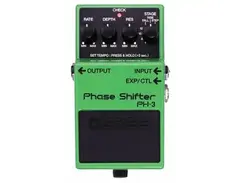
We did not turn out to be besties with Boss pedals somehow, I might as well be an Ibanez guy, but I've always found a better option to Bosses. Maybe because of their boxy 80's design, or too digital look and feel. Having owned a few analog phasers, and read the reviews, I did not expect too much from this guy, apart from a bit more versatility, but I could not resist a good second hand price, and it well worth the money. Firstly, this thing sings. To me the 4 stage mode sounds just as good as an analog phaser. To be honest, a bit better in case of the MXR, and a bit less "organic" than the small stone, but the differences are minimal, and maybe appear at playing dynamics, but I could hardly pass a blind test comparison. To my ears the 4 and 10 stage mode sounds a bit more natural than the 8 and 12, I guess the latter may be more beneficial at studio application than live. I tend to keep it on 4 stage for by now, and use the fun modes for solos, especially "fall" which gives a very unique edgy decay for the solo licks. I've also found the step mode usable with appropriate rate settings. And here comes the real fun: an option to synch the rate with the song tempo! This is a feature that all phasers should have! At first I was playing it with an expression pedal, that turns the pedal into a very sensitive wah pedal. It is fun for some songs, but I rather pump it than adjust, as it's not easy to find the sweet spot, but the tap tempo mode does the job very well. If I could ask for more, I'd prefer to have double tap mode too but i you are patient, the pedal is capable to handle very slow taps just as well. This really shows the beauty of phasing. I'm considering to get an exterior switch to tap tempo with it while still having the option to bypass the pedal, but it's not really a necessity, since when I use a phaser I tend to keep it on for the whole length of the song. For the same reason the slight volume drop does not bother me at all. What could be really cool is an option to switch modes with an exterior switch. Might as well be a doable mod. Anyways, this pedal is much recommended, very versatile, and sounds just as good as the classics.
180
not for tap dancers
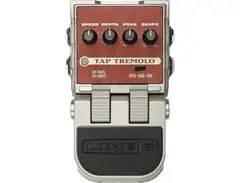
If I'll ever start a second career, I'll design stompbox cases. Not that I have the slightest clue of electronics, but I can see clearly what a mistake is packing otherwise great functions into an ugly and unpractical casing. That's the point with the ToneCore series. Huge, heavy, and somehow still cheesy, featuring a double-hinged, but still loose switch, that you can never be sure if engaged or not, especially with the "tap" feature, which is always on. This is the thing that I hate with all "tap" pedals. I'd much rather connect a separate tap pad, switch, or button than trying to combine it with the main standby switch of the pedal, which is just prone to error. I'm having this pedal for years now, and STILL fail sometimes to kick it hard enough to switch on or off, rather than going into the blinking "tap" mode. Try once more, and you fucked up the tempo. Not that setting the tempo by tapping would be so easy: you'd better tap double time than what you'd expect would set the desired tempo. BUT, apart from that, this is an excellent tremolo, with some great sounds, all the features you need, and a bit more. Firstly, the pedal can make a stereo pan effect, and can also forward stereo signal thru the pedal. The "Bias" mode is supposed to reproduce an onboard tube tremolo, good to have it, but I believe the more subtle and symetric "opto" mode is what we usually expect from a tremolo pedal, and it more than meets my expectations. The sound is transparent, well controllable, and noiseless, with no noticable volume drop. The "peak" control is a nice addition to the usual septh/wave/speed set. This will add a dynamic range to the speed, that will increase when you hit the strings harder. As the chord decays, the speed sets back to the set speed. I kind of preferred the other way round, setting a speed for normal output, and slow down when the chords decays, but it is still capable of reproducing the dynamic trem you can hear in songs like Bob Dylan's "Everything is broken". All in all, it's one of the best budget trems, for which I subscribed, I only hope that Line 6 will update the tonecore docks with something more compact and user friendly.
180
sorry for my disappointment
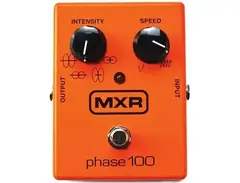
This is no doubt ?THE? phase tone that everybody's after, so maybe because of its fame, it was a major disappointment for me, sorry for that. I had and I even have phasers that sound better to my ears, my old Small Stone, in the first place. I'm unable to fork out a decent subtle or prominent sound from it, it sounds artificial at all settings. I even cannot reproduce an authentic Stones sound with it, despite that they were reportedly using Phase 100 on Some Girls and nearby tours. It does not help either that the intensity control was surprisingly mirrorred sometime during its long production years, so when somebody is referring to "position 2" you can never be sure which setting he's meaning. Some sources state that the old "script logo" version, or Eddie Van Halen's signature version sounds different and better. I cannot confirm that as yet with no chance of comparison, but truth may be in it, as my vintage Small Stone sounds warmer and fuller than the current nano version of EHX.

41016
a smalls tones a whole different approach to phasing and doesn't filter things much at all whereas the bandwidth of the mxr stuff is highly limited... small stone guys never like mxr phasers. Took me years to warm up to these guys. The odler ones definitely sound different than the newer ones just like the 2nd edition small stone I sued to use was different than my Russian ones which were in turn different than the new one I have around. I recently had to help a guitarist produce a some girls, shattered sound for a record Iw as engineering and my newer mxr stuff would not cut it. It was far too overtly phasey. The small stone was not tight enough sounding. We wound up going to a chorus or flanger to approximate it believe it or not. It wasn't dead on but it captured more of the warbly warmth than any new mxr pahsers could.
180
Yes, you may be right that those sounds fall closer to a mild warm flanger than any of the current phasers, but I learned to like phasers just for themselves. I've found that there's no two similar phasers, they are somewhat unpredictible, but I found the Phase 100 the least likeable, I just feel it unnecessary at each settings, probably because the filtering you refer to. I used to have an Ibanez PT-9 that also had a character of it's own, that I cannot reproduce with neither the MXR nor the Small Stone.
41016
I have owned more phasers, flangers and choruses then probably anyone frequenting this site... there are so many factors contributing to differences in phase tone circuit wise... the ehx and mxr sounds are just polar opposites in EVERY regard design-wise
41016
by the way, definitely try a phase 45... tis like the bad stone of mxr phasers and the mxr sound mates well with the 4 stage versus 8 stage phasing. If you can find one try a mutron… that's my desert island phaser. The I or the II, both are great.
180
bought to review
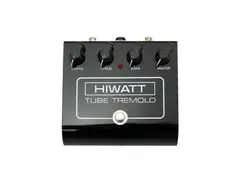
I purchased this pedal because it was relatively cheap for a brand new tube tremolo, and also because I could not find any useful reviews about it. I was looking for a pedal to serve as an extension to a practice amp. Reverb could be better, but tremolo looked like a natural choice, and I thought a tube tremolo with a master volume option might also serve as a preamp powered by tube gain. Wrong. Let me start with the bad news: despite of the tube drive, you cannot use this pedal as a plain pream, because the tremolo effect is present at even minimum level of all controls. Secondly, the "master volume" option should rather be called an "attenuator" option, since it only starts boosting the signal when set past 3 'o clock, leaving the majority of its range for volume UNDER the bypass volume. This is weird. Does anyone want to reduce volume with a tremolo activated? As for tremolo unit: my ears are not trained enough to judge if it's a opto or a real tube bias tremolo, but I suspect the latter. One thing for sure: the effect differs from any settings of any tremolos I've heard before. It has a very prominent, choppy, staggered sound at all settings of the wave control, even at minimum setting, smoothing it a bit indeed, while it provides the staccato of a machine gun when maxed. Quite the same with the rest of the controls: The "Speed" range extends from carpet dusting to machine gun speed, and "Depth" sets the effect from prominent to very prominent. No subtle pulsating wobble is possible, the effect is straight in your face at even minimal setting. When recorded and mixed with other instruments it curiously sounds cool, no blending, it is just there, natural, asymmetrical, and if a tremolo can sound "warm" it is warm then, the tube does the job. The thing that I'm missing here is an "effect level" knob to mix the rate of dry and tremolo signal, but since I've never had the opportunity to drive a real onboard trem of a Vox or a blackface Fender, maybe it's the good old, familiar and simple stompbox trem sound is what I'm looking for.
41016
vox's trem is very disctinctiive and is really just an afterthought... the circuit is a tube vibrato cribbed from Hammond Organs and Dick Denny realized that if you ground out half the vibrato circuit it becomes a choppy trem (depending how the vibrato depth is set via an internal trimmer on the top preamp terminal strip ;-) Bias wiggle trem takes place in the power ection by the way, so even a tube pedal trem is just a preamp variety and the differences will just be in whether the modulation is controlled by a lightbulb and photo cell or another tube stage driven by the oscillator triode. Blackface fenderin the larger amps is the photocell, aka opto trem while vintage vox, supro, gibson and many other amps equipped with trem on just one channel use a whole extra triode stage as the modulator. There's bias stuff going on with that triode to make the modulation happen but its not what people mean when they refer to bias trem, that refers to Fender's small amp trem like on the tweed tremolux and blackface Princeton. In a band mix the power-stage bias trem is the only one that stands out particularly although opto versus tube modulators have a different shape to the attack and decay that's inherent in how the tube or bulb/cell ramp up and down and it can't be changed that much by varying the shape of the oscillator circuit from sine to square, although the tube is more capable of square-like shapes. The other main difference between all tube trem and opto circuits is that the tube produces a thump that needs to be filtered out of the extreme bass with a notch fitler or smaller coupling caps into the power section while the opto circuits produce a light ticking noise that's right in the midrange and cannot be removed without heavily coloring the voice of the channel in an unpleasant way. Bias trem in the power stage uses the fixed bais circuit as its own modulator and therefore has no weird artifacts in the signal, just trem.
180
“Effect level” mod added.
180
the best of three worlds
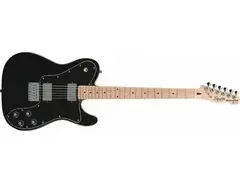
This is by design a 72 Deluxe / Custom hybrid, and the Custom II tweaked even more on it by adding those great Duncan designed P90’s. The result was so great, that Fender even nicked it back from Squier, like the ‘51, making a Vintage modified Fender. There’s not many Fenders that actually originate from Squiers. I’d probably post this to the Custom II, as the humbuckers in mine had been replaced to Seymour Duncan Phat Cats before I got hold of it, which are basically humbucker sized P90’s, shifting it closer to the Custom II. For this reason I cannot comment on the original sound with Humbuckers, but the aesthetics of the guitar is still closer to the black and chrome Customs, so I chose to post here. All I know the sound with the Phat Cats is very impressing, which together with the playability and 72 looks of the guitar makes is a great instrument. The comfortable maple neck has a satin finish over a somewhat flamed wood, which provides a very nice touch. Being a standard telecaster player, I’m sometimes puzzled by the double controls, and switch pickups accidentaly with the strangely “Les Paul” positioned pickup switch. Other than that, the guitar has a decent sound at all positions, and I like the option to roll back tone separately on the bridge pickup to cut high, while maintaing the transparent warmth of the neck pickup. I keep this in open E and with moderatelly hugh action so that I can also slide on this. Last time I recorded I took my new Gibson Les paul Junior to the studio with the intention to record with that, but then I ended up recording the better half of the album with the Squier VM Custom. Should you be interested in hearing the recorded sound of Custom with a pair of Phat Cats, see “Side A” of my 2018 album “Oszi Kikelet” on Soundcloud.
180
Don’t judge it by the cover
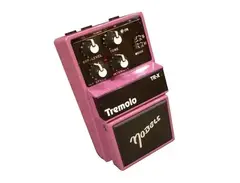
A great sounding, versatile trem in a shitty, oversized box, with clumsy controls. The box literally fell apart when I acquired it. First I had to glue back the metal sheet to show the lettering of the cheap plastic controls on the case. Then the pedal still staggered sound when it was switched off, so I had to take it to a tech guy. He said it looked like it had been put together in a hurry, before evacuating a factory, he had to re-solder everything. What I’m left with is a well functioning, and good sounding pedal, with lots of options, but I had to work for it. Output level control is a great addition, unfortunately missing from several trems that suck volume, like Boss TR-2. There’s a high filter that reduces the effect on higher pitch notes when turned up, which I’ve found very useful for fills and sevenths over trem base chords. The pedal is slightly larger and heavier than a Boss pedal, but less sturdy, I believe dropping it on the wrong side with the cheesy pc board mounted knobs would destroy it. Despite of it is being functionally outstanding, it did not make me a fan of Nobels pedals. I only wonder if Nobels “legendary” OD-1 was put together so carelessly, how did it make to be a legend.
180
Good base for upgrades
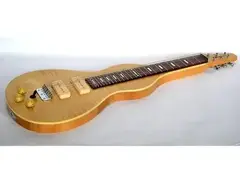
This is a budget version of the classic 6-string Weisenborn style electric lap-steel favored by Ben Harper, marketed by Amazon. The guitar is made of solid wood, with dimensions of the original that can serve as a good platform to upgrade. Mine came with a wooden nut and a simple bridge, that seemed to be replaced with better steel part by the maker in newer versions. The tuning pegs are classic Kluson types, that serve well, but the electronics is truly crap. The P90 pickups look cool, but having low output, and high noise, they are not ideal for a lap steel. The steel knobs do not fit well with the otherwise nice flamed maple finish that provides a Les Paul look to the guitar.
180
A childhood dream
The Austin Special was designed by former Keith Richards guitar tech and Texan luthier Ted Newman-Jones.I’ve first seen his design in David Dalton's Stones bio, "The first twenty years", and fell in love straight with this dynamic, offset-waist shape 5 string guitar, that Keith Richards used during the late seventies, but I had to wait some ten years before I got one that shows some authenticity with the original 5 string prototype.
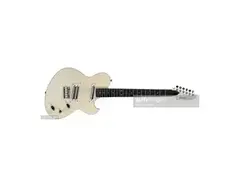
I first saw these, mass produced in a Chandler ad from a 93 Guitar World mag. Although the ads did not refer to Ted N-J, but the presence of the 5-string model as well as the "Austin" brand made it clear. A few years later I managed to get hold of one in a local guitar pawnshop in Budapest. Mine is labeled No.23 and made in 1992. There ‘s no “made in” tag anywhere on the guitar, but the materials, feel and finish show a close resemblance to my MIJ strat, so I believe the guitar has a Far East origin. It is lightweight and relatively small guitar, with good balance. It has a simple, offset waist, contoured black body with chrome hardware, and a pearl binding. I believe they came in off white or black exclusively. Mine's black, but this was the only stock photo I've found so far.
The two-piece maple neck is scarf-jointed at about 2/3 of its length, closer to the tilted head stock, otherwise it is very similar to a standard telecaster neck. The headstock is strongly tilted backwards, and feature vintage style Kluston keys.
The neck has a nice, vintage satin lacquer finish and feels good to touch. The bridge humbucker is in fact two singles in a line, of which one can be muted by pulling the tone control. I tend to use this feature: I play single most of the time, and only push it form more gain when necessary. This forms a H(S) / S arrangement, that consists of 3 lipstick pickups made by Chandler The bridge is hard-tail strat syle with string through body and provides excellent sustain. The lipstick pickups have a transparent sound with low output.
I added an EMG afterburner push/pull booster for some extra gain. This guitar sported a retro look before retro was hip, having the klusons, the pearl binding, lipsticks, and on top of all that: chicken head controls. While providing a visual feedback, these turn a bit too easily, and I tend to turn down volume accidentally when I strung a big chord. Also, the push and pull mechanism easily turns the tone flat. I usually turn the tone midways between flat and sharp, since the guitar has a treble sound already. What else can I say? It's a classic, rare, and excellent guitar, which looks cool, plays great, and capable of a great sound with the help of some pedals or onboard gadgets.
180
This is the sound I wanna hear
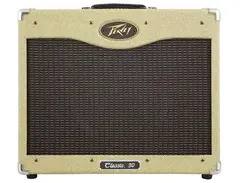
This is my first tube amp. I had been saving my money for a Fender for years, until I had the opportunity to trade this amp for a bunch of pedals in about 2010, and never turned back. It's size, weight and capacity was ideal for my profile, and I fell in love with its rich warm sound. Mine is the older model with the rectangular front panel, reverse control board, and no option to footswitch boost. The drive channel is footswitchable, but it has a different, flatter equalization than the clean one. An EQ pedal in the chain may help, but I've found that I come out better driving the clean channel with a stomp-box to have a rich drive sound. The built in spring reverb is perfect for me, always keep it on, so I never use the cheap plastic foot-switch. I once tried the greenback speaker mod, but I've found that the stock (blue marvel) speaker's voicing better suits the amp's sound characteristics. Shortly after purchasing the amp, I managed to get a matching EC30 extension cabinet, that incredibly enhances the output in a live environment, so I soon found myself dragging a half stack everywhere on stage. The only issue I ever had with it in 8 years was a melt plastic tube socket, that was replaced with ceramic.
-s.webp?v=1784333828)
180
It is part of my personality
This one is my first serious electric guitar and probaby the last one that I'd ever part with, as the old ad says. To be honest, not particularly for the quality of the instrument, but for the adventures, bands and stages we've seen together. I like the idea of being buried with it, or probably pass it over to a good friend who'd take care of it rather than sell it. Mine is an 1990 factory second, having a finish that wears off very easily, giving it a nice road-worn look. I think people pay extras for this these days, but I got hold of it for a bargain price. It has a blonde color with a rosewood neck, that has a very chunky U profile. This may be unusual for the American Standard that usually came with a more modern C neck in later model years. I replaced to original pickups to a set of Texas Specials, which did improve the sound a bit, but I still regret that I sold the original Delta-tone set. Apart from that, it is all original, and now lives in a black deluxe wooden case. This is my main stage guitar I've recorded most of the music on my Soundcloud profile playing this guitar.
180
If it's fine by Keef, it's fine by me
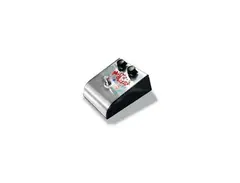
I'm using it as a clean booster for already overdriven solos in the first place. Sometimes, when I'm using more guitars on stage, I'm putting it into the other guitar's loop to even volume differences. It's a great clean booster with more than enough headroom and a tone control option. My only issue is that the pots are prone to turn accidentally, so I put felt washers under the controls to hold them in place. I'm usually boosting at 10 o'clock (a bit thickening) tone and 2 o' clock on the volume.