Every rig tells a story. Start yours.
Catalog your gear, wishlist what's next, and share the setups behind your sound — free.
Create your EquipboardGear 10


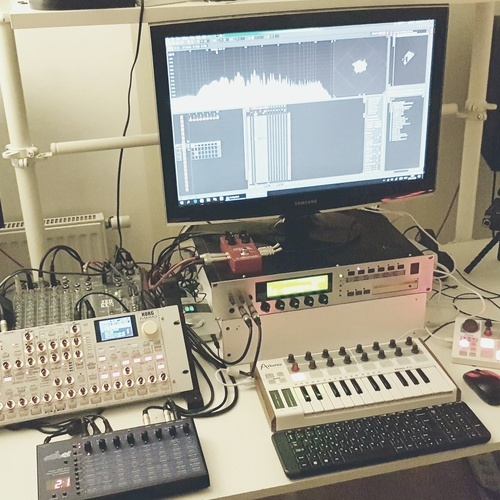
This gear has all you want from a fully qualified sampler. Basically it can record from 5 kHz (!!!) mono to 44.1 kHz stereo. Sampling on lower frequencies brings you warm and juicy lo-fi sound. Especially 22.5 kHz recording has a dedicated LoFi option to shape the sound nicely. Audio input can be routed directly to FX stage making this machine a cool outboard signal processor. What makes this sampler apart from the mainstream is the unique workflow, within samples got high authority and got near everything (envelopes, filter + EQ, output and keymapping) attached to every single sample. You can manage them in banks for bulk settings and link them to Programs which are final interfaces for put everything in order. If you never seen such a template, you may facing some day of learning the non-traditional vision of Yamaha's engineers. Darkside: it's SCSI implementation very slow, IDE controller is a bit picky, and OS can't handle basic failures like bad sectors on HDD surface. If you want the best from this gear, you better to get SCSI to SD driver or IDE to SD converter and a 8 GB SD memory card, but you should read about on net, because some type of SD interfaces are not compatible with the A5000. Very, very big sound, you will recognize the taste of some famous track's from 2000-2010!


When you start to use one, you become an addict. It's not analog, it's digital and something. I don't know. It's just Radias. Identificable, you can't confuse its sound hence the continuous morphing dual filters and very edgy oscillators. It's a strange hybrid, the first oscillator can be operate as a traditional signal source and in this mode you can switch to cross mode (crossfades the second oscillator), unison mode (a.k.a supersaw, supersqure, supertriangle and supersine) and VPM mode (I don't really understand how it works, but it creates typical metal bell sounds). It can operate as a wavetable oscillator with 64 very different waves and usual others: Noise, Formant and DrumPCM mode. Formant mode is another good one, because Radias has the ability to record your voice and it stores the formants. Then you can use it as a formant source which brings many fun for creating robot voices and other stupid or sci-fi related humanoid sounds. Effects are exceptionally good, but it lacks DSP power, so when you set a delay and reverb on the same tone, the delay time is reducing to 1 sec. Rotary and TalkingMod effects renting all the two FX slot for a tone, so they can use alone. Otherwise, virtual patch system reminds me to the E-MU engine, and God bless the internal audio bus, then you can internally mix and vocode your tones making really exclusive sounds and beatrhythms. It has an arpeggiator, 2 x 32 step polyphonic sequencer, and Korg's other magic invention, the ModStep which is basically a 3x16 step-sequencer for modulate parameters on every tone independently, and it can run free or keysynced, of course can be triggered by the master arpeggiator or step sequencers. Guess the potentials... So it's a digital synth with a modular-like patching system and a VST-like interface. It has very deep programming possibilities, and factory presets are good represention of the features and opportunities. For me, it's far better than a Virus TI, but of course, it's only personal. (I had a Virus before too.) Oh, and a sidenote:it has a template system for tones. When you start sound-sculpturing, you can just dial in the best starting tone from the 128 overwritable synth template. :) You can save your typical tones as templates. So literally you can build your personal style-machine from this one. :)


As a tabletop synth gear, it has a suprisingly deep sequencer and very easy access controls. Many cases it just better than Ableton Live or Machine software, because instant and encourage creativity. S/PDIF is a bit choosy, but you have 2 stereo sub output. MIDI is awesome, and it can act as a sound module. But why you want use this as a sound module if this machine born to take control?! :)