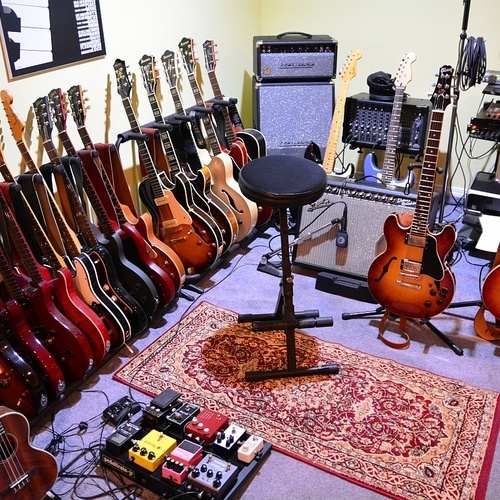
axel_tnl's Studio Setup

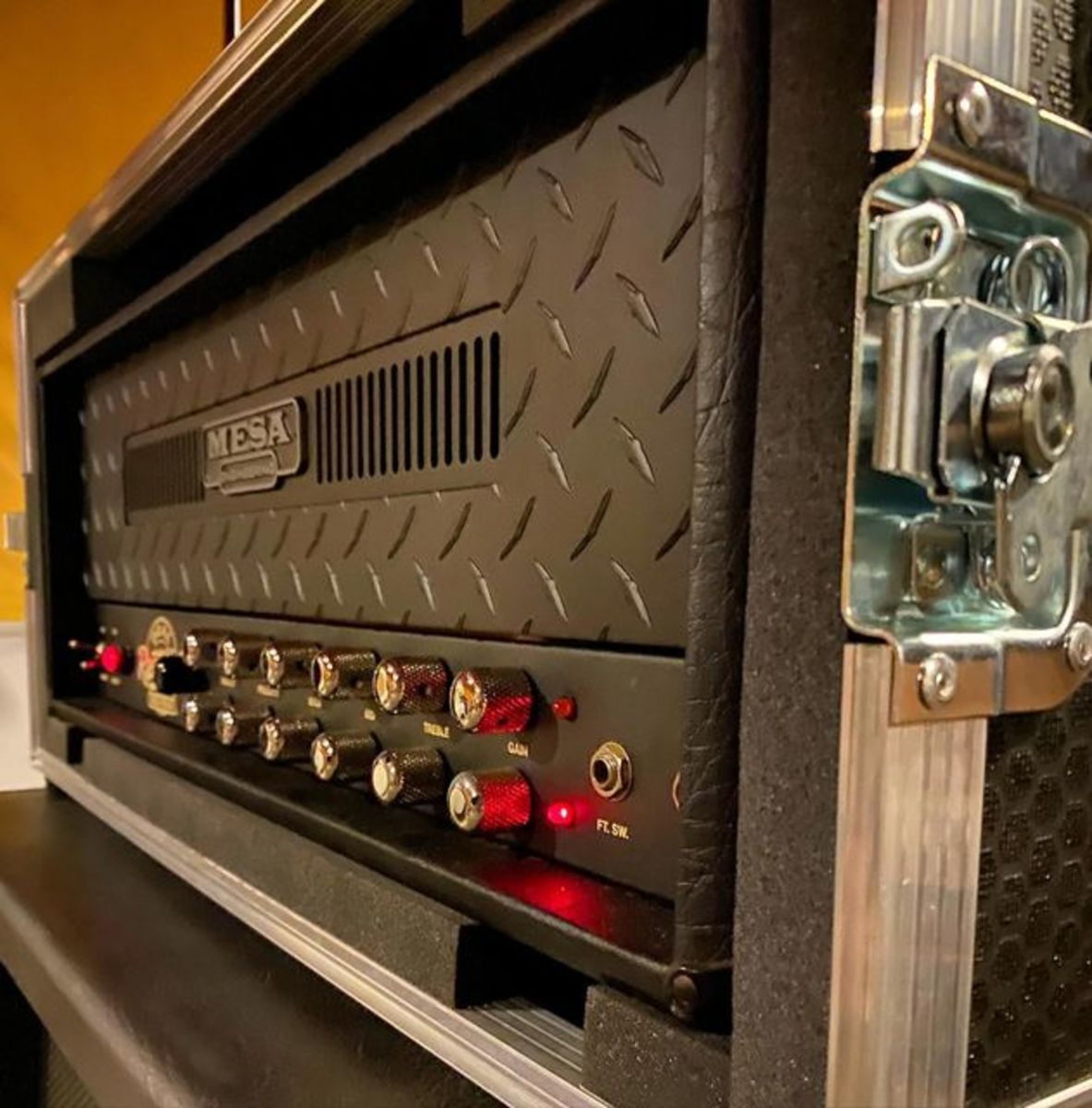
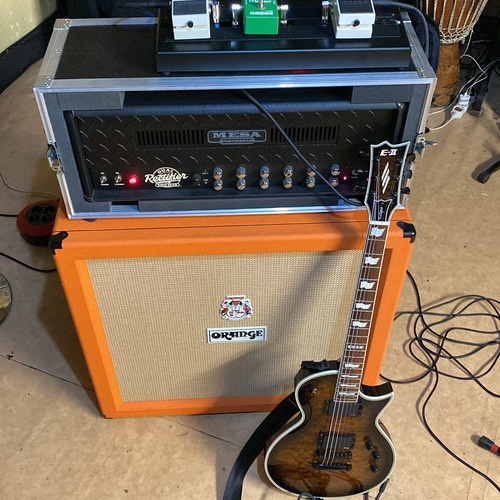
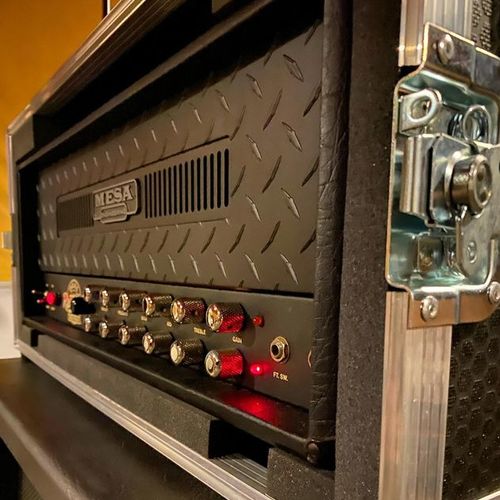
Mesa Boogie dual rectifier Rev G
More gear photos from axel_tnl


Gear in this photo
This rig
~$1,544

Mesa/Boogie Dual Rectifier 2-channel 100W Solo Head (1992 - 2000)
Avg price: $1,544.00


The best of high-gain sound
My head is a Rev G, mass produced before the release of dual three channels. This is THE SOUND of the 90's. The rev G is the 'stabilized' version of the 2 channel dual rectifiers, the most produced, it is darker, has more bass and gain and has less mids or rather different mids compared to previous revisions. The first versions were closer to boosted Marshall or Soldano SLO 100.
100 Watt Amp Head: - 2 channels - 5 12AX7 preamp tubes - 2 rectifying lamps 5U4G - 4 x 6L6 power tubes - effects loop in series until revision F, in parallel thereafter. - 1 master, 1 presence, 1 bass, 1 mid, 1 treble and 1 gain per channel - 'copy' function from one channel to the other: in normal mode the two channels have a different voicing, in 'clone' mode they have the same voicing and their presence settings are added together; the two voicings are 'Modern' and 'Vintage', so you can choose to have a modern and a vintage or two vintage or even two modern. The sounds will never be identical but can be quite close. - 1st clean / crunch channel, rear switch - 2 outputs 4 ohm, 1 output 16 ohm, 1 output 8ohm - rotary selector for the effects loop (bypass, with orange channel only, red, both) - 1 relay for effects loop switching - 1 relay for channel selection - 1 slave out to power another power amp - 1 bias selector, depending on whether 6L6 or EL34 are used - 1 lamp (vacuum tubes) or diode (silicon diodes) rectification selector - 1 'spongy' / 'bold' power attenuator selector, allowing the lamps to work a little more, sound a little more vintage in 'spongy' mode, full power in 'bold' mode - 1 volume of effects loop, serving as general master when it is activated.
the config is not simple. The settings are not common to other amps I've had (Peavey, Krank). The potentiometers interact according to their travel...
Very important to understand how this amp works: the two presence buttons are linked and work together, regardless of the channel chosen (and the mode of voicing)!! the presence of the orange channel manages the treble, the 'incisive' side, while the presence of the red channel manages the 'brilliant' side and acts on lower frequencies. So be careful to try the race of the TWO presences when looking for a sound on one or the other of the channels.
The parallel effects loop is... crappy. Well no, but if you use recent effects processors, they only appreciate serial loops. And there, miracle, this dual rectifier can be modified VERY SIMPLY, and we can thus recover a perfect series loop, and that's what I hastened to do. The sound is now identical when I use the loop or not, whether it is disabled or bypassed (hard bypass). Adjusting the overall volume via the effects loop knob is a real plus, especially since the levels of the two channels are very sensitive and you can quickly burst your eardrums. You have to try everything to find what you prefer and it takes time: - 'Bold' or 'Spongy'? - Modern and Vintage? Modern and Modern? vintage and vintage? - Clear ? clearly boosted? light crunch? 2nd saturation? - vacuum tubes or silicon diodes?
Orange channel: - Clear as saturated it is quite dark. I found the clean usable but overall I don't like this channel, the only use that might interest me would be as an alternative overdrive channel, because you can overdrive it as much as the Red channel. The sound is thick, not very dynamic and the saturation is constant, whether you attack frankly or little. So if you like crunch vox or hughes & kettner, very clear and powerful which only saturate on frank attacks and on extreme frequencies, go your way.
Red Channel: There it thickens, the sound is there, powerful, raspy, thick, bass worthy of a sub with a good big quality 412, highs that pierce the eardrums. Attention to the setting of the presence, if you do not want his fuzzy you have to put little, I am about 3/4. The gain starts to drool at 7, we get closer to a sound like Entombed on uprising when we push further. I prefer a gain of 6/7 and the addition of a Lichtlaerm Audio Aesahaettr upstream (boost with eq) and there, it's huge.
I play hardcore, I'm the only scratch.
The sound is very typical, but that's why we turn to this kind of amp. Well adjusted, we have a saturation rich in harmonics which covers all frequencies well, and which does not get lost with the bass in the mix. For me, the sound has never been so clean in repeats.
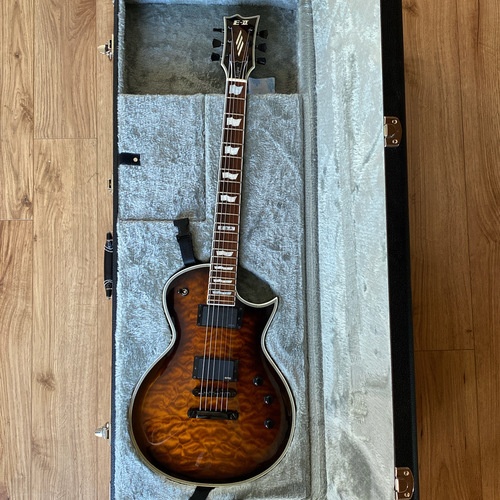
I plug on a Ltd ec-1000t ctm
I've had it for a few years, but it puts the slap in the face to everything I've had before in the overdriven channel. I never liked the sound of dual rectifier outputs later and yet I can not part with it. I was impressed by the quality that emerges from the head, at each level, to the ignition switch and the connection of each cable, you have to manipulate all that to realize it.
About this setup
This gear photo by axel_tnl features 1 piece of gear, including Mesa/Boogie Dual Rectifier 2-channel 100W Solo Head (1992 - 2000).




.jpg?v=1784736721)