
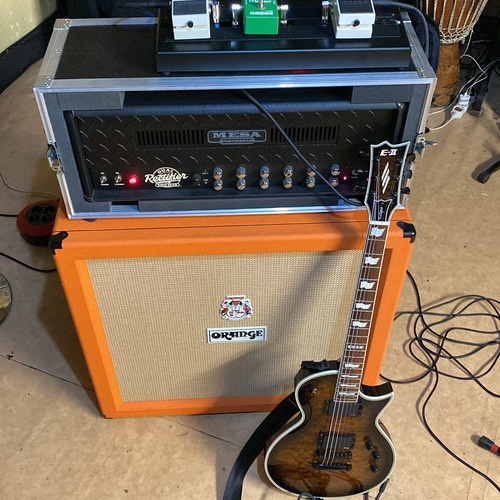
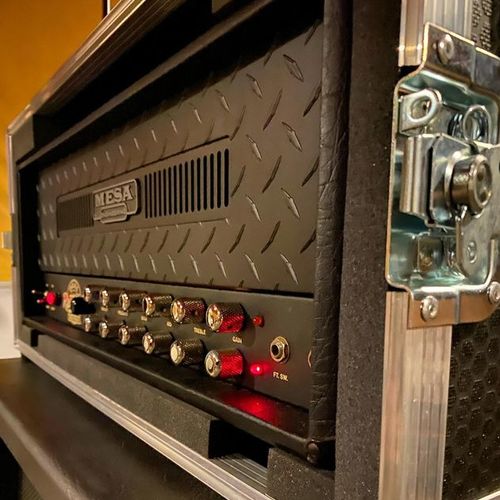

Pricing and availability
We compare 600+ stores and found this item at 1 store. Prices updated .
Store
Reviews
Price




Average Price: $1,544
High-end/Boutique
$300
$801+
Price Tier
Budget
Standard
High-end
* Product prices and availability are updated by Equipboard every 24hrs and are subject to change. Equipboard may receive compensation for purchases made at participating retailers linked on this site. This compensation does not affect what products or prices are displayed, or the order of prices listed. For more information, please refer to our affiliate disclosure.
Description
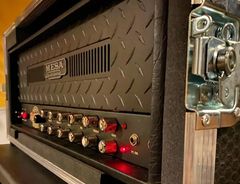
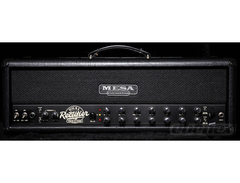
1992-1999 2-channel 100W Dual Rectifier
Product specs
| Brand | Mesa Boogie |
| Model | Dual Rectifier Solo Head 2-Channel 100-Watt Guitar Amp Head |
| Finish | Various |
| Year | 1992 - 2000 |
| Made In | United States |
| Categories | Guitar Heads |
| Built-In Effects | No Built-In Effects |
| Electronics | Tube |
| Impedance | 16 ohms, 4 ohms, 8 ohms |
| Number of Channels | 2 Channels |
| Number of Inputs | 1 Input |
| Output Power (Watts) | 100 |
| Power Tube Type | 6L6 / EL34 |
| Reverb | None |
FAQs
-
What are the core tonal characteristics of the Mesa/Boogie Dual Rectifier 2-channel 100W Solo Head?
-
The Mesa/Boogie Dual Rectifier is renowned for its aggressive, high-gain sound, making it ideal for rock and metal genres. It offers a bold low-end response and a rich, harmonic midrange, providing both powerful overdrive and clear clean tones.
-
Does the Mesa/Boogie Dual Rectifier 2-channel 100W Solo Head work well with pedals?
-
Yes, the Mesa/Boogie Dual Rectifier is known for its excellent compatibility with pedals. Its effects loop allows for seamless integration of modulation and time-based effects, enhancing your tonal versatility.
-
How does the Mesa/Boogie Dual Rectifier 2-channel 100W Solo Head handle different power tubes?
-
This amp head can accommodate both 6L6 and EL34 power tubes, allowing you to customize your sound. The 6L6 tubes offer a more American-style, scooped midrange tone, while the EL34 tubes provide a British-style, midrange-forward sound.
-
Is the Mesa/Boogie Dual Rectifier 2-channel 100W Solo Head suitable for live performances?
-
Absolutely, with its 100-watt output, the Mesa/Boogie Dual Rectifier is powerful enough for large venues and live performances. Its robust construction and dynamic range make it a reliable choice for gigging musicians.
-
What type of music is the Mesa/Boogie Dual Rectifier 2-channel 100W Solo Head best suited for?
-
The Dual Rectifier is particularly well-suited for rock and metal genres due to its high-gain capabilities and robust sound. However, its versatile channel options also allow for clean tones suitable for other styles.
Videos

Silas Fernandes
Amps face Off: Dual Rectifier 2 ch vs 3 ch
Amps face Off: Dual Rectifier 2 ch vs 3 ch
Silas Fernandes
My Mesa Dual Rectifier Solo Head 2 Channel

Middle Aged Gear Junkie
Reviews
PROS
-
Exceptional versatility with multiple modes and channel cloning for diverse soundscapes
-
Iconic 90s sound with rich, harmonic saturation
-
Takes pedals exceptionally well, enhancing tonal flexibility
-
Powerful bass response, especially on the red channel
-
Clean tones are often overlooked but surprisingly sweet
-
Modular design allows for simple modification to perfect series effects loop
-
Robust build quality, providing a reliable gigging option
CONS
-
Complex configuration; requires time to master controls and settings
-
Parallel effects loop may not suit modern processors without modification
-
Orange channel can sound dark and lacks dynamic response
-
High gain settings can lead to muddiness if not carefully managed
-
Prone to excessive loudness over prolonged use
Owner Insights
We analyzed real musician discussions from forums and Reddit to find what players love, question, and tweak about Mesa/Boogie Dual Rectifier 2-channel 100W Solo Head (1992 - 2000).
Features and functionality
-
The 3-channel version lacks a built-in attenuator, affecting volume control for home use.
Source -
The 3-channel version has three sets of three knobs, distinguishing it from other versions.
Source -
The Mesa Dual Rectifier's effects loop mod from parallel to series is considered essential by some users for optimal performance.
Source
Comparisons
-
The 90s 2-channel reissue is sought after for its tonal qualities compared to modern models.
Source -
The original Dual Rectifier's preamp was a clone of the Soldano SLO 100, paired with Mesa's power section.
Source -
The Rectoverb 25 head, paired with a 2x12 vertical cab, is recommended for achieving a tone close to the old Dual Rectifier.
Source
Use cases and applications
User experience
Mods and upgrades
-
Replacing the 6L6 tubes with EL34s and using old stock RCA preamp tubes can enhance the Mesa Dual Rectifier's tone for a high-gain, Marshall-like sound with more bottom end.
Source -
Using a Boss GE-7 EQ pedal in the effects loop can significantly enhance tone shaping, emulating the graphic EQ found in larger Mesa amps.
Source
Critic Reviews
5.0 out of 5
Based on 1 Review and 1 Rating

2143
The best of high-gain sound
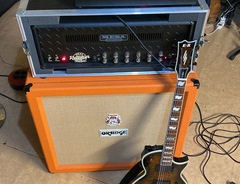
My head is a Rev G, mass produced before the release of dual three channels. This is THE SOUND of the 90's. The rev G is the 'stabilized' version of the 2 channel dual rectifiers, the most produced, it is darker, has more bass and gain and has less mids or rather different mids compared to previous revisions. The first versions were closer to boosted Marshall or Soldano SLO 100.
100 Watt Amp Head: - 2 channels - 5 12AX7 preamp tubes - 2 rectifying lamps 5U4G - 4 x 6L6 power tubes - effects loop in series until revision F, in parallel thereafter. - 1 master, 1 presence, 1 bass, 1 mid, 1 treble and 1 gain per channel - 'copy' function from one channel to the other: in normal mode the two channels have a different voicing, in 'clone' mode they have the same voicing and their presence settings are added together; the two voicings are 'Modern' and 'Vintage', so you can choose to have a modern and a vintage or two vintage or even two modern. The sounds will never be identical but can be quite close. - 1st clean / crunch channel, rear switch - 2 outputs 4 ohm, 1 output 16 ohm, 1 output 8ohm - rotary selector for the effects loop (bypass, with orange channel only, red, both) - 1 relay for effects loop switching - 1 relay for channel selection - 1 slave out to power another power amp - 1 bias selector, depending on whether 6L6 or EL34 are used - 1 lamp (vacuum tubes) or diode (silicon diodes) rectification selector - 1 'spongy' / 'bold' power attenuator selector, allowing the lamps to work a little more, sound a little more vintage in 'spongy' mode, full power in 'bold' mode - 1 volume of effects loop, serving as general master when it is activated.
the config is not simple. The settings are not common to other amps I've had (Peavey, Krank). The potentiometers interact according to their travel...
Very important to understand how this amp works: the two presence buttons are linked and work together, regardless of the channel chosen (and the mode of voicing)!! the presence of the orange channel manages the treble, the 'incisive' side, while the presence of the red channel manages the 'brilliant' side and acts on lower frequencies. So be careful to try the race of the TWO presences when looking for a sound on one or the other of the channels.
The parallel effects loop is... crappy. Well no, but if you use recent effects processors, they only appreciate serial loops. And there, miracle, this dual rectifier can be modified VERY SIMPLY, and we can thus recover a perfect series loop, and that's what I hastened to do. The sound is now identical when I use the loop or not, whether it is disabled or bypassed (hard bypass). Adjusting the overall volume via the effects loop knob is a real plus, especially since the levels of the two channels are very sensitive and you can quickly burst your eardrums. You have to try everything to find what you prefer and it takes time: - 'Bold' or 'Spongy'? - Modern and Vintage? Modern and Modern? vintage and vintage? - Clear ? clearly boosted? light crunch? 2nd saturation? - vacuum tubes or silicon diodes?
Orange channel: - Clear as saturated it is quite dark. I found the clean usable but overall I don't like this channel, the only use that might interest me would be as an alternative overdrive channel, because you can overdrive it as much as the Red channel. The sound is thick, not very dynamic and the saturation is constant, whether you attack frankly or little. So if you like crunch vox or hughes & kettner, very clear and powerful which only saturate on frank attacks and on extreme frequencies, go your way.
Red Channel: There it thickens, the sound is there, powerful, raspy, thick, bass worthy of a sub with a good big quality 412, highs that pierce the eardrums. Attention to the setting of the presence, if you do not want his fuzzy you have to put little, I am about 3/4. The gain starts to drool at 7, we get closer to a sound like Entombed on uprising when we push further. I prefer a gain of 6/7 and the addition of a Lichtlaerm Audio Aesahaettr upstream (boost with eq) and there, it's huge.
I play hardcore, I'm the only scratch.
The sound is very typical, but that's why we turn to this kind of amp. Well adjusted, we have a saturation rich in harmonics which covers all frequencies well, and which does not get lost with the bass in the mix. For me, the sound has never been so clean in repeats.
I plug on a Ltd ec-1000t ctm
I've had it for a few years, but it puts the slap in the face to everything I've had before in the overdriven channel. I never liked the sound of dual rectifier outputs later and yet I can not part with it. I was impressed by the quality that emerges from the head, at each level, to the ignition switch and the connection of each cable, you have to manipulate all that to realize it.
Artist usage
Add artist
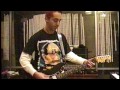
In this video recorded by Sylvia Massy, the audio engineer for System Of A Down's first album, a Mesa/Boogie Dual Rectifier 2-channel 100W Solo Head can be seen behind him.


Wes Borland used the Mesa/Boogie Dual Rectifier 2-channel 100W Solo Head (1992 - 2000), as confirmed by a video on YouTube by ANALOGr titled "Mesa Boogie Rectifier from Wes Borland," which highlights the Wes Borland ArtistFirst collection available at ANALOGr.com.


In Godsmacks music video for "Keep Away," Tony Rombola is seen at around 0:24 using a Mesa/Boogie Dual Rectifier Solo Head. This identification is based on the visible number of knobs, which indicates it is not a 3-channel model, but rather a Dual Rectifier Solo Head.

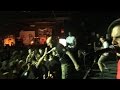
In a live performance with Betrayed on August 13, 2011, Todd Jones used a Mesa/Boogie Dual Rectifier Solo Head 2-Channel 100-Watt Head, as seen in a video by hate5six.


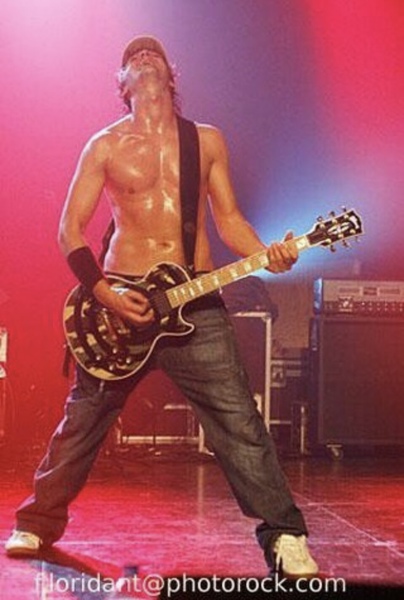
Cyril actually used a Mesa/Boogie DUAL Rectifier 2 Channels and not a TRIPLE 2 Channels during Shaka’s early years and first album tour.

.jpg)
Album Usage
The Mesa/Boogie Dual Rectifier 2-channel 100W Solo Head (1992 - 2000) has been featured on the following albums:
Genre Usage
Based on how artists on Equipboard use this gear, it is most commonly found in the following genres.
Used With
Based on how musicians on Equipboard use Mesa/Boogie Dual Rectifier 2-channel 100W Solo Head (1992 - 2000), it is most commonly used with the following gear.


Community setups
Show yoursSimilar
Add recommendation3 alternative and related items for Mesa/Boogie Dual Rectifier 2-channel 100W Solo Head (1992 - 2000), curated by the Equipboard community.

$299.00 - $399.00
A amp emulation pedal, based on the 1992 Mesa Boogie Dual Rectifier.

$1,800.00 - $3,299.00
A newer 3-channel version of the dual rectifier, less beloved among purists and fans of the original.

$1,544.00 - $3,499.00
A new for 2025, reissue of the classic spec dual rectifier of the 1990's.
More Mesa/Boogie Guitar Amplifier Heads
$1,800.00 - $3,299.00
in Guitar Amplifier Heads Rank


$2,999.00 - $3,492.21
in Guitar Amplifier Heads Rank


$715.00 - $1,359.00
in Guitar Amplifier Heads Rank


$1,799.00 - $3,149.00
in Guitar Amplifier Heads Rank


$1,599.00 - $2,099.00
in Guitar Amplifier Heads Rank


$3,409.99 - $3,659.00
in Guitar Amplifier Heads Rank


$1,750.00
in Guitar Amplifier Heads Rank


$2,399.00 - $3,069.00
in Guitar Amplifier Heads Rank


$1,900.00
in Guitar Amplifier Heads Rank


$689.00
in Guitar Amplifier Heads Rank


$4,139.12
in Guitar Amplifier Heads Rank


$2,029.00 - $2,590.00
in Guitar Amplifier Heads Rank

-m.webp?v=1785078010)
$1,800.00
in Guitar Amplifier Heads Rank

-m.webp?v=1785150848)
$3,599.00 - $4,572.62
in Guitar Amplifier Heads Rank


$1,300.00


$3,409.99 - $4,222.00


$1,799.00 - $3,149.00


$2,999.00 - $3,699.00


$1,299.00 - $1,999.00


.jpg?v=1785120438)

$2,399.00 - $2,599.00


$2,999.00 - $3,299.00


-m.webp?v=1785152456)
$1,251.73 - $1,799.00


$1,999.00 - $2,159.00


$875.00 - $1,359.00

-m.webp?v=1785130840)
$1,544.00 - $3,499.00


$1,800.00


$1,800.00


$2,499.00 - $2,880.00


$1,229.00


$2,499.00 - $2,539.00


-m.webp?v=1784103472)


Accessories & Related Items



Gear Guides






Most Popular Guitar Amplifier Heads
Most Popular Brands
-
Added to Equipboard on by
axel_tnlGearIQ 2143
-


