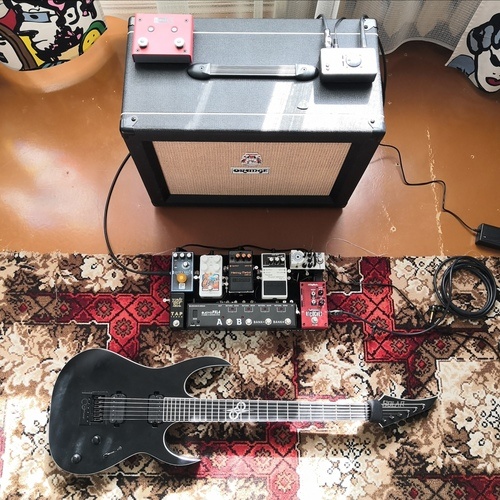
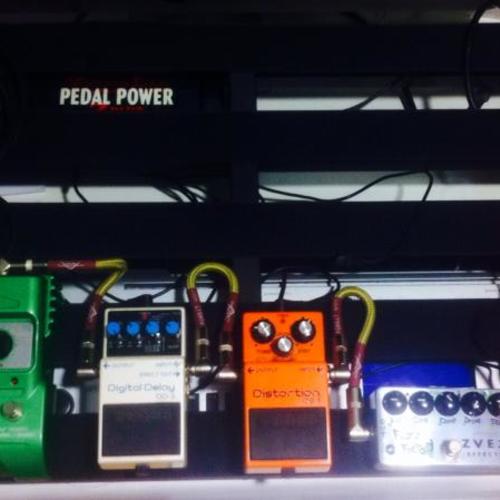
axel_tnl's Metal Pedalboard

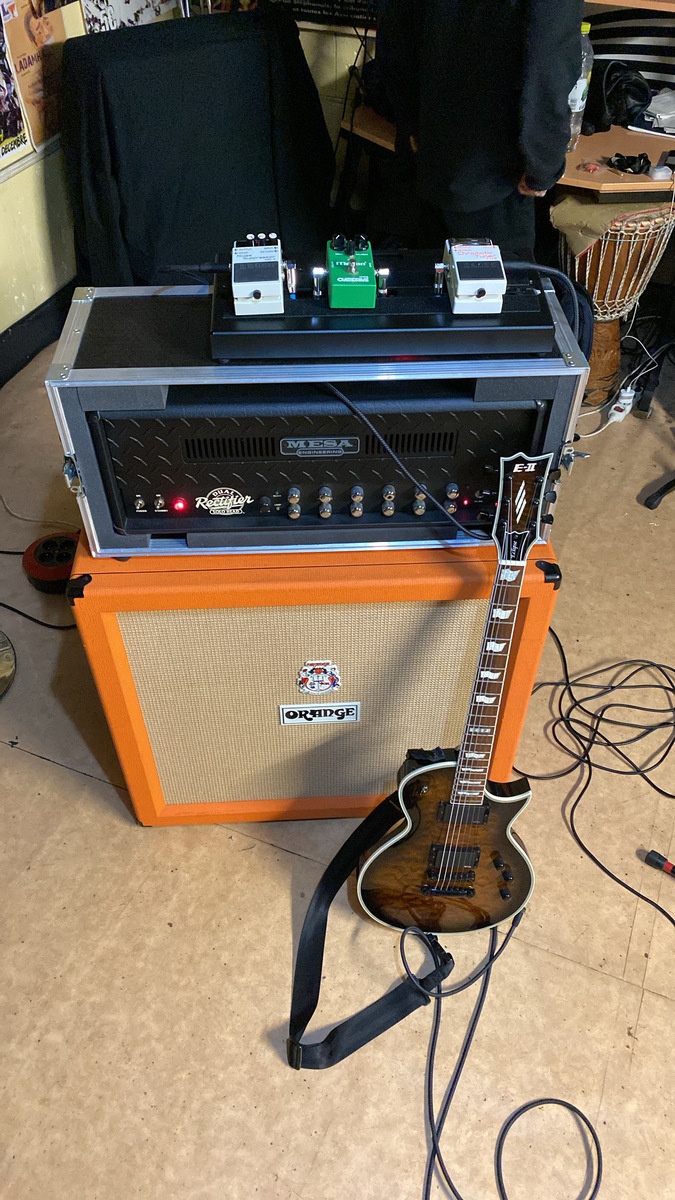
More gear photos from axel_tnl
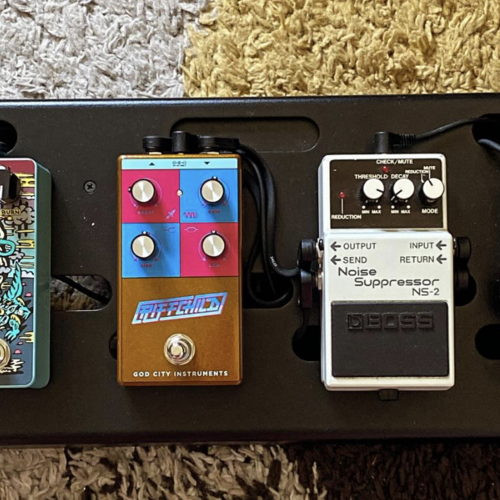


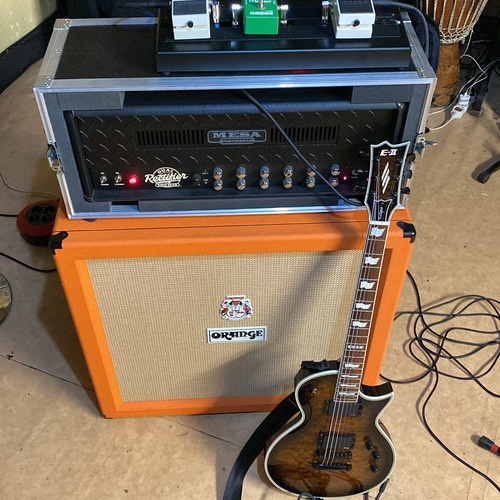
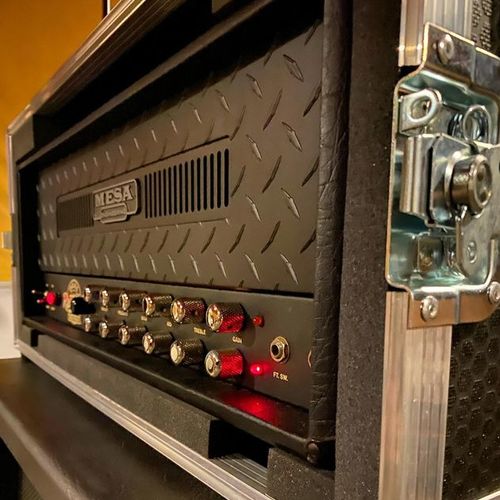
Gear in this photo
This rig
~$6,829
Value by category
- Amplifiers 44.9%
- Guitars 43.4%
- Effects Pedals 8.3%
- Other Gear 2.9%
- Music Accessories 0.4%
- Strings 0.1%
Price mix
Mix of standard and high-end

Mesa/Boogie Dual Rectifier 2-channel 100W Solo Head (1992 - 2000)
Avg price: $1,544.00


The best of high-gain sound
My head is a Rev G, mass produced before the release of dual three channels. This is THE SOUND of the 90's. The rev G is the 'stabilized' version of the 2 channel dual rectifiers, the most produced, it is darker, has more bass and gain and has less mids or rather different mids compared to previous revisions. The first versions were closer to boosted Marshall or Soldano SLO 100.
100 Watt Amp Head: - 2 channels - 5 12AX7 preamp tubes - 2 rectifying lamps 5U4G - 4 x 6L6 power tubes - effects loop in series until revision F, in parallel thereafter. - 1 master, 1 presence, 1 bass, 1 mid, 1 treble and 1 gain per channel - 'copy' function from one channel to the other: in normal mode the two channels have a different voicing, in 'clone' mode they have the same voicing and their presence settings are added together; the two voicings are 'Modern' and 'Vintage', so you can choose to have a modern and a vintage or two vintage or even two modern. The sounds will never be identical but can be quite close. - 1st clean / crunch channel, rear switch - 2 outputs 4 ohm, 1 output 16 ohm, 1 output 8ohm - rotary selector for the effects loop (bypass, with orange channel only, red, both) - 1 relay for effects loop switching - 1 relay for channel selection - 1 slave out to power another power amp - 1 bias selector, depending on whether 6L6 or EL34 are used - 1 lamp (vacuum tubes) or diode (silicon diodes) rectification selector - 1 'spongy' / 'bold' power attenuator selector, allowing the lamps to work a little more, sound a little more vintage in 'spongy' mode, full power in 'bold' mode - 1 volume of effects loop, serving as general master when it is activated.
the config is not simple. The settings are not common to other amps I've had (Peavey, Krank). The potentiometers interact according to their travel...
Very important to understand how this amp works: the two presence buttons are linked and work together, regardless of the channel chosen (and the mode of voicing)!! the presence of the orange channel manages the treble, the 'incisive' side, while the presence of the red channel manages the 'brilliant' side and acts on lower frequencies. So be careful to try the race of the TWO presences when looking for a sound on one or the other of the channels.
The parallel effects loop is... crappy. Well no, but if you use recent effects processors, they only appreciate serial loops. And there, miracle, this dual rectifier can be modified VERY SIMPLY, and we can thus recover a perfect series loop, and that's what I hastened to do. The sound is now identical when I use the loop or not, whether it is disabled or bypassed (hard bypass). Adjusting the overall volume via the effects loop knob is a real plus, especially since the levels of the two channels are very sensitive and you can quickly burst your eardrums. You have to try everything to find what you prefer and it takes time: - 'Bold' or 'Spongy'? - Modern and Vintage? Modern and Modern? vintage and vintage? - Clear ? clearly boosted? light crunch? 2nd saturation? - vacuum tubes or silicon diodes?
Orange channel: - Clear as saturated it is quite dark. I found the clean usable but overall I don't like this channel, the only use that might interest me would be as an alternative overdrive channel, because you can overdrive it as much as the Red channel. The sound is thick, not very dynamic and the saturation is constant, whether you attack frankly or little. So if you like crunch vox or hughes & kettner, very clear and powerful which only saturate on frank attacks and on extreme frequencies, go your way.
Red Channel: There it thickens, the sound is there, powerful, raspy, thick, bass worthy of a sub with a good big quality 412, highs that pierce the eardrums. Attention to the setting of the presence, if you do not want his fuzzy you have to put little, I am about 3/4. The gain starts to drool at 7, we get closer to a sound like Entombed on uprising when we push further. I prefer a gain of 6/7 and the addition of a Lichtlaerm Audio Aesahaettr upstream (boost with eq) and there, it's huge.
I play hardcore, I'm the only scratch.
The sound is very typical, but that's why we turn to this kind of amp. Well adjusted, we have a saturation rich in harmonics which covers all frequencies well, and which does not get lost with the bass in the mix. For me, the sound has never been so clean in repeats.
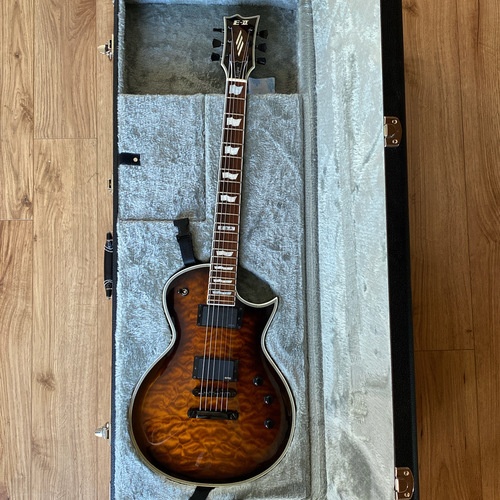
I plug on a Ltd ec-1000t ctm
I've had it for a few years, but it puts the slap in the face to everything I've had before in the overdriven channel. I never liked the sound of dual rectifier outputs later and yet I can not part with it. I was impressed by the quality that emerges from the head, at each level, to the ignition switch and the connection of each cable, you have to manipulate all that to realize it.

Orange PPC412 Guitar Speaker Cabinet
Avg price: $1,392.69


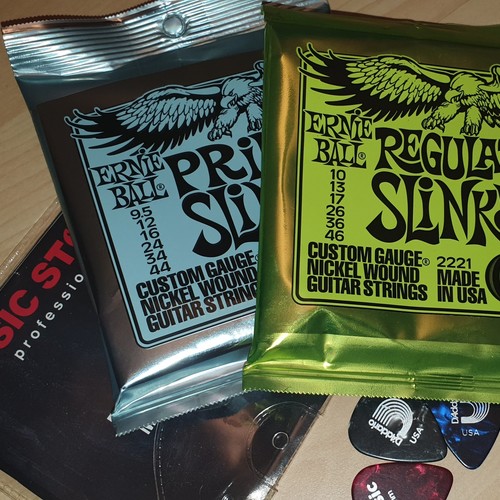
Ernie Ball Regular Slinky Guitar Strings (10-46)
Avg price: $7.54

Avg price: $133.72

Avg price: $100.04

-m.webp?v=1784845186)
Avg price: $106.33

Avg price: $226.55

Celestion Vintage 30 12'' 60-watt
Avg price: $130.80


Avg price: $2,964.00


Avg price: $25.79
Safest system out there
The DiMarzio Clip Lock Strap is one of the straps that you see often on both Ibanez and Musicman guitars. It’s a unique take on straps and locking systems in that it uses a quick release buckle that stays attached to the guitar. This guarantees that the strap will stay on your guitar, and you can always guarantee you have a secure connection, unlike certain other guitar straps.
This strap fixes a few things about strap locks currently on the market. Schaller strap locks have an issue with both squeaking during heavy usage and the nut coming loose. The nut issue can be fixed with loctite, but you need to buy the strap lock system again to fix the squeaking. The biggest issue with Dunlop strap locks is that the ball bearings might not fully engage inside the lip. This can cause the guitar to come apart from the strap.
The DiMarzio strap system prevents this, for the most part. There are a few issues with this system, however. The biggest is that the piece that stays attached to the guitar tends to scratch it up. Despite the ends always staying very secure, you should always make sure the screws are tight, and this goes for all strap systems out there.
Overall, this is a really good strap locking system. In fact, I think this is the most secure strap locking system on the market.

EMG 81 Active Ceramic Humbucker Guitar Pickup
Avg price: $96.87
the best active pickups on the market
The EMG 81 is one of the pickups that helped make EMG a name for itself. It’s a pickup with an active preamp inside it. That means it requires a power source. In this case, it’s a 9V battery. It’s housed in a special cover with no pole pieces and has a ceramic magnet.
The EMG 81 is a pickup that’s getting a bit dated today, but it is still a great pickup. Overall, the pickup really pushes the amplifier, despite the pickup itself actually being low output. This is mainly thanks to the built in active preamp. It’s a quiet pickup that doesn’t need a buffer for long cable runs, and it doesn’t interfere with nasty RF waves like most regular pickups do. This is what helps make EMGs more appealing, especially in a live situation.
The pickup is very tight, has some good midrange and some screaming high end, but it’s also a bit bright. It has some awesome grind going on, but this can lead to it being overly bright in the wrong piece of wood. I find it works great in more neutral to mid heavy woods such as alder and mahogany. Basswood can be a bit iffy, depending on the tone you’re going for. I don’t recommend using this in a body made of a dense wood such as maple. The pickup can be used in both the neck and the bridge. Some find it works great in the neck, but I simply find it to be too bright for the lead tones I usually go for.
The biggest issue with EMGs is that they can sound a bit “linear.” They’re very compressed, and this can lead to some guitars sounding more similar than if they’d have passive pickups. Some argue this case, but it’s true to an extent. The guitars won’t sound identical, but they’ll sound a bit more similar than if they might have a pickup that’s more picky about woods such as the Seymour Duncan JB.
Overall, the pickup is great, especially for those who play metal. It can be a bit dated sounding thanks to the boutique market, but I still feel this is one of the best active pickups on the market.

Avg price: $100.76
Only in the neck
The EMG 60 is a pickup that is a variation on the typical EMG humbuckers. It is commonly paired in the neck position of a dual humbucker loaded guitar with an 81 or an 85 at the bridge position. I have one as stock in my ESP Eclipse II and I can certainly see the appeal in this pickup for active pickup users. Compared to the 81 or even the 85 it's a a fairly bassy sounding pickup, and it has a certain tightness in the low end that is optimum for really thick sounding lead work. Compared to the 85 as a neck position pickup, the EMG 60 definitely has more output going through it which makes it ideal for higher gain applications. The 85 is a bit more vintage in character and has a slightly more classic quality to it to my ears.
I'm particularly a fan of this pickup's clean tones. This is where you really start to hear the output that this pickup has. I find it to be a particularly dynamic pickup. The drive tones on thr other hand, are wonderful and I think the EMG 60 makes for an excellent compliment to the 81 in my ESP. It's very thick and fluid, and the harmonic overtones are simply astounding. I don't think it's a dynamic enough humbucker for blues or classic rock - that's a job for the 85. All in all I think the EMG 60 is a cool pickup for someone looking for a killer high gain pickup to compliment something like the 81.
About this setup
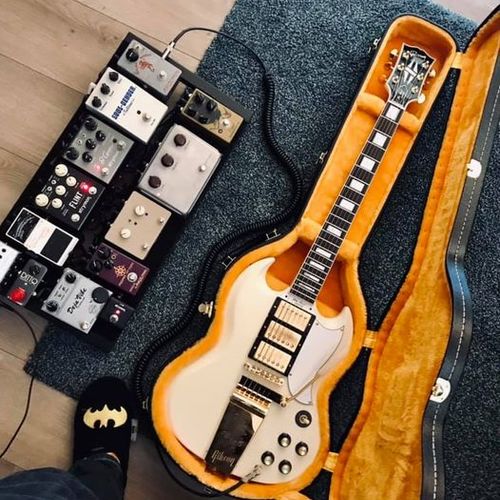
This gear photo by axel_tnl features 12 pieces of gear, including Mesa/Boogie Dual Rectifier 2-channel 100W Solo Head (1992 - 2000), Orange PPC412 Guitar Speaker Cabinet, and Ernie Ball Regular Slinky Guitar Strings (10-46). The setup spans Amplifiers, Guitars, and Effects Pedals, with a mix of standard and high-end pieces. Artists with this kind of gear are most often found in the Rock, Pop, and Metal scenes. Notable artists with overlapping gear include Jordan Posner, James Hetfield, and Paul Gilbert.
Similar Artist Setups
Pro artists whose gear list overlaps with this photo.