
james_peter_neligan's Reviews
8 reviews Back to james_peter_neligan's Equipboard
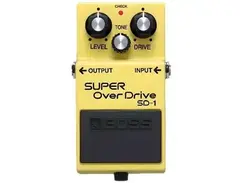

Always come back to this one
43 years of uninterrupted production for a reason. No, it’s not “transparent” sounding. No, it’s not boutique. Yes, it’s a classic. Great for boosting leads and tightening the low-end on a Marshall-style tube amp that’s just on the edge of break-up. You’ve heard this on countless recordings. Easily the equal of the Ibanez TS-9 for half the price.
Preferred Settings + Usage:
Level maxed, Tone at 12 to 1 o’clock. Gain at 8 to 9 o’clock

Early 80’s MIJ Tubescreamer variant, with a cool twist
Rare, but still relatively under the radar, these were part of a short-lived early to mid-80’s line of guitar effects pedals made in Japan by Korg, under license to Pearl, who marketed them. Whether that’s Pearl as in the Japanese drum brand, I’m not sure, as information on these long-discontinued 40+ year old products is nearly non-existent. If it WAS the drum company, they - perhaps unwisely - used a different logo. Anyhoo, this is a soft-clipping overdrive pedal in the Ibanez Tubescreamer/ Boss SD-1 mould. However, in lieu of a standard tone knob, there are separate controls for EQ - with 7 different frequencies from low to high and all points in between - and for EQ Gain, to cut or boost gain in the selected frequency. This makes it a very versatile tone-shaping tool, that can be adapted to any set-up. This pedal houses not one, but two JRC4558 chips (as used in the Tubescreamer, the Boss SD-1 and most iterations of the OD-1). The Pearl OD-05 packs a lot of gain, with a nice, gnarly character. It wants to feedback a lot, but could do with more volume (Level on full, with gain anywhere below 9 O’clock is only marginally louder than bypass unity). I use mine for lead boosts, so I keep the EQ setting firmly in TS territory: lower-mid to upper-mid boost depending on the amp. Symmetrical clipping gives it a smoother, more compressed feel than a Boss OD-1, but it has a similarly aggressive, snarly quality, at least in the settings I use. However, if you want mid-scooped grungy tones, or bass-heavy Sabbath sludge, it can do that too. The buffered bypass is good quality. This is not a tone sucker. Bigger footprint than a Boss or Ibanez pedal. Bear this in mind if board-space is limited. It can run off a standard modern 9V power supply. No dicking around with 12v necessary. It sounds even sweeter running off a cheap, carbon battery, though. As a big fan of Rick Rubin’s early production work in the late ‘80s, I remember being intrigued reading in a metal hammer interview with the guitar player from Wolfsbane circa ‘89, recounting how Rubin made him use this pedal for tracking guitars on their debut album. It’s possible that Korg were also the OEM manufacturers for Tokai branded pedals around this same time, as the even rarer Tokai TMD-1 Metal Driver from the same era, had a pretty much identical circuit and control layout. Though Pearl are long out of the effects pedal market, the OD-05 circuit is available as a DIY clone project through Aion FX or BYOC. The Octaver and Flanger pedals from this series are also highly regarded by those who know. The less coveted DS-06 Distortion pedal tries to pull the same variable EQ trick as the OD-05, but with a hard-clipping circuit. There was also a Chorus, an Analog Delay, a Compressor and a frequency enhancer called a Thriller

Solid, unpretentious tube combo with a scaled-down JTM-45 feel
Not much info out there about the Supro 1968RK, so I thought I’d throw this review out there. This is the 1x12 version of the earlier 1970RK 1x10 combo designed by Supro in collaboration with pedal guru Robert Keeley as a neutral-voiced « pedal platform » amp. Made in China. Has the stylish, retro-looking Supro cosmetics. Points for being pretty light to carry. Single-channel, single input, Master Volume, Bass, Treble and Preamp Volume (gain) controls. Effects loop Send input and Return output. 2x6V6 output tubes, 2x12ax7 preamp tubes. Same tube complement as my prized Marshall 4001 Studio 15, and similar panel layout (the Marshall has a Mid control, which the Supro doesn’t) but voiced very differently. The 1968RK packs a surprising amount of low-end for a semi-open back 1x12 combo, and a surprising amount of clean headroom for such a low-powered amp. Supro claim it’s 25W in Class A, but something doesn’t add up there. 2 x 6V6 in Class A will not put out 25W, more like 15. 18 tops. It’s not as loud at full throttle as the 15W Marshall 4001, but that could be because the 4001 packs a Celestion Vintage 30 speaker with 100dB sensitivity vs the 97dB G12M-65 Creamback in the Supro. This is not something I will say often, but I actually think the V30 might have made a better - as in tighter, less muddy sounding - choice for stock speaker in this Supro model than the Creamback. Not only does this thing pack a LOT of bass, but it also has the kind of compressed, saggy response I normally associate with a tube-rectified amp, which it isn’t. The sag, combined with the abundant low end puts me in mind of the JTM-45/Tweed Bassman vibe. Great if that’s your bag, but it might not be. This amp is sold as the perfect pedal platform, and in this capacity it - mostly - delivers. The effects loop is clean, transparent and very quiet. A Roland RE-201 Space Echo through the FX loop of this amp sounds unreal. It single handedly eliminates the background hiss, and will do the same for any noisy modulation pedals. However, noise aside I found that my Boss CE-2 Chorus and DM-3 Delay sounded better going into the front of this amp than through the loop…go figure. The amp is voiced with prominent low-mids (the Creamback probably helps here), so the absence of a Mids control is not felt. That said, some may find the 2-Band EQ somewhat limiting. Would be my amp of choice for recording slide or lead, as the naturally compressed response compliments it. Think early 70’s Ampeg/Stones vibe, but with the sagginess and woodiness of a JTM-45, and you’re in the ballpark. Definitely one for the old-school, blues-literate guitarist. If that’s not you, you may wanna skip this one.

Unsung king of the analog BBD choruses
The unsung king of the 80’s MIJ bucket-brigade chorus devices. More transparent than the Boss CE-2, with a more neutral EQ curve, but even more shimmery, liquid and articulate. 18V gives it added headroom and a slight volume boost. Think Hiwatt to the CE-2’s Marshall. The first Chorus of its kind to feature dual outputs for stereo operation. Unlike some other Ibanez pedals from this series (AD-80, FL-301, and of course the TS-808) these are still relatively under the radar, and with a little patience can still be had for a fair price. Be advised that they require 18V, and have a mini-Jack DC input rather than the modern industry standard 3,5mm barrel-plug.

A classic for a reason
The only chorus you’ll ever need. For my taste, only the 18V Ibanez CS-505 surpasses it for lushness, but it’s as close as makes little difference. Unlike with the CS-505- I don’t detect a volume boost with the CE-2. However, what it does do is fatten/boost the lower mid response. As such, at more subtle settings, or with Rate high and Depth low/off, it can do nicely as an understated thickening agent for your leads (Johnny Winter and David Gilmour certainly thought so). I have a black label MIJ from ‘81 and a green label MIT from ‘89. FWIW, the Japanese unit sounds very slightly warmer, and seems to blend into your signal in a tiny bit more natural way, but it’s also noisier than the Taiwan pedal, which itself has a cleaner (ever so slightly flangey?) character that some may prefer. Both sound warm, thick and lushly analog, and both are superior to the Waza Craft reissue, which I felt was short of the mark. If you score an original, be advised that they run on the old Boss ACA power, which translates to 12V off a modern power supply. Alternatively, you can power it off another Boss pedal with a 2nd DC output (e.g. TU-3, NS-2). As with any modulation effect, the CE-2 will devour a 9V battery pretty quick, so better not to rely on battery power.
-s.webp?v=1784617421)
Everything you need and nothing you don't (apart from the hold function which is truly obsolete in this age of loop pedals))
The earlier large-chip MIJ version (1986 -1990) is supposed to be warmer sounding than the more commonly found MIT version with the smaller chip. I dunno, either version sounds a bit clinical on its own, but in the mix this translates to clear repeats that cut through nicely, unlike some analog units that sound nice on their own in your living room, but can easily be a muddy mess in a band mix. If delay is not a core part of your sound, but rather something you use parsimoniously for added texture and ambience, then this is the unit to go for. And it's quiet.

Have owned a few of these
The world's first soft-clipping overdrive pedal, released a good year before the Tubescreamer. Earlier ones (77-79) are the most prized. Later ones (82-85) are a bit more shrill, with more obvious bass-cut/upper-mid surge. Great pedal. Raunchier and ruder sounding than a TS. For punching your leads through a dense mix it still has few rivals, though the SD-1 is close. Best used into a Marshall or similar.
Preferred Settings + Usage:
Level high, drive low

Good pedal, not that easy to dial-in
Have owned a couple of these down the years. The most tape-sounding of all the BBD analog delays. 18V gives it a lot of power, the repeats are VERY loud and can easily overwhelm if not dialled in carefully (8 o'clock on the blend knob is roughly equivalent to 12 or 1 oclock on the Boss DM-2/DM-3). Maximum delay time is rated at 300ms but is in fact noticeably longer than the Boss DM-2/DM-3, which are also rated at 300ms. The repeats are powerful, warm and very "3-D". Cool piece of vintage kit, but somewhat impractical for modern use (requires 18V, mini-jack rather than modern industry standard barrel plug power input, will drain 2 x 9V batteries very quickly so battery power not recommended). It can also be VERY noisy when combined with other effects. Using some form of noise gate/noise suppressor before this pedal would be advisable. The buffered bypass is noticeably inferior to Boss pedals and imparts a slightly tinny, metallic quality to your tone. The first of these that I owned had a weird, phaser-style bleed into the dry signal when bypassed that I actually really liked (trippy, in a good way), but some would understandably hate it. Honestly, for all practical intents and purposes the current production Ibanez AD-Mini does the job better (much quieter, easier to dial in useable tones, smaller and 9V powered with a barrel-plug) for a fraction of the price the AD-80 now pulls.