Odyssey Eurobeat
Odyssey/Ken Blast/Eurobeat Brony (A-One/Avex/Attack the Music/ Professor). Howling @ the moon. She/Her. I was the community manager here, quite a few years ago!
Every rig tells a story. Start yours.
Catalog your gear, wishlist what's next, and share the setups behind your sound — free.
Create your EquipboardGear 22
In VERY brief, much of my musical prowess comes from composition, not sound dsign. I grew up using only a Korg 05R/W and an abandonware MIDI sequencer to make my earliest work, so this holds a nostalgicplace in my heart AND a huge breath of fresh air for picking the right sounds. I could go into more detail here, but if you wait long enough you may see a longer writeup somewhere else...!
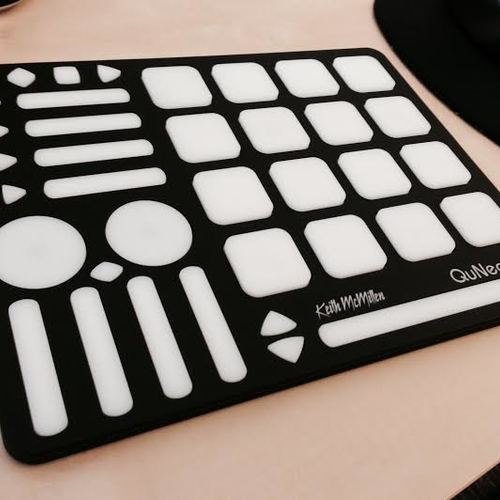
Some of you may recall that I wrote some rather flattering words for the QuNeo back during my tenure as the Community Manager here at Equipboard, but confessedly I didn't have all that much time with the unit as I'd have liked while writing those words. I had played with the unit, sure— but I hadn't put it through the wringer of a genuine on-stage performance yet. So, how does it hold up compared to my original idea of it (which would probably put it somewhere between winning the lottery and attaining nirvana)?
Yes, nearly everything on this controller is mappable. Every corner of the 4x4 grid's buttons can be mapped to be its own thing, including pressure and X/Y information. It really is capable of as much as it says it is. But... is it really that necessary? I've switched from using the "8x8" setup in live settings to just using them as a basic set of 4x4 buttons with no pressure. The pads feel wonderful when you're using them as just pads; as their own 'knobs', however, getting the pressure right takes a LOT of fine-tuning and tedium. You CAN use it with the pre-set tuning right out of the box, but be ready to over-mash or under-mash in the heat of performance. Using the 'faders' behaves similarly— be ready to adjust them quite a bit over time. (I use this with Traktor in most cases, though the ability to swap into a mode with a channel controlling Ableton Live has made it VERY useful in live situations.)
This is NOT to say that the QuNeo is not ideal, nor that it can't be tuned to suit anyone's needs. It really is one of the most flexible and capable controllers on the market, outside of the MIDI Fighter 3D. However, if you really want to unlock the full potential, be ready for a LOT of trial-and-error and some frustrating nights with the software— all ENTIRELY rewarding, mind, and the constant reminder that you can do as much as you can do with the controller undoes most of the damage of those nights. However, it really shines as just a straightforward set of drum pads— lusciously squishy drum pads that tend to be just responsive enough to hit that 'sweet spot'. DEFINITELY worth a purchase as a 4x4 grid, as well as a more expandable controller. If you don't want to pour a lot of time into a controller, it may not be for you, but the reward of that time is well worth the trouble.
4.5/5 - Some needed fine-tuning for pressure & X/Y keep this controller from pure godliness.
I bought a couple of Native Instruments' synthesizers and plugins before making the plunge into Komplete, and I'm still kicking myself for not doing so sooner. The bundle of plugins and instruments included in this pack will satisfy producers in all styles and genres—granted, I've only used them for electronic music production for the most part, but I've also done my fair share of recording and performing with traditional acoustic instruments, and the tools in this bundle handled them equally well.
Nearly $500 is not cheap, but if you can afford to make the leap, you'll be heavily rewarded.
This is my primary vocal microphone, it's not perfect and sometimes it's been a bit temperamental but it's enabled me to deliver much clearer recordings than my previous hand-me-downs.
My review of this sound card may not be fair— see, I don't just use it to produce, I also use it in my live shows, which it wasn't necessarily made to do (Native Instruments makes other sound cards for those purposes). Still, this sound card's extremely sturdy build (I have this strange theory that it could survive falling out of an airplane, though I'd prefer not to test it) and flexible input/output options have served me without fail for the last couple of years, and it's still as functional as day one.
It's certainly not the cheapest sound card on the market, certainly not for performance— but if you can afford to dedicate money to a properly powerful sound card for your productions, I heavily recommend the Traktor Komplete Audio 6.
INSTANT PUNCH. I absolutely adore this compressor.
Keytars are awesome! Back when I was in more of a band situation, I used this to perform! Surprisingly, I still use it to play things in, particularly when what I'm playing in needs more expression and soul.
Just picked this up, it's fun to see the samples I've heard before (and which ones really add life to an otherwise all-instrumental track)!
The Oxygen25 is a welcome addition to your studio! For the price, it delivers exactly what you need without many frills— 25 keys, octave control, pitch bend and modulation wheels, a volume slider, transport controls, and eight MIDI CC knobs. It's a fairly large controller for only having 25 keys (partially due to the fact that it has full-length keys instead of the common "mini keys"), so it's not the best solution for producers who also need a performance tool (even though Ean Golden famously used this controller with Traktor to DJ full sets), but it's right at home in a studio for sure.
You do NOT need a Mac to make music! That said, this machine's been with me to Hell and back, and it's earned its stripes and recouped expenses by far.
Best $30 headphones you will EVER get. I use these when I don't want to risk my M50s getting broken!
Studio monitors! Can't mix without 'em!
I'm stunned my own MPK Mini isn't broken by now— I use this controller for quite possibly everything. Whether I'm at the airport working on music between flights or on stage performing, this controller is an absolute powerhouse for whatever I throw its way. I upgraded to this from the LPD8, and what an upgrade it was— with two banks of eight drum pads, eight assignable knobs, and 25 keys with octave control, any MIDI parameter is at my command.
Obviously it's not the solution to every problem— if it was an all-in-one solution, I wouldn't need to use it alongside a Mixtrack and MIDI Fighter when I perform. It's stunning how quickly all those knobs and drum pads get taken up, so even if you know what you're doing, you'll end up resorting to the keys for many of the functions you wish you could assign to those pads.
That's my only problem with this controller, and frankly it's not a bad problem to have. For the price I paid for it, it's everything I've wanted it to be and then some. If you need a go-to controller for on the go production or are curious about controllerism as a performance method (and can't afford a QuNeo), this is a fantastic piece of kit!
Logic has some stellar built-in synths, and ES2 is no exception! This gave me my earliest synth-brass sounds.
Short of owning a DX7, Native Instruments' FM8 is one of your best choices when it comes to FM synthesis. In addition to providing basic envelope, filter, and operator functions, FM8 steps things up by adding effects, processing, additional equalization, and arpeggiation.
FM synthesis is kind of intimidating if you ask me, but FM8 has made the discovery process much easier and more intuitive than I ever thought it would be. If you're on the fence about FM synthesis, I might pick up a cheaper option— if you're serious about FM synthesis, however, there simply isn't a better software option on the market than FM8.
If you produce electronic music of any flavor, chances are good that you’ve heard of this almost entirely ubiquitous plugin from an equally ubiquitous developer. Massive bills itself as “the ultimate synth for bass and leads”, but it’s capable of so much more, including lush pads, meticulous arpeggios, piercing plucks, and even noise effects.
I actually use Massive a bit TOO much in my own work— need a pad? I'll open an instance of Massive. Need bass? There's Massive. Making a piercing eurobeat brass? "Square-Saw II" in Massive. It handles bass and leads fantastically, sure, but it handles everything else quite wonderfully as well.
When I feel experimental with my performances I use Ableton! I can't afford Standard at the moment, though... *sob*
I'm not much of a DJ (I prefer buttons and knobs to turntables), but I much prefer Native Instruments Traktor over Ableton Live when it comes to performance software. With two-or-four-deck mixing capabilities, built-in samplers, and insane MIDI mapping capabilities (in some cases even more flexible than Live!), I can get Traktor working with as much or as little gear as I need, in any style of play I'd like.
Whether you're a seasoned DJ or a beginner to performing electronic music at all, Traktor was a HUGE help getting me out there and I submit that it will be the same for you.
Logic Pro X may be the successor to the much-beloved 9, but it doesn't succeed on quite as many levels. Yes, it has new plugins (including a fantastic vocal editor that directly rivals Melodyne) and sounds, and if you're new to production or have recently 'graduated' from Garageband, then these will serve you well. But existing Logic users will be turned off by a rehauled workflow that caters more to newbies and fans of other DAWs than the way we knew and loved, as well as a distinct lack of 32-bit plugin support (a much-beloved feature of the previous version, and a big reason why many who upgrade to X return to 9).
Logic Pro X gives a lot of nice features, but it's not so much an upgrade so much as a shift from the previous version.
**Review specifically for Logic Pro 9:**
Logic Pro 9 is possibly one of the best DAWs on the market, surpassing even its successor Logic Pro X. Sure, it may only work with a proprietary plugin format (AU) and it doesn’t have a built-in performance mode like FL Studio or Ableton Live, but what it does have, it handles so masterfully and flexibly it’s hard to hold that against it. Logic Pro 9 is particularly good if you’re working with MIDI, though audio-oriented producers are certainly not left in the cold with Logic’s answer to Live’s Warp feature, Flex.
I personally use Logic Pro 9 to produce my own work, and I adore its workflow. Everything from the layout to the keyboard shortcuts flows beautifully, and whether I’m deepening a dubstep growl, brightening a eurobeat brass, or just plain dabbling in any of its stellar built-in plugins, Logic is a DAW that will heighten, not hinder, your productions.
Tip your hats and cross your hearts, lads and lasses! The MIDI Fighter Classic is the predecessor of the insanely versatile MIDI Fighter 3D and its own spinoff, the Twister. While this controller didn't have gyroscopic controls and fancy side-buttons, what made this controller stand out was its raw versatility— you could solder additional buttons/knobs into built-in ports along the side, replace any of the buttons, or even build it yourself or break it down for use in other projects.
The biggest feature of this controller is the arcade buttons, which were used because they react much faster than drum pads, keys, or plastic buttons on other controllers, and can take a lot of heavy use. They're also just plain cool. My own MIDI Fighter's buttons are starting to gunk up along the sides, but I put stickers on the tops and sides of them for a while so I only have myself to blame for this.
I haven't been able to try out the MF3D or the Twister yet, but if they're anything like the Classic (or, somehow, improvements upon it), then I heavily recommend you pick them up!
DAWs and Software 1
Wishlist 0
Nothing here yet.
Gear Photos 1
Top artists 100
The artists Odyssey Eurobeat has added the most gear to.
Showing the top 12 of 100 artists.