Every rig tells a story. Start yours.
Catalog your gear, wishlist what's next, and share the setups behind your sound — free.
Create your EquipboardGear 27


This guitar is a magnificent beast -- it has a nice slender neck, a snappy ebony fretboard, and a Bigsby that does not pull the guitar out of tune every time you use it. Even though the guitar is 42 years old the pots work noiselessly; the fretboard is fine; and the pickups sound great (not sure what kind they are; tarbacks perhaps?)
Gibson referred to this guitar as a "limited edition" SG Standard, as it features an unbound ebony fretboard. As it is not clear whether Gibson made any Standards with a bound rosewood board during 1974-75, "limited edition" might be somewhat misleading. But that's what they called it.


This guitar has everything I was looking for in an SG: slim 60s-style neck, 24 frets, Bigsby tremolo, and three Classic '57 humbuckers. Only thing that keeps it from getting five stars is tuning issues caused by the Bigsby. While the tuning problems are annoying, they are pretty much offset by the coolness of the Bigsby.


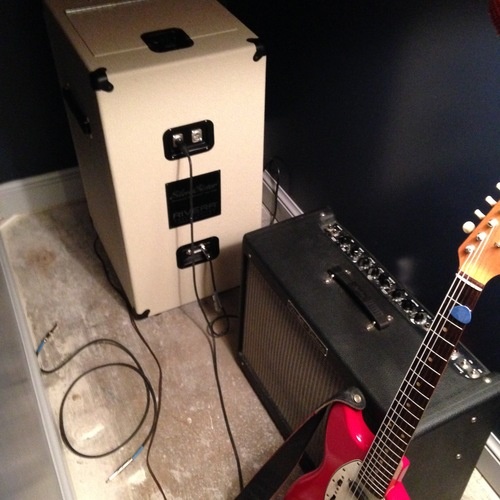
The Silent Sister is a great solution to the problem of recording guitars without making yourself deaf and driving everyone else crazy. It is an awesome product. I only wish they offered the Vintage Celestion 30 model in a black cabinet.

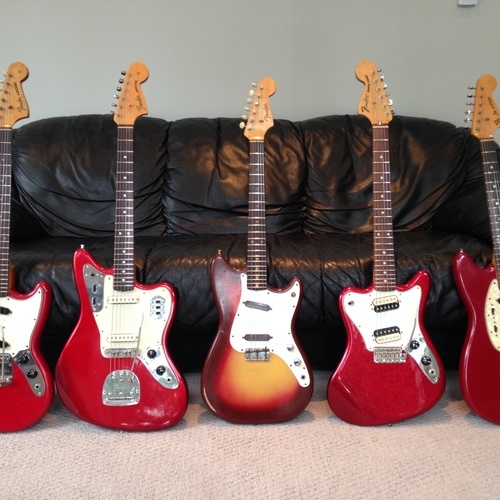
This guitar is potentially great -- it's got a 24 1/4" scale, a nice straight flat and wide fretboard, a Hagstrom tremolo system, and of course the famous DeArmond gold-foil "Mustache" pickups, which sound raunchy and kind of trashy, in a good way. They seem to have a lot of output and they produce a very full-sounding spectrum of sounds.
When I got the guitar, one of the volume pots was stuck in place, and the other volume pot was functioning but very noisy. Deoxit solved both of those problems. The only problem now is the pickguard has warped a bit over time, and this has caused the pickups to be raised up, getting too close to the strings; as a result, when I first got the guitar, the action could not be properly adjusted to make the guitar comfortably playable without having the strings come too low over the pickups. The solution has been to raise the whole neck with a shim. I am still fine-tuning this, and intend to install one that fits the whole neck pocket (right now I am just using a cut-up business card). This WILL be a great guitar when I get it completely set up.

This is one of the least expensive guitars I own -- I bought it used for $325 -- and it is my favorite guitar to play at the moment. It has a coil-tapping feature, so you can get a nice thick, raunchy sound with the humbuckers engaged, or a clear and jangly sound in single-coil mode. The Floyd Rose tremolo works well; it is almost impossible to get this guitar out of tune when the tuners are locked down. It has a beautiful appearance, and it is pretty heavy as well -- you probably should avoid this guitar if you have back issues.
Just to add my 2 cents to the Gibson vs. Epiphone debate, I brought this guitar in to my local Guitar Center a few weeks ago, plugged it in to a good amp and wailed on it for a while. Then I plugged in a whole series of new Gibson Les Pauls. While each guitar has its own individual qualities and tones, making precise comparisons difficult, it seemed to these ears that my $325 Epiphone compared favorably to a succession of $2000-$3500 Gibson guitars.


My Gibson "The Paul" is a 1979; I've had it since about 1989. It is a stripped-down Les Paul with all the high-quality hardware you expect on a Gibson Les Paul (Grover tuners, Tune-O-Matic bridge, etc.) and a few twists that are out of the ordinary: a solid walnut body and an ebony fretboard. It came stock with the Gibson T-Top humbuckers, which produce a nice full, warm sound with a lot of snap and definition. Its only drawback for me is its lack of a tremolo piece; but this doesn't make it any different from the standard Gibson or Epiphone Les Paul model, and the hard tail allows for more sustain than you might otherwise get, so that's not really that much of a drawback (as long as you have other guitars to use for your tremolo work!).
It is a very heavy guitar, which I don't mind; that probably contributes to its tonal qualities as well. The bottom line is: all the original parts of this guitar function fine, and the guitar is 36 years old. That says a lot for the quality of the workmanship and parts that went into this beast. And yet today these guitars seem to fetch $700-$750, which is only about $50-100 more than they cost in 1979! When you factor in inflation, the guitar has not been a good financial investment, to say the least. But it is still my go-to guitar for solos when I'm recording, and I find it very pleasing to the eye as well.

-m.webp?v=1784559371)


-m.webp?v=1784585441)

-m.webp?v=1784617214)
Wishlist 0
Nothing here yet.