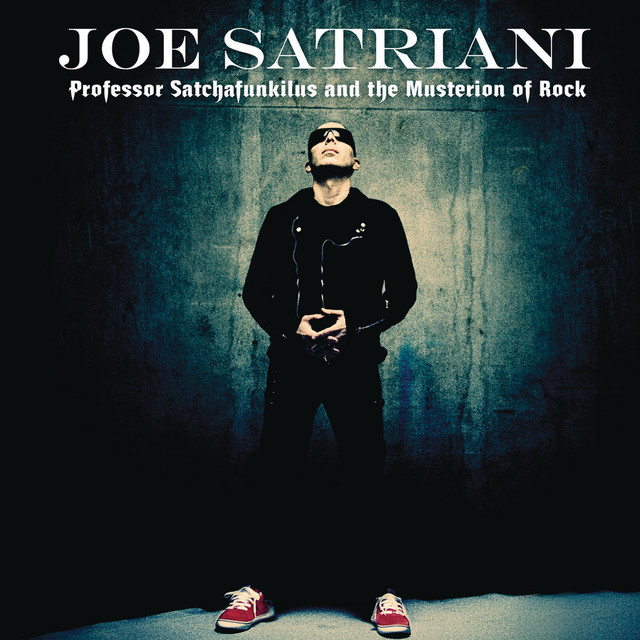
Joe Satriani – Professor Satchafunkilus and the Musterion of Rock
The music gear and equipment used by the artists, producers, engineers, and more involved in the making of the 2008 album Professor Satchafunkilus and the Musterion of Rock.
Music from Professor Satchafunkilus and the Musterion of Rock
Artists on Professor Satchafunkilus and the Musterion of Rock

Gear Used On Professor Satchafunkilus and the Musterion of Rock
Explore the instruments, equipment, software, and production tools used in the making of Joe Satriani – Professor Satchafunkilus and the Musterion of Rock (2008). Click more on each item to see exactly how it was used.

Microphones used by Joe Satriani on Professor Satchafunkilus and the Musterion of Rock

Used on Professor Satchafunkilus and the Musterion of Rock:
And what about those famous guitars, which included Ibanez JS1200, JS1000 and JS2PRM electrics (his signature line), a Bruce Sexauer FT-14 acoustic and a 1948 Martin 000-21? For the demo recordings, Satriani used either a Palmer or Marshall SE100 speaker simulator paired with one of his many guitar amps, including those from his signature Peavey JSX Series. In the studio, he played into either a CAD D189 or an SM57. For clean guitar parts and acoustic guitar, he used a KM54.
The CAD D189 would later be included in Satriani's signature CAD microphone pack.


Avg price: $112.64
Used on Professor Satchafunkilus and the Musterion of Rock, among other recordings and live performances.
And what about those famous guitars, which included Ibanez JS1200, JS1000 and JS2PRM electrics (his signature line), a Bruce Sexauer FT-14 acoustic and a 1948 Martin 000-21? For the demo recordings, Satriani used either a Palmer or Marshall SE100 speaker simulator paired with one of his many guitar amps, including those from his signature Peavey JSX Series. In the studio, he played into either a CAD D189 or an SM57. For clean guitar parts and acoustic guitar, he used a KM54.


Avg price: $3,824.38
Used on Professor Satchafunkilus and the Musterion of Rock:
And what about those famous guitars, which included Ibanez JS1200, JS1000 and JS2PRM electrics (his signature line), a Bruce Sexauer FT-14 acoustic and a 1948 Martin 000-21? For the demo recordings, Satriani used either a Palmer or Marshall SE100 speaker simulator paired with one of his many guitar amps, including those from his signature Peavey JSX Series. In the studio, he played into either a CAD D189 or an SM57. For clean guitar parts and acoustic guitar, he used a KM54.
A KM-54a owned by Satriani, possibly the same microphone, was later sold on Reverb.com via Bananas at Large.
-m.webp?v=1785236512)
Avg price: $3,582.88
Used for the robot vocals and talkbox on "I Just Wanna Rock", as can be seen the mini-documentary of the recording of Professor Satchafunkilus and the Musterion of Rock starting at 3:52 and 4:41 respectively. Satriani explained the recording process in this September 25, 2008 Guitar World interview.
GW Tell me about how you recorded all of the voices on the soon-to-be audience-participation favorite “I Just Wanna Rock.”
SATRIANI [laughs] It wasn’t as easy as you would think. People assume recording large groups of people is no biggie: you just gather everybody ’round a mic and—boom!—you’re done. Not so. After three or four passes, if you’re trying to record a crowd, or if you’re trying to make what sounds like a crowd with multiple tracks, the vocals can get in the way of the music.
GW And the voice of the robot on that track?
SATRIANI That’s my voice, recorded three times and heavily distorted, going [in a robotic voice]: “What is your purpose?” That’s what the robot is saying to the crowd. I was using low-fi distortion, a SansAmp and a couple of different plug-ins to change the intensity of my voice. But on the part where the robot is getting into it and saying, “I wanna rock! I wanna rock with you!” I used my Talk Box. I’d been threatening to use my Talk Box for years, but I couldn’t remember how to position the tube in my mouth. So I called ZZ in the room and said, “You gotta help me figure out how to work this thing.”
GW I’m trying to imagine what goes through a 15-year-old’s head: “Aw, jeez. I gotta help my dad with his damn Talk Box!” Are you “cool dad” when this happens, or “dorky dad”?
SATRIANI [laughs] Dorky dad, definitely! Face it: the human race has to progress, and that means that the younger generation will always be cooler than their parents.
GW Even if their parents are in the next room playing with a Talk Box?
SATRIANI Especially if their parents are in the next room playing with a Talk Box! [laughs]

Studio Equipment used by Joe Satriani on Professor Satchafunkilus and the Musterion of Rock

Used during the development of Professor Satchafunkilus and the Musterion of Rock:
"The process of writing, arranging and ultimately recording began in Satriani's home studio, a spaceship-like enclave containing a Pro Tools HD2 system running on an Apple G5, a set of Roland V-Drums, a couple of keyboards and, of course, a whole lot of guitar amps. 'I started doing little bits of recording around '99,' says Satriani. 'It went from using Logic on a laptop to getting a fully dedicated Pro Tools system. The last three or four records have had quite a lot of material recorded right here in this room.'"

Used, albeit minimally, during the production of Professor Satchafunkilus and the Musterion of Rock:
"Turns out about half of the guitar parts on the record came from those demo sessions, as well as all of the keyboard parts. Everything else was recorded at The Plant Studios in Sausalito, Calif., in the facility's historic Studio A, which offers a 1,200-square-foot tracking room with a circa 1972 sunburst pattern on the sidewall and a much newer SSL 9000 K sitting in the control room. (...)
Satriani and crew spent three weeks mixing at The Plant, where Cuniberti bypassed the SSL altogether to mix exclusively 'in the box.' After three weeks, they moved to his home studio, affectionately dubbed Digital Therapy Labs, which offers a Pro Tools HD3 system and enough plug-ins to allow him to use the same techniques as he would during a traditional mix session."

Avg price: $320.00
Used by producer John Cuniberti on Professor Satchafunkilus and the Musterion of Rock:
"Satriani and crew spent three weeks mixing at The Plant, where Cuniberti bypassed the SSL altogether to mix exclusively 'in the box.' After three weeks, they moved to his home studio, affectionately dubbed Digital Therapy Labs, which offers a Pro Tools HD3 system and enough plug-ins to allow him to use the same techniques as he would during a traditional mix session."

Avg price: $3,726.37
Used in Studio 21 for Is There Love in Space?, Professor Satchifunkilus and the Musterion of Rock and Black Swans and Wormhole Wizards (particularly for the intro of "Littleworth Lane"), as stated in Strange Beautiful Music: A Musical Memoir.
Is There Love in Space?
Before reuniting with John Cuniberti, Matt Bissonette, and Jeff Campitelli to record Is There Love in Space?, I started recording the new songs at Studio 21, my home studio, trying once again to break my own style down and rebuild it into something new. I was deeper into Pro Tools now and having much more success and fun with it. The new record would feature quite a bit of compositional variety, with lyrical-sounding melodies and more angular-sounding solos—and two vocal tracks!
At Studio 21, I was using a Korg Triton DAW keyboard, Universal Audio 1176 and LA-2A compressor/limiters, an Empirical Labs EL8S, old API EQs, the Millennia Media STT-1 mic pre, and Palmer speaker simulators. For guitar amps I had an interesting collection: Soldano, Mesa Boogie, Cornford, Vox, Wells, and several vintage Marshalls. Added to that group was my new Peavey JSX prototype head. Everything just started to sound better!
Professor Satchifunkilus and the Musterion of Rock
I was using an old Marshall SE100 as my main speaker simulator, which meant I was going guitar into amplifier into Marshall SE100 into Pro Tools directly, or through the STT-1 if I wanted to shape it with some EQ or optical compressor. Additionally, the SE100 has some really clever ways of simulating a microphone being right at the cone, at a slight angle, or at a big angle. I like using the 30- and 60-degree angles—off axis, they call it—and it worked pretty well. It really does sound like an amp being miked up by a 57, so that setup worked in my room. As far as guitars, I was using the Ibanez JS1200 and the JS1000 most of the time. What mattered more than the equipment by that point was that another two years had gone by where I continued getting more proficient at recording with Pro Tools in general.
Black Swans and Wormhole Wizards
With “Solitude,” I was thinking about how I often require time to be alone, much as my parents did, and I coupled that with my mother’s absence from her house once she passed. It was so profound, I couldn’t put it into words. I was working on a song called “Heartbeats” at my home studio one afternoon when the inspiration came. I was thinking “Heartbeats” needed some kind of introduction, but instead I started writing a piece that was much bigger. It was a song about my moments of solitude, and the lonely feeling in my mother’s house now that her spirit had moved on. It eventually found a home on the record right before “Littleworth Lane.” I played my JS1000 direct into my STT-1 for that recording.
Drum Sets used by Joe Satriani on Professor Satchafunkilus and the Musterion of Rock

Used during the development of Professor Satchafunkilus and the Musterion of Rock:
"The process of writing, arranging and ultimately recording began in Satriani's home studio, a spaceship-like enclave containing a Pro Tools HD2 system running on an Apple G5, a set of Roland V-Drums, a couple of keyboards and, of course, a whole lot of guitar amps. (...)
"From his professionally tuned shuttle, Satriani recorded 16 or so demos, which he would later use during tracking sessions with drummer Jeff Campitelli and bassist Matt Bissonette. Satriani played drums when he was a teenager; he usually records drum patterns with the V-Drums into MIDI, creates a basic rhythm and then works out the guitar tracks. 'He'll basically build up the entire arrangement and then edit those arrangements in Pro Tools,' says [producer John] Cuniberti. 'Once that's done, he has a choice of attempting either finished guitar parts or just using the demo guitars as a representation for later use. In the studio, there is a point where he, or we, decide which guitars we're going to keep from his demo sessions and which guitars we're going to replace.'"
Software Plugins and VSTs used by Joe Satriani on Professor Satchafunkilus and the Musterion of Rock

Used by producer John Cuniberti on Professor Satchafunkilus and the Musterion of Rock:
"Satriani and crew spent three weeks mixing at The Plant, where Cuniberti bypassed the SSL altogether to mix exclusively 'in the box.' After three weeks, they moved to his home studio, affectionately dubbed Digital Therapy Labs, which offers a Pro Tools HD3 system and enough plug-ins to allow him to use the same techniques as he would during a traditional mix session.
'I haven't changed the way I mix,' he says. 'I use the Waves API bundle for most of the EQ, the Altiverb reverbs — with those I can get my EMT plates, my echo chambers, my halls — and various compressors depending on what's called for. All of that is bused to a Neve 8-in/2-out summing box I built and then to an SSL stereo compressor. Joe and I have grown up with Neve, API and SSL consoles, so we couldn't divorce ourselves from them.'"
Effects Pedals used by Joe Satriani on Professor Satchafunkilus and the Musterion of Rock

Used on "I Just Wanna Rock", as can be seen the mini-documentary of the recording of Professor Satchafunkilus and the Musterion of Rock starting at 4:37. It is also mentioned in this November 15, 2008 Ultimate Guitar interview. Satriani explained the recording process in this September 25, 2008 Guitar World interview.
Guitar World
GW Tell me about how you recorded all of the voices on the soon-to-be audience-participation favorite “I Just Wanna Rock.”
SATRIANI [laughs] It wasn’t as easy as you would think. People assume recording large groups of people is no biggie: you just gather everybody ’round a mic and—boom!—you’re done. Not so. After three or four passes, if you’re trying to record a crowd, or if you’re trying to make what sounds like a crowd with multiple tracks, the vocals can get in the way of the music.
GW And the voice of the robot on that track?
SATRIANI That’s my voice, recorded three times and heavily distorted, going [in a robotic voice]: “What is your purpose?” That’s what the robot is saying to the crowd. I was using low-fi distortion, a SansAmp and a couple of different plug-ins to change the intensity of my voice. But on the part where the robot is getting into it and saying, “I wanna rock! I wanna rock with you!” I used my Talk Box. I’d been threatening to use my Talk Box for years, but I couldn’t remember how to position the tube in my mouth. So I called ZZ in the room and said, “You gotta help me figure out how to work this thing.”
GW I’m trying to imagine what goes through a 15-year-old’s head: “Aw, jeez. I gotta help my dad with his damn Talk Box!” Are you “cool dad” when this happens, or “dorky dad”?
SATRIANI [laughs] Dorky dad, definitely! Face it: the human race has to progress, and that means that the younger generation will always be cooler than their parents.
GW Even if their parents are in the next room playing with a Talk Box?
SATRIANI Especially if their parents are in the next room playing with a Talk Box! [laughs]
Ultimate Guitar
What is your purpose? I couldn't tell what he was saying. Sorry.
I know, me neither. [laughs] It's very distorted. I recorded that at home, first. It was the first thing I recorded to see if it would be funny enough, you know? Once I got that I thought, Oh, that's cool. Then I thought, Well, then what happens? So I thought, Ok, he goes to a rock concert and it starts to humanize him and he wants to rock but he doesn't know how. So he starts to say, I wanna rock, I wanna rock, I wanna learn how to rock with you. And I looked around my room and I'm thinking, I need something to plug into that makes him less of a robot. And my eyes caught the Framptone talkbox, which I had been desperately trying to use for three records and I could just never come up with anything creative that was better than Peter Frampton or Richie Sambora or Joe Walsh, you know? [laughs]
But then I thought, Ah, ok, its not me it's the robot! So I used the talkbox to be that sound of the robot having rock 'n roll change its life. Then I recorded that and thought, Ok, now I can build a song around this. So then I wrote the song actually around those two recorded bits. Yeah, it's crazy.