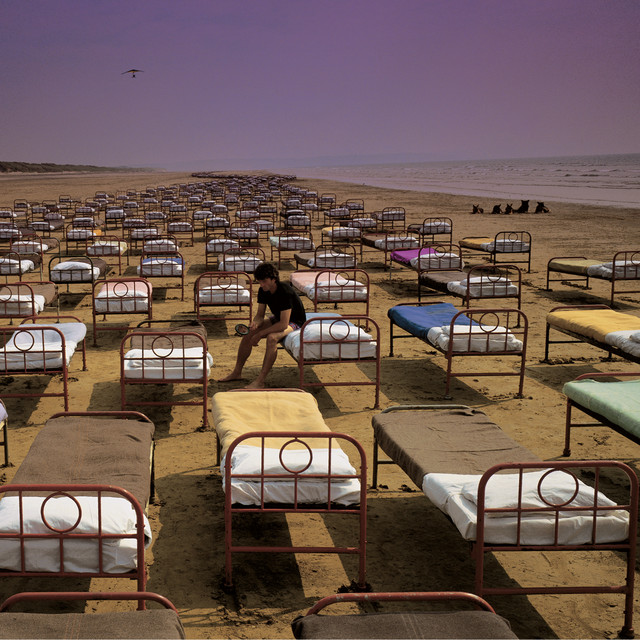
Pink Floyd – A Momentary Lapse of Reason
The music gear and equipment used by the artists, producers, engineers, and more involved in the making of the 1987 album A Momentary Lapse of Reason.
Music from A Momentary Lapse of Reason
Artists on A Momentary Lapse of Reason


Gear Used On A Momentary Lapse of Reason
Explore the instruments, equipment, software, and production tools used in the making of Pink Floyd – A Momentary Lapse of Reason (1987). Click more on each item to see exactly how it was used.

David Gilmour
Roles:
Effects Pedals used by David Gilmour on A Momentary Lapse of Reason

Boss CS-2 Compression Sustainer
Avg price: $94.34
Used in the Momentary Lapse of Reason Tour and the Division Bell tour alongside the MXR Dynacomp. (http://www.kitrae.net/music/David_Gilmour_Tone_Building.html#ToneBuildingPulse http://www.gilmourish.com/?page_id=156)
"Additional pedals include a Boss CS-2 Sustainer, MXR Dyna Comp, Iba- nez CP9 Compressor-Limiter, Boss Hyperfuzz, Electro-Harmonix Big Muff, two Chandler Industries Tube Drivers and three Boss Graphic Equalizers. He also operates several master volume pedals: one for his 4x12 cabinets, another one for his rotating speakers, another for his voice box and a speed control for the doppolas." - Phil Taylor, David Gilmour's guitar tech.
"After extensive tests David decided on the following list of effects to be incorporated: Boss CS-2; Pete Cornish G-2 Fuzz; EH Big Muff; Pete Cornish Soft Sustain-2; Chandler Tube Driver; Pete Cornish Tape Echo Simulator; Pete Cornish Custom Stereo Chorus using a modified Boss CE-2." - from Pete Cornish website


-m.webp?v=1783350004)
Avg price: $109.00
Used on his solo album About Face and Pink Floyd's A Momentary Lapse of Reason.
In a 1984 issue of Guitar Player Magazine, Gilmour said the following of his sound: "At the moment, the sound that I'm using a lot of the time is going through a Boss HM-2 Heavy Metal to a Boogie amplifier to a [MXR] DDL and then on into a regular Fender amplifier....I use a DDL on it...because I find it stops the fuzz box from from sounding like a fuzz box. It smoothes off the unpleasant, raw frequencies that you get from the fuzz box. Then you get a nice sort of sound.”
Amplifiers used by David Gilmour on A Momentary Lapse of Reason

Fender Concert Rivera Era Combo (1981-1987)
Avg price: $882.00
A couple of Fender Concerts were sold at auction for $77,500 as part of Christie's The David Gilmour Guitar Collection auction. The listing has the following description:
FENDER MUSICAL INSTRUMENTS, FULLERTON, CIRCA 1982 AND 1983 A PAIR OF GUITAR AMPLIFIERS, CONCERT One bearing the serial number F332178, stamped on the chassis, the other stamped F210503 18 ½ in. (47 cm.) high, the cabinet; 23 ¾ in. (60 cm.) wide; 11 in. (28 cm.) deep
The Fender Concert amplifier was part of the II Series line produced by Fender under Paul Rivera from 1982 to 1986, among the last amplifiers to be made at Fullerton. The amps were designed with both a clean and mid-boost gain channel to compete with the Mesa Boogie Mark Series amps that were popular at the time. A stereo set up of the two Fender Concert amplifiers was first incorporated into David Gilmour’s session rig in mid-1984 and used during recording sessions at London’s AIR Studios for Paul McCartney’s 1984 soundtrack album Give My Regards to Broad Street. With his 1984 Candy Apple Red 57V Stratocaster (lot 56) fed into the two Fender Concert amps, Gilmour performed a memorable solo on the McCartney ballad No More Lonely Nights, requesting that his session fee be donated to a charity of McCartney’s choice. The Concert amps made a notable appearance at the legendary Live Aid concert in London’s Wembley Stadium on 13th July 1985 when David Gilmour performed a set as part of Bryan Ferry’s band, which included the songs Sensation, Boys and Girls, Slave to Love and a cover of John Lennon’s Jealous Guy. Numerous photographs and live film recordings exist of the performance, showing a total of four Fender Concert amplifiers stacked on top of four Fender speaker cabinets on the stage. The concert amplifiers remained in Gilmour’s session and stage rig through 1985, used during recording of Pete Townshend’s 1985 solo album White City: A Novel and for live performances with Townshend’s short-lived supergroup Deep End in October and November 1985, including a live performance on cult British television show The Tube on 11th October and two nights at London’s Brixton Academy on 1 and 2nd November in aid of Townshend’s Double O charity.
As documented on Gilmourish and on Spare Bricks, one of the Fender Concert amps was also used on A Momentary Lapse of Reason, particularly for the intro of "Sorrow".
intro; the guitar was recorded with a Big Muff into a Fender Concert combo and fed through Floyd’s Quad PA system at the LA Sports Arena.
Meanwhile, Kit Rae notes that Gilmour used four different Fender Concerts for Live Aid.
A modified version of the rig was used on July 13th, 1985 when Gilmour played a set of songs with Bryan Ferry's band for the Live Aid benefit concert in London's Wembley Stadium. Keyboardist/guitarist Jon Carin was a member of Bryan Ferry's backing band at this time, and he would later work extensively with Pink Floyd in that same period. David can be heard on Slave to Love and John Lennon's Jealous Guy. He used four Fender Concert combo amplifiers stacked on top of four Fender speaker cabinets. The lower cabs do not appear to be mic'd. As sated above, the clean channel of the Concerts sounded very much like a black face Twin Reverb.

Keyboards and Synthesizers used by David Gilmour on A Momentary Lapse of Reason

Avg price: $20,234.25
The EMS Synthi A is a synthesizer which uses exactly the same electronics as the VCS 3, but rehoused in a Spartanite briefcase. Instead of routing signals using patch cables, as a Moog did, it uses a patch matrix with resistive pins. The 2700 ohm resistors soldered inside the pin vary in tolerance - 5% variance and later 1%. The pins have different colours: the 'red' pins have 1% tolerance and the 'white' have 5%, while the 'green' pins are attenuating pins having a resistance of 68,000 ohms.
The later Synthi AKS incorporated an early digital 256 event KS (Keyboard Sequencer) sequencer in the lid, input provided by a capacitance sensitive Buchla like keyboard.
Perhaps its most prominent use is in Pink Floyd's "On the Run" from their 1973 album The Dark Side of the Moon, as well as the introduction to The Alan Parsons Project's "I Robot." Along with Klaus Schulze and Tangerine Dream, other frequent users of the instrument include Tim Blake & Miquette Giraudy of Gong, Richard Pinhas of Heldon, Merzbow, Thomas Lehn, Cor Fuhler and Alva Noto.
From Wikipedia's page on the EMS VCS3
.jpeg?v=1783065966)
Richard Wright
Roles:
Studio Equipment used by Richard Wright on A Momentary Lapse of Reason

Richard Wright began using the Kurzweil K250 synthesizer/sampler during the production of "A Momentary Lapse of Reason." According to Fika, he later upgraded to the K2500 for the P.U.L.S.E. Tour.
Keyboards and Synthesizers used by Richard Wright on A Momentary Lapse of Reason

Avg price: $292.57
Another instrument used by Wright since A Momentary Lapse, It was one of the keyboards more used into the Division Bell Sessions

Nick Mason
Roles:
Studio Equipment used by Nick Mason on A Momentary Lapse of Reason

Allison Research Kepex Keyable Program Expander
Used on Mason's bass drum to produce the "heart beat" on "Speak to Me", as stated by sound engineer Alan Parsons in this June 1998 interview with Media&Marketing.
The opening [heart beat] was just a gated bass drum. Kepex noise gates or expanders were quite a new technology at the time. It actually explains a lot about the sound of the album, since the Kepex had a sound of its own.