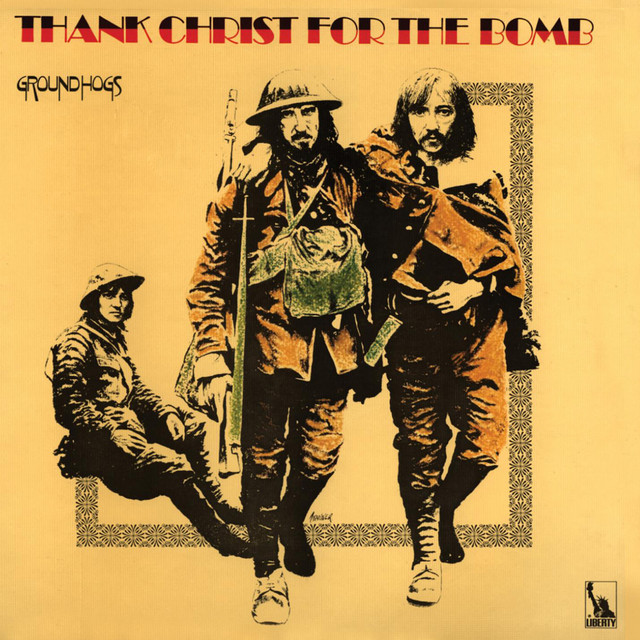
The Groundhogs – Thank Christ for the Bomb
The music gear and equipment used by the artists, producers, engineers, and more involved in the making of the 1970 album Thank Christ for the Bomb.
Music from Thank Christ for the Bomb
Artists on Thank Christ for the Bomb


Gear Used On Thank Christ for the Bomb
Explore the instruments, equipment, software, and production tools used in the making of The Groundhogs – Thank Christ for the Bomb (1970). Click more on each item to see exactly how it was used.
Studio Equipment used by Tony McPhee on Thank Christ for the Bomb

McPhee used an Add-A-Sound that he personally modified, as known from the following sources:
ZigZag, March 1971, "Tony McPhee... Groundhog" by John Tobler
What about records? You’ve never thought of bringing in Moogs and what have you?
No, I’m not really a weird noise freak. I think it’s much better and cleverer to get a strange sound out of an ordinary instrument, which is why I admired Hendrix so much. He could make Moog noises with a guitar, and though I don’t consciously try to copy him, I do sometimes get similar effects.
Yes, and the wah-wah pedal often accentuates the similarity...
Well, a lot of people don’t realise about wah-wahs....I mean, every little step you bring it down is a different tone, and you can get all sorts of noises from it. I’ve also got an octave splitter which sounds great through the Laney gear — it gives you an octave above and an octave below. Hendrix uses one on ‘Machine Gun’ — it gives a sort of modulated note, where you have the note and other frequencies with it which aren’t really related, so you end up with a weird sort of dischordant sound. And I’m just discovering exactly what you can get out of this device.
Melody Maker, June 5, 1971, pg. 34, Any Questions?
I use a Laney 100-Watt stack, plus an Arbiter Add-A-Sound octave splitter, which adds higher harmonies, producing a "violin" sound and also lower octaves, which used [sic] on "Cherry Red." I modified this unit and built in a pre-amp with high-pass filter which acts as a treble boost. I also use a Shcaller [sic] wah-wah pedal. On "Thank Christ" we had completely different equipment, so the sound is different on "Split", plus the fact that I also used a Fender Stratocaster for many of the numbers on "Split," notably parts 2 and 4, using a combination of wah-wah and tremolo arm to get "whizzing" effects.
Sounds, March 18, 1972, "The Groundhogs: Tony McPhee At The Talk-In" by Jerry Gilbert
Since Thank Christ For The Bomb you've started to get into sounds and effects which you can obtain by using the studios and also by modifying your guitar and amplification.
Yeah definitely. Studios are weird things, you know you can get a sound on stage which suits you but you can't get it in a studio so you have to muck about with it quite a bit and in doing so you get a different sound. I use a wah-wah pedal which I'm using less of now – it got a bit tiresome after a while – then there's a new thing called an octave splitter and that just sort of gives you a rough octave above and below.
You can get sounds like a bass and sustained sounds with a weird quality and in effect it's like an electrical Rory Gallagher – you know this ability he's got of striking harmonics, well in actual fact that's what it does, so you can cheat quite well on those things. Also playing two notes at once it gives you the same effect as a ring modulator which is very trendy these days... notes which are the subtraction and addition of the two frequencies and this sort of thing which gives you a bubbly sort of sound. That's all I get along with really but I do feel now that I want more – not simply from gadgets because I don't use these as gadgets, I use them as separate instruments really.
The whole point is I knew I could imitate things like strings on the new album but I wanted the actual strings sound for some reason otherwise it makes it another freaky album which I didn't want to do. When the mellotron comes on stage we are going to have to re-think quite drastically – not that we do much thinking; we'll probably just slide along like we always do.
July 8, 1972 photos from Carl Dunn of The Groundhogs performing at Concert 10, posted to Facebook by McPhee on September 12, 2011 (Photo 1, Photo 2) (visible)
Dallas Arbiter Octave Splitter
Sounds, May 5, 1973, "Mac’s Home Cooking: The Groundhogs" by Jerry Gilbert
For having exploited the full range of guitar sounds via the various echo and wah-wah pedals and octave splitter, he turned to the electronic keyboard instruments just as a duck turns to water.
"I only want to use a synthesiser to synthesise — nothing more. I synthesised a drum kit and got an amazing brass sound. I want to use a brass sound on the new album, but brass musicians are a pain in the arse so this is ideal. You can never mistake a synthesiser for the real thing, though, because it has characteristics of its own".
Andrew Liles website, Discography, "Split-Up" (2015)
In 1971 when ‘Split’ was originally released, there were {a few} guitar pedals, mainly wah-wah, overdrive & chorus (with a bit of phasing or ‘flanging’). I had an Arbiter and a sound early octave pedal but I was keen to find ‘new’ sounds, like ring modulation. Some of the 70’s bands have re-done their most popular albums but I never thought I could improve on Split, with Martin Birch engineering at De Lane Lea studios, it had it all!
When Andrew Liles (regarded by some to be the funniest man) told me he’d like to re-do Split I thought he was having a laugh, but he has done what I would have IF I’d had the modern pedals.
Andrew has done me a great service by bringing my recordings into the 21st Century.
Tony (T.S.) McPhee – 2015


Acquired by McPhee sometime after the recording of Hogwash and used for The Two Sides of Tony (T.S.) McPhee, as stated in this May 5, 1973 Sounds interview, a November 1974 Beat Instrumental interview and in a 1997 interview with John Tobler.
Sounds, May 5, 1973, "Mac’s Home Cooking: The Groundhogs" by Jerry Gilbert
Tony started building the studio in January, the centrepiece being an eight track console which he’d procured from the De Lane Lea studios in Kingsway. As a technician for whom nothing less than the right sound is sufficient, he made up his mind that Hogwash would be the last album the Groundhogs would record in London.
[...]
"Studios really piss me off so I wanted to get my own studio done because it was necessary", McPhee blandly pointed out. "It started off as a four-track and then became eight when I got this equipment."
[...]
"The eight track I have is obsolescent, which means that I have to go and stick jacks in round the back but that doesn’t matter — I mean how much more can you get from a modern machine?"
Beat Instrumental, November 1974, "Home Studios: Tony McPhee" by Del Robinson, pgs. 28
Tony certainly has plenty of opportunity to develop his engineering now. For a start, the centrepiece of the crowded control room is the Cadac 8-track desk, which he bought second-hand from Majestic Studios in Clapham. 'It can be converted very easily to 16.' This is the second desk Tony's installed in his home studio. 'I did a deal with De Lane Lea, before they became Kingsway Recorders, and bought about £5,500 worth of gear, which was the basis of a complete studio.
'I used the original desk to do my solo album, but it didn't have the advantage of pan pots, so when this one came up I decided to take it. I've ordered an Ampex 16-track recording machine which I should be getting very soon.'
Rock's Backpages audio, "AUDIO: The Groundhogs' Tony McPhee (1997)" by John Tobler (@ 53:38)
Tony "T.S." McPhee: So, by that time, I'd got equipment, 'cause my idea was it's cheaper to buy the equipment. Then you can, from that point, you can have as many albums as you'd like. Yeah.
John Tobler: Yeah. You mean recording it?
McPhee: Recording from it, yeah.
Tobler: Okay.
McPhee: So I actually bought out De Lane Lea... a eight-track,
Tobler: Yeah.
McPhee: which is what we did Thank Christ and Split on.
Tobler: Oh.
McPhee: And other assorted bits and pieces. And so, from that point on, I did my own albums.
The following information further corroborates that the A-Range built for De Lane Lea Kingsway was sold to McPhee:
- The March 1970 issue of Beat Instrumental reports on page 23: "Equipment at Kingsway includes an 18-channel 8-track console, custom-built by Sound Techniques, which was also responsible for the electronics of the 8-track tape machine, which has a 3M deck. In addition, there are Ampex four-track, two-track and mono machines and an EMI mono."
- The May 1970 issue of Beat Instrumental reports on page 12: "At De Lane Lea's Kingsway studios, the Groundhogs were putting finishing touches to their album".
- On the "Recording Consoles" page of Sound Techniques' website, there are only pictures of the A-Range consoles built for De Lane Lea Wembley and De Lane Lea Soho. Yet, the site's "History" page lists a total of three De Lane Lea consoles: Soho, Kingsway and Wembley.
Effects Pedals used by Tony McPhee on Thank Christ for the Bomb

Avg price: $359.00
Besides this photo, McPhee's Schaller wah-wah is known from the following sources:
August 27, 1970 photograph by Charles Everest of The Groundhogs at the 1970 Isle of Wight festival
ZigZag, March 1971, "Tony McPhee... Groundhog" by John Tobler
What about records? You’ve never thought of bringing in Moogs and what have you?
No, I’m not really a weird noise freak. I think it’s much better and cleverer to get a strange sound out of an ordinary instrument, which is why I admired Hendrix so much. He could make Moog noises with a guitar, and though I don’t consciously try to copy him, I do sometimes get similar effects.
Yes, and the wah-wah pedal often accentuates the similarity...
Well, a lot of people don’t realise about wah-wahs....I mean, every little step you bring it down is a different tone, and you can get all sorts of noises from it. I’ve also got an octave splitter which sounds great through the Laney gear — it gives you an octave above and an octave below. Hendrix uses one on ‘Machine Gun’ — it gives a sort of modulated note, where you have the note and other frequencies with it which aren’t really related, so you end up with a weird sort of dischordant sound. And I’m just discovering exactly what you can get out of this device.
Beat, May 1971, "Groundhogs' 'Split'" by T.T., pg. 17
'A lot of the strange sounds you hear on Split were actually done in the studio,' he adds, 'but all I use on stage is me guitar, me amp, and a wah-wah.'
Melody Maker, June 5, 1971, pg. 34, Any Questions?
I use a Laney 100-Watt stack, plus an Arbiter Add-A-Sound octave splitter, which adds higher harmonies, producing a "violin" sound and also lower octaves, which used [sic] on "Cherry Red." I modified this unit and built in a pre-amp with high-pass filter which acts as a treble boost. I also use a Shcaller [sic] wah-wah pedal. On "Thank Christ" we had completely different equipment, so the sound is different on "Split", plus the fact that I also used a Fender Stratocaster for many of the numbers on "Split," notably parts 2 and 4, using a combination of wah-wah and tremolo arm to get "whizzing" effects. I use two other guitars, a Gibson SG which I've had for ten years, and recently I bought a Zemaitis, which I used on Top Of The Pops. This guitar was custom built for me by Tony Zemaitis and has an engraved metal front. It has one Fender and one Gibson pick-up but any could be fitted. Cost of similar guitar would be around £250 from Tony at 19 Laitwood Road, Balham, London SW12 (01-675 1342). On "Junk Man", the wind sound is transistor noise from the wah-wah pedal and the other effects were obtained using the Stratocaster with tremolo arm, wah-wah pedal and volume pedal simultaneously, and then playing the track through a speaker at one end of the studio picking it up with a mike at the other end, panning this against the original track in the mix at the same time varying the speed of the 8-track machine! All the other effects were obtained with pedals and channel panning. I played the organ which happened to be in the studio that day. I sang to a pre-recorded backing track on Top Of The Pops, but it would have been a lot easier to have done the whole thing live!
Sounds, March 18, 1972, "The Groundhogs: Tony McPhee At The Talk-In" by Jerry Gilbert
Since Thank Christ For The Bomb you've started to get into sounds and effects which you can obtain by using the studios and also by modifying your guitar and amplification.
Yeah definitely. Studios are weird things, you know you can get a sound on stage which suits you but you can't get it in a studio so you have to muck about with it quite a bit and in doing so you get a different sound. I use a wah-wah pedal which I'm using less of now – it got a bit tiresome after a while – then there's a new thing called an octave splitter and that just sort of gives you a rough octave above and below.
You can get sounds like a bass and sustained sounds with a weird quality and in effect it's like an electrical Rory Gallagher – you know this ability he's got of striking harmonics, well in actual fact that's what it does, so you can cheat quite well on those things. Also playing two notes at once it gives you the same effect as a ring modulator which is very trendy these days... notes which are the subtraction and addition of the two frequencies and this sort of thing which gives you a bubbly sort of sound. That's all I get along with really but I do feel now that I want more – not simply from gadgets because I don't use these as gadgets, I use them as separate instruments really.
The whole point is I knew I could imitate things like strings on the new album but I wanted the actual strings sound for some reason otherwise it makes it another freaky album which I didn't want to do. When the mellotron comes on stage we are going to have to re-think quite drastically – not that we do much thinking; we'll probably just slide along like we always do.
- July 8, 1972 photos from Carl Dunn of The Groundhogs performing at Concert 10, posted to Facebook by McPhee on September 12, 2011 (Photo 1, Photo 2) (visible)
Sounds, May 5, 1973, "Mac’s Home Cooking: The Groundhogs" by Jerry Gilbert
For having exploited the full range of guitar sounds via the various echo and wah-wah pedals and octave splitter, he turned to the electronic keyboard instruments just as a duck turns to water.
"I only want to use a synthesiser to synthesise — nothing more. I synthesised a drum kit and got an amazing brass sound. I want to use a brass sound on the new album, but brass musicians are a pain in the arse so this is ideal. You can never mistake a synthesiser for the real thing, though, because it has characteristics of its own".
Schaller Wah Wah Pedals
Facebook, Tony McPhee, September 13, 2011
Succinctly put,Col, I even had a Schaller Wah-wah nicked off the stage Newcastle City Hall. People were searched as they went out but they'd obviously stashed it somewhere.
Facebook, Tony McPhee, September 13, 2011
Tony McPhee Succinctly put,Col, I even had a Schaller Wah-wah nicked off the stage Newcastle City Hall. People were searched as they went out but they'd obviously stashed it somewhere.
Col Price Daunting when your out on tour. That message came through and i had Split pt2 on. Full on wah riff.
Tony McPhee That was the Schaller pedal, better than the Cry baby in my opinion, hard to find now. Actually I might try Ebay!!
Interview with Tony Bacon for The SG Guitar Book: 50 Years of Gibson's Stylish Solid Guitar (2015), excerpted in Guitar, "The oral history of the Gibson SG" by Tony Bacon (September 3, 2019)
“Also, I put a push-button switch mid-body that put a capacitor across the output, like a tone control – my version of a wah-wah pedal, before I got my first Schaller wah. I’d press it in solos and so on to imitate a wah pedal.
Amplifiers used by Tony McPhee on Thank Christ for the Bomb

Discussed at length on pg. 18 of the June 1978 issue of Beat Instrumental and listed among McPhee's equipment on the back cover of Back Against the Wall.
Beat Instrumental, June 1978, "Don't Mention the Gr**ndh*gs! says Tony 'T.S.' McPhee. Peter Douglas apologises" by Peter Douglas, pg. 18
In line with this begin-all-over-again approach Tony has ditched a lot of the equipment he accumulated with the old band through some remains. "I'm still using the EMS Hi-Fi, mainly because I use it as a power supply. Let me explain: when this band got together, I thought right — I still had the Laney cabinets and all that sort of stuff I used to use — you can't walk into a pub with that stuff. So I thought I'd look around for some smaller gear. I'd got a fifty watt Marshall, but I found that was too loud — I couldn't get it to scream without It deafening everybody. Anyway, I was round at a friend's house and he brought out this amplifier — it was an old Guild, circa 1960 I should think. He said it didn't seem to work, and I didn't have any tools with me at the time, so I couldn't look inside it.
He told me he'd had a bit of an accident with it — he'd plugged it in and smoke had poured out of the back. Apparently there was a fuse missing and they'd forgotten it was a 110 volt amplifier. It had never been changed from the American voltage. So I walked off with it, bought myself another transformer and a few resistors, stuck 'em all in, and it worked fine. It's the sort of amp where the inputs are marked 'organ' or 'accordian'!
"I took the speaker out, 'cause I blew it. Anyway, it was obviously quite low sensitivity, so I knew I'd have to have to put something in front of it to wind it up. Now for some time I'd been using a transmitter/receiver, and that boosts the signal up a bit, but with the receiver it was always awkward to know exactly where to stick it. So I stuck the receiver on the pole of the Hi-Fli and plugged it into the Hi-Fli using the power supply. And the Hi-Fli boosted the signal up a bit more so I can get a raw sound at quite a low volume. I just plug it in, turn it right up, and away it goes."
A more involved way of raunching up the sound of a guitar could hardly be devised. The obvious question was — why? What was wrong with getting one of the new amplifiers on the market that can deliver everything from a slight bite to a fuzzy buzz?
"Urm . . ." A pause. ". . because whenever I've gone out and got a new amplifier they've always been a disappointment after a while. The only amplifier that I really liked was one I built myself a long time ago. It was the only one that would do everything that I wanted it to, and some time ago I got hold of the parts again — and transformers for valve amps are pretty rare now. I've still got these parts at home, so I must make another one up. But in the meantime this Guild functions well. It's just the right sort of sound. I think it was intended to be about fifteen watts, but the transformer I put in it gave it a bit more H.T., so it'll probably go to about twenty, twenty-five. It's just got one very old 12" Jensen loudspeaker in it — which blew, but I had that rewound with a heavier coil. At the moment I'm running it into the speakers of the Marshall — just using the speakers of that, 'cause it's handy just to sit on the top."
Back Against the Wall back cover
Guild 20watt circa 1958
Although the model is not specified, it can be deduced. In the 1958 Guild catalog for the United Kindgom, the 66-J is the only one of the three amps listed that is rated at twenty watts. The 1960 Guild catalog further specifies that the 66-J has a "remote speaker jack" and that its twelve-inch speaker is by Jensen.
Guitars used by Tony McPhee on Thank Christ for the Bomb

Fender Stratocaster Electric Guitar
Avg price: $622.79
McPhee used at least four Stratocasters, which are known from the following sources:
1969 photograph, posted to Facebook by The Groundhogs on January 12, 2010 (visible)
August 15, 1970 photograph of McPhee at the Krumlin Festival, which became the cover of Split (Source 1, Source 2) (visible)
Claudio Hosquet's footage of the 1970 Isle of Wight festival (Part 2 of 5) (@ 2:38)
Melody Maker, June 5, 1971, pg. 34, Any Questions?
I use a Laney 100-Watt stack, plus an Arbiter Add-A-Sound octave splitter, which adds higher harmonies, producing a "violin" sound and also lower octaves, which used [sic] on "Cherry Red." I modified this unit and built in a pre-amp with high-pass filter which acts as a treble boost. I also use a Shcaller [sic] wah-wah pedal. On "Thank Christ" we had completely different equipment, so the sound is different on "Split", plus the fact that I also used a Fender Stratocaster for many of the numbers on "Split," notably parts 2 and 4, using a combination of wah-wah and tremolo arm to get "whizzing" effects. I use two other guitars, a Gibson SG which I've had for ten years, and recently I bought a Zemaitis, which I used on Top Of The Pops. This guitar was custom built for me by Tony Zemaitis and has an engraved metal front. It has one Fender and one Gibson pick-up but any could be fitted. Cost of similar guitar would be around £250 from Tony at 19 Laitwood Road, Balham, London SW12 (01-675 1342). On "Junk Man", the wind sound is transistor noise from the wah-wah pedal and the other effects were obtained using the Stratocaster with tremolo arm, wah-wah pedal and volume pedal simultaneously, and then playing the track through a speaker at one end of the studio picking it up with a mike at the other end, panning this against the original track in the mix at the same time varying the speed of the 8-track machine! All the other effects were obtained with pedals and channel panning. I played the organ which happened to be in the studio that day. I sang to a pre-recorded backing track on Top Of The Pops, but it would have been a lot easier to have done the whole thing live!
July 8, 1972 photos from Carl Dunn of The Groundhogs performing at Concert 10, posted to Facebook by McPhee on September 12, 2011 (Photo 1, Photo 2) (visible)
Fender Stratocaster
Instruments used :
Gibson S.G, Fender Stratocaster, Yamaha Acoustic, Zemaitis Bass, Ludwig Drums, ARP 2600 Synthesizer, Mellotron
INSTRUMENTS: Gibson SG, Fender Stratocaster, Zemaitis, Yamaha, Harmony Acoustics, H/H Amplification, ARP 2600 synthesizer and EMS Sequencer
- Beat Instrumental, March 1976, "Tony McPhee: The Hogs Return" by Chris Simmons, pg. 25
Tony had already defined himself as a "sounds rather than notes" man, and we discussed his choice of equipment bearing his definition in mind. On the guitar side he has both a Gibson SG Junior and a Strat, enjoying the variation that two such different axes offer. "I've had the Gibson about fourteen years," he enlarged; "at various times I've thought about buying other guitars, but I'm glad I didn't. It's an all-round guitar, and the wide neck suits my style of finger playing. As well as the thinner, harsher sound the Strat gives me, the main advantage there is the tremolo arm. Actually, I also have a Zemaitis fitted out with humbucking pick ups so that it's quite close to the Gibson sound, but have never really found it fits."
Footage of The Groundhogs performing "Your Love Keeps Me Alive" at the Marquee on October 28th, 1976 (starting at 0:10)
Beat Instrumental, June 1978, "Don't Mention the Gr**ndh*gs! says Tony 'T.S.' McPhee. Peter Douglas apologises" by Peter Douglas, pg. 18
"I thought what I needed was a total change all round. I used to use the SG almost totally, and I've still got the Zemaitis — it's hanging up on the wall, been there for years! The trouble was that the metal front tended to oxidise with the sweat, and I thought it was just going to get ruined. I thought I'd rather wait until I could get some sort of coating put on it. I've been trying to figure that out. Nobody's come up with a good answer. I've always liked the raunchy sound of the Strat, and towards the latter part of using the Gibson I fixed a Strat pick-up in the middle between the two Gibson pick-ups, but it still didn't react the same — the density of the body and all that sort of stuff obviously had something to with it — so I decided that I'd have to get used to the Strat.
"I used to play finger-style, and the Gibson strings were further apart, and the neck was wider and flatter, so I thought, well, with the Strat I'd have to get used to a pick again because of the heftier fingerboard. But now that I have got used to it, it was a good thing because I had to totally change style. I've also put on heavier gauge strings. I used to have ridiculous strings — started off with a .007, went on to something like a .009, .011, .018 . . . I used to have an unwound 4th sometimes! Well, playing finger-style that's fine, but with a pick they annoyed me after a while — too floppy. So now I start off with a .009, .011, .014, .022, .032, .042 — something like that, usually Rotosound. I find that they work OK. I've never been a great strings fanatic ..."
- The Yelping Hounds, Issue 17 (Spring 1998), "Split" by Paul Freestone
The front of the album featured a striking image of Tony McPhee split into circular segments. The guitarist is playing a white fender stratocaster which is one of the two guitars he used for the recording sessions for Split. The white strat didn't belong to McPhee - it was borrowed from his brother-in-law who refused all offers to part with it. [...] Both of the two guitars McPhee used on Split have disappeared without trace. The ex-brother-in-law (from McPhee's first marriage ) who owned the white strat is now deceased. The guitar was sold before his death but to whom is unknown. (It's odd to think that the the current owner of the white strat has probably no idea of its true historical & financial value.)
Pooconos festival looking towards stage, Me playing my grey 1963 Strat( later stolen in Wales, bugger it!)
- Interview with Tony Bacon for The SG Guitar Book: 50 Years of Gibson's Stylish Solid Guitar (2015), excerpted in Guitar, "The oral history of the Gibson SG" by Tony Bacon (September 3, 2019)
“I got my SG Standard from the Selmer shop in Charing Cross Road, central London, in 1962. I chose it because it had a tremolo arm like a Stratocaster, which was my first choice – Hank Marvin had a Strat and I loved the single-coil sound of its pickups.
“I also loved the sound of Gretsch guitars and the look of their Jet Firebird. But the SG had the side-action vibrato – I hate the term whammy bar. And the clincher was the position of the pickup selector switch, similar to a Strat’s – but not a Goldtop’s, which was in the wrong place, ergonomically, as far as I was concerned. And the Goldtop was a heavy guitar.
- The SG Guitar Book: 50 Years of Gibson's Stylish Solid Guitar (2015) by Tony Bacon, pgs. 33-34
"I chose the SG Standard because it had a tremolo arm like a Stratocaster," McPhee recalls, "which was my first choice – Hank Marvin had a Strat and I loved the single-coil sound of its pickups." The Selmer shop had no Strats, so his attention turned to other possibilities. "I also loved the sound of Gretsch guitars and the look of the Jet Fire Bird. But the SG had the side-action vibrato, and the clincher was the position of the pickup selector switch, similar to a Strat’s – but not a Goldtop’s, which was in the wrong place, ergonomically, as far as I was concerned."
- strat-talk.com (Fender Stratocaster Guitar Forum), March 3, 2017 reply by simoncroft on "The Fastfingers pic thread." by Fastfingers
Even in the early 70s, you could get a '60s Strat for around the £100 mark if you were lucky. Usually, they'd be a bit tatty/amateur refin for that money, but I knew a guy in a C&W group who was lucky enough to bump into some guy called Tony McPhee. Eddie Green had barely heard of The Groundhogs, but he had a certain 'gift of the gab', so Tony sold him a white 60's Strat for £95, from memory.
- strat-talk.com (Fender Stratocaster Guitar Forum), May 31, 2019 reply by simoncroft on "Pre-CBS Values In The 80s???" by mikej89
Strats were worth nothing in the early 70's. I went around all the music shops in Birmingham, England, to sell my white '62 and was offered generally £60. I sold it for the only offer of £80, virtually mint. I bought it used (private sale) around 1965 for £35 - from someone who must have been desperate for the money (it was offered at £70)! Obviously, I wish I had kept it, but nobody knew then that the vintage Strat market would take off so spectacularly. I still have my Fiesta Red '62 which I bought used in 1963 for £130. New price then was £172 - a lot of money in 1963 for a 17 year-old!
Check out @Alan Crossley's post . I'm sorry to say it, but you were robbed, mate. Unfortunately, dealers have to charge VAT, pay all the overheads of their business, and make a profit. £200-250 would have been closer to market value, although I occasionally saw them go for a lot less. (I know someone who bought one from Tony McPhee of The Groundhogs for £99 around that time!)


Pete Cruickshank
Roles:
Amplifiers used by Pete Cruickshank on Thank Christ for the Bomb

Custom / DIY Bass Amplifier Cabinet
In the early years of The Groundhogs, Cruickshank's bandmate Tony McPhee personally built amplifier cabinets for him, as stated by McPhee in this March 1, 2011 WFMU interview and on page 171 of London, Reign Over Me: How England's Capital Built Classic Rock by Stephen Tow.
WFMU's Beware of the Blog, "Split: A Conversation with Tony McPhee" by Alex Goldstein (March 1, 2011)
"Thank Christ For The Bomb" is one of my favorite albums. How did that record come together? Did you record it live in the studio? Is there a good amount of improvisation within the Groundhogs?
Following on from the last question when I heard "Oh, Well" by Fleetwood Mac I knew we had to record in the same studio because that was an incredible recording. In fact there was a Karlson Speaker cabinet which Martin Birch, who was the engineer there, told me was used by John McVie, that name again... This was/is an incestuous business! I used to make speaker cabinets for Pete Cruickshank at the time, in fact he used one on the album which is why I was so interested in the Karlson enclosure (too difficult for me to build at the time).
London, Reign Over Me: How England's Capital Built Classic Rock (2020) by Stephen Tow, Chapter 6, pg. 171
In 1966, the Groundhogs would morph into the psychedelic Herbal Mixture in 1966, but that fizzled out after a couple of years; they eventually re-formed the Groundhogs as a power trio by 1969. By that time, the blues boom was in full force. What distinguished this generation of blues from the earlier R&B boom? One word: “Heavier,” McPhee exclaimed. The evolving equipment, including the Marshall Super 100 head featuring 100-watt power, had something to do with it as well. “With the invention of the fuzz box used on the Stones’ ‘Satisfaction,’ [plus the Taste’s] Rory Gallagher had used a treble boost for ages, so changing or modifying the guitar sound was necessary even in the ’60s,” McPhee wrote me. “Heavier sounds was the next step, so amps and speakers had to get louder and bigger. I made or modified my own amps and made my own speaker cabinets. I made [bassist] Pete Cruickshank’s cabinets also.”