
Wurlitzer
23Also known as: Wurli, Wurly, The Mighty Wurlitzer
UnclaimedFounded in 1853 by Franz Rudolph Wurlitzer in Cincinnati, Ohio, Wurlitzer is one of the most storied names in American musical instrument history. The Wurlitzer family's instrument-making roots trace back to 1659 in Saxonia, Germany. The company rose to prominence through a remarkably diverse product line: acoustic pianos, massive theatre pipe organs marketed as "The Mighty Wurlitzer," coin-ope...

$2,592.30
in Vintage & Electric Pianos Rank


$4,200.00
in Vintage & Electric Pianos Rank

.jpeg?v=1784656821)

$3,199.00
in Vintage & Electric Pianos Rank


in Vintage & Electric Pianos Rank

.jpg?v=1784895999)


$29.99 - $1,850.00
in Vintage & Electric Pianos Rank


-m.webp?v=1784334431)
$3,499.97
in Vintage & Electric Pianos Rank


$4,080.00
in Vintage & Electric Pianos Rank


in Vintage & Electric Pianos Rank


$2,600.00
in Vintage & Electric Pianos Rank


$4,000.00
in Vintage & Electric Pianos Rank


in Vintage & Electric Pianos Rank


-m.webp?v=1754870560)


Founded in 1853 by Franz Rudolph Wurlitzer in Cincinnati, Ohio, Wurlitzer is one of the most storied names in American musical instrument history. The Wurlitzer family's instrument-making roots trace back to 1659 in Saxonia, Germany. The company rose to prominence through a remarkably diverse product line: acoustic pianos, massive theatre pipe organs marketed as "The Mighty Wurlitzer," coin-operated jukeboxes — most famously the Model 1015 "Bubbler" — and the Wurlitzer electronic piano, produced from 1954 to 1983 across roughly 120,000 units.
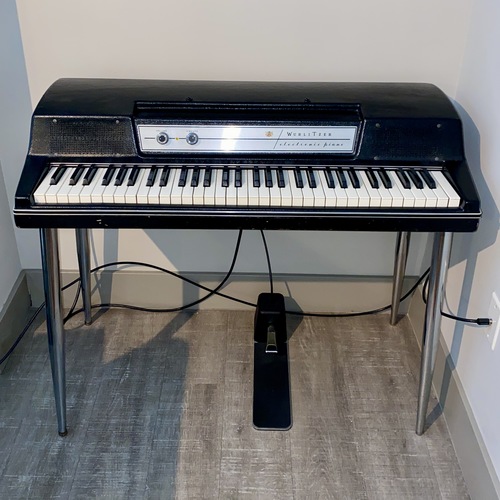
The Wurlitzer electric piano, particularly the 200 and 200A models, became one of the most recognizable keyboard sounds in popular music. Its tone is sharper and punchier than the Rhodes, often described as having a distinctive "bark" when played aggressively. Ray Charles brought the instrument into the mainstream on "What'd I Say" in 1959. Supertramp built their signature sound around paired Wurlitzer 200s, with both Roger Hodgson and Rick Davies playing them simultaneously on tracks like "The Logical Song" and "Dreamer." The instrument appears on recordings by Queen, Pink Floyd, Elton John, Steely Dan, Norah Jones, Donny Hathaway, and Joni Mitchell, among many others. Spooner Oldham played a Wurlitzer 140B on Aretha Franklin's "I Never Loved a Man (The Way I Love You)," and Joe Zawinul used one on the jazz standard "Mercy, Mercy, Mercy."
After changing hands through Baldwin Piano Company and Gibson Brands, the Wurlitzer brand rights were reacquired by the original Wurlitzer family. The brand's product portfolio includes jukeboxes — produced in partnership with British manufacturer Sound Leisure — and the officially endorsed Wurlitzer by Rhodes virtual instrument plugin, a software recreation of the classic 200A electric piano.
Wurlitzer has 41 products cataloged on Equipboard, including Vintage & Electric Pianos, Organs, and Upright Pianos. Their gear is featured by 196 artists, with the strongest followings in Rock, Pop, and Electronic. Notable users include Damon Albarn, Cory Henry, and Benmont Tench. Wurlitzer's catalog spans the full price spectrum — from entry-level options to high-end flagships.
Artists Who Use Wurlitzer


.jpg?v=1784895999)


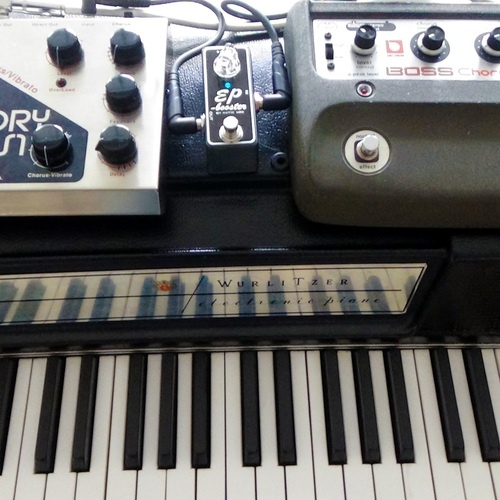
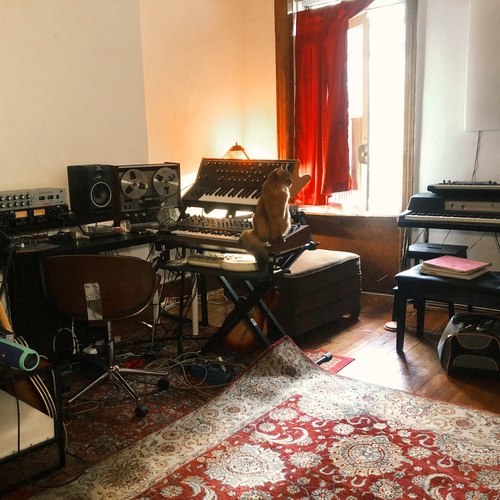
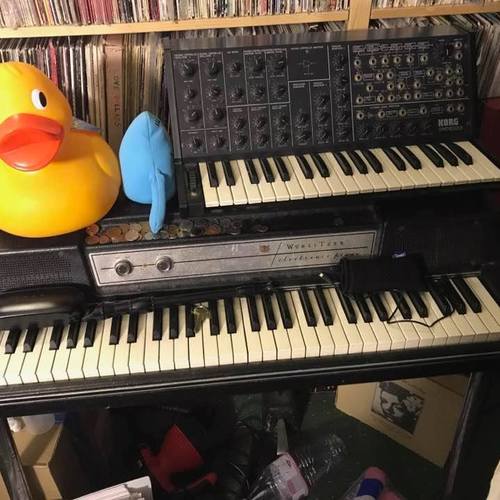
Community setups featuring Wurlitzer
Show yours



Are you on the Wurlitzer team?
- Be the first to know when an artist is spotted using Wurlitzer gear
- Curate the Wurlitzer catalog, images, and product details
- Respond to community photos and reviews of Wurlitzer gear
- See how Wurlitzer gear is trending on Equipboard