
moogbadger's Reviews
73 reviews Back to moogbadger's Equipboard

3982
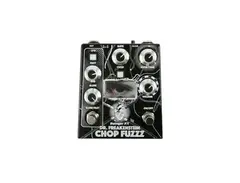
Incredible Fuzzz pedal!
This is an extraordinary fuzz pedal, it’s quite unique.
It’s hard to describe exactly, like many David Rainger creations.
There have been many versions of the Dr Freakenstein fuzz. This is the latest version as of 2026. The fuzz - which I can only describe as the heaviest Tonebender-like gated fuzz I’ve ever heard - can’t be turned down, or blended with a dry level. It’s fixed, apart from its volume, which can go incredibly loud. Its tonality can be controlled, using an overtone knob. The overtone knob is like a low-pass resonant filter on a synth, with a definite resonant peak (it’s not just a low-pass, there’s a definite resonance spike). To the left is a bank of knobs and switches controlling the LFO. The LFO can be switched on or off, and it introduces a sweeping phase-shifting effect. There’s a toggle for this which can be used to set the rate of this phase shift cycle, and two knobs above it control the speed. ‘Slow’ moves the phase from a gentle sweep to a fairly fast wobble. The ‘fast’ knob takes the modulation into the audio range; in other words, it adds an additional note to your tone, much like a ring modulator. The LFO can be manipulated at the same time as the overtone knob, to produce some truly stunning fuzzed-out synth effects.
Finally, in the middle, there’s a simple ‘chop’ switch, which introduces a 100% wet square wave tremolo effect (think ‘Spacemen 3’), with a wide-ranging rate control.
The pedal comes supplied in a dayglo 1970s ‘Clockwork Orange’ glam-rock box! Indeed, the whole pedal is sort of reminiscent of some of the more ‘out there’ phase-shifted fuzz effects you heard on the more adventurous glam rock and punk records in the 1970s. It’s fabulous! The pedal also comes with Rainger’s pressure-sensitive ‘Igor’ expression switch, which can be hooked up to remotely control either the resonant filter overtone, or the tremolo. An external CV signal can be used to control the range of the LFO. There’s also a ‘Hi/lo’ switch at the back which can control the overtone range and intensity.
It’s a remarkable fuzz pedal, capable of some truly ferocious, vicious and punky sci-fi synth guitar madness. If you’re after a transparent overdrive, you’re probably in the wrong place here. If you’re a Sigue Sigue Sputnik fan, however, you’ll be thrilled! I love it. I’ve not tried it with a delay yet, but I’m anticipating the results being thrilling, and I can imagine it multitracking very well indeed.
3982
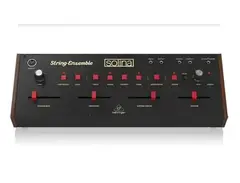
Very accurate!
Behringer says:
‘ This synthesizer is more than a nod to the past; it's a bridge to new sonic adventures. With its classic design and modern enhancements, the Behringer Solina is a must-have for those seeking to blend vintage warmth with current innovation.’
I can’t say I agree with this! Ok, so Behringer’s carbon copy clone of the Eminent / ARP Solina string machine might have MIDI, but, apart from that, this is a straight-up, VERY accurate clone of the same machine you’d have found gracing the keyboardist’s set-up in a 1975 prog band.
There’s something to be said for having access to the original analogue sound for this classic string machine. Don’t get me wrong, G Force did a great job with their Virtual String Machine VST, but nothing quite comes close to the fizzing, slightly wonky raspy crustiness of the true analogue instrument (especially in the lower registers which use the cello).
There’s not much to say, really, here? It’s an almost indistinguishable clone. It’s also very limited - it’s a replica of ONE single string machine. If you love this sound - which, fortunately, I do - you’ll love this. If you don’t, you’ll be left scratching your head. Each of the ‘instruments’ is a very simple electronic wave (some kind of sawtooth). The waves only really come to life when put through the BBD chorus ensemble, which gives ‘that’ sound. The sound you can hear on Bowie’s ‘Low’, numerous Cure songs (Inbetween Days, Just Like Heaven, most of ‘Disintegration’), Floyd’s ‘Dogs’, Air’s ‘Moon Safari’. It’s also worth considering if you’re a Joy Division fan, as they used an ARP Omni 2, and the strings from the Omni are very close sonically to the Solina - so you’re getting close to the pad sounds on ‘Atmosphere’, ‘Decades’ from ‘Closer’, or the keyboard part of ‘Love Will Tear Us Apart’.
Dedicated string machines are often overlooked these days. Basically, these ancient machines were what rock and pop keyboardists used to use for pad sounds before the first polyphonic synths such as the Prophet 5 arrived. As such, they all evoke a nostalgia for the 1970s. They won’t necessarily make all that much sense to younger players, unless they’re fans of the bands and acts who made use of the Solina and other string machines in the mid-late 1970s.
Polyphony is very large and there’s an added phase shifting effect, based on the EHX Small Stone (think Jean Michel Jarre). All the limitations of the original machine are included too - the cello and contrabass only appear in the lower registers of your MIDI keyboard.
It’s worth noting that the original ARP Solinas are now on the market at about £1500, so the Behringer clone really does make sense. It’s literally 1/10 of the second-hand price for a vintage original. It’s basically a no-brainer, unless you like collecting antiques or you’re a museum curator.
3982
A fun compromise
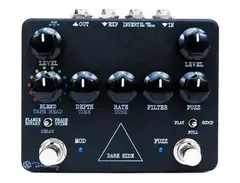
This, the Keeley Dark Side (if you haven’t guessed from the title) is a multieffects pedal which seeks to help you get close to the 1970s David Gilmour tones in one convenient format.
First of all, let’s be clear: this pedal gives you a ‘flavour’ of those 1970s Floyd guitar tones. I don’t think Robert Keeley intended it to be the last word in sonic accuracy, and, having owned and played this pedal extensively for about three years, I can confirm that more ‘authentic’ tones are obtainable from buying separate pedals. There are far more accurate Binson simulators, uni-vibes, flangers, rotary speaker sims and fuzzes out there, if you’re absolutely hell-bent on recreating David’s pedal sounds down to the last letter.
The right-hand side of the pedal is dedicated to analogue fuzz, which Keeley has based on a 1977 op-amp fuzz. It has three modes - full, scooped and flat. They all sound fantastic. But they don’t sound exactly like any of the fuzz pedals Gilmour has actually used in his career, however. They just sound ‘a bit Gilmoury’. In other words, if you absolutely must have the exact fuzz sound of Pompeii, you’d probably get an Analog Man Sun Face. If you absolutely must have The Wall fuzz sound, you’d get the EHX Ram’s Head reissue. But that’s missing the point - the fuzz is more of a generic ‘Gilmour fuzz’. It’s crunchy and it packs loads of gain, but it never gets woolly or muffled. It captures the essence of his distortion sounds.
On the left-hand side, we have controls for the delay and the modulation. Here’s the kicker, and the most frustrating aspect of the pedal: you can’t have delay and modulation active at the same time. The delay and mod obviously share the same chip. So, it’s one or the other, which is a real shame. It means you have to supply your own separate delay pedal if you want to use the modulations with delay! You can have fuzz with delay, or fuzz with modulation, but not all three and not modulation and delay. This means that the Dark Side is not, and can never be, a ‘one stop’ solution for every possibility. If you’re in a covers band and you’re doing say, ‘Run Like Hell’, you could use the drum delay circuit from the Dark Side, but it doesn’t sound right without the flanger, so you’d have to supply your own. Or vice-versa (you could use the flanger on the Dark Side and bring your own delay).
The delay side (toggle in middle position) is very detailed and contains 12 rhythmic patterns, which are meant to represent all the tape head combinations of a Binson Echorec. The timings are well thought out, but the overall delay timbre is, to my mind, far too clean to be a tribute to the tonal character of the Binson - it needs more instability and ‘flutter’. Combined with the fuzz though, it will pass in a live situation.
Switch the toggle and you can access, on the left hand side, a flanger which becomes a rotary speaker effect, and, on the right-hand side of the toggle, a phaser which becomes a univibe.
The flanger isn’t a goth flanger with tonnes of jet plane feedback. In this sense, it’s more appropriately calibrated so that it sounds like the more chorus-ey flanger sounds Gilmour favoured from his EHX Electric Mistress from ‘Animals’ through to ‘The Wall’. It works quite well, but to be honest, it is a chorus, really! Likewise, the rotary speaker effect too, is pretty much a watery chorus sound. It’s very pretty, and I think the idea was to replicate the way David used the Yamaha RA200 or Leslie 147, which he utilised more as a slow-sweeping ‘always on’ chorus. It’s probably the least accurate of the modulations here - it doesn’t really get all that close to the Leslie sounds of Dark Side. It sounds at its best on faster settings, and might just work for ‘Any Colour You Like’, but on slower speeds it really does just sound like a warbly chorus.
The phaser is quite a convincing take on the Phase 90 and the uni-vibe works well too, with a more pronounced ‘throb’ that you’d associate with the Shin-ei. It wouldn’t convince a purist though, and when I compare it to even the digital TC Electronics Viscous Vibe, it seems less accurate. But it’s not too bad, and, again, the phaser and the vibe do benefit when they’re paired up with the fuzz on its lowest gain setting.
A switch on top of the pedal lets you change the order, so you can have fuzz into modulation, or modulation into fuzz, which opens up more possibilities. There’s also an expression input.
I think it’s best of you approach the Keeley Dark Side not as the ‘last word’ in sonic accuracy for David’s tones, and think of it more as a kind of ‘1970s guitar sounds’ multieffects pedal. It will get you into Gilmour territory, without sounding exactly like the gear he used. And furthermore, you can have a mix of modulations, so you can have a flanger with a hint of Leslie, or a phase with a hint of univibe. As such, if you think of it more as being a pedal which is a tribute to 1970s guitar effects in general, then the Dark Side becomes a uniquely useful Swiss Army knife for anyone who loves those 1970s tones. If you’re in a Floyd tribute band and you’d like to keep things simple, the Dark Side could be paired with say, the Catalinbread Echorec and an MXR Dynacomp, and the audience wouldn’t have any grounds for complaint at all (after all, the chances of the keyboard player having a genuine Synthi A, or a bank of perfectly tuned wineglasses at their disposal is very low too!). What the Keeley Dark Side gives you is a very convenient and handy ‘essence’ of the 1970s Floyd guitar experience. If you’re on a budget, it’s a very effective way to get reasonably close to those iconic tones (the Dark Side is pricey, but nowhere near as pricey as buying seven vintage or ‘authentic’ single pedals!).
Keeley’s ‘Loomer’ pedal (which I will review later) is an attempt to capture early 90s shoegaze tones in a single box. I have to say, in my humble opinion, the Dark Side fulfils its brief much more effectively than the Loomer. But more of that anon.
Above all, remember that you can’t have delay and modulation at the same time, so whatever you do, please don’t buy one thinking you can!
3982
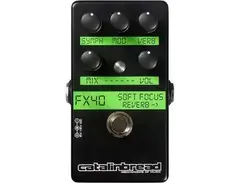
Early Slowdive in a box - but that’s all it is!
The Catalinbread FX40 is a very specialised reverb pedal with one aim in life - to accurately reproduce the sound of Slowdive circa 1993. As such, it does that extremely well. It’s been designed to basically mimic the ‘Soft Focus’ patch on the Yamaha FX500 which was reportedly used by many of the original ‘Thames Valley’ shoegazers of the early 90s, most notably, Slowdive, especially on their second record, ‘Souvlaki’. Mix and Volume are pretty self-explanatory, and the Volume goes way past Unity, adding some clean heft to the sound. Reverb sets the reverb time, and Modulation and ‘Symphonic’ controls add the flangey chorus swirl (and also the ‘shimmer’) which turns this into a proper shoegazing delight. Yes, you can turn off the modulation and use it just as a reverb if you wish. But frankly, don’t bother - it doesn’t exactly excite as a standard reverb. It’s meant to be dimed with everything flat out on max to get ‘that’ sound.
Versatile it isn’t, that’s for certain, but it’s definitely ‘Slowdive in a box’. Keeley’s Loomer pedal contains a similar preset, but this seems to be a richer and more successful take on it. Bring your own overdrive and delay and you’re all set for some nostalgic fun.
3982
Excellent value for money
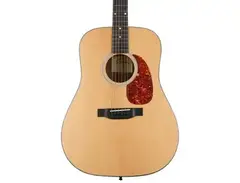
The humble acoustic guitar is actually quite a complex beast - so many factors influence the way each and every guitar sounds, from the bracing inside the body, to the material that the nut/saddle/bridge is made from, to the types of wood used for the top.
However, one thing that acoustic players do definitely seem to be unanimous on is this: if you’re in any way serious about the tone of your acoustic guitar, you should look for a guitar that is made entirely from solid wood. Cheaper budget acoustics have improved enormously since the 1970s/80s, and most these days will have at least a solid top (usually Sitka spruce). In terms of how the guitar projects, the top material is the most important component, and a laminated top acoustic, especially a young one, will almost always have that tell-tale ‘cardboard box’ tone: thin, lacking bass and projection, and lacking in harmonic texture. However, if only the back and sides are laminated, this too reduces the richness of the sound quite considerably. The difference can be quite subtle, especially in older guitars, which tend to mellow as they age, but even newer players will be able to tell the difference between an all-solid and part-laminated acoustic when played side by side. The solid guitar will have a depth, richness, and a sort of ‘three dimensional’ quality, it will speak more clearly, and it will, in short, sound more like an acoustic guitar.
The problem: solid body acoustics are expensive. Everything seems more expensive these days, but to be honest, you’ll be hard pressed to find an all-solid wood acoustic for less than about £800 at least. Most of the major manufacturers (Martin, Taylor) don’t start offering all-solid acoustics until you hit the £1000 mark, or nearby.
That’s why this no-frills dreadnought from Eastman is such a revelation. What we have here is an extremely well-built, all-solid wood guitar for under £600. Given that it also has a bone nut and saddle, excellent ‘gear’ tuners, a clean ebony fretboard, and selected sitka and sapele tonewoods - features you’d expect to see on a guitar at three, four times the price - this is astonishing value for money. And it sounds wonderful; it compares favourably to almost any Martin or Taylor. The instrument is very plainly, but tastefully finished; it’s an open-pore satin, so you won’t find any shiny lacquer here. This also seems to help the guitar ‘breathe’ naturally. It’s dynamically responsive, and can go from delicate fingerpicking to huge piano-like chords - an impressive range. It’s just a lovely-sounding guitar. The intonation is spot on and the neck is quite comfortable. The factory action is slightly higher than I’d like, but I think this is easily adjusted by a luthier (and going from 12s to 10s will make the guitar less fatiguing to play too).
Martin and Taylor dominate the market. There’s little doubt that their legendary, high-end guitars sound marvellous, and they’re famous for a reason. But consider this: for the price of the Eastman E1D, all Martin can offer you at this point is a guitar with High Pressure Laminate sides; a guitar on which they’ve actually tried to disguise the plywood back and sides by scanning a real wood texture and laser-printing this on to the guitar. That’s what £600 from Martin will buy you. I’d love a Martin D-35, as that’s what Gilmour used on ‘Wish You Were Here’. The problem is, I don’t have £3,400 to spend on a basic acoustic six-string dreadnought.
Many are put off by the fact that Eastman are a Chinese manufacturer, based in Beijing. When you look into the company, you realise that it’s a family business with many years of experience of building mandolins. The staff are skilled handcraftsmen and women who take pride in their work, and they seem to be well-treated. Buying Chinese doesn’t have to mean buying unethically.
I cannot recommend this guitar highly enough. Essentially, the Martin or Taylor tone is within reach for mere mortals here, leaving you £2,800 better-off than you would have been. Ok, so the E1D doesn’t quite sound as nice as a Martin D-35. But it’s very much in the same general sonic space! That’s incredible value for money, especially when you consider that the tone of the instrument will also improve with age and playing. For context, the E1D sounds nicer even than my Takamine TAN15c, a custom workshop Japanese acoustic. My budget Epiphone doesn’t even really sound like a guitar compared to this, the difference in sound quality, volume and ‘voice’ is huge.
3982
It’s the archetypal chorus
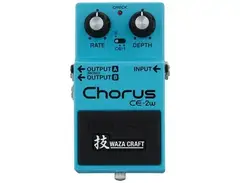
If you ask almost any guitarist - and especially guitarists of a certain age (cough) - to imagine a chorus effect, THIS is the sound they will bring to mind. It’s the archetypal Roland/Boss chorus effect, made legendary and burned indelibly into pop music history. It’s there in the jangly twinkle of Johnny Marr’s arpeggios, it’s the breezy open chords of Chrissie Hynde’s early Pretenders, it’s Robert Smith’s basic Jazzmaster tone on ‘17 Seconds’, it’s the basis of so many indie, dream pop and new wave guitar sounds. It’s the sound of ‘Echo Beach’ by Martha and the Muffins!
Nearly 10 years ago, Boss decided to accurately reissue the CE-2 chorus pedal, and whilst there, they took the opportunity to throw in a CE-1 emulation too. Lots of you will be familiar with the history of chorus, so I won’t labour the point. Initially it was a major feature of the Roland Jazz Chorus amp, the JC120. Boss discovered that players loved the effect so much that they built it as a standalone unit, the CE-1. A couple of years later, they shrank the essence of the CE-1 into the compact CE-2. In truth, the big old CE-1 can get crazy, especially with the vibrato (check out ‘Christine’ by the House of Love to hear the CE-1 in full weird warbly psychedelia mode), something that the much simpler CE-2 wasn’t capable of. If anything, Boss have made the CE-2 emulation in the Waza just a little bit ‘too’ polite and demure. It sounds lovely, but I do seem to remember it being a little deeper and lusher. Not to worry, the CE-1 and vibrato settings make up for this - a gorgeously deep analogue chorus comes tumbling out then. It’s still not a ‘true’ CE-1 emulation because you’re missing the preamp stage of the original, but I believe Boss has now brought out another stompbox with the CE-1 pre-amp emulated as a stand-alone effect.
I feel like I’ve come full circle. My very first pedal was a DOD FX65, way back in 1987 (thanks dad!). This was basically a clone of the CE-2. For some reason, I then went off on a voyage of discovery, encountering all manner of digital chorus units throughout the 90s and 2000s. You have to try these things, but, to be honest, you can’t best analogue chorus. There’s nothing ‘wrong’ with the chorus models in say, the Line 6 HX Stomp - but they can’t hold a candle to analogue chorus, and once you’ve experienced the immersive warm power of the ‘real’ thing, it’s very hard to go back.
Cons? Yes, just a couple. Bucket Brigade chorus will always be noisier than a digital model, it’s just the nature of the beast. But that’s actually part of its charm, in a way. Also, be aware that this is a very expensive pedal, built in Japan. It IS costly, but, depending on your needs, it’s possible that you may never need to buy another chorus ever again. You might though: the CE-2 Waza has ‘that’ Roland sound, and you are stuck with it. You can’t make it sound like Peter Hook or Kurt Cobain. If that’s your thing, I suggest you investigate some amazing ‘homage to EHX’ pedals by the builder PastFX (who incidentally have their own take on the CE-1, for a price). You may also be on the lookout for a chorus effect that flirts with flanging or delay, in which case there are options for you from Earthquaker, Walrus Audio, Dreadbox and so on. But this is the ‘archetypal’ stereo chorus effect that guitarists have used in lashings since the late 1970s - look no further.
Quick tip for you: can’t afford a Juno 60? Not to worry, just put your Yamaha Reface CS string patch through the Boss CE-2W and you might fool someone! The ‘Juno’ chorus - the ‘best’ bit of the Juno for some - is basically just the Roland chorus, which is what this is.
3982
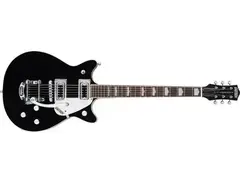
Not too bad, it’s a budget guitar and feels slightly better than one.
Pros: looks good, surprisingly well-made, Filtertron pickups sound chunky and clear
Cons: Factory set up is well-intonated, but the strings feel really ‘tight’ and the guitar goes out of tune very easily, will require work at the luthier’s to get it to play comfortably, access to higher frets is impeded by the design of the guitar. The Bigsby copy bridge is also not too good for tuning stability.
3982
Let the Haters Hate. Let them eat Hate...
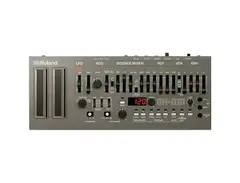
It's perhaps something of a reflection on the poor state of internet discourse when Gordon Reid, a man who's been playing synths for 40 years and writing very eloquently about them for almost as long, has to say:
'So here’s the bottom line... I know that I’m going to get torn to shreds by some readers for writing this but, if I overlooked the inevitable aliasing at the highest pitches, I was usually able to make the two synths sound indistinguishable from one another. From the simplest leads and basses, to orchestral sounds, to more complex sounds and effects, the SH-01A handled almost everything that my SH-101 could throw at it.' https://www.soundonsound.com/reviews/roland-sh-01a
Now, I may not be as experienced or as distinguished as Mr Reid, but I bought my SH-101 in 1998, so it's fair to say that I know this synth pretty well. And guess what? The boutique version sounds pretty damn close. Maybe lacking a tiny indefinable something in the 'organic warmth' department, perhaps? But part of me thinks that this elusive warmth is actually just caused by ageing resistors and capacitors, and that actually, this is what the SH-101 sounded like in 1982. It certainly sounds a lot better than my old SH-101 currently does, with its 60 Hz hum, hiss, tuning issues, crackling (and sometimes failing altogether) pots, and the boutique's tough metal top panel is obviously in much better nick than the original's cracked, dirty and stained plastic carriage - and broken keys, too! It might cost a small fortune to service and repair.
Furthermore, my SH-101 will never let me program a 16 step pattern with 4 voices of polyphony on every single step, create unison 4-voice patches, or create chords. It'll never produce Juno-like pads which sound gorgeous through delay and reverb when I tweak the PWM.
'But Bro, it's not analogue!'. No, no it isn't. And I'm starting to think I don't care when it sounds as good as this.
Downsides? Well, yes. No keyboard, bring your own. No proper power supply, and the USB power jack input is far from ideal. No CV in, which is a tragic oversight. The sliders are small and fiddly. And I've had preferred real wheels to the ribbon sliders, which don't seem to work all that well,
Maybe the true analogue power of the SH-101 would win in a live situation. But I'm almost certainly never going to take this unit out live, and once it's in your DAW, in a mix, I'd challenge anyone to tell the difference. Honestly.

3982
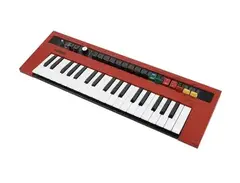
Can only be described as 'an organ'.
In 2015, Yamaha created the Reface range of pint-sized keyboards. There were four, and each one tried to capture the essence of classic instruments in a diminutive form. The CP covered electromechanical pianos, the DX covered FM and the DX7, the CS covered virtual analogue synthesis, and this, the YC, is an attempt to shrink those classic tonewheel and reed organs down to size.
It's very simple - you get a Hammond, a Vox Continental, a Farfisa, an Ace Tone (i.e. Roland before they were Roland) organ, and a shot at Yamaha's own YC-10, which had a striking red tolex livery (it's still used today by psych bands such as Bitchin' Bajas). Perhaps in a nod to that, the tough plastic casing of the YC is also finished in a striking 'Racy Red', making it arguably the most striking and attractive in the range. The control panels are basic, accessible and immediate. You get master volume, octave switch (5 switches over 37 keys, so, pretty wide), model select, vibrato/chorus with depth control, two types of percussion - not drum sounds, more like short pitched notes on a synth with the sustain turned all the way down and a fast decay and release - there is a 'length' control to determine release), and two effects - distortion and reverb. There's also a rotary speaker emulation that can be applied to all models, and this offers four states - off, stop, slow and fast, with a toggle switch. Tonal shaping is, thrillingly, driven by no less than nine mini-drawbars for some primitive added synthesis fun!
So - it doesn't sound like a lot, but when you combine all these possibilities together - the models, the drawbars, the effects and the rotary cabinet - hundreds of permutations are actually possible.
The models themselves are pretty sonically accurate. You can get some great 'Dark Side of The Moon' organ tones using the Hammond. The Farfisa is great for early Pink Floyd (think Piper or Echoes). The Vox is a bit weaker - it's harder to dial in that truly trashy garage rock sound, even with the distortion added. The Ace Tone almost sounds like a synth, and the YC has the same vibe. Of course, in a small digital modelling synth, you're never going to get the mojo of the original instruments, but these sounds are authentic enough to sit in a mix, and certainly good enough for gigging.
Here are the downsides (IMHO): the keys are too small, the vibrato/chorus section is poor (there's basically no difference between the two), the distortion effect is good at low settings but begins to sound pretty grim when it's fully cranked, and the MIDI output socket is weird, needing a breakout cable which you might easily lose. I would have also liked a sort of 'hold' function, but I suppose that would have detracted from the spirit of recreating the original instruments. The rotary effect sounds excellent! Really nice, but it would have been even better if you had more control over the ramping times, or maybe a way of controlling this with an expression pedal. It's also a bit fiddly to change it when you're playing big chords with two hands, which is where a hold section would have come in handy. The reverb is lovely, and really brings the tones to life. The percussion section is also a great feature once you work out that it can be used make the sounds of say, the ethereal plinky organ parts on the Doors 'Waiting For The Sun'. There's no delay effect - if they could have built a Binson Echorec emulation in, that would have been fantastic for 'Piper' -era tones, but I suppose that's what pedals are for, right?
So overall, if you're wanting a Stereolab / Doors / Velvet Underground / Early Floyd vibe, and you don't want to hulk a 300lb behemoth to gigs, you could do a lot worse than this.
3982
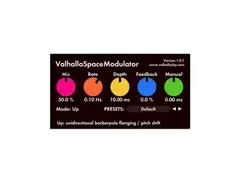
Nice freebie modulation plug in
Valhalla DSP have been know to give these away as a bonus plug-in if you buy one of their marked up ones. It's simple, but I'm finding it useful for shimmery slow flanging sweeps. What makes it really useful is the number of modes available - up, down, through zero, 360 ensemble, symphonic - there are 11 in total.
-s.webp?v=1784180498)
3982
Great source of vintage sounds
This little keyboard has really impressed me. It's part of the Yamaha Reface line of single-purpose keyboards released in 2015, along with the DX, the YC and the CS. This one - the CP - exclusively models the old electromechanical keyboards so familiar from countless records by Floyd, Miles Davis, Mahavishnu Orchestra, Supertramp, etc etc.
You get a Fender Rhodes Mark 1 and 11 emulation, a Wurlitzer EP-200, a Hohner clavinet, a toy piano, and Yamaha's own CP electromechanical piano. I got it mainly for the Mark 1 Rhodes emulation, and it doesn't disappoint. It obviously doesn't quite have the mojo of a real Rhodes, but it sounds quite authentic. The Rhodes mark II is for you Chicago fans out there - I've never liked it, but it's there if you want it...The Wurli is pretty good if a bit polite, but you can sort that by bringing in a bit of grunge via the dedicated overdrive knob. The Clavi is less good - it sounds a bit plastic and honky, but it might pass in a mix. The toy piano might be useful if you're into sound design, and the CP piano emulation is great for capturing those early 80s Peter Gabriel tones.
Where it really wins though are the included effects, each with a dedicated knob. You get dirt (overdrive), tremolo/pan (depending on which model you've selected), a very authentic-sounding 4-stage phaser, a chorus (which works particular magic on the CP model - with a fast rate and high depth, you're into 'Ashes to Ashes' territory), digital and analog delay (the latter sounding more like a decent tape delay, which can self-oscillate. The digital delay can repeat indefinitely too at the highest feedback levels, creating a little sound-on-sound effect), an auto-wah (needs tweaking to find the sweet spot, as they all do) and a surprisingly cool and clean reverb to bring all the sounds to life and give them a sense of space.
All the controls are laid out in a WYSIWYG sort of way, so it's incredibly immediate, great for sketching out ideas.
There's a couple of downsides. The tiny keys are touch-sensitive (you can make the Rhodes and Wurli 'bark' in a satisfying way), but they're a bugger to hit accurately. They feel ok - quite good actually - but there's no denying that you'd be better off plugging a bigger controller keyboard into this to get the most out of it. Which brings me to the second point, which is that there's only a MIDI breakout cable rather than dedicated MIDI in and outs, which means you have to look after the breakout cable or you're stuffed. You'll also have to buy your own sustain pedal, as it's not included (and you will need it to get a really authentic Rhodes experience).
But these are fairly minor quibbles. This thing is ace, and it's a joy to get access to these old sounds in such a straightforward way. Recommended.
Oh yes; nearly forgot! There's a hidden acoustic piano. It's not the best, but it's useable, You can find it by turning the model knob selector in between any two models before powering on. You lose it again as soon as you go to one of the official models however, and the only way to get it back iis to power down and repeat the trick. I think this must be some sort of OS bug that a Yamaha employee 'accidentally' left in, perhaps because he/she felt that the toy piano was a bit of a useless preset (which it is, to be frank) and wanted to compensate us...
3982
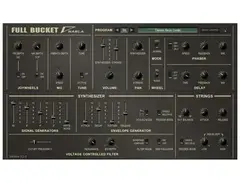
Korg Delta Emulator
Sometimes it astonishes me how some developers produce lovely synths for free or donation. This is a fairly 'authentic' and vibey sounding emulation of the Korg Delta, a key instrument on the Human League's 'Dare' album. I'll investigate more Full Bucket stuff now. I can't believe it's free.
3982
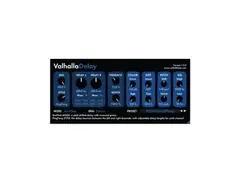
Valhalla have done it again.
Valhalla dsp (Sean Costello) have built a steady following over the last ten years; people seem to like the company ethos: keep prices affordable and standardised, and deliver intuitive and user-friendly, non-skeuomorphic interfaces on which every knob and slider does exactly what it says it's going to do.
As a result, just about every tech-minded band interviewed these days seems to have one or more of the Valhalla reverbs installed on their hard drive. Although Valhalla has flirted with delay before, this is their first dedicated professional-level multifunction delay plug in. And it's a winner. It covers just about every 'normal' thing you're ever likely to want to do with a delay plug in, and then offers a few more esoteric treatments too. The sound quality is fantastic throughout, and what the interface lacks in glamour, it makes up for in terms of ease-of use and clarity.
It has seven different delay modes. The first four cover all 'normal' delay duties: Tape (Echoplex), BBD (Boss DM-2), Hi-Fi (1/4 inch tape delay, like they used in the 70s) and 'Digital'. Three more modes - Ghost, Pitch and Reverse Pitch - handle the weirder stuff. Parameters available within each of these modes are carefully selected to be suitable for each; so, for example in tape mode, wow and flutter are available, and in digital mode, modulation rate and depth are offered. Ghost mode offers frequency shifting, and the pitch modes give you pitch in semitones. The delay time can be adjusted between 0 ms and 20 seconds, and all modes have a lovely 'Diffusion' effect, which smooths the attack of the delays to give smearing and reverb-like tones. Three 'Eras' are available for all delays - past, present and future, with brightness increasing, and an 'Age' control adjusts the amount of artifacts in the delays. The syncing options are comprehensive - straight, dotted and triplets, and 'Styles' controls the number of delay lines - Single, Dual, Ratio, Ping-Pong and Quad. Most modes have a stereo spread control that adds real depth.
Just about the only thing missing, really, is some sort of resonant filter in the delay signal path. But apart from that, this plug-in should take care of 90% of your everyday delay needs. It's only $50, too.
3982
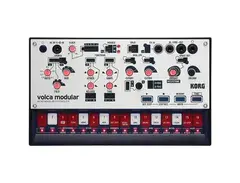
It's a Tiny Buchla Music Easel. Sort of.
I'd like to be able to write a proper, informed review of this. But I can't, and I suspect it's because I'm not intelligent enough to understand West Coast synthesis. You turn a knob and it adds harmonics to the simple triangle wave...ok, got that bit....but now...if you plug this into here...it...why is it doing that? What's a low pass gate? Argh....now it's making Saul Bass Phase IV noises...like a bathtub full of ants...
I'll do a proper review in due course when I've learned what it all means. It's fun, anyway, and it's given me a newfound increased respect for Suzanne Ciani. Incidentally, despite the low cost, that's what this sounds like: like some of the stuff I've heard of Suzanne's from the early 1970s. Good stuff, Korg.
41016
I feel ya. I've been eyeing this guy since it came out but I'm sort of afraid of buchla type stuff and generally feel suspicious of so-called generative music. I know people can make music that way and still be composers, but I can't see myself pulling it off right now.... maybe once I eek every last sound out of my neutron
41016
and what's with the microscopic patch points? does it use proprietary cables? I only see a single 3.5mm jack for CV from a sequencer or another synthesizer....
3982
It's incredibly fiddly, yes...no MIDI, just CV...tiny little cables, which you get a heap of, but once you've inserted more than three, it gets very cluttered, unless you've got the fingers of a nine year old girl! The good news is that it's semi-modular, so you can start sequencing straight away with the basic triangle - I've just been running this though reverb (it has a ghostly spring emulation of its own which is characterful, but not very defined - I've been running it through the Eventide Blackhole for a more Hi-Fi sound) and adding/removing harmonics, and that sounds pretty good (and totally different to subtractive) in terms of instant gratification. It doesn't take much to get into 'not very musical' territory, though...I've been looking though YT for tutorials, but it seems that the best ones assume a certain amount of modular knowledge already. I'll keep persevering though, as it sounds 'different' enough to merit that. Korg have crammed quite a lot into this one - it's the most complicated Volca by far. Maybe Korg are planning something bigger based on how well this does?
41016
those fiddly cables sound like a deal breaker.... my eurorack cables are already smaller than I like and I wish the neutron took 1/4" LOL It would be cool if they tried something bigger, because the Buchla architecture sounds interesting.

3982
Nice analogue sounds.
Dreadbox might be more familiar as a manufacturer of standalone synths such as the acclaimed Erebus, and modular gear, but apparently this Greek company cut their teeth on guitar stompboxes originally, so, if his is true, this pedal sees them coming full circle, so to speak.
'Komorebi' is an Japanese word for which there is no direct translation in English, but apparently it means 'the dappled effect you get when sunlight streams through trees'(!). I don't know what that would sound like, but this is a BBD analogue chorus/flanger pedal which works with guitar, bass and synths. There are three LFO waveshapes (triangle, saw up and saw down), and four knobs - 'amount', 'static', 'feedback' and 'rate'. 'Rate' is the LFO rate, 'Static' is actually the delay time, Feedback is self-explanatory, and 'Amount' is a graduated pot rather than a binary thing. Turned more counter-clockwise, it gives you more of a chorus effect until it reaches the halfway point, and then more extreme things - based on LFO depth - start to happen from thereon in. It turns from a chorus into a flanger in a graduated way. It's typically analogue, in that each control operates over a very wide range, so turning the rate knob (or any knob) by a minuscule amount will have a huge effect on the sound: so it's a tweaker's dream, as a very wide range of sounds are possible - from simple doubling and thickening to insane, almost ring-modulated, completely atonal white noise, with 80s CE-2, rotary speaker and classic jet flanger tones sat somewhere in the middle. So far, I've only tried it with guitar, but it can be hooked up to modular gear too.
It's quite expensive! But then again, it's actually about the same price new as the BOSS CE-2 Waza Craft, so not massively so, and it's capable of a far greater range of sounds, too. It does indeed sound analogue, with none of the brittleness sometimes associated with cheaper digital choruses. Of course, this means it can get quite noisy, but arguably that's just par for the course with BBD modulation. Overall, a good-sounding analogue modulation pedal - rich, deep and rewarding. It comes with its own adaptor - 15V, so don't lose that!
3982
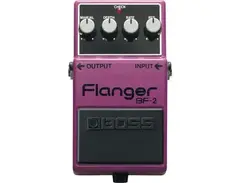
The original BOSS stompbox flanger
Yes! I finally found one in Liverpool's Curly Music for about £50. I typed the serial number into Google and apparently this one's from about 1990, Taiwanese. This is the one to get if you want those classic 80s tones - Robert Smith, Prince, Siouxie, Billy Duffy ('She Sells Sanctuary'), Cocteaus, Psychedelic Furs...Not saying the BF-3 is a bad pedal, but it's a modern digital flanger which just doesn't have the mojo of this one. The BBD chips make all the difference, especially in the feedback control - it's a flange that seems to sit with and become part of the guitar sound, rather than sitting on the top of it.
3982
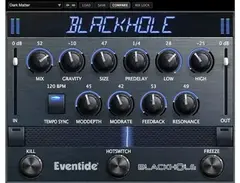
Lovely but usually overpriced.
This is a very high-quality algo reverb with some innovative performace features and controls (like 'Gravity', which seems to change the 'direction' of the reverb). However, lovely though it is, it's well worth waiting until it's on sale. It can be had for £30 or so then, in contrast to its usual price of £160. £160 is far too much to pay for what's effectively one patch from the Eventide Space or H9! It also uses the PACE iLok system for verification, which is a pain in the arse.

3982
Lovely Guitar
A lovely acoustic from the lower end of the high end of Takamines. I can see why David Gilmour went through a stage of favouring Takamines for live use. I'm not an acoustic snob (I've got a cheap Epiphone that sounds just fine to me), but I must admit that I can hear a difference with a sub-£1000 guitar; it just sounds...richer, woodier, deeper. More like an acoustic guitar, if you know what I mean? This one is all solid wood with a Cedar top, and it sounds great.
3982
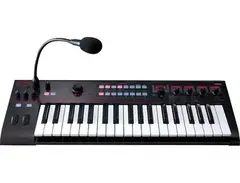
A hidden gem, with one caveat
A lot of people look at this synth and assume it's some sort of 'less successful' MicroKorg. I got it in 2007 or so when it came out, because just playing with a few presets tells you that actually, what we have here is a kind of budget Korg Radias, and it will make sounds that the MicroKorg could only dream of. It can sound superb,
So WHY, oh WHY, Korg chose to put such a powerful synth inside a such a flimsy, cheap, crappy box, the sort of build quality that wouldn't pass muster as a kid's toy, is beyond me. I mean, how much would it have taken to make the casing decent and strong? Korg killed what should have been a killer synth here. I still use it occasionally, if I can get the power cable to connect to the input jack without slipping out!
3982
Unofficial VCS3 Clone
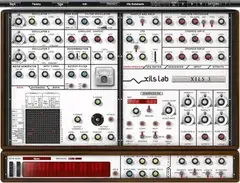
This was one of XILS Lab's first virtual analogue synths. They never specifically said, 'this is a tribute to the EMS VCS3', but just looking at it, it's pretty obvious what it's supposed to be....
The matrix will take you some time to get used to, but it's well worth it, as the sound is quite close.