
moogbadger's Reviews
73 reviews Back to moogbadger's Equipboard

3982
The Classic Analogue Delay
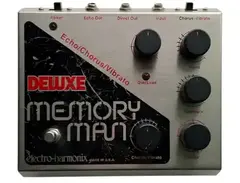
There are so many versions of EHX's Memory Man/Deluxe Memory Man that it can be a bit bewildering for the newcomer to get their head around. It's been around in some form or other since the mid to late 1970s.
Mine's a reissue from about 2006 and it's one of the last 'original chassis' jobs made by EHX before they moved into the current XO series of Memory Men. In other words, it's got a big footprint, it takes a weird power supply (24 V). I don't know what sort of chips it's got in it, but I know they're different to the ones used in the XO series, although they may also not be the most desirable and sought-after ones. I'm still researching that, and the internet is full of heresay!
It's only when you use a real analogue delay - especially one that's fairy faithful to earlier models - that you gain a new-found respect for the original users of these pedals. It's a bit like when you get a real analogue synth with no presets and realise how much work there is to do. The Memory Man doesn't spoon feed you with tap tempos or tailor-made settings banks. You get simple controls for delay time, regeneration, input to the gain stage, blend between echo and dry, and so on. A single switch changes modulation between chorus and vibrato modulation, and depth can be controlled too.
The pedal is capable of subtle, but the range offered by the knobs is immense and it's possible for things to go into science fiction territory very quickly! The regeneration control begins to self-oscillate just past the halfway mark and gets very loud, very fast! Combine this with delay time tweaking, and wild, often unpredictable laser beam siren effects come out. If you're not fast with turning down the feedback it sounds like you might blow up your pedal, or amp, or both!
The delays themselves are very rich, warm, musical, and they seem to blend with your guitar rather than sitting on top of them glassily. They actually sort of 'become' the guitar sound, if you see what I mean. It's totally, totally different to any digital delay, even ones that attempt to model analogue or tape echoes. It's hard to tame, and it feels like you're on the edge of something a bit chaotic all the time. The upside of this is that you really feel like the effect is another instrument in your hands. It's organic and it responds in an interactive way to what you put into it. It's constantly changing in subtle ways that the ear finds very pleasing. The vibrato is my favourite of the two modulations, as the chorus, when pushed, can become quite 'ill' sounding, as its rate doesn't seem to go fast enough to match the depth. Being analogue, the delay times go no further than about 500 ms, but you won't miss the longer delays here; in a sense, the pedal isn't 'for' that...it's also noisy!
If I have a criticism (and this really is me being a spoiled brat now, I'm very lucky to own such a gorgeous pedal), it's that...well, the sound is SO SIMILAR to a certain world-famous guitarist, one who made his name by playing the Memory Man as if it was a new instrument in the late 70s and early 80s (and no, I'm not talking about Andy Summers/John Martyn!) that it can be difficult, initially, to find your 'own' sound with it. It has such a strong personality that inevitably, it does lend itself to sounding a bit like that world-famous guitarist...no matter what you play...
3982
Excellent
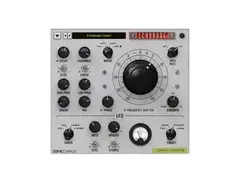
An excellent and quirky delay plug-in from Magnus at Sonic Charge. This one incorporates a Bode frequency shifer (please note: this isn't the same thing as a pitchshifter! The latter uses FFT. This is an old-school frequency shifter, similar in sound to a ring modulator). The audio is shifted and then sent to a delay. An LFO is used to modulate the delays, and the delay has an excellent 'smear' function, which can be used to give a sort of psuedo reverb effect. You can control the dry/wet mix of the plug in very easily too.
It can be useful to get an authentic 'Dr Who' vibe, and the comprehensive preset list demonstrates the full scope of the plug-in, with names like 'Swedish 1970s Television Reverb'...
It's really good fun to use.
3982
The KARP Mini-Odyssey
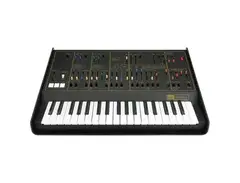
Following the massive success of Korg's reissue of its own MS20, they paired up with original ARP Odyssey designer David Friend to try to recreate the 'other' must-have monosynth from the early 1970s, the ARP Odyssey.
The ARP experience is very different to the MiniMoog experience. The MiniMoog feels smooth and luxurious and silky. The ARP feels more 'punk', and bit less user-friendly! The sliders are less predictable, the modulation routings can sometimes leave you doing some head-scratching, and you'll experience the 'it's not working! It's broken!' phenomenon a bit more with an ARP Odyssey.
But get beyond that, and what you have here is a very versatile synth which, on paper at least, makes the MiniMoog seem a bit limited. It's all here if you're into R2 D2 noises. Two independently tuneable oscillators with a choice of square and sawtooth waveforms, recreations of all three of the low-pass filter types that graced various incarnations of the Odyssey, FM, oscillator sync, sample and hold, two types of envelope generators for the amplitude envelope, ring modulation, two types of noise sources (white and pink), a comprehensive LFO with square and triangle waveshapes, a high-pass filter, and an overdrive circuit for the low-pass filter too.
There are downsides to this reissue. Some people have complained that they keys are a bit too narrow compared to the original to play fluent solos (this is an 86% scale model of the original Odyssey), and KORG have faithfully recreated the awful pressure-sensitive pitch bend button (when, to be honest, I wish they hadn't! Wheels are so much easier to use, and you have to have the biceps of Mike Tyson to push down hard enough on the pitch button to get vibrato; and when you do, you overcompensate and it's too much vibrato)...
But it's an ARP ODYSSEY! With MIDI! Get yer sequencers out for some old-school Berlin electronica fun...Tangerine Dream used ARPs on 'Rubycon', and with some tweaking, you can get close to those sounds with this beast.
So I'm not complaining...
3982
Great delays for the money
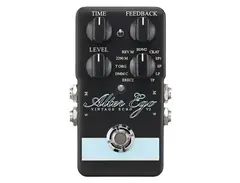
If you want that 'tape echo' sound without the hassle of actually carrying around a real Roland Space Echo/Maestro Echoplex etc., there are now several small compact digital devices on the market that will approximate the sounds for you for under £200. This is one of the better ones! You get fairly nice approximations of the mighty Binson Echorec (Floyd's magnetic 'Piper'-era echo of choice), the Maestro, the Space Echo, the EHX Deluxe Memory Man, the Watkins Copicat and so on. There's also a really nice David Lynchy Oil Can delay, the Tel Ray! Of course, purists would say that none of the simulations sound as good as the real things. They probably don't. But who wants to cart a Watkins Copicat onto a stage wet with beer and vomit, in front of 6 people, in 2017?. All I know is that the delay tails on this thing degrade and 'ghost out' nicely, losing their fidelity with each repeat very well, and the feedback can be driven into self-oscillation for all manner of psychedelic and dubby weirdness.
It's a Toneprint pedal as well, so in theory you could design your own delays for it. I don't bother...
Oh, AND it's a looper...it gives you about 20 seconds of infinite overdubbing fun!
Recommended.
The cord on the supplied wall-wart adaptor broke recently. But that's probably because I treat my pedals like shit and carry them around in a plastic bag on the train...

41016
when you're right you're right! I spent ore time servicing my chorus echo than I did using it and it regularly stopped working at gigs. I'll stick with my X4 and Alter-Ego... running into distorting british amps its all the same LOL
-s.webp?v=1784180553)
3982
Not much fun on its own, but paired up....?
It only does one thing! It does it well though. It uses granular synthesis to freeze the spectral bins of whatever you've just played, and then it plays it back to you forever in latch mode. Initially I thought, 'that's nice...but how can I actually make use of it?'. The answer for me was to get some sort of looper. Then, using the Freeze pedal, it becomes possible to build up huge layers of synth guitar, note-by-note. I think EHX actually want you to do this; they probably envisioned that players would couple this with all sorts of other effects like modulations, delays and reverbs so that we could all do Brian Eno impersonations in our bedrooms. Which, it seems, is exactly what we're doing! Of course, it works just as well with synths etc.

5453
You have any issues when you engage & it causing a tick or blip? I swapped out for a different toggle & it’s all fixed up. Eno the fuck out indeed!
3982
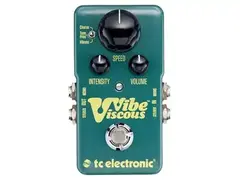
Digital will never be able to do Univibe, but this ain't bad either
The Univibe effect ('what's that?' you say. Come on , you know this...it's Hendrix's 'Star Spangled Banner', it's Gilmour's clean guitar sound on Floyd's 'Breathe') is one of the hardest to simulate digitally. I don't know why, but Roger Meyer explains it very well in a book I've got (this one: https://wordery.com/guitar-effects-pedals-dave-hunter-9781617131011?currency=GBP>rck=c1NKRVpPM3ZrdHRUb0xZWE1SUlFSblJsaXVqRnc4NjE2Tkc1bnU0bWZnMXNocS9XOXZWZkM0RkN4QkU0R3VCeHdUbUVENFFMeDA5WjhUSXU5aEJpQ3c9PQ&gclid=EAIaIQobChMIxKzKou-51QIVQr7tCh22ww2vEAQYASABEgK1SfD_BwE).
The original Univibe was based on four photoelectric cells. It was a very analogue effect. The waveforms used were always changing smoothly and interacting with each other in a complicated way, which is why it's hard to replicate using the jagged bits. Something like that, anyway! I've never had the pleasure of playing through an analogue one, as the original Roger Meyer ones and the Japanese Shin-e ones are really expensive (think £500 +). So, I'm no expert. However, to my amateur ears, it sounds as though the DSP boffins at TC have got pretty close. You can hear the classic Gilmourish sound on the 'chorale' mode, and the more subtle vibrato mode sounds ok too. This is a toneprint pedal too, meaning that if you have access to a shiny Apple tablet device you can design your own Univibe sounds on the TC software and download it into the pedal. To be honest, the supplied toneprint sound is nice enough...
I've no doubt that if I had the dosh to spend on a real optical analogue Univibe, it would sound better than this. But I don't. And even the bloke who writes and edits the 'Gilmourish' site seems to think it's an acceptable affordable way to get reasonably close to the classic Univibe sound.
http://www.gilmourish.com/?page_id=4537
3982
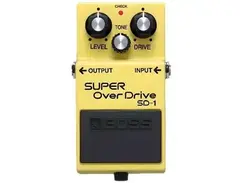
It does what it days on the tin
If you ever find yourself feeling a bit snooty about mass-produced BOSS pedals, just look at the Equipboard list of respectable musicians who've either got an SD-1 on their board right now, or have used one at some point. Was their music any the worse for this? Did you ever find yourself thinking, 'If only they'd used a boutique overdrive, I could take it more seriously?'. No, did you hell.
It's a classic for a reason. At lower drives, it adds a nice boost and a bit of crunch. At higher drives, a clean smooth controllable bit of dirt. Into an overdriven amp, it'll give you that Steve Jones chug. It does what it says. It's dead easy to use. It sounds good. And it costs less than a heavy night out.
3982
It's up to you
So - the eternal question: are you after: a) world superstardom, the invention of whole genres, groundbreaking electronic music pioneering, musical chameleonism, acting, mime artistry, art connoisseuerdom, video artist hobnobbing, internet pioneer, musical maverickdom, sex symboldom, massive critical respect and commercial success
OR
Painting the odd Royal; presenting a programme about sick animals; doing the odd cartoon; playing the didge on the wackier Kate Bush records; being a registered sex offender?
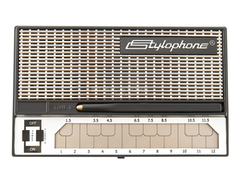
You see, as everyone knows, both David Bowie and Rolf Harris made extensive use of the Dubreq Stylophone. So, with this tool in your hands, it really is up to you. It's what you make of it, ladies and gentlemen.
Here's a tip though; DI it, whack it through some ghostly reverb, and you've got a sort of uniquely characterful 'space surf' theremin for about £20. 'What's that? A vintage synth of some sort?' people ask me. If only they knew.
3982
I'm on Max 5, but it's similar
Ah, Max. Or Max/MSP. Or Max/MSP/Jitter. Where to start?
Well, Max (we're on version 7 now, with 8 no doubt not too far away) will terrify you at least twice. It will terrify you once, right at the start, when you open it up and realise that there's nothing there. A blank slate. A total tabula rasa.
And then, when you've learned a little bit about what it's for and what it can do, it will terrify you again, as the sheer number of possibilities begin to open up in front of you. How deep does the rabbit hole go? You want to build a sequencer with just white noise for the sound source and ADSR-controlled steps with a separate filter cutoff value for each step? Sure. You want to build an xOx drum machine where the computer decides which steps will sound at any given time with the statistics controlled by a Markov table? Yep. You want to speed up an audio sample by a factor of 50 or even 500? Yep. You want to build a synth where you can draw the pitches on an LCD screen? Yep. You want to build an avant garde noise generator with 64 independently tuneable FM oscillators? Yep. You want to build a synth which combines Buchla-style wavefolding and West Coast style subtractive filters on one half of the screen and Karplus-Strong plucks on the other half? Yep. You want to run some oscillators through seven filters and six delays? Yep...
Max is an object-orientated visual programming language. It has its DNA in the MUSIC and GROOVE programs created by Max Mathews of Bell Labs in the 1960s (he who made the computer sing 'Daisy Bell'). In the 1980s it was developed by Miller Puckette and others at IRCAM at the Pompidou Centre in Paris. Initially, it was entirely information-only. MIDI and messages. Then, in about 1997, David Zicarelli added real-time DSP to the basic system of information flow, and Max/MSP was born. A bit later, video processing was possible with the arrival of Jitter.
https://en.wikipedia.org/wiki/Max_(software)
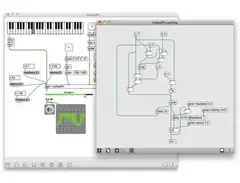
Basically, Max works like this; there are objects which can be connected together, modular-synth style, with virtual patch cords. There are audio objects - denoted by the presence of the tilde ~ - and information generating and processing objects, such as the metro object, which outputs a pulse when you give it an 'argument' in milliseconds, for example. There are message boxes and number boxes for controlling the way that other objects behave over time. Initially, it's totally baffling. Then, as more is learned, it all become clear. Or clearer. Many of the objects exist as GUIs to make them more user-friendly, such as the function object, which is a breakpoint object to help you visualise the shapes of envelopes, or the gain~ object, which when created takes on the shape of a slider on a mixing desk. Colours and shapes can all be changed. UI objects can be customised, or you can try building them from scratch in javascript or by creating them in Photoshop.
I'd start by creating some rect~ objects. Simple bandwidth limited squarewave oscillators. Then add a floating point number box to give the oscillator a frequency in Hz. Then add a gain~ object and an EZDAC so you can hear the wave. Then add another number box to control the pulse width of the wave. Good luck...
Some good books: https://www.amazon.co.uk/Electronic-Music-Sound-Design-Practice-x/dp/8890548401
These are beautiful. They explain it all far better than I ever could.
-s.webp?v=1784127448)
3982
Not just a bass machine
Yes, the SH-101 is known for bass primarily. But do some higher stuff, add a bit of the gorgeous PWM, put it through a tape delay and...bang! You've discovered the secret to the Boards of Canada sound, early Squarepusher and so on.
It's a classic for a reason. Nothing else sounds quite like it - not even Arturia's Minibrute, which I think was an attempt to get close.
41016
I always think of a Guy Called Gerald when I think of the 101, those non-303 acid lines
3982
Latest incarnation
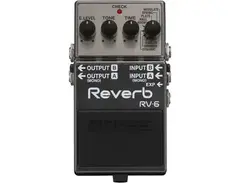
BOSS's RV-6 is the latest incarnation of their stompbox digital reverb series, which started with the RV-2 way back in the late 1980s.
This one is pretty good! This time round we get Hall, Plate and Spring, a delay/reverb setting, the gorgeous modulated delay setting has been improved in richness from the RV-5, and we also get BOSS's attempts at the now-ubiquitous 'shimmer' reverb. Which, alas, isn't the best; it's a bit harsh to be honest. But, helpfully, there is a dedicated TONE knob, and, with a bit of tweaking, that harshness can be tamed a little. Strymon and Neunaber are still the kings of shimmer, but they're expensive! This is a good compromise for the more budget-conscious.
Good old BOSS, eh? Yes. Their pedals are workmanlike, a bit generic, and, dare I say it, just a wee bit ...boring? But, you know what? They get the job done. And sometimes that's what you want.
3982
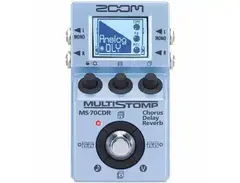
Zoom have a reputation for being a bit tacky, but this is really quite good!
This is a surprisingly good-sounding digital multieffects unit offering a range of sounds; not just the 'chorus/reverb/delay' mentioned, but other things too, like pitch-shifting, filtered delays, vinyl crackle, tremolo and triggered machine-gun delays. Effects can be strung together - up to six in theory, but more like 2 or three in practice. Where possible the DSP boffins at Zoom have attempted to recreate and model pedals from other manufacturers, so there's attempts at the BOSS CE-1, the EHX Small Clone, and some of the wackier spatial effects available on the Eventide pedals.
My first impressions are that this is a very useful pedal to have around. Ok - let's be clear. It doesn't sound as good as the dedicated standalone effects boxes it's trying to replicate. But it's not so far off as to be unusable either, and some of the effects - like the amazing 'particle reverb', with its gorgeous swelling atmosphere - are worth the asking price alone. It's a very quiet pedal, and if you pair it up with some more expensive boutique effects (I've been feeding it into pedals by Earthquaker devices and Neunaber), it can help to expand your sound considerably.
A word of warning about the 'shimmer' effect; it's horrid and metallic! Look elsewhere for that.
On the plus side, some of the modulation effects are surprisingly warm for a digital effects box. There's also lots of control parameters within the individual effects; it's great for tweaking stuff.
Once again; don't buy this thinking it's a miracle box that can replace your Strymon Blue Sky. It can't compete with that. But with prices starting at just £75 in some places, this is astonishingly good value for money.
-s.webp?v=1784180366)
3982
Does what it says on the tin!
Lovely warm analogue phase pedal that offers a nice cheap alternative to the MXR Phase 90 pedals. It's THAT sound - you know, 'Breathe' by Pink Floyd. Perhaps not quite as rich as the MXR Script reissue, but it will get you close. There's two settings, one quite subtle, one less so (more pronounced 'notch' filtering. I prefer the subtle one.
3982
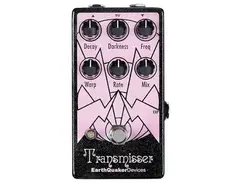
Unleash cosmic chaos with extreme reverb effects
The EQD Transmisser is a very unusual reverb capable of totally unsubtle and extreme reverb effects. Even with the reverb length set to minimum, it's still pretty long. The tone is governed by a peaky low-pass filter with a sharp Q value, which means it always seems to add some kind of dirt to the signal. It's easy to totally swamp your signal with this one, so you get more reverb than signal very quickly! If you have an expression pedal you can do dynamic filter sweeps with it. The modulation adds slow warbly weirdness or fast warbly weirdness, and at the heart of it all is an unpredictable 'Warp' control which seems to change all the parameters in one fell swoop, including the pitch. I would say it's definitely suited to psych or shoegaze type music; if you want a really clean and hi-fi reverb, look elsewhere. If you want to explore the murky depths of space, get this...
3982
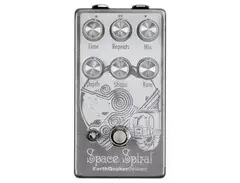
Strange and dreamy - or annoying and wobbly, depending on personal preference
EQD are becoming very well-known for handcrafting boutique pedals which offer familiar effects with a unique twist that takes them a bit beyond what you'd expect from a typical BOSS pedal.
This one's a digital delay that sounds anything BUT 'digital'! If you want super-pristine delay, look elsewhere. It's based on a lo-fi karaoke chip and is capable of up to 600 ms of delay. Its ace card is a rate and depth-adjustable modulation with triangle and square waves available. A wide range of delay effects are possible, from rotary speaker type sounds, to seasick chorus, to slapback, to full-on dub delay with self-oscillating feedback for shoegazers, to Floyd Echorec tones. With Mod depth set to full and speed set slow, you will be totally out of tune! But maybe that's what you want. For me, I love the feedback control, which can produced some very trippy - and yes, spiralling - effects. Think Slowdive's 'Souvlaki Space Station' and you'll get the idea. If you want stupidly long delays or total clarity, look elsewhere - this is a uniquely-voiced delay that you'll either love or hate.
-s.webp?v=1784185427)
3982
The were clanky and crap enough for the Beatles, so they're good enough for me, too
Yes, behold, the British invasion guitar, the one that the Beatles made cool and that Mods everywhere use. Preferably through a Vox AC30. With lots of compression.
It's clanky, it's kind of workmanlike, it jangles, it's not subtle. But if it was good enough for John Lennon, it's good enough for me. Who needs one of those Paul Reed Smith guitars? They're only for people who can actually play the guitar properly anyway! If you're at the level of clanking out chords in a ham-fisted way (see: all early Beatles, all Oasis, me), then this is the guitar for me. Sorry, I mean, you.
41016
actually I think the a30 was pretty far out of fashion in the UK when this guitar came in.... the ebatles were recording with the vox UL hybrid amps, blackface showmans, paul's blonde bassman, and a selmer treble n bass by then and I don't think Mayall who introduced them to the casino ever used voxes. Believe it or not the ac30 only appears on the first and maybe second beatles LP and the early singles.... most of their vox recordings are AC50s and 100s.
3982
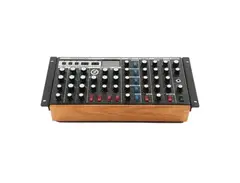
Minimoog with FM
So, why would you pay so much for an analogue monosynth with three oscillators and one filter and only a couple of LFOs?
Well, because it sounds...like THAT.
The Voyager can do FM too, taking it beyond the classic MiniMoog.

3982
Interesting, but not essential sequencer
I thought I'd take advantage of an '80% off' deal on Breaktweaker. I'd downloaded the demo and thought it looked interesting, but it's way overpriced at its usual asking fee for 200 dollars or so.
Basically, it's a drum machine and sequencer with some nice features. You get six lanes, one for each sound. There's a large sample library of 'standard' drum sounds (the usual suspects, 909-y kicks and snares, some dubsteppy things). You've got fine control over individual steps in the sequence - samples can re-pitched, distorted, filtered and so on. Additionally - and most innovatively, the individual steps can be micro-edited to a ridiculous degree. The sample is cut up into tiny granular chunks, and the individual chunks can be reordered in a variety of ways to give stutters or pitched sounds. So it's like 'step granular' synthesis. Additionally, each lane of sounds can have a different number of steps - so one lane might be 16 steps, another 5, and so on, which is good for creating unusual polyrhythms. The transport speed of each individual lane can be different too.
It's not just samples though - each lane has a synthesizer option. LFOs can be assigned to a wavetable, and so interesting blippy or Buchla-esque sequences can be built by putting a different note on each line. Synths and samples can be mixed within the lane too.
There are some problems though. It's a MIDI-triggered instrument. There is a free-flowing preview option, but it would have been nice to have a 'copy pattern to track' option, as the MIDI triggering depends upon your fingers (yes, you can quantise it afterwards; the idea is like Stutter edit, where you build loads of patterns, one on each key of your controller, and jam with them in real-time).
And it's a CPU hog. If there's too much going on, it will cause audio dropouts quite quickly.
Having said that, this is a lovely plug in for creating glitchy or quirky loops quickly. If it was just a bit cheaper, it would be better, though.
5453
Huh, second time today I heard po. Asitive stuff about this guy. Think it’s on sale currently? Thanks for the review-
3982
Quite hard to get your head around
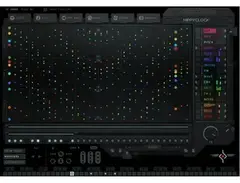
It's not very often that you open a VST, play with it for several hours, and yet still fail to understand how it operates. Let's just say that Obscurium is so feature-packed that it's difficult to know what the hell is going on with it. Forget standard GUIs - this one relies on you drawing parameter changes on a sci-fi interface. Practically everything can modulate everything else. Pretty soon the screen is undulating with wave-like oscillations and morphing between sounds. The hardest thing to get out of Obscurium is a straight bass or lead sound. It's not really 'for' that, though. It's for stumbling upon really unusual and quirky stepped polyrhythms, or chord sequences you'd never normally think of, or cyber drum loops, or complicated evolving pads.
A bit like Sonic Charges' Synplant - when you've run out of inspiration, this might be one to turn to! It's best if you just throw caution to the wind and stat turning knobs. Don't worry too much about how you might have got there.
3982
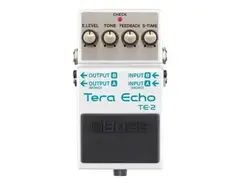
Weird
One of BOSS's more experimental stompboxes. It's hard to know what it 'is' - it seems to be a delay and filter-sweeper which responds to the dynamics of your playing. It can add a subtle wash, or it can just sound a bit over-the-top when it turns everything you do into a sort of 'laser gun' sound! It's good, but I suspect that it's more of a novelty effect for when you want something a bit off the wall; if you just want a basic delay there are plenty of those. I wouldn't recommend this as a 'main' delay pedal effect, it's too unpredictable.