
moogbadger's Reviews
73 reviews Back to moogbadger's Equipboard

3982
Very Cool Little Drum Synth
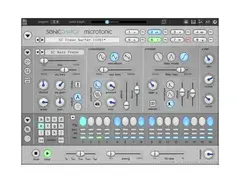
MicroTonic is about ten years old now, but that doesn't stop it from remaining one of the cheaper and best little drum-synth plug-ins you can get. There are no samples here; that's not the idea. Synthesis is the name of the game here, and each of the eight instruments have exactly the same flexible architectural starting point from which you can make an array of different percussion sounds. In simple terms, each individual percussion sound consists of a mix balance between an oscillator and a noise source. So, for example, if you were creating a kick drum, you'd probably mostly favour an oscillator-heavy mix, and if you were creating a hi-hat, you'd favour the noise source more. The oscillator can be pitched over a very wide range (and, crucially, accurately too, so that the fundamental is an actual diatonic note) with a choice of three waveforms, and it can be pitch-modulated; you can also EQ it, distort it, change its attack and release and so on. The noise source has fine envelope control, and can be filtered in low, band and hi-pass modes. The 16-step sequencer is simple but works well, and the step length can be changed, which should keep all you awkward Autechre fans happy! Over the years, a number of improvements have been made, such as a feature that lets you morph between two states, and the ability to copy MIDI to track in your DAW. Teenage Engineering have also made a pocket operator which uses Microtonic as its sound creation brain - the PO 32, which is an innovative way of liberating the sounds from the software domain. https://www.teenageengineering.com/products/po-32
But by and large it's remained the same for many years, perhaps because Magnus pretty much got it right the first time around. You can think of it as being a sort of simpler version of what the Elektron Machinedrum is, in software form (although the two sound nothing like each other). MicroTonic sounds a little like the drum sounds that Cabaret Voltaire or the early Human League used to use - think early Mute records releases too. It sounds like an early analogue drum machine. It can't do big 'rock' drums, for example; you'll need the real thing or samplers if that's what you're aiming for. It's a niche plug-in, but what it does, it does effectively and distinctively.
3982
Not too bad, but not the best
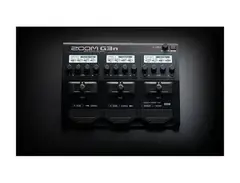
A budget multieffects from Zoom, which I got mainly because it's got a headphone output and so is useful for practicing late at night without the neighbours wanting to kill me.
It only cost about £120, and to be honest it does sound like it! The drives and overdrives all have that 'digital' sound that never entirely convinces, and although the delays, reverbs and modulations are quite good, they seem, if anything, to be a step down from previous cheap Zoom units in terms of the number of parameters offered/tweakability. If you accept that this is an entry-level unit that can give you some passably good practice sounds for not much money, you won't be too disappointed with it. If it was still 1991, this unit would be amazing. But it's not 1991. If you're trying to sound like it's 1991, this could be just what you need!
3982
Pretty basic, but ok.
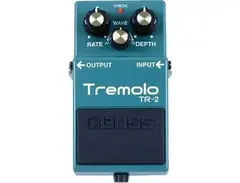
Nice simple trem unit from BOSS, which gives you a good 'retro' amplifier trem sound in a box, with the waveshape adjustable from a gently undulating triangle to a choppy square. However, it does cause a volume drop, and without a tap tempo or MIDI it can be hard to sync it up for performance duties.
3982
Has real character.
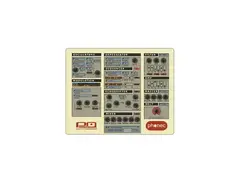
I have version 2 of this synth. It's lovely! Programmer Jack Resweber was inspired to create this synth on the back of childhood memories of those 'introduction' idents you used to get on VHS cassettes, which often featured strange abstract electronic pads over the company logo. He says (in 'Computer Music' magazine, March 2018), 'these video logos were often accompanied by really weird sounds from some kind of obscure electronic instrument. The audio was slightly warped by the worn-out VHS tape, which added an eerie quality to it. That's what Phonec is all about.'
And I think he's succeeded; it's a great synth for creating such textures. The basic synth is pretty straightforward, with 2 oscillators, noise and filters - so far, so subtractive - but what sets it apart is a complex modulation system which allows you to create pseudo 'snags' and dropouts to the signal, mimicking old VHS tape. It's great for that Boards of Canada or Hauntology vibe; it's got real character. Paired up with a tape hiss simulator, I think this synth will do a convincing impression of 'that' sound, and it also works extremely well with Psychic Modulation's 'EchoMelt' delay plug in too. Recommended.
3982
Workmanlike but dependable
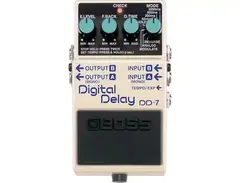
This is the most recent BOSS stompbox digital delay, introduced in about 2009 or so. I think BOSS are due an update at some point in the near future, as it will be ten years in the catalogue next year. I expect they'll take some newer features from their flagship DD-500 and shrink them down next time.
Yes...there's not all that much to say about this one. It does what it does well enough. I think my favourite setting is the modulated delay; I'm not all that keen on the reverse setting on this pedal. It will do totally clean digital delays with long report times with ease. The 'analogue' mode is supposed to simulate the warmth of the analogue BOSS DM-2, but it doesn't, really; the 'analogue' repeats just sound like they've been treated with a simple low-pass filter, and they don't 'warble' enough to convince as analogue-style repeats.
It's good enough, but it's just a bit...boring? Sterile? The DD-3 actually sounds more 'musical', in a way. Maybe I've been spoiled with other, more exciting offerings from TC Electronics, EHX and Earthquaker Devices, but it would be nice to see BOSS being a little more adventurous with their stompbox delays in future.
The tap tempo function is admittedly very useful in a band context though!
3982
Marvellous ROMPLER
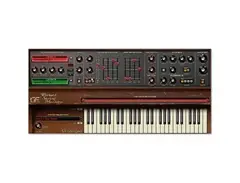
For those of is that can't afford, or can't track down those classic old string synthesizers such as the ARP Omni 2 or the Solina (and let's face it, that's most of us!) this is a beautifully-sampled ROMPLER that will get you very close indeed to those classic tones found on Joy Division's 'Closer', the Cure's 'Disintegration' and Air's 'Moon Safari'. Highly recommended. Oh yes...and it's got the Elka Rhapsody in it as well. Which is the one on Tangerine Dream's best records, Phaedra and Rubycon. And it sounds pretty close.
3982
Superb analogue-style echoes
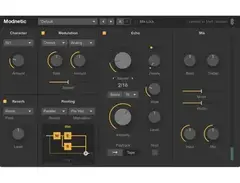
Surreal Machines are a relatively new company who started out making Ableton Live effects. Now they've branched out into AUs and VSTs, and the results are pretty excellent. 'Modnetic' is an attempt to capture the quality of old tape echo units, like the Roland Space Echo, whilst giving the user plenty of opportunities to tweak the parameters in a 21st Century way. The results are authentic and innovative at the same time, particularly as you can choose the routing of the modulation effects (chorus, flanger and phaser), their 'age', and so on. Delay times can be specified in beat divisions or Ms for maximum flexiblity, and changing these parameters 'on the fly' will result in authentic 'speeding up or slowing down' delay swirls. You're also given a wealth of convolution reverbs to choose from. The results sound so good that this CPU-light plug-in easily gives more expensive tools like Soundtoys Echoboy a run for its money.
3982
Better than a lot of commercial synths
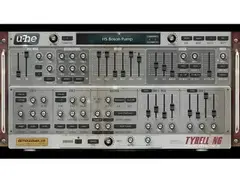
I can't say a bad word about this. It sounds better than a lot of commercial synths, and it's totally free. What's not to like?
3982
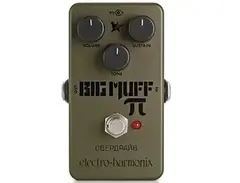
At last...I've found my ideal Muff.
I'd never played a 90s Green Russian Muff (the Sovtek ones), but I'd heard good things about them over the years. I'd never been entirely happy with my other two Muffs. The Double Muff is great for crunchy overdrive, but it's hard to get long sustain out of it. The Little Big Muff does the sustain, but it's just a bit too scooped and fizzy/muddy for me.
I saw Mogwai's Stuart Braithwaite with one of these reissues at a gig in Manchester earlier this year, and it sounded amazing in that context.
I think I've found my ideal Muff at last. This offers a lovely sustain and distortion which somehow seems smooth and crunchy at the same time. It seems to give your playing some serious mayhem whilst also retaining definition, punch and clarity. Coupled with a good analogue-style delay, it will do the 'Gilmour' lead sound with ease, responding well to vibrato and big bends without breaking up easily. Back off with the sustain and tone controls, and it gives you opportunities for really meaty rhythm playing too. The tone control on particular is great for making sure that low-end is retained. The pedal seems to have more presence in the mid-range than the American Pis.
My first impressions are that this is a great-sounding distortion pedal which is easy to use. I'd recommend it wholeheartedly.
3982
Follow the money
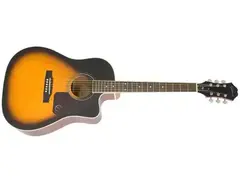
I suppose I could complain about this electro-acoustic. I could say that it's got just a hint of the boxiness and hard-to-define 'plasticness' that marks out a 'one step beyond beginner' acoustic guitar. I could talk about the fact that it's not got that aged, rich, woody tone that every true acoustic guitar connoisseur looks for in an instrument. I could talk about how the guitar doesn't really respond, lovingly, to your every caress, and fall lovingly and rapturously under your fretting fingers.
Yes, I could say all that.
I could also say; imagine you're an average-to-reasonable acoustic guitarist who can play some chords and a bit of fingerpicking, and you've worked out that you'll never be Bert Jansch or even Nick Drake. Let's say that remortgaging your house and selling your relatives into the slave trade to buy a 1930s Gibson or Martin is probably a bad idea as you're not actually a good enough player to merit such extravagance. Well, you could do worse than buy this guitar. If you can bear the fact that it says 'Made In Indonesia' on the back of the headstock and 'Epiphone' instead of 'Gibson' on the other side, you'll be rewarded with a simple, comfortable playing experience, a good action, good intonation, a reasonable amount of volume, clarity and definition, and a guitar that won't make you sound worse than you are. Plugged in it sounds...well, like they all do, pretty much....!
The thing is, this perfectly reasonable guitar cost me £175. Ok, so that was before the madness of the English Referendum vote and the devaluation of Her Maj's pound sterling. Now they're £230.
Yes, I've tried a few high-end Gibson acoustics. Yes, they all sound better than this. But they don't sound TEN TIMES better, which is what you'll pay for them. You simply can't dismiss this as a 'piece of garbage', because it isn't. It's a perfectly reasonable, nice sounding little guitar with a solid spruce top. It's far, far better than the actual junk acoustics I struggled with in my teens; the 'no name' guitars sold by piano shops with actions an inch off the fretboard at the 12th fret and no truss rod. I would have loved to have an instrument this good to learn on in 1985. And I think I'm lucky to have one now, too.
3982
A Truly Modern Synth
A lot of VST synths are trying to recreate and preserve the past. This made a lot of sense until the big analogue synth revival started about eight years or so ago. Now, in 2018, we're practically tripping over new, affordable analogue synths from Korg, Arturia, the modular manufacturers and so on. Part of me has always thought that really, computers should be used to do things that are still impossible in the physical domain.
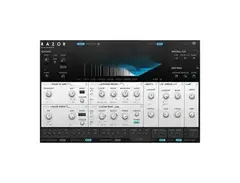
Razor is such a synth. Because it uses hundreds of partials to craft its whole sound - from the oscillators to the filters to the reverbs - it's a synth that simply couldn't have existed in the 80s or 90s.
What does it sound like? Brutal, crystalline, precise, clean, robotic, powerful. I like it. When it came out it seemed to be marketed as a 'dubstep' synth, which is a shame, as dubstep isn't the 'latest thing' any more. However, this synth can do glacial pads, futuristic leads and tinkling bells with ease, too. I sometimes use the vocoder function, and because the carrier signal is so mathematically 'pure', consisting of stacks and stacks of sine waves, it sounds really special.
3982
Main workhorse
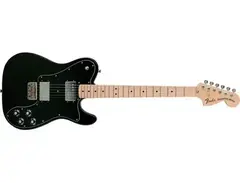
The amazing thing about this Mexican reissue is that the intonation has stayed spot-on for ten whole years, and it's left the house plenty of times. I just feel this that is a well-constructed guitar which has served me very well indeed. It feels really easy to play and rarely gives me any headaches. The fretboard is lovely, and you can get a wide range of tones out of it due to the humbuckers. I think of the sound as being a cross between a Les Paul and a Strat; due to the PUPs, we're not really in classic shrill Telecaster territory here. The toggle switch is probably the weakest part of the whole ensemble.
3982
Get the BF-2 instead
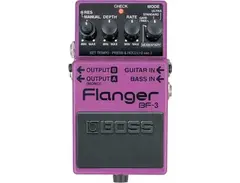
BOSS discontinued the analogue BF-2, which formed the basis of the classic Robert Smith guitar sound, in the early 2000s, and they replaced it with this. I suppose they were trying to update the pedal for a new Millennium. And yes, it's got more options; a standard mode, an Ultra mode, a slicing/pan mode, it's stereo, and it'll take a bass, and there's a momentary switch so you can add the effect at certain points only, and....
...and it doesn't sound anything like as good as the BF-2. This is a digital flange effect with none of the mystery, depth and vibe of its predecessor. Just get that instead.

41016
see, their updated phaser is a great pedal, totally unappreciated, awesome new features! but who sues an 80s boss phaser anyway? When i think phasing I don't think of Boss. But the BF2 was so iconic they shoulda made it until the end of time, unchanged.
3982
Yes, I've noticed how good the PH-3 sounds on demos online. It can offer some truly 21st Century phasing effects with its upwards and downwards modes and its step filter. It can also do a sort of almost pseudo wah on lead lines if you crank the resonance. I think that might be my next BOSS pedal, actually, as it makes a change to the MXR/Small Stone thing, and no-one is really using the PH-3, so it's a good way of sounding different. Graham Coxon's got one though: he knows!
41016
its a little killer, got oen a little after it came out after my friend's little brother let me try his. He got one just because he was into all thigns Boss but iw as like "step LFO!"
41016
usually modern Boss is badly retreading their glorious past, crunching out qulity budget boxes and making abd simualtions of Roland branded FX but there are a few recent jems like the PH3 and that insane Slicer pedal that remind me how good Boss can be
-s.webp?v=1784179924)
3982
Reissue, 2008
I have the reissue one from about 2008. I know everyone says that to get the 'Cobain' sound you must have the Depth switch to 'full', but on mine that seems to produce an unusable detuned warble! I keep it on the 'normal' depth and turn the rate up, and that seems to me to be closer. Yes, it's a classic chorus pedal, unmistakeably 'analogue' in character. It doesn't sound as good as the Way Huge Blue Hippo or the Walrus Audio Julia though; those are sweet. On the other hand, it doesn't cost as much!
It's as hissy as anything, too. Go for a BOSS chorus if this bothers you; what you sacrifice in richness you gain in cleanness.
41016
the old small clones do THAT sound with THOSE settings.... the new ones are harsh and extreme. I know, I've had a new one around for a long time and I never use it. I have no idea what EHX changed. None pf the reissue pedals sounda s good as 70s and 80s models other than the LPB1 and its relatives like the muff fuzz.
3982
It's alright
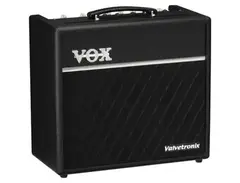
This is my current amp as I've lent my Pathfinder 15 to a friend. To be perfectly honest, that little Vox solid-state amp sounds a lot better, and is less of a faff to use than this one is. The inclusion of real tubes doesn't make it sound like a valve amp, I don't really like the way it resets to digitally-stored defaults each time you change amp settings, and it sounds a bit muddy and ropey if you turn it up too high. It's ok - I mean, for practice, after a bit of fiddling, you can get it to sound good, and the AC30 model is quite nice - but I really wish Vox would make more of their 'natural' amps and fewer of these modelling ones. The effects are ok, but synthetic-sounding compared to pedals, and the fuzzes and overdrives aren't much to write home about either, and they seem to make using stompboxes even more difficult. I think I might get a really basic Orange amp next time. I just need something simple with a clean channel and a dirty one, that sounds good quiet and loud, and one 'volume' knob!
41016
vox makes tons of 'natural' amps... more AC varieties then you can shake a stick at. They're not all so affordable these days. I doubt they'll ever reissue the 60s and 70s solid state designs though. They weren't exactly cheap to produce and I doubt they would stand up to modern consumer electrical regualtions.
-s.webp?v=1784185316)
3982
The Classic 1970s Phaser
I was lucky enough to borrow an original 1974 Phase 90 from a friend in the late 90s when I was doing my first experiments with analogue synths, trying to sound like Stereolab. This reissue doesn't sound quite as nice as that one did, but it's pretty close. I think the Script reissue is supposed to be even closer.
The MXR phase sound is inherently richer and deeper than the EHX Small and Bad Stones, and I think it's useful to have both options. As some people have said, the MXR seems to add a tiny bit of overdrive to the guitar signal, whereas the EHX pedals sound a lot lighter and more translucent by comparison (whilst still sounding authentically 1970s). The MXR clobbers you round the head with very rich, chewy, unsubtle phasing. But if you want that 'Have A Cigar' sound, the MXRs are the only way to get it.
-s.webp?v=1784127642)
3982
Crying out for a reissue
If ever there was a BOSS compact pedal crying out for a reissue, it's this beast!
In 1994, as a callow 20 year-old, I blew my student loan on a four track. I had just enough dosh left for one pedal. First I tried the reverb, the RV-3, which was nice. I was about to get that when the bloke in the shop said, 'I think you should try this too.'
I was immediately gobsmacked by it. BOSS had somehow managed to fit a sophisticated rack-mounted 16 bit DSP engine into a guitar pedal. As I skipped through the 11 modes on offer, I realised that it was something of a Swiss Army Knife for the bedroom musician. Three modes gave you standard digital delay, and eight more gave you what were, at the time, groundbreakingly weird pitch and delay effects. It split the signal into two voices, each of which could be shifted independently; so you could do so much stuff with it. Debussy whole-tone cascading fairy ascending motifs; octaver effects; harmonist effects; bass imitations; robotic shimmery electronic noises; reverse delay, useful as a psuedo reverb; chorus-like detunes. And I never even got round to exploring the expression input. If I had, I'd have discovered that it can also be a whammy pedal.
There was so much it could - and still can - do. The only thing I missed was that changing the delay time didn't change the pitch, like on the DD-3. So, you can't do that spiralling feedback thing with it; you'll just get nasty clicks when you change the delay time as the clock gets reset.
But apart from that, this pedal was a masterpiece. It was discontinued in 1999. If there's one pedal I'd like to see BOSS reissue one day, it's this one. I put everything through it! Guitar, drum machine, synth. It made everything sound interesting - almost like a Rainbow Machine before there was a Rainbow Machine. Highly recommended for experimentalists.
3982
Pretty cool if you ask me!
I've had an ambiguous relationship with overdrive and distortion throughout my life. I'm basically a shoegazer at heart, and in the 1990s I shied away from it as it was associated in my mind with 'big hair' and metal acts. I now realise, of course, that all my favourite shoegazers were distortion freaks; the effect sounds very different when it's syphoned through oodles of reverb and echo and modulation.
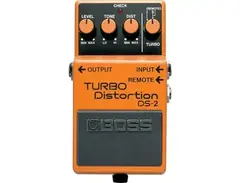
We live in the era of the boutique overdrive/distortion pedal now, with brands like Earthquaker, Way Huge and Wampler being particularly highly-regarded in this field. The humble BOSS distortions - the DS-1 and similar - are seen as being a bit cheap and nasty these days, beginner's pedals. However, I was so impressed by the Boss SD-1 that I decided to give the DS-2 a try.
I really like it! I was looking for a fierce, crunchy, but clean and controllable distortion that WASN'T also a 'fuzz', as the EHX Little Big Muff pretty much gives me all the fuzz I could ever want. I tried - and really liked - the MXR Super Badass distortion, but alas, it was just too pricey for me (money is tight at the moment). I think this is a good pedal for half the price. And actually, thinking about it, those early 90s shoegaze bands just used BOSS distortions; that was all they had access to in the days before the internet and the boutique pedal explosion (not strictly true; there was the RAT, but not many shops stocked even EHX pedals back then, it was before the renaissance in EHX's catalogue). So, in many ways, if you are influenced by the sounds of The Cranes, Slowdive, Ride and Lush, this pedal will give you that early 90s distortion sound!
I used to have a handmade Crowther Hotcake, and admittedly it sounded better than this. But it broke down, alas. This fills the gap. If it was good enough for Kurt Cobain, Bernard Butler and Prince, it's good enough for me. It sounds good with my set-up, which is a good Telecaster into a Vox Valvestate amp. Some people say it's too bright, which may be true with their rigs. I suppose distortion comes down to personal taste, but I like this pedal.
3982
Different
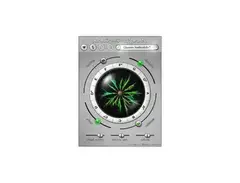
Synplant is created by Magnus Lidström, the man behind Sonic Charge, who also came to prominence with the Malstrom synthesizer included free with Propellerhead's Reason. Under the hood, Synplant is actually a fairy conventional (FM? I dunno?) synth, but what makes it stand out from the crowd of synth plug-ins is its innovative user interface. The idea basically is that the user simply pushes and pulls at graphics until they get a sound they want! The core sound is represented by a 'seed' at the centre of the interface. Each seed grows 'branches' (nicely animated wavy fern things). As the branch is pulled, it changes loads of synth parameters FOR THAT NOTE on THAT KEY only. So, in other words, it's possible to create a synth patch where every sound on every key is different, which is a departure in itself! If one particular sound takes your fancy, you can 'replant' the seed so that all the keys now share that sound. The process can be repeated endlessly until you've reached a sound you like. If you get a sound that's almost right apart from one thing, you can dive into the synth's 'DNA editor' window, which gives you finer control over things like envelopes, filter cutoffs, amplitude modulation levels and so on, like a 'normal' synth would. The global controls on the front panel control broader things like FX wet/dry level, atonality, tuning and so on. The modulation wheel often offers up surprises, and the whole plant can be spun with automation to give evolving sounds too...
I love Synplant mainly for its sound; it's sort of cold, digital, but somehow organic and quirky at the same time. It also sounds very 'modern' in the sense that it's not trying to slavishly recreate a MiniMoog or whatever; it sounds like something that could only really exist in the 21st Century. It's almost impossible to predict how tweaking the branches will affect the timbres, and it's very liberating to just use simple tactile controls and your ears to create new sounds. Sometimes it's worth just hitting the 'create new random seed' button and seeing what it can come up with!
It can be a bit quiet and weedy sounding, which I usually fix with compression. Still, this makes a change to a lot of modern soft synths which immediately blow out your channel strip (yes, looking at you, Arturia!) and you have to instantly turn them down...
3982
If I was a better guitarist...it'd get four or five stars!
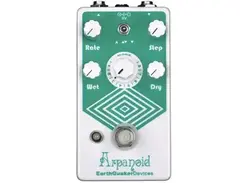
Aside from the more famous Rainbow Machine, this is Earthquaker's weirdest pedal. It's a pitch arpeggiator capable of tracking chords. It takes whatever note you play into it and transforms it into an adjustable ascending or descending scale. That's right; you play a single 'C', and if you're in Mode 1, it will play a C major scale from -1 octave to the note you've played. If you're in Mode 6, it will play a C minor scale from the note you've played to one octave above. There are wet-dry controls, a rate knob for adjusting the speed through which the scale plays, a step knob for adjusting how many 'steps' of the scale are played, from 'one' to all of them, and a toggle switch for adjusting whether the scale plays up, down, or does a palindrome.
Now, this is all very well and it's totally amazing! The pitch tracking and the smoothness of the scale interpolations are very good indeed.
But...
Well, to be honest, this is a pedal for those of us who are really shit-hot at music theory. The sort of people who know which Phyrigian or Locrian mode goes with which diminished 19th or whatever. Most of us will want to play chords on our guitars, and things are pretty involved playing just one single note on this thing. Things get even more complex throwing in a fifth. Add a third and you'd better be pretty sure whether that's a minor or major third you've got there! And then...your song changes key...argghh....
So, I'm not saying this is a bad pedal. It isn't. It's extremely clever and it sounds good. But to get the most out of it, don't expect instant gratification. It's one for really just sitting down and experimenting with, and you might find that it only fits with one passage of one verse or whatever. It's similar to a frequency shifter in that respect; you could spend years trying to master this pedal!
One thing which could be better: I wish it had MIDI or CV inputs, or even just a tap tempo, so that you could lock the speed of the arp to a beat. So far, I've found that it gives a pleasing effect when the number of steps of the arp are low (say, 2), and the rate of stepping through fairly high. Used like this, the pedal can give you a really quirky and unusual sort of 'pitched tremolo' effect, especially when used with a delay to smear the pitch changes a bit. Also, when there's only one step, it becomes a good-quality octave pedal or simple pitch-shifter.
Andy from Pro Shop guitars makes it sound amazing in this video: https://www.youtube.com/watch?v=v-N_Ar3xfak
But he knows what he's doing, of course!