


Pricing and availability
We compare 600+ stores and found this item at 7 stores. Prices updated .
Store
Reviews
Price




Average Price: $264
Standard/Professional
$150
$601+
Price Tier
Budget
Standard
High-end
Price History
Based on price data from 5 merchants for "Keeley Dark Side Workstation". Prices shown reflect NEW condition. Tracking began Apr 2, 2026.
* Product prices and availability are updated by Equipboard every 24hrs and are subject to change. Equipboard may receive compensation for purchases made at participating retailers linked on this site. This compensation does not affect what products or prices are displayed, or the order of prices listed. For more information, please refer to our affiliate disclosure.
Description
Unleash your creativity with the Keeley Dark Side Workstation, a revolutionary multi-effects pedal that merges analog fuzz, delay, and modulation in a single, cutting-edge stompbox. Crafted with inspiration from the iconic sounds of the 70s, this pedal invites you to journey through an array of tones and soundscapes.
The Dark Side's analog fuzz circuit, based on a 1977 op-amp fuzz, provides transparent distortion with maximum sustain and clarity, while the digital side delivers 12 syncopated, tape delay variations and four modulation effects: flanger, rotary speaker, univibe, and phaser. The distinctive character of each effect can be further explored using an expression pedal (not included).
Built in the U.S.A with premium components, the Dark Side is equipped with a high-end 24-bit DSP engine, ensuring unparalleled tonal quality. The rotary effect is more chorused than Keeley's Monterey pedal, while the univibe throbs with greater intensity. For convenience, a TRS insert allows you to add other effects between the fuzz and delay/modulation sections.
Key Features:
- Analog fuzz based on a 1977 op-amp fuzz circuit
- High-end 24-bit DSP engine
- 12 syncopated tape delay variations
- Four modulation effects: flanger, rotary speaker, univibe, and phaser
- TRS insert for adding other effects
- Order switch for changing the order of effects
- Expression pedal input for real-time control of multiple parameters
- Hand-built in the U.S.A with premium components
- True bypass for preserving signal integrity when the pedal is off
- Rugged metal casing ready for life on the road
Product specs
| Pedal Type | Fuzz, Delay, Rotary/Flange, Phaser/U-Vibe |
| Analog/Digital | Analog Fuzz with DSP effects |
| Inputs | 1 x 1/4" (instrument) |
| Outputs | 1 x 1/4" |
| Other I/O | 1 x 1/4" (expression) |
| True Bypass | Yes |
| Power Source | 9V DC power supply (sold separately) |
| Power Usage | 75mA |
| Height | 2" |
| Width | 4.7" |
| Depth | 3.8" |
| Weight | 0.9 lbs. |
FAQs
-
What effects are included in the Keeley Dark Side Workstation?
-
The Keeley Dark Side Workstation includes fuzz, delay, rotary/flange, and phaser/U-Vibe effects, allowing for a wide range of tonal possibilities.
-
Is the Keeley Dark Side Workstation pedal analog or digital?
-
The Keeley Dark Side Workstation features an analog fuzz circuit combined with digital DSP effects for modulation and delay.
-
Does the Keeley Dark Side Workstation have true bypass?
-
Yes, the Keeley Dark Side Workstation is equipped with true bypass to ensure your signal remains unaffected when the pedal is not in use.
-
What power supply is required for the Keeley Dark Side Workstation?
-
The Keeley Dark Side Workstation requires a 9V DC power supply, which is sold separately.
-
Can I use an expression pedal with the Keeley Dark Side Workstation?
-
Yes, the Keeley Dark Side Workstation has a 1/4" expression pedal input for real-time control over certain effects parameters.
Videos

Guitar Gear Demos
Keeley Dark Side Guitar Effect Pedal - Does it sound like Pink Floyd?
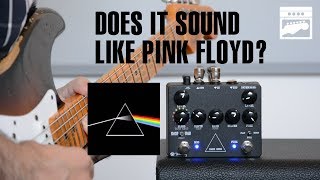
Keeley Dark Side Guitar Effect Pedal - Does it sound like Pink Floyd?
Guitar Gear Demos
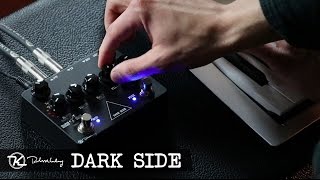
Keeley Electronics - Dark Side Workstation - Synthesizer

Keeley Electronics
Reviews
PROS
-
Versatile fuzz with multiple tone modes
-
Excellent delay, easily dials in classic sounds
-
Modulation allows for running two effects at once
-
User-friendly despite initial complexity
-
High-quality tape delay emulation
-
Offers a wide range of Gilmour and classic fuzz tones
-
Works well with both guitar and bass
-
Hand-crafted, high-quality construction
-
Inspires creative guitar playing and sound exploration
-
Capable of competing with larger pedalboards alone
CONS
-
Cannot use modulation effects with delay simultaneously
-
Learning curve for color-coded delay settings
-
Inability to combine some effects limits versatility
-
Fine settings difficult to adjust during live performance
-
Some effects may not perfectly emulate Gilmour's exact tones
Owner Insights
We analyzed real musician discussions from forums and Reddit to find what players love, question, and tweak about Keeley Dark Side Workstation.
Mods and upgrades
User experience
-
Users express frustration over the lack of specific knob settings provided online for emulating famous tones, highlighting a common learning curve with the pedal.
Source -
One owner describes a challenging acquisition journey, underscoring the pedal's desirability and worth despite initial difficulties in obtaining it.
Source -
Some owners feel the layout could be unintuitive, particularly for those who prefer straightforward controls over extensive knob-tweaking.
Source
Comparisons
Use cases and applications
-
For a Gilmour-esque tone, users recommend using a British-flavored amp set clean or with light breakup to enhance the fuzz's clarity and definition.
Source -
The fuzz and modulation flip trick is noted for achieving a super-shoegaze sound, offering creative uses beyond typical settings.
Source -
The pedal's rotary effect is highlighted for its unique contribution to tone, becoming essential even for those previously unfamiliar with rotary sounds.
Source -
Placing the pedal in an effects loop of a low to medium gain tube amp is suggested to optimize the fuzz and modulation interaction.
Source -
Users find the pedal versatile for stacking with other modulation effects and use it predominantly for its fuzz capabilities.
Source
Features and functionality
-
The Keeley Dark Side requires a separate delay pedal for simultaneous modulation and delay, as it cannot engage both at once.
Source -
The expression pedal input is non-assignable, controlling only the 'Rate' for modulation and 'Feedback' for delay.
Source -
The Keeley Dark Side allows users to toggle between phaser/vibe or flanger/rotary settings, offering extensive modulation possibilities.
Source -
Users appreciate the multi-head delay but note it cannot be engaged simultaneously with modulation, which some find limiting for live use.
Source -
The pedal's fuzz is op-amp based and praised for its power and fierceness, though opinions on its quality vary.
Source
Critic Reviews
4.5 out of 5
Based on 2 Reviews and 18 Ratings

3982
A fun compromise
This, the Keeley Dark Side (if you haven’t guessed from the title) is a multieffects pedal which seeks to help you get close to the 1970s David Gilmour tones in one convenient format.
First of all, let’s be clear: this pedal gives you a ‘flavour’ of those 1970s Floyd guitar tones. I don’t think Robert Keeley intended it to be the last word in sonic accuracy, and, having owned and played this pedal extensively for about three years, I can confirm that more ‘authentic’ tones are obtainable from buying separate pedals. There are far more accurate Binson simulators, uni-vibes, flangers, rotary speaker sims and fuzzes out there, if you’re absolutely hell-bent on recreating David’s pedal sounds down to the last letter.
The right-hand side of the pedal is dedicated to analogue fuzz, which Keeley has based on a 1977 op-amp fuzz. It has three modes - full, scooped and flat. They all sound fantastic. But they don’t sound exactly like any of the fuzz pedals Gilmour has actually used in his career, however. They just sound ‘a bit Gilmoury’. In other words, if you absolutely must have the exact fuzz sound of Pompeii, you’d probably get an Analog Man Sun Face. If you absolutely must have The Wall fuzz sound, you’d get the EHX Ram’s Head reissue. But that’s missing the point - the fuzz is more of a generic ‘Gilmour fuzz’. It’s crunchy and it packs loads of gain, but it never gets woolly or muffled. It captures the essence of his distortion sounds.
On the left-hand side, we have controls for the delay and the modulation. Here’s the kicker, and the most frustrating aspect of the pedal: you can’t have delay and modulation active at the same time. The delay and mod obviously share the same chip. So, it’s one or the other, which is a real shame. It means you have to supply your own separate delay pedal if you want to use the modulations with delay! You can have fuzz with delay, or fuzz with modulation, but not all three and not modulation and delay. This means that the Dark Side is not, and can never be, a ‘one stop’ solution for every possibility. If you’re in a covers band and you’re doing say, ‘Run Like Hell’, you could use the drum delay circuit from the Dark Side, but it doesn’t sound right without the flanger, so you’d have to supply your own. Or vice-versa (you could use the flanger on the Dark Side and bring your own delay).
The delay side (toggle in middle position) is very detailed and contains 12 rhythmic patterns, which are meant to represent all the tape head combinations of a Binson Echorec. The timings are well thought out, but the overall delay timbre is, to my mind, far too clean to be a tribute to the tonal character of the Binson - it needs more instability and ‘flutter’. Combined with the fuzz though, it will pass in a live situation.
Switch the toggle and you can access, on the left hand side, a flanger which becomes a rotary speaker effect, and, on the right-hand side of the toggle, a phaser which becomes a univibe.
The flanger isn’t a goth flanger with tonnes of jet plane feedback. In this sense, it’s more appropriately calibrated so that it sounds like the more chorus-ey flanger sounds Gilmour favoured from his EHX Electric Mistress from ‘Animals’ through to ‘The Wall’. It works quite well, but to be honest, it is a chorus, really! Likewise, the rotary speaker effect too, is pretty much a watery chorus sound. It’s very pretty, and I think the idea was to replicate the way David used the Yamaha RA200 or Leslie 147, which he utilised more as a slow-sweeping ‘always on’ chorus. It’s probably the least accurate of the modulations here - it doesn’t really get all that close to the Leslie sounds of Dark Side. It sounds at its best on faster settings, and might just work for ‘Any Colour You Like’, but on slower speeds it really does just sound like a warbly chorus.
The phaser is quite a convincing take on the Phase 90 and the uni-vibe works well too, with a more pronounced ‘throb’ that you’d associate with the Shin-ei. It wouldn’t convince a purist though, and when I compare it to even the digital TC Electronics Viscous Vibe, it seems less accurate. But it’s not too bad, and, again, the phaser and the vibe do benefit when they’re paired up with the fuzz on its lowest gain setting.
A switch on top of the pedal lets you change the order, so you can have fuzz into modulation, or modulation into fuzz, which opens up more possibilities. There’s also an expression input.
I think it’s best of you approach the Keeley Dark Side not as the ‘last word’ in sonic accuracy for David’s tones, and think of it more as a kind of ‘1970s guitar sounds’ multieffects pedal. It will get you into Gilmour territory, without sounding exactly like the gear he used. And furthermore, you can have a mix of modulations, so you can have a flanger with a hint of Leslie, or a phase with a hint of univibe. As such, if you think of it more as being a pedal which is a tribute to 1970s guitar effects in general, then the Dark Side becomes a uniquely useful Swiss Army knife for anyone who loves those 1970s tones. If you’re in a Floyd tribute band and you’d like to keep things simple, the Dark Side could be paired with say, the Catalinbread Echorec and an MXR Dynacomp, and the audience wouldn’t have any grounds for complaint at all (after all, the chances of the keyboard player having a genuine Synthi A, or a bank of perfectly tuned wineglasses at their disposal is very low too!). What the Keeley Dark Side gives you is a very convenient and handy ‘essence’ of the 1970s Floyd guitar experience. If you’re on a budget, it’s a very effective way to get reasonably close to those iconic tones (the Dark Side is pricey, but nowhere near as pricey as buying seven vintage or ‘authentic’ single pedals!).
Keeley’s ‘Loomer’ pedal (which I will review later) is an attempt to capture early 90s shoegaze tones in a single box. I have to say, in my humble opinion, the Dark Side fulfils its brief much more effectively than the Loomer. But more of that anon.
Above all, remember that you can’t have delay and modulation at the same time, so whatever you do, please don’t buy one thinking you can!

654
Brilliant, but not as Gilmour as intended
TL;DR: not a pitch perfect Gilmour emulation, but a damn near perfect pedal in its own right.
I'm not saying you CAN'T nail a good Gilmour tone with this pedal, but the really fun stuff is doing something decidedly less Gilmoury. The fuzz is a fantastically muffy affair, but it's a little more aggressive than the silky smoothness one typically associates with the man himself. I'll stick to my Muffuletta for Comfortably Numb, but honestly, the roided out sound of the Dark Side's fuzz lends a super gnarly, almost Hendrix-esque blues vibe to Money. I was hoping this fuzz would eliminate the need for my Muffuletta, but they're two different beasts; no mode on the Muffuletta matches the grit of the Dark Side's Fuzz, but the Dark Side is quite a bit darker than the Muffuletta and lacks some clarity and articulation (the former of which I resolved by boosting with a BD-2). Ultimately, The Dark Side captures a vibe that the Muffuletta doesn't, so I will likely be keeping both.
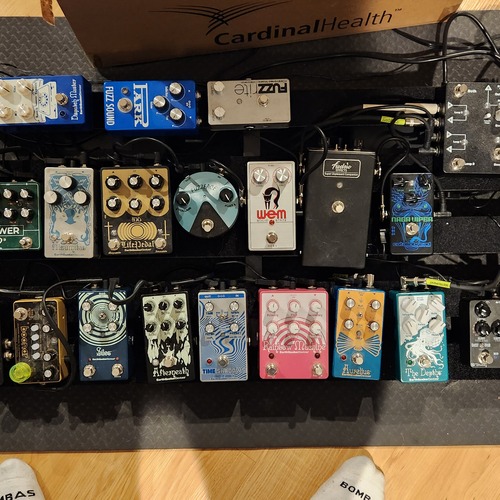
On to the modulation side then; I'll start with the Phaser/Vibe, which is fine, just fine. Blending between the two gets you some pretty cool textures, but as these effects are basically the same, it feels a little redundant to have the blend, and perhaps replacing either with something a little more oddball would have been more fun. Not that it matters to me much; the range of the rate/depth on my EQD The Depths, combined with it's tone and low end controls, make it much more useable for me, and I don't see myself really using the Phaser on the Dark Side.
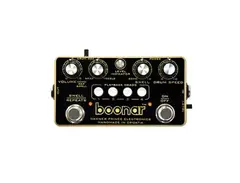
The Delay actually sounds pretty great; it doesn't quite capture the atmosphere of my Boonar (to which I compare it directly because they're both supposed to be Echorec simulations) but it's a great sound; as I have the Boonar, I likely won't use it often, but it's rather brilliant in all honesty, and I'd be happy to use it if I needed to save space, or stacking it with other delays for some super ambient stuff. I keep my Boonar at classic Echorec time settings, but because the Dark Side's delay doesn't have the reverb-y quality of the Boonar, it'd probably be a bit better suited to rhythmic stuff (not that rhythmic stuff without a tap tempo is particularly ideal).
Finally, the Rotary/Flanger Mode. This is the holy grail of the pedal; this sound is immense. The rotary is deep and has that nice, crunchy churning you get from a Leslie, and the Flanger does a great job of capturing the more subtle nature of the original Electric Mistress (well, subtle compared to the Deluxe at least). On cleans, a blend of the two captures that great sound from the middle of Pigs. With the rate cranked and the Fuzz in front, I got the Pulse 'Any Colour You Like' tone effortlessly (though with a fair bit more aggression thanks to the fuzz).
But here, really, is why I say that this pedal isn't quite 'Gilmour'; this modulation is always either not quite enough or far too extreme for the majority of those tones. The jet-like swirl of the flanger starts blending in after not that much depth, and the Rotary mode is a little too leslie-ish (Gilmour did use on early on but it was the more chorus-y Yamaha rotary with which he really made his mark). These effects aren't overpowering, and they sound INCREDIBLE, but it's not Gilmour-specific, and people looking to capture those Hallowed tones from the 79-80 Wall tour would do well to look elsewhere.
I wouldn't, however, say that this is to the pedal's detriment. It nails the Gilmour vibe effortlessly, even if it doesn't nail the specific tones. And besides, once I'd had my fun trying to get that stuff, I ended up having far more fun dialling it in for my own stuff; I got down a fair few ambient pads, raging leads and rhythm/chordal textures as a result of the inspiration this pedal gave me.
Bottom line: it probably won't satisfy extreme Gilmour purists. But it's a great entry point to that vibe and those tones, and people looking for one of Keeley's Workstation-Type pedals that does a couple of different effects brilliantly for easy use and quick inspiration can do no wrong here!
Artist usage
Add artist

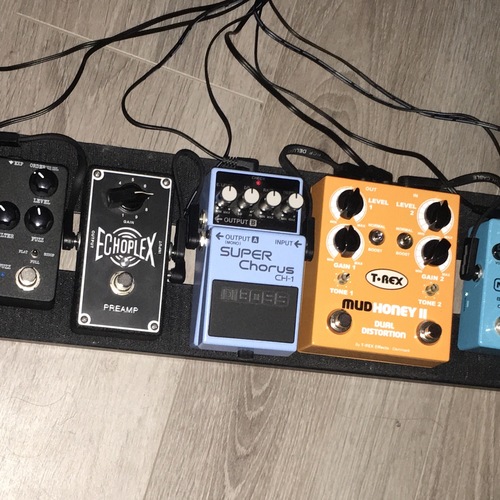
Board No. 2 is home to the Fractal MFC-101 Mark II Foot Controller, Keeley Psi Fuzz, Keeley Wolff Octave Fuzz, and a Keeley Dark Side Workstation.


“I’m really enjoying my new Dark Side and Monterey guitar pedals. A great friend and talented producer Sue Pelino referred me to them and I’m looking forward to adding them to my live stage rig.”

.jpg)
In an Instagram post, Sarah Lipstate features the Keeley Dark Side Workstation among her gear, highlighting its use alongside her Squier Bass VI.


Listed on Brian's official Keeley artist page.


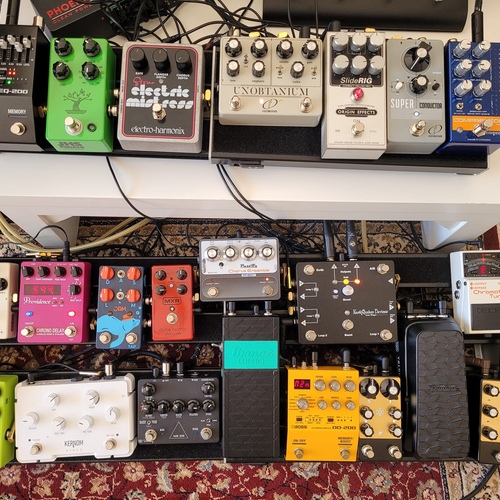
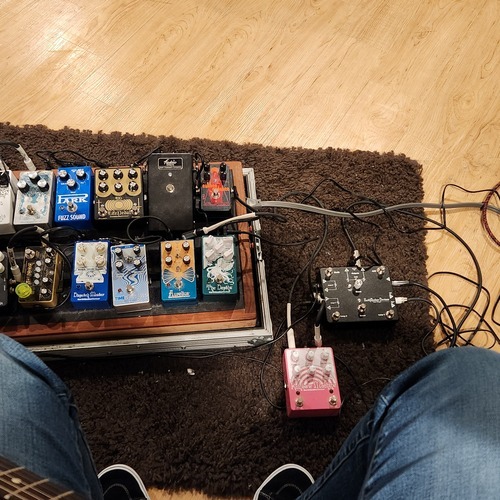
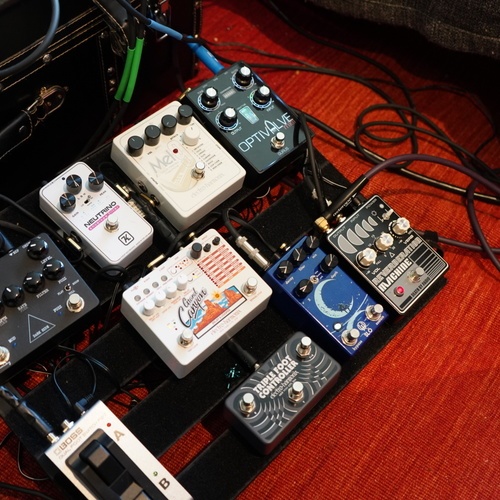
In this image, taken from his Premier Guitar interview, many of his studio pedals are photographed. One of the pedals in this photo is Keeley Dark Side.




“The Dark Side pedal is one of the most versatile pedals I have ever plugged in to. In live situations where you need to cover a wide range of sounds and in the studio where you want to be as creative as you can imagine, this is the pedal for it."


At 22:13 in the Premier Guitar video titled "The Red Clay Strays' Rig Rundown with Drew Nix & Zachary Rishel Guitar Gear Tour at the Ryman," a Keeley Dark Side Workstation can clearly be seen on Zachary Rishel's pedalboard, confirming its use by the guitarist.
Genre Usage
Based on how artists on Equipboard use this gear, it is most commonly found in the following genres.
Used With
Based on how musicians on Equipboard use Keeley Dark Side Workstation, it is most commonly used with the following gear.


Community setups
Show yours






Similar
Add recommendation2 alternative and related items for Keeley Dark Side Workstation, curated by the Equipboard community.

$139.00 - $159.00

$859.00 - $2,432.00
More Keeley Multi Effects Pedals

$299.00 - $333.00
in Multi Effects Pedals Rank


$222.42 - $349.00
in Multi Effects Pedals Rank


$159.95 - $219.00
in Multi Effects Pedals Rank


$159.00 - $359.00
in Multi Effects Pedals Rank


$126.00 - $169.00
in Multi Effects Pedals Rank


$249.00 - $276.00


$179.00 - $199.00


$179.00 - $199.00


$249.00 - $275.00


$169.00 - $210.00


$315.00 - $325.00
in Multi Effects Pedals Rank


$169.00 - $179.99
in Multi Effects Pedals Rank

$159.00 - $169.99
in Multi Effects Pedals Rank

$439.12 - $599.00
in Multi Effects Pedals Rank


-m.webp?v=1784559485)
$299.00 - $403.18
in Multi Effects Pedals Rank


$599.00 - $699.99
in Multi Effects Pedals Rank


$399.00 - $449.00
in Multi Effects Pedals Rank


$598.74 - $1,499.99
in Multi Effects Pedals Rank


$569.00
in Multi Effects Pedals Rank


$231.89
in Multi Effects Pedals Rank


$811.00 - $1,399.00
in Multi Effects Pedals Rank
.jpg?v=1784563516)


-m.webp?v=1784559416)
$160.00
in Multi Effects Pedals Rank


$214.76 - $449.99
in Multi Effects Pedals Rank


$115.00
in Multi Effects Pedals Rank

$104.00 - $214.00
in Multi Effects Pedals Rank


$61.80 - $309.99
in Multi Effects Pedals Rank


$299.00 - $549.99
in Multi Effects Pedals Rank


$499.99 - $549.99
in Multi Effects Pedals Rank


$141.00 - $649.99
in Multi Effects Pedals Rank

.png?v=1784519118)
Accessories & Related Items




-s.webp?v=1784546875)


Gear Guides




.webp)

Most Popular Multi Effects Pedals
Most Popular Brands
-
Added to Equipboard on by
 rainydayloops
GearIQ 363
-


