
nikfarr's Reviews
17 reviews Back to nikfarr's Equipboard


15320
A One-Trick Pony (But It's a Good Trick)
It's a little lame to review a guitar pick, I know. But much as a painter will select different brushes for specific purposes (certain textures, sizes, whatever) a good guitarist should probably have a handful of picks available for specific tasks.
This floppy little Tortex plectrum is my go-to when strumming chords on an acoustic guitar. It's virtually useless for anything else--try playing electric, and you'll likely tear it in half on the strings halfway through one song. It's borderline awful for picking single notes, especially if you're going to play more than one per measure. It's too soft to snap back into position, and it's very easy to find yourself missing beats.
But let's go back to the acoustic strumming. If you've got a solid rhythm and a light-to-medium strumming technique, you'll find that one of life's most sublime pleasures is raking this paper-thin pick across a fresh set of bronze strings. There's just something so clean about the sound this plectrum draws from a guitar; it sounds like all the great background rhythm playing on classic rock records from Bowie's 70s stuff to the Who's... well, almost everything.
15320
As Used by the Edge of U2 Fame
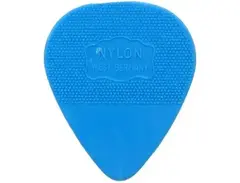
I started using these because I read that the Edge plays with them, holding them backwards to strike the string with the dimpled part of the pick. He says it gives the notes that distinctive ching sound you'll hear on U2 records, versus a smooth pick, which produces more of a ping. He's right. Try it and you'll hear it immediately. It's kind of fascinating how different the articulation of picked notes is when using a Herdim this way.
With that said, beyond that, it's as good a plectrum as I can imagine. It's hard but still has some give/flexibility; the smooth side is nice for clean chord strumming; and when holding the dimpled side as it was meant to do, the texture serves as a grip to help prevent one from accidentally dropping the pick while playing.
I mean, it's a guitar pick; it's pretty hard to screw up. So, nice job, Herdim. I guess.

15320
Haha! I always assume if I don't like a pick, that it's probably intended for an application other than the one I'm using. I've never really considered the idea that a pick has a design flaw; I assume I have the design flaw. Hmm.
15320
A Flawed Yet Intriguing Instrument
In the interest of full disclosure, I feel the need to point out two things:
- I would actually give this instrument a 3.5 rating if half-stars were available.
- I do not play hard or heavy rock.
I feel these clarifications are necessary, because if this review comes across as highly positive, please bear in mind that I was very surprised by this guitar. I acquired my SK-3 ST during the course of a trade transaction, and while it wasn't what I wanted initially, it turned out to be what I needed.
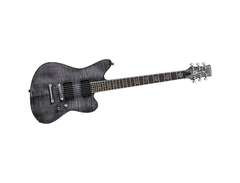
Charvel released this guitar a couple of years ago as a kind of reissue of their underrated Surfcaster from the 1990s. The Skatecaster is only peripherally related to that semi-hollowbody, single-coil-equipped instrument, however, borrowing only its shape and a few cosmetic appointments as a basis on which to build.
On first glance, the SK-3 ST is a very good-looking instrument, with a clean, modern design. The model I own has a flat black (more like charcoal) matte finish, and the light gray binding on the body and neck really stand out in a kind of classy way. The uncluttered controls contribute to the sleek feel, and although the neck and headstock are assembled from 2 separate pieces of wood that have slightly different colors, this doesn't detract from the great look. About the only complaint I have is that the pearloid inlays on the fretboard are a little on the large side, and to me they look a little "Nu-metal gone Vegas."
The second thing one notices when picking up the Skatecaster is how light it is. I'd be surprised if it even clocked in at 6 pounds. However, it still manages to feel sturdy and substantial, due to the dense feeling of the mahogany used to craft the body and neck.
Speaking of the neck, it's very flat and that took some getting used to on my part, as I'm much more used to rounded Fender and Gibson-style profiles. While I didn't care for it at first, after about 30 minutes of playing I came to realize that it might be one of the most comfortable-feeling necks I've ever had the pleasure of playing. This is due in large part to the fact that the back of the neck is not finished--it's described on Charvel's website as "oil-rubbed." Whatever the case may be, having your hand make such a direct connection with the wood of the guitar is a really interesting experience. And with its 25.5" scale length, the SK-3 ST feels different than most short-scale guitars that are designed for hard/heavy rock.
The black nickel hardware is also very nice, blending handsomely with the look and feel of the rest of the guitar. The tuners, bridge and tailpiece all feel very sturdy and solid. It might have been nice to have even basic straplocks included, but the black nickel strap buttons are very well-designed and I have yet to have a strap slip off them.
With regard to the Skatecaster's functionality, it's been described on other sites as a one-trick pony and I don't think that's quite a fair assessment. While it's true that the guitar is clearly intended for heavier types of music, I've personally had a lot of success playing other genres on it, including pop rock and post-punk/new wave type.
After owning this guitar and using it as a second instrument for several months, I do have some concerns about the SK-3 ST... Read More
41049
Hell, I love beaters... I miss the days when pawn shops were full of oddball Japanese guitars for under 300 bucks that I could beat into the ground without feeling bad. You plan to change the pickups out?
15320
I actually sold the guitar (wrote the full review awhile ago) to a guy who said he swapped out the pickups for--I believe--a pair Seymour Duncan Distortions. Not my cup of tea, but then, I don't play in a metal band. He's very happy with the guitar, now, though.
But to go back to the "beater" thing for a moment: I will say, that guitar had one of the best-feeling necks I've ever played. Obviously, these things are very subjective, and I've subsequently talked to other players who absolutely loathed the SK-1's neck. Honestly, if I hadn't needed the money, I'd probably have kept the neck and installed it on some kind of Fender just because I loved it so damned much.
15320
A Great and Highly Versatile Digital Delay Pedal
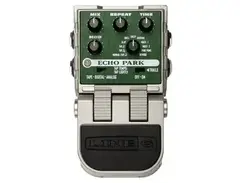
In terms of solo applications, the Echo Park never fails to sound great. In fact, it makes practice a lot of fun because it opens up a world of experimentation via the various models, settings and delay patterns that are available. I was reminded of a quote from The Edge of U2, who described how he incorporated echo into his composition process when writing guitar parts once he really started to find out what he could do with the effect. I found myself delving deeply into the Echo Park's features just because it was so easy to do, and the result was a plethora of new ideas as well as a refinement of older ones.
In a recording scenario, I initially had some problems with the Echo Park because I was unaware that using a Line 6 power supply would resolve noise issues. Unfortunately, prior to obtaining the DC-1G cable, the Echo Park was unusable in the studio because of the buzzing it created even when the pedal was turned off. However, once I obtained the Line 6 proprietary power supply, the signal cleared up instantly and the sound was just beautiful. (Update: Voodoo Labs' Pedal Power 2 Plus is an ideal unit if you're looking to run juice to several pedals simultaneously, as it includes a port that is set up specifically for Line 6 pedals.)
This is a good place to mention a quirk of the Echo Park: when it's turned on, there is a small but noticeable volume boost. There will be a certain percentage of the guitar-playing population who will strongly dislike this, but I'm not one of them. In fact, I love the little hint of extra gain it adds to the signal--and since I rarely turn my Echo Park off, I don't notice the discrepancy between the dry sound and the effected one.
The reason I mention the volume boost when discussing recording with the Echo Park is because it's the one situation where I had to account for it. Playing alone, it's a non-issue; playing in a band, it's kind of an advantage. In a studio, however, where microphones are carefully placed and settings are adjusted specific to a certain sound, I didn't think to compensate by having the engineer work with the pedal on first--which would have been a good idea, because if the mics are picking up a hot signal well, a slight volume dip will generally not be a problem. However, a sudden boost in signal can result in unanticipated, unwanted distortion. So, note to anyone who will use the Echo Park for recording... Read More
41049
I am debating whether I think that level boost when engaged is good or bad. I can see where that would be handy if you only use the echo park for solos or just use a tasteful slap all the time, but I hate when effects tamper with my gain structure as I am a volume-knob type of player and tend to run my amps super-loud and control things from the guitar. Echo is a classy effect, but every echo unit from the first tape delays to all the modern digital stuff is a pain in the balls in one way or another.
15320
Honestly, it's really pleasing (to my ear) in this context. It's a super-slight bump and since I almost never play with a pristine signal anyway, I actually really like it. It's consistent and entirely predictable, so it's relatively easy to work with/around. But if you're looking for a perfectly clean echo pedal, this is not it.
15320
A Decent Hybrid Amp With a Few Flaws
I'll say it upfront: I love hybrid amplifier technology. I'm no stickler for tubes/valves, but there's something about a purely solid state amp that turns me off a little. Incorporating even one 12AX7 at the preamp stage warms things up just enough that I'll consider using them. I sincerely hope that this hybrid concept takes off and is further developed to the point where the sounds carry more punch and presence.
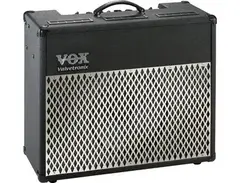
I've used the AD50VT in several different contexts: practicing, recording, and live gigs. It excels in the role of solo rehearsing, mainly because the wattage knob on the back of the amp functions like an attenuator would on a full-tube amp. It allows you to dial things down to 1 watt, or all the way up to 50 and all points in between. When using this knob with the Master Volume and Gain controls, it's possible to achieve thick, harmonically rich tones at bedroom volumes. It doesn't feel exactly like playing through a cranked tube amp, but you'd be surprised how much sustain can be squeezed out of a 1x12" at very low volume!
Additionally, this Vox combo makes a decent recording amp. I'm not sure I'd use it on a professional session, as there can be a little solid state fizziness in the treble when using certain amp models at high gain settings, but for demoing, if you insist on micing up an amp and dialing up cool sounds in a hurry, the AD50VT makes it pretty easy to capture very usable tones that strongly resemble those heard on classic rock recordings. For instance, the "UK 70s" amp model doesn't provide the punch of an un-modded Marshall half-stack, but it definitely conjures the appropriate vibe and will get you in the general area.
In terms of live performance, don't be fooled by the AD50VT's small size: with its closed-back cabinet, it has a tight low end and focused mid-range sounds that allow its tones to cut through a mix with ease. As mentioned, the high end can get a little fizzy from time to time, but whenever that happens, dialing back the Treble knob seems to help. The amp also has a pretty decent amount of volume on tap. The drummer from one of my old bands was easily the loudest I've ever played with, and my AD50VT was able to keep up with him without an issue. (Granted, it was usually pretty close to dimed.)
The only real problems with this amplifier pertain to live scenarios, where... Read More
-s.webp?v=1785250696)
15320
A Valiant Effort, But Not User-Friendly
First, it's worth noting that the sounds in this little blue box are great. The effects blend with a signal very well, allowing for the instant creation of lush atmospheres or just adding a little color to the sound of a wailing solo. However, I personally found the tones a little thin-sounding, compared to the rich analog tones of EHX's Digital Memory Boy or even the Line 6 Echo Park's tape echo model. The TC Electronic delay is, by comparison, remarkably clean but this comes at a cost to the character of the pedal.
Second, some of the pedal's innovations are a little clumsy. For instance, the idea of letting a player use their hands to set the tap tempo is a very good one considering that most guitarists spend a lot of energy working on their timing. It's likely that your strumming hand has better timing and control than either of your feet. However, having to hold down the FlashBack's footswitch for two full seconds to access the tap tempo is a real buzzkill. In a live performance situation, having your signal muted for as long as it takes to tap in a new tempo leaves a very noticeable gap in the mix. Also, while you are only required to hold the footswitch down for two seconds, this feels like an eternity onstage!
With that said, the Looper feature is one of the easiest to use of any I've ever encountered, although it does require that the player have pretty good foot-timing because there's no built-in quantization. The pedal starts recording the very instant you hit the footswitch, and starts playing as soon as you step on it again. However, with a little practice it's quite simple to get used to and before long, you'll be layering loops like a pro. My only qualm with the Looper is that one can't use a delay sound at the same time as looping, but this limitation is logical and not a deal-breaker.
The only feature I'll say I dislike outright on this pedal is the fact that the switch used to toggle trails on or off ("trails" referring to echoes continuing to occur after the pedal is turned off) is hidden in the pedal's chassis. To access it, you have to pick up the pedal and use a coin or some other large, flat implement to unscrew a panel on the reverse side of the FlashBack, inside of which you'll find an on/off switch. It seems to me that even mounting this as a toggle on the side of the pedal would have been a better idea than putting it under and inside of it.
When playing alone, the FlashBack is... Read More
41049
I really enjoyed your review and it made me think again about buying one of these or the alter ego... maybe I need the big version of these pedals to be able to tap my delays right, the strum feature sounded cool, but you made a great point about the gap in the guitar parts while you stomp, wait and then strum. And 'thin' sound is worrying too. Then again would probably use it true stereo into a distorting amp. Might thicken the tones up.
15320
I just bought the Flashback 4x, which is by far a superior pedal. The sounds are still killer--same thing, obviously--but the extra footswitches make it way more user-friendly. The dedicated tap tempo and separate effect on/off switches alone are a massive improvement. Only some of the tones are thin-sounding; most (especially the ones with modulation) are simply gorgeous. None of them feel as thick as a straight-up analog pedal does, but with that said, the "analog with modulation" setting is incredibly musical and very, very addictive. Highly recommended.
41049
Thanks! I really like the digital modeling route for delay since I don't use it a lot and its tough to wanna invest in a pile of vintage racks and stomps. But it sucks not having effects when the gig requires them. Great follow up about the 4X, man. Now I just have to decide whether to spend the time seeking the aler ego version or just roll with the blue one in all the big box stores....
15320
I'll do a review of the FB4X soon. It's a terrific pedal with arguably only one design flaw that I've found after 2 gigs with it (and even that is debatable). It's one of the best delays I think I've ever owned, and I've probably had one of everything under $300. Kills the DL4 IMO, although again, your mileage may vary.
If you want to hear my tunes, feel free to check out my bands' Soundcloud pages: http://www.soundcloud.com/bestnotbroken and http://www.soundcloud.com/oftheoceansea. Good luck getting through any of it :-)
15320
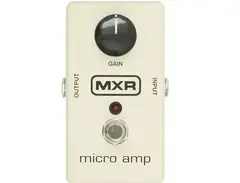
Very Good When Used as a Clean Boost Pedal
It's worth noting that the Micro Amp is mainly useful in the context of playing live, specifically with a tube amplifier. It's not likely to add much to your solo practice or writing sessions (although if you practice or write at a fairly loud volume, you may find that stomping on this guy when you arrive at a song's solo section fattens your sound a lot, which can be very inspiring) and when used in conjunction with a solid state or hybrid amp, you're unlikely to really be able to take advantage of the M-133's ability to add searing gain to an already-saturated amp sound.
Therefore, please bear in mind that "live performance" is the perspective from which the rest of this review is written, as I have never bothered to use this pedal in a recording context--since two different guitar signals recorded on different tracks can be blended to taste during mixdown, with levels raised or lowered accordingly.
MXR/Dunlop initially marketed the Micro Amp as a mere volume boost, and it definitely does a great job as such. As mentioned earlier, activating on the pedal as you play introduces a boost that is as subtle or extreme as you want it to be; as an added bonus, I can attest that I've never noticed any coloration to my guitar tone when using the M-133. Other boost pedals often introduce a midrange "hump" that I, personally, usually don't mind. But it's nice to know I can use the MXR unit to get more of my sound, unadulterated.
A secondary function, per the manufacturer, is to slam the front end of a tube amplifier with extra volume to create even more saturated gain sounds than an amp is capable of producing on its own. Again, the M-133 Micro Amp excels at this, too.
Recently, MXR/Dunlop has been touting the pedal as a quick fix for guitarists who switch back and forth between, say, a Fender Stratocaster and a Gibson Les Paul during the course of a performance. Anyone who has utilized two instruments with different pickup configurations during the course of a single show is going to be... Read More
41049
You left out the studio. If, like me, you often like to play solos on a vintage spec strat or tele into a an old-school tube amp with moderate amounts of preamp gain, a clean boost like this is an invaluable tool while recording. I used to be a dyed in the wool TS9 man (and later an 80s SD1 guy), often using them as a colored, dirty boost for solos with fender guitars (like everyone and their mother likes to), but in the 90s I got turned on to clean boosts, treble boosts and even the venerable MXR Dynacomp as ways to add gain and 'cut' (these pedals generally turn your hi-z guitar signal into a fairly low-z affair that drives the cable a lot easier which will add/preserve treble just like a buffer) for a solo sound without sacrificing the bandwidth and signature voice of my guitar. I do this more in the studio than live, believe it or not. Live I tend to dime an AC30 and control everything with my guitar volume knob. Maybe I'll run an always-on boost or buffer if I need a line-driver on a big stage.
As far as MXR's claim that this is an easy output matching fix for guys who go between fender and Gibson? The very different frequency responses on bolts with single versus gibbies with buckers means the perceived level may never really match up, but if you're just trying to get them to tickle V1 in your amp similarly it may help. Personally I switch guitars as much for a change in output as I do for a change in feel. I have less need for multiple amps or channel switchers if I recognize that my wannabe-59 tele is not a hard rocker and I save that guitar for ballads and such where a clean, chimey tone and a little less volume at 10 is quite alright... by the same token I have to recognize my 335 mostly wants to rock, but the A2 pickups are soft in tone, low output for humbuckers and sit back in the mix as a rhythm instrument, so I should use her that way live... Then there's my SG. Not a tone of output on paper, but DCR is not the be-all-end-all of output and out-front-ness, because that guitar wants to rock hard and stand out with the vocal as something the audience (when there is one) wants, no.... NEEDS to listen to. And that's just my 3 favorite guitars, they all have a voice and a use which is why MXR's whole marketing conception seems to defeat the point of switching guitars live... or switching at all. Out put and frequency response are 50% of my motivation. a variety of outputs isn't a problem to solve, its a palette of colors to paint with and your tube amp's the brush.
That said, the M-133 is a pretty flat sounding transistorized boost pedal, though it doesn't have the tubey sparkle of a ZVex SHO or any other jfet or mosfet based booster.
15320
Wow. I wish I could add your thoughts to my review as a third-party opinion. That's super valuable input! I haven't really used mine in a studio setting--seemed a little redundant to me, in my admittedly limited experience--so that's very useful information.
I don't really know that MXR is still marketing the MicroAmp as a single-coil/HB matching device, but they sure were about ten years ago when I got mine. Which is odd, given that Seymour Duncan makes a similar device that isn't just a boost pedal, but actually has a bit more going on under the hood. (Like you, though, I'd debate the merits of such a device on grounds that I don't see much point in trying to make different guitars sound the same.)
Thanks for adding those thoughts. I hope anyone who reads my review will also consider your experience as well.
41049
Thanks. I always try to kick out a lot of practical info on pieces of gear I've made extensive use of...

15320
A Nice, Powerful, Versatile Workhorse of an Amp For Modern Rock Players
For the record, I would more accurately rate this amp at 3.5 stars out of 5. Three sounds too low, but four would be too generous. With that said...
Some amplifier manufacturers are getting really good at packing a vast array of features into their products. And while this was largely window dressing for about a decade, today many of these features are very usable. However, the upshot of all the built-in technology is that many amps require a thorough reading of a Bible-sized manual to gain an understanding of the basic manual operation of your new gear.
This is where the HT-Studio 20 succeeds among its peers: Blackstar has hit a great balance between putting in enough features to appeal to guitarists who need versatility, while keeping the user interface clean and simple.
The control panel is very straightforward, with each channel on its own side. The Clean Channel controls are limited to Volume and Tone knobs. At first, I thought this would be very limiting, but after a little over a year with this amp, I can say that a well-voiced clean channel like this one really doesn't seem to need any additional options. I set the Volume where I want it based on the environment I'm in, and then I turn the Tone knob left to roll off the high end and increase the bass frequencies, or turn it to the right to dial in some more treble while taming the bass. It's that easy.
The Overdrive Channel is a little more complex, with its own Gain, Volume and EQ section. The HT-20 has a LOT of gain on tap, by the way--more than I will ever use. In this way, I can see why metal guys dig Blackstar's gear. However, I find that I'm able to keep that dial below 12 o'clock and summon everything from classic rock crunch to modern rock grind. Anything above that just seems egregious to me, but if you're looking for more, the Studio 20 has it.
Another interesting feature of the Overdrive Channel is its independent EQ section. While it has separate knobs for Bass, Middle and Treble frequencies, the HT-20 also makes use of Blackstar's proprietary Infinite Shape Feature (or ISF)... Read More

12239
Solid review! I've been curious about the blackstars.
So many others are just "This product is the best for.... reasons".
15320
Thanks for reading, Boom. I ended up trading in the HT-20 toward an AC-30C2, but only because I prefer a strictly British-voiced character. I really wasn't making full use of the Blackstar's versatility. But it's a great tool for someone in a cover band, say--who plays clubs and doesn't need a ton of volume, but also needs tonal versatility. That said, it doesn't quite have its own character, to my ears, which is why I docked it 1.5 stars. Still, it's a very good amp.
15320
A Straight-Up Modern Classic
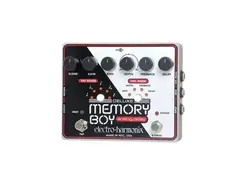
The anticipation was killing me: I'd just purchased a used Deluxe Memory Boy (referred to henceforth as the DMM) by Electro-Harmonix (referred to henceforth as EHX). However, the store had to hold it until local law said it had not been reported as missing to the police. I got a great deal on the pedal, and couldn't wait to see what an analog echo unit with a tap tempo feature would do for me.
It turned out to be worthwhile. The DMM's brushed-steel casing was bigger than most compact single effect pedals, but smaller than most digital modeling units or even other analog delays. I'm always impressed when a pedal's construction is sturdy enough to use for defense in a home invasion scenario, but light enough that a toddler with a good arm could chuck it across a room.
I wasn't concerned about the lack of a battery port as I always run my pedals daisy-chained to a power supply anyway, but realize that this could be an issue for some players who prefer the independence conferred by a 9-volt rectangle. Still, I powered up the pedal and dove right in, and was immediately impressed by the DMM's rich, lush sounds. As an experienced user of echo pedals, it didn't take me long at all to figure out what was going on with EHX's latest entry into the market. Soon, I was conjuring everything from U2-esque triplet-accented arpeggios to blurry, My Bloody Valentine-ish swathes of color trailing strummed chords.
As always, when reviewing a pedal, I like to evaluate and consider it in every context in which it will be used. To that end, I'd like to start by discussing how the EHX Deluxe Memory Boy performs when playing without accompaniment.
The DMM's analog sound is big, big big: it adds so much girth to a guitar signal that, if used properly, sounding like 2 or even 3 guitarists is possible. The multitude of features basically begs the user to dig in and explore, and the variety of patterns and textures available lend themselves well to the creation of new guitar parts or even of full songs/instrumental pieces. Run in stereo, the DMM is even more formidable.
In a studio situation, the DMM is an ideal peformer. Its relatively low noise threshold (uncommon in the world of analog delay units) makes it a breeze to record. And because the user can control so much of what the effected signal sounds like, it's possible to get a setup going where there's minimal difference when switching the DMM on and off--always a huge relief for studio engineers.
When performing with a band, which is where my own Deluxe Memory Boy has gotten the most mileage, the pedal is highly valuable... Read More
15320
Very versatile. It's not the most distinctive delay on the market, but it's easy to get a great sound out of and fun to use.
15320
A Great Analog Solid State Amp
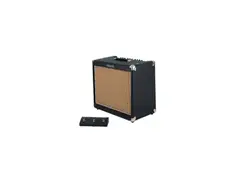
When I utilized the Trademark 60 in solo practice and writing sessions, I found it incredibly inspirational. While it doesn't have the attenuator-type of technology found in, say, Vox's hybrid amplifiers--meaning that like a true tube amp, the Trademark 60 sounds better the louder you push it--even at low volumes, I had no trouble finding tones and sounds I really liked, making it a lot of fun to play through.
Recording was a fairly easy proposition, too, as the amp sounds great either miked up (I suggest pointing your microphone directly at the center of the cone, though, because the thick basket-weave grill cover does absorb a certain amount of sound that typically passes right through cloth covers) or when connected directly to a recording source via the SamsAmp's XLR output. In fact, when comparing two tracks played with the same amp side-by-side--one miked up, one sent through the SansAmp output--it was a little difficult to tell which was which. In the end, the miked track had a little more "air" to it, giving it a tiny bit more of a realistic feeling, but this is unlikely to be something an average listener would notice.
In a live context, Tech 21's creation becomes a little more of a complicated proposition. While the amp sounds fantastic on its own, and is more than capable of keeping pace with a full band (I had several scenarios where I had to turn it lower than expected so as not to deafen a drummer), when playing on the same stage as another guitarist who has a tube amplifier things can get trickier. It's then that the solid state thinness of the tones become a little more noticeable, and while you can compensate somewhat via the EQ knobs, it still lacks that fundamental punch that comes with real tubes.
With that said, this amp has some pretty cool tones that are uniquely its own, and it makes one wish after awhile that instead of going the modeling route, Tech 21 had pursued the creation of an analog-circuit solid state amp with a singular character... Read More
41049
You're a gear review artist. Do you write for a print guitar rag or something?
15320
Nope, just for shits 'n' giggles via my little blog. But thanks for the kind words, and for taking the time to read my ramblings!
-s.webp?v=1785164458)
15320
Hard to Beat at Its Price!
Right off the rack, the fit and finish of this bass was astounding. It absolutely smoked my old Affinity Precision, which had jagged, sharp fret-ends and seemed to be impossible to intonate. And the tones... the comparison almost seemed unfair. The 70s Jazz Bass's simple control setup allows for a huge variety of tones, ranging from a deep reggae throb to a trebly rock attack.
There are two Duncan-Designed single coil pickups, which are where the "vintage modified" part of the bass's name comes in (they're spaced according to 60s specs, rather than true 70s measurements). These are positioned at the neck and bridge. The first chrome-plated knob that your plucking hand will encounter controls the volume of the neck pickup, whereas the second one adjusts the volume at the bridge. The third is a master tone knob, which controls the tone for both pups simultaneously.
It's that simple.
Now, you might expect that like most jazz basses, this one tends to do bright rock tones and not much else, and you're not far from the truth--I don't really do any jazz, blues, or what-have-you. But my post-punk and new wave influences mean that my bass tracks move between high lead runs up near the top of the neck with a drone string going (a la Joy Division/New Order's Peter Hook) and low, deep pulsing tones softly picked with the fingers or even the thumb (along the lines of Public Image Ltd's Jah Wobble, or Sting in his Police days). The Squier 70s VM Jazz bass keeps up with all of it quite ably, because the pickups are voiced so differently that mixing and blending with the volume knobs alone produces a fairly wide array of sounds. And that's before we even mix in the tone knob... Read More
15320
Great Dirtbox With Minor Flaws
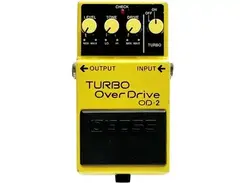
In terms of tonal character, it should be noted that the OD-2 produces two types of overdrive, accessible via the Turbo On/Off switch. With the Turbo switch turned off, the sound is reminiscient of a darker-voiced SD-1. It retains the slightly aggressive edge of the Super Overdrive, presumably the result of asymmetrical clipping, rather than the smooth sound of symmetrical clipping a la the Tubescreamer.
However, turn the Turbo switch on, and this is where the magic really starts to happen. Suddenly, the pedal produces a very thick sound bordering on distortion that absolutely saturates both rhythm and lead playing. As with the SD-1, on most settings it's not so heavy that it drowns out the individual notes in a strummed chord, but it's definitely a much fatter sound than the Super Overdrive, rich with harmonic overtones.
But just when you're starting to fall in love with the pedal, things get sticky. The OD-2 has one major quirk that you'll probably discover pretty quickly if you spend even a little time playing through it. Finding "gain unity" (or the point where the volume coming out of your amp when the effect is on is equal to the volume coming out of your amp when the off) is a very tricky prospect. And just when you think you've got it figured out, beware: I've had this pedal set so it sounds exactly as I want it to, then transported it from a practice space to a show without changing the settings at all, only to turn it on and find that the effected signal's volume is dramatically lower than the clean sound when the pedal is off. Oddly, I've never found that the pedal seems too loud--the mystery problem usually results in not being able to wring quite enough volume out of it, to the point where the clean/dirty sounds feel totally out of balance... Read More
41049
This was a really thorough review of a ubiquitous, mass market pedal we all owned at some point in our careers. Thanks for doin' it up right.
15320
No worries, Jim. I'm pleased to be able to add to any useful dialogue about a "lost" classic. (Still don't know why these aren't being manufactured anymore, though I guess the new SD-1W has incorporated some of the features found in the OD-2. Yet to get my hands on that one, though.)
15320
A Fine Modern Version of a Classic Amp
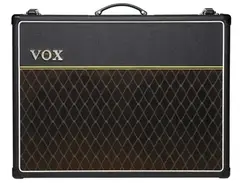
The Vox AC-30C2 (the "C" stands for "Custom") was released in early 2010 to replace the previous AC-30CC (or "Custom Classic") line. For those who are unfamiliar with the venerable AC-30 amplifier, this combo has been in production since the early 1960s and has appeared on countless stages worldwide, and on many of the most popular rock and pop recordings of all time. The secret to the Vox AC-30's magic seems to lie in its versatility: it is capable of producing beautiful, chiming clean tones at high volumes, yet it can also dish out some fairly nasty overdrive sounds when it's cranked. And more importantly, it can hit every sweet spot in between these two extremes.
Bear in mind that these amps are no longer manufactured in the UK. Korg acquired Vox in 1992, and in 2005, they moved production to China. Subsequently, some players insist that the quality of products has diminished. And indeed, with the release of the AC-30C2, some changes were made to the company's flagship amp that offended purists, but it's worth noting that many of these alterations are considered by other players to be improvements.
As the former owner of an AC-30TB/6 that was manufactured in the UK (which I unfortunately had to part with several years ago for financial reasons), my personal opinion is that the AC-30C2 represents a step forward in some ways, and a step back in others.
When I first plugged into the amplifier at my local music store, I was immediately struck by the build of the amp. It's every bit as heavy as I remember my old AC-30 being, but the three plastic handles on the modern model feel thicker and sturdier, making transportation at least a little easier and less worrisome. Also, although the cab is apparently made of MDF (particle board, basically), the whole thing seems well-constructed and very solid.
The amplifier retains its older siblings' classy looks... Read More
15320
Amazing Leveling Tool
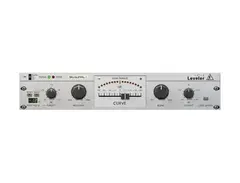
Selig's Leveler (formerly known as the Curve) is an intelligent processing tool capable of evening out tracks with incredibly disparate dynamic levels without raising any background noise present in the recording. I'm not sure whether it's available for any other DAWs, but it is touted primarily for use with Propellerhead's Reason.
It's quite easy to use, with a deceptively simple user interface that provides a lot of processing options. The basic idea is that you apply it to a track, and then watch as the meter tells you the lowest volume (in dBs) present, as well as the highest. Then, you set the target level, and adjust the Curve control to balance out the two extremes. The wet/dry knob allows you to blend the signal to taste, so you can squash the signal to make the quiet parts as loud as the loudest parts, or lay back a little to preserve some of the original performance's dynamic integrity.
What's more, the Selig Leveler somehow manages to accomplish this without coloring the tone of the track, and doesn't raise the background noise level. I have used this rack extension on vocals that were recorded in less-than-ideal circumstances (mainly bright rooms with more reflection than I'd have liked), and although I ran a noise gate to kill the signal between the singer's lines, there was still a little bit of extraneous air audible between certain syllables. The Leveler managed to raise the quiet verse parts substantially without these elements becoming more pronounced. I don't understand how it manages to do this, especially without a sensitivity or threshold control, but it does. I've subsequently had a lot of luck performing similar cleanup on live drum tracks, and on certain bass tracks, I use the Leveler instead of a compressor to smooth things out.
In short, I would say that the Selig Leveler is an absolute must-own rack extension for any Reason user who tracks live vocals or instrumentation. With a little experimentation, it can absolutely help achieve a more professional-sounding mix.
-s.webp?v=1784732434)
15320
A Unexpected Gem
I'm always skeptical about user-contributed reviews on forums, websites and the like, especially when it comes to an instrument that has been owned for a short period of time. How often do you come across an evaluation where the writer's enthusiasm seems to be fueled more by the endorphin rush of a recent purchase than by the actual quality of the product? "I got this guitar two days ago, and it is THE MOST AWESOME GUITAR EVER UNICORNS RIDING RAINBOWS SHOOT OUT OF MY AMP WHEN I PLAY IT ZOMG!!!!"
In my humble opinion, you don't really know much about a guitar until one has played at least a handful of practices and gigs with it, and put it under the microscope of a recording. And even then, it's debatable how well you'll understand the instrument.
With that said, I've owned my Coronado II for a few months now, and I've put it through its paces in all three of the main environments I described above. I feel pretty well qualified to review it by now, although I will say that you should take my opinion with a grain of salt, because the "new guitar" smell hasn't worn off yet--at least, not psychologically. That could be a good thing, though. In all honesty, the Coronado has quickly and unexpectedly become my favorite guitar. It's basically everything I've ever wanted in an axe, though I never thought I'd find it in this Chinese-made reissue of a late-60s weirdo model.
The original Coronado rolled out in 1965 as Fender's response to the British Invasion; many of those bands landed in the US playing hollowbodied guitars, and it seems Leo didn't want to miss the boat (or plane, as it were). However, it didn't really find an audience, and the Coronado was discontinued in 1972.
Fast-forward to 2013, when the popularity of indie rock hit an all-time high and a diverse group of artists could be clocked rocking vintage Fender hollowbodies like the Coronado and Starcaster. The California-based guitar manufacturing icon responded to demand by reissuing both of these instruments, albeit with some modifications made. The Coronado II, in particular, is fairly different from the original design in several ways; the biggest change being the inclusion of a center block, which adds heft and is alleged to dramatically reduce feedback.
I must confess that I've never played an older model. However, the instant I picked up the RI version, I knew it was the guitar for me. There are several things I love about this instrument. The first thing is the feel. Chinese-made products have a spotty reputation at best, so I was surprised by the high quality of the workmanship. The binding was beautiful and perfectly placed (even around the f-holes!) and the frets, which are normally ragged and snarly on a foreign-made, budget-priced instrument were filed perfectly. The intonation was flawless right off the rack, and even after I switched from the floor-model size .09 strings to my preferred D'Addario .11-.49s, I didn't need to make any adjustments. It was perfectly in tune.
The guitar feels wonderful; the center block brings it to over 8 lbs, but the instrument is large enough that the weight seems to be somehow more evenly distributed than something like a Les Paul. The balance is such that the neck never dips when hanging off your body via a strap--it always juts out into space, pretty much wherever you leave it after letting go. I cannot stress enough how much of a convenience this is when playing a live show, especially if you're a somewhat active stage performer. The neck profile is fairly slim, so if you like modern Strats (especially the MIM 70s Classic Player reissues), you'll be right at home on the Coronado. The body is obviously thicker than most Fender solidbody models, but somehow, it doesn't feel substantially different, the way a 335 does. It's still fairly compact, and its size didn't take more than a few days to adjust to. Already, I very much prefer it.
The Fidel'itron pickups are a big part of the appeal of this guitar for me. To call them "versatile" would be an understatement. If I didn't know better, I'd say that they were intuitively adapting to whatever I'm playing and however I'm playing it. If I need a sparkling-clean tone that with that classic Fender single-coil spank, the Coronado II delivers it. On the other hand, if I need a big, thick, sustained sound, it turns out the guitar is no shrinking violet--I can get "rawk" sounds just as easily. And the real magic happens when you're looking for those in-between tones. It's incredibly easy to dial in semi-dirty sounds, and the guitar cleans up in response to my pick attack or when the volume is dialed back a little. It's like the damned thing is reading my mind on the fly.
For the record, I play in an original pop/rock band that moonlights playing covers. We do a pretty wide variety of material in our covers sets, ranging from 70s/80s rock and new wave to modern pop and even a small amount of R&B/hip-hop. I used to switch between 3 guitars over the course of an evening to get the right sound and feel for each song; I now find myself playing 90% of the set with the Coronado II. And the only reason I switch is that at the end of the night, when I REALLY lay into my guitar in the home stretch, I don't want to beat my trusty steed senseless. (I save that aggression for the Strat.)
I really can't recommend this guitar highly enough. It's an absolute bargain at $699, and I bought mine as a B-stock for $599 due to a blemish in the finish that I'm still unable to locate, 4 months in. Pro life tip: the Coronado II also fits nicely into most 335-sized hardshell cases, making it really easy to protect and carry. Check it out if you get the chance.
15320
Nice Boost Pedal With Added Feedback Capability
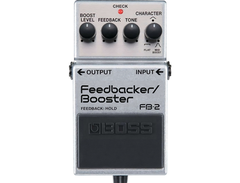
There are two kinds of guitarists: those who prefer a transparent boost, and those who don't mind a little color in their signal. The Boss FB-2 seems to come up somewhere in the middle, oddly enough. It's nowhere near as clear as, say, the MXR MicroAmp--probably due to Roland's buffer--but at its mildest EQ setting, it's much more difficult to hear than you might expect.
The secret sauce here is the Tone knob, which allows the user to dial in anything from a flat (non-EQed) signal to a bold midrange hump, up to more extreme settings. And actually, with the Tone knob at 12 o'clock, the pedal can really fatten a guitar's sound and really help it cut through a mix. This is especially useful with single-coil guitars, like a Fender Strat, which can sound thin in the context of a live band.
This pedal has a few other neat tricks up its sleeve. Most obviously (since it's part of the unit's name), it can assist in the generation of feedback when the pedal is held down. It does this by raising the volume slightly, and the nature of the feedback generated varies depending on where you position the Feedback knob. In my experience, the noise floor and volume increase substantially the higher you set this value; however, that can be a desired effect in certain circumstances. The lower half of this dial can be used to summon nice, droning waves at fairly low volumes, making it extremely useful in small gig or practice settings.
Another nice aspect of the FB-2 is that, with the Boost and Character knobs set sufficiently high, the pedal begins to act more like an overdrive pedal. It has a more harsh character than, say, the SD-1 or a Tube Screamer, but it's not unpleasant--in fact, there are times when I find myself using the pedal specifically in this way, rather than engaging my super-smooth Fulldrive II MOSFET. I like the "clang"-y nature of the FB-2's driven tones; they're reminiscent of classic punk and post-punk records, to my ears.
In short, this is a cool pedal with a fair amount of sounds to be explored. Highly recommended.
15320
A Great Budget-Level Compressor for Reason Users
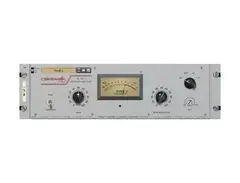
Cakewalk's Reason-based emulation of the legendary LA-2A compressor (itself a version of its CA-2A VST) is a very versatile tool for getting live recorded elements to either pop or sit correctly in a mix, or for taming some wilder electronic sounds.
I have personally found that this compressor is excellent for vocals and guitars, and I've had a fair amount of luck applying it to live recorded drum tracks, as well. The presets are useful, if only as a starting point, but it's essential to learn to tweak the RE-2A by ear to achieve the best results.
A word of caution: this is not a very transparent-sounding compression tool. With that said, I really love the warmth it can add when used properly. It gives vocals a certain live quality that additional processing sometimes seems to take out of even a well-recorded signal. I don't apply it to glossy-sounding synths very often for this reason; using the RE-2A may undesirable coloration of certain instruments that are best presented with a pristine, digital sheen.
In summation, I would highly recommend this studio effect for all Reason users, but especially those who mix live recorded tracks in with their programmed electronic elements.