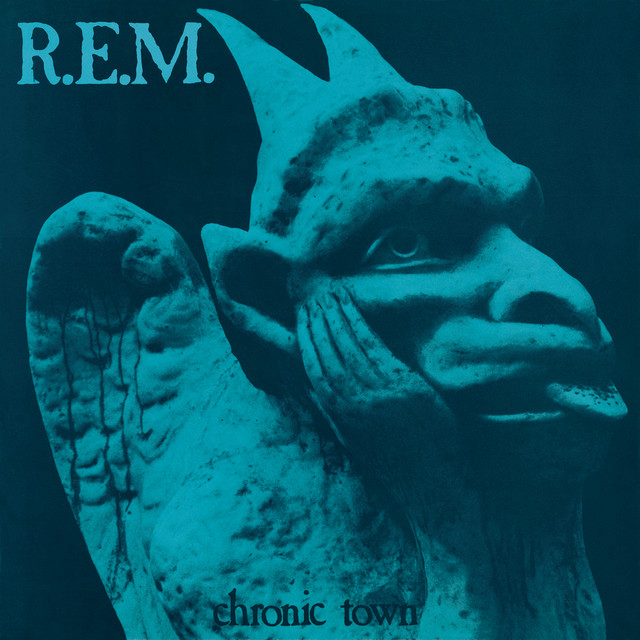
R.E.M. – Chronic Town
The music gear and equipment used by the artists, producers, engineers, and more involved in the making of the 1982 single Chronic Town.
Music from Chronic Town

Gear Used On Chronic Town
Explore the instruments, equipment, software, and production tools used in the making of R.E.M. – Chronic Town (1982). Click more on each item to see exactly how it was used.

Peter Buck
Roles:
Amplifiers used by Peter Buck on Chronic Town

Avg price: $449.95
Producer Mitch Easter's Gemini II was used on Murmur, according to these five sources.
R.E.M.'s Murmur by J. Niimi (2005)
Peter Buck's workhorse amp—his Fender Twin—was broken at the time, so Easter loaned him his checkerboard-grill Ampeg Gemini II for the session, which was used on most tracks, alongside the studio's little solid state (i.e., transistor rather than tube-driven) Kasino amp. Guitar-wise, Buck had brought his maple-glo Rickenbacker 360, which he had also used on the Chronic Town session.
RickResource, blue330 (Mitch Easter), April 14, 2008 comment on the thread "What about Peter Buck?"
Mr. Buck played a 360 on Murmur, not a 330. And I recall it was the Jetglo one, not the Mapleglo one he had on their first session here in NC. On Murmur, the amps were a little Kasino solid state thing (Pilgrimage only), and an Ampeg Gemini II. No AC30s! They came much later, and the last couple of times I saw them his amp was a small Silvertone.
Mitch Easter
Sound on Sound, November 2009, “REM ‘Radio Free Europe’ | Classic Tracks”
Standing on the left side of the studio, Peter Buck used Easter's own Ampeg, wide open without gobos and miked with an EV 635 or, for some overdubs, a compressed Neumann U47 FET.
Tell us about the guitar sounds…
“Peter [Buck] played all the guitars. I think he had a [Fender] Twin Reverb then. He used those for a long time. In the session, he played an electric 12-string, but not a Rickenbacker. It was a Fender Electric XII. I didn’t have a lot of recording equipment, but I did have a good guitar and amp selection.
“I told him, ‘You might want to try this.’ When we did Murmur [in 1983], I remember Peter’s Twin Reverb was dead, so that record was done with my 60s Ampeg Gemini II. It’s on every song on Murmur except Pilgrimage. I think the guitars on Murmur are the classic early Peter Buck sound.
“The thing about Peter Buck’s sound that’s really important is he used larger gauge flatwound strings. That’s what made it all work. Those Rickenbacker pickups sound better the more metal you put over them. And you develop a very deliberate way of playing. That’s what you can hear in his playing. You can hear everything he did. He really mastered it.”
[Guitar Player, February 9, 2022, "'A Lot of Bands Simply Wanted to Fit In, but R.E.M. Always Wanted to Be Themselves': Producer Mitch Easter Reveals the Genius Behind the Jangle Pop"]
What amps was Peter using at first?
He had a Fender Twin, and that’s what we recorded with. I remember when we were doing “Pilgrimage” at Reflection Studio in Charlotte, the Twin was in the shop. [“Pilgrimage” was recorded prior to Murmur as a “test” for I.R.S. Records.]
I didn’t have anything with me, but there was a Kasino solid-state amp in the studio, so we used that, and it sounded great. I think some people might faint knowing that we used this little 25-watt solid-state practice amp, but it had a really nice sound. There were oddball things like that.
For Murmur, he still didn’t have his amp back, so he used my Ampeg G-15. That amp and the Kasino are what’s on Murmur. When they came in to do Reckoning, he had his Twin back. But if you’re a distinctive-sounding guy like him, you sound like yourself no matter what.


World Instruments used by Peter Buck on Chronic Town
-m.webp?v=1783164314)
Avg price: $612.71
Producer Mitch Easter's Danelectro sitar was used for the Chronic Town EP and Murmur, as recalled by Easter in R.E.M.'s Murmur (2005) by J. Niimi.
Easter brought along his white Fender Electric XII twelve-string guitar (a gift from his father when he turned thirteen; Peter Buck did not own an electric Rickenbacker twelve-string at this point, contrary to fan myth), as well as his trusty Danelectro electric sitar (which Buck had used in the Chronic Town session, most prominently on "Gardening at Night"). Easter's Electric XII can also be heard on many of Let's Active's early recordings.

Guitars used by Peter Buck on Chronic Town

Fender Electric XII 12-String Guitar
Avg price: $1,750.00
Producer Mitch Easter's XII twelve-string was used on Murmur, as recalled by Easter in R.E.M.'s Murmur (2005) by J. Niimi.
Easter brought along his white Fender Electric XII twelve-string guitar (a gift from his father when he turned thirteen; Peter Buck did not own an electric Rickenbacker twelve-string at this point, contrary to fan myth), as well as his trusty Danelectro electric sitar (which Buck had used in the Chronic Town session, most prominently on "Gardening at Night"). Easter's Electric XII can also be heard on many of Let's Active's early recordings.

Studio Equipment used by Peter Buck on Chronic Town

Avg price: $26.75
Used to record the Chronic Town EP, as recalled by producer Mitch Easter in this November 2009 Sound on Sound interview.
"After buying all of this used equipment, the bare minimum you could make records with, I just started up shop. I didn't have any training or professional experience, but having already made tons of four‑track recordings at home on a TEAC 2340 with my friend Chris Stamey — using only an Echoplex and a TEAC device that would switch the four outputs to left, right or centre — I figured, 'Well what's the difference?' It really wasn't all that different. The four‑track had been fantastic in terms of learning how things worked, and I was right in figuring the pro stuff would be the same, except I had to start all over again because it was much more clean‑sounding. This great fur that the old four‑track had put on everything made it all hang together, and so now I had to re‑learn what I was doing.
"I had two 3M tape machines — a classic M56 two‑inch 16‑track and the equivalent M64 two‑track machine — along with a pair of ADS 810 monitors and a Quantum Audio board manufactured in California by one of the very few companies that were still making humble pro‑level consoles. It was a 12‑channel board with an eight‑channel sidecar, bolted together at the factory to custom order. With 20 inputs, 16 tracks of monitoring, three‑band EQ on every channel, a couple of aux sends and a couple of echo sends I thought I was really living. It was an unbelievable leap from anything I had ever used before. Everything worked pretty well and I also bought a couple thousand dollars of good microphones, the showpieces being two AKG 414s.
"Everything was learned as I went along. With the TEAC, Chris and I had originally put two microphones on the drums, which was a good introduction to moving the mics around until everything sounds good, and then later, when we had four or five microphones, we started messing around with individually recording more parts of the kit, and from that I learned a lot about just tuning the drums. The fact that we had no EQ and no nothing made us get the sounds totally with drum tone and mic placement.”

Michael Stipe
Roles:
Studio Equipment used by Michael Stipe on Chronic Town
Avg price: $26.75
Used to record the Chronic Town EP, as recalled by producer Mitch Easter in this November 2009 Sound on Sound interview.
"After buying all of this used equipment, the bare minimum you could make records with, I just started up shop. I didn't have any training or professional experience, but having already made tons of four‑track recordings at home on a TEAC 2340 with my friend Chris Stamey — using only an Echoplex and a TEAC device that would switch the four outputs to left, right or centre — I figured, 'Well what's the difference?' It really wasn't all that different. The four‑track had been fantastic in terms of learning how things worked, and I was right in figuring the pro stuff would be the same, except I had to start all over again because it was much more clean‑sounding. This great fur that the old four‑track had put on everything made it all hang together, and so now I had to re‑learn what I was doing.
"I had two 3M tape machines — a classic M56 two‑inch 16‑track and the equivalent M64 two‑track machine — along with a pair of ADS 810 monitors and a Quantum Audio board manufactured in California by one of the very few companies that were still making humble pro‑level consoles. It was a 12‑channel board with an eight‑channel sidecar, bolted together at the factory to custom order. With 20 inputs, 16 tracks of monitoring, three‑band EQ on every channel, a couple of aux sends and a couple of echo sends I thought I was really living. It was an unbelievable leap from anything I had ever used before. Everything worked pretty well and I also bought a couple thousand dollars of good microphones, the showpieces being two AKG 414s.
"Everything was learned as I went along. With the TEAC, Chris and I had originally put two microphones on the drums, which was a good introduction to moving the mics around until everything sounds good, and then later, when we had four or five microphones, we started messing around with individually recording more parts of the kit, and from that I learned a lot about just tuning the drums. The fact that we had no EQ and no nothing made us get the sounds totally with drum tone and mic placement.”

Mike Mills
Roles:
Studio Equipment used by Mike Mills on Chronic Town
Avg price: $26.75
Used to record the Chronic Town EP, as recalled by producer Mitch Easter in this November 2009 Sound on Sound interview.
"After buying all of this used equipment, the bare minimum you could make records with, I just started up shop. I didn't have any training or professional experience, but having already made tons of four‑track recordings at home on a TEAC 2340 with my friend Chris Stamey — using only an Echoplex and a TEAC device that would switch the four outputs to left, right or centre — I figured, 'Well what's the difference?' It really wasn't all that different. The four‑track had been fantastic in terms of learning how things worked, and I was right in figuring the pro stuff would be the same, except I had to start all over again because it was much more clean‑sounding. This great fur that the old four‑track had put on everything made it all hang together, and so now I had to re‑learn what I was doing.
"I had two 3M tape machines — a classic M56 two‑inch 16‑track and the equivalent M64 two‑track machine — along with a pair of ADS 810 monitors and a Quantum Audio board manufactured in California by one of the very few companies that were still making humble pro‑level consoles. It was a 12‑channel board with an eight‑channel sidecar, bolted together at the factory to custom order. With 20 inputs, 16 tracks of monitoring, three‑band EQ on every channel, a couple of aux sends and a couple of echo sends I thought I was really living. It was an unbelievable leap from anything I had ever used before. Everything worked pretty well and I also bought a couple thousand dollars of good microphones, the showpieces being two AKG 414s.
"Everything was learned as I went along. With the TEAC, Chris and I had originally put two microphones on the drums, which was a good introduction to moving the mics around until everything sounds good, and then later, when we had four or five microphones, we started messing around with individually recording more parts of the kit, and from that I learned a lot about just tuning the drums. The fact that we had no EQ and no nothing made us get the sounds totally with drum tone and mic placement.”

Bill Berry
Roles:
Studio Equipment used by Bill Berry on Chronic Town
Avg price: $26.75
Used to record the Chronic Town EP, as recalled by producer Mitch Easter in this November 2009 Sound on Sound interview.
"After buying all of this used equipment, the bare minimum you could make records with, I just started up shop. I didn't have any training or professional experience, but having already made tons of four‑track recordings at home on a TEAC 2340 with my friend Chris Stamey — using only an Echoplex and a TEAC device that would switch the four outputs to left, right or centre — I figured, 'Well what's the difference?' It really wasn't all that different. The four‑track had been fantastic in terms of learning how things worked, and I was right in figuring the pro stuff would be the same, except I had to start all over again because it was much more clean‑sounding. This great fur that the old four‑track had put on everything made it all hang together, and so now I had to re‑learn what I was doing.
"I had two 3M tape machines — a classic M56 two‑inch 16‑track and the equivalent M64 two‑track machine — along with a pair of ADS 810 monitors and a Quantum Audio board manufactured in California by one of the very few companies that were still making humble pro‑level consoles. It was a 12‑channel board with an eight‑channel sidecar, bolted together at the factory to custom order. With 20 inputs, 16 tracks of monitoring, three‑band EQ on every channel, a couple of aux sends and a couple of echo sends I thought I was really living. It was an unbelievable leap from anything I had ever used before. Everything worked pretty well and I also bought a couple thousand dollars of good microphones, the showpieces being two AKG 414s.
"Everything was learned as I went along. With the TEAC, Chris and I had originally put two microphones on the drums, which was a good introduction to moving the mics around until everything sounds good, and then later, when we had four or five microphones, we started messing around with individually recording more parts of the kit, and from that I learned a lot about just tuning the drums. The fact that we had no EQ and no nothing made us get the sounds totally with drum tone and mic placement.”