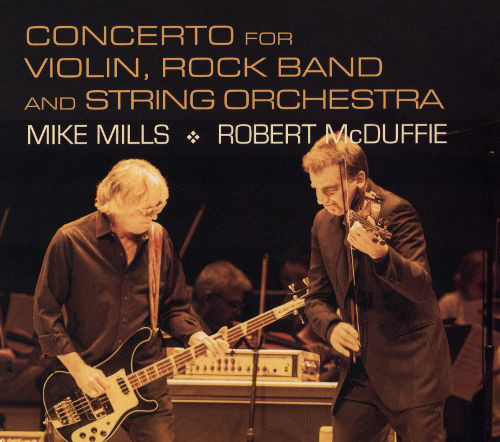
Mike Mills
R.E.M. bass player
Role
Role
Mike Mills' Gear


In this photo, Mike Mills can be seen playing a Fender Precision Bass.
Find it on:


R.E.M. live on the tube 11/18/83. The whole video you can see Mike playing the jazz bass through the bridge pickup.
Find it on:


Used in the "mid-70s", as stated in this July 13, 2017 Music Radar interview.
His mid-70s bass setup was modelled after that of a local hero, Allman Brothers Band bassist Berry Oakley. “I had two Fender Dual Showman reverb amps: one cabinet with two 12s and one cabinet with four tens,” he remembers. Although Mills is most often associated with the Rickenbacker 4001, he went through a series of basses before finding the Rick.
“I played a beat-up Hofner for a while,” he says. “Then I played an Ampeg Dan Armstrong clear acrylic bass, followed by a Fender Musicmaster, and then I found that ’71 Rick.”
The 4001 remained Mills’ instrument of choice “until one of the horseshoe pickups went out. We couldn’t find another one.” He got a factory-replacement pickup, but wasn’t happy with it, so he went through another series of basses - an Ibanez and Guild among them - before trying out a 1970 Fender Precision he calls Old Yeller after its original finish.
“I had sort of resisted the P-Bass,” he says, “because everybody played them. But then I found out why. It was because they’re the best, especially for live shows. They’re just so durable, and they don’t go out of tune. They sound fantastic, and they feel good to play.”
Eventually, though, Mills’ bass tech located a working vintage horseshoe pickup, and the 4001 was returned to active duty. It’s actually a 4001S with Rick-O-Sound stereo output. “But I’ve never used it,” laughs Mills. “We tried it, but it was more trouble than the sound was worth.”
Mills has made a point of avoiding bass guitars with more than four strings. “I can’t stand them,” he says, admitting that five-string basses “just confuse me.”
Find it on:


Mills can be seen using a Hofner 500/1 Bass in this photo.
Find it on:

Mills can be seen playing a Rickenbacker 4001 in this photo.
Find it on:


Mentioned in this March 12, 2021 The Holtz Effect interview.
Well, on the bass, the only pedal I remember plugging in is the Big Muffski. There is a Korg keyboard bass—not keyboard, pedal bass, it's literally like church organ pedals and you play them and you can adjust the sound with the synthesizer that's built into it, but you play it with your feet, so you can stand up and be doing something else, in theory, and then play these pedals with your feet while you play the bass guitar with your hands or play guitar with your hands, whatever you're doing.
Find it on:

In this live photo, Mills can be seen playing a Luna Guitars Athena Aqua Mist Guitar.
Find it on:

In this image, Mills can be seen playing a Godin Shifter Classic 4 Bass.
Find it on:

Used on Murmur, according to these two sources.
R.E.M.'s Murmur by J. Niimi (2005)
Mike Mills had been using a Dan Armstrong bass up to the time of Chronic Town, but Easter lent him his Rickenbacker 4001 bass on an early garage session, and by the time of the Murmur sessions Mills had bought his own. Mills played through the studio's trusty Ampeg B-15, which was set up in the hallway outside the live room.
This time around, while Bill Berry's drum kit was conventionally miked in the booth — "I'm sure we had an [ElectroVoice] RE20 on the bass drum, because that's what you did in the United States at that time” — Mike Mills played his Rickenbacker bass through the studio's Ampeg B15 amp which was recorded with a distant mic in a small corridor. "I had probably just read that Geoff Emerick miked Paul McCartney from about eight feet away,” Easter says. "We would try stuff like that, and sure enough it worked.”
Find it on:

Visible in this photo of Mills' pedalboard, sourced from Kit Rae's Big Muff Pi Page.
Shown above, left to right: Jeff Jourad's (The Motels, Dance Hall Pimps, The Roosters) well used and modded Triangle Big Muff, purchased in 1978 for $15, Pete Townshend (The Who) in 1977 using a V3 Muff taped on top of his amp, with his Gretsch Chet Atkins 6120 guitar for his solo album recordings in 1977, and Mike Mill's (R.E.M.) V8 Russian Big Muff from his bass pedalboard.
(...) Mike Mills of R.E.M.- Mike used a Sovtek "Civil War" Big Muff in 2004, and has laso [sic] been seen with the stick black Russian Big Muff.
Find it on:

Mike Mills using this bass during R.E.M's "MTV Unplugged"
Find it on:

Seen on the cover of "And I Feel Fine... The Best of the I.R.S. Years 1982-1987"
Find it on:

In the video titled "R.E.M. 'Everyday Is Yours To Win' Live at Hansa Tonstudio," Mike Mills can be seen playing a Gibson SG '61 Reissue.
Find it on:

Used in the "mid-70s", as stated in this July 13, 2017 Music Radar interview.
His mid-70s bass setup was modelled after that of a local hero, Allman Brothers Band bassist Berry Oakley. “I had two Fender Dual Showman reverb amps: one cabinet with two 12s and one cabinet with four tens,” he remembers. Although Mills is most often associated with the Rickenbacker 4001, he went through a series of basses before finding the Rick.
“I played a beat-up Hofner for a while,” he says. “Then I played an Ampeg Dan Armstrong clear acrylic bass, followed by a Fender Musicmaster, and then I found that ’71 Rick.”
The 4001 remained Mills’ instrument of choice “until one of the horseshoe pickups went out. We couldn’t find another one.” He got a factory-replacement pickup, but wasn’t happy with it, so he went through another series of basses - an Ibanez and Guild among them - before trying out a 1970 Fender Precision he calls Old Yeller after its original finish.
“I had sort of resisted the P-Bass,” he says, “because everybody played them. But then I found out why. It was because they’re the best, especially for live shows. They’re just so durable, and they don’t go out of tune. They sound fantastic, and they feel good to play.”
Eventually, though, Mills’ bass tech located a working vintage horseshoe pickup, and the 4001 was returned to active duty. It’s actually a 4001S with Rick-O-Sound stereo output. “But I’ve never used it,” laughs Mills. “We tried it, but it was more trouble than the sound was worth.”
Mills has made a point of avoiding bass guitars with more than four strings. “I can’t stand them,” he says, admitting that five-string basses “just confuse me.”
Find it on:

Visible in this photo of Mills' pedalboard, sourced from Kit Rae's Big Muff Pi Page.
Find it on:

r.e.m. live on the tube 11/18/83. Mike is using the amp head through his fender bass cabinent
Find it on:

In a user-uploaded photo from the Chicago Tribune, Mike Mills is shown with a Fender Pink Paisley Telecaster, highlighting his preference for this distinctive electric guitar.
Find it on:

Mentioned in this July 13, 2017 Music Radar interview.
His strings of choice are D’Addario nickelwounds, 45-100 gauge. “I’m a roundwound guy,” he says. “I like a lot of midrange, a lot more than most bass players. And I like a little buzz in there.”
Find it on:

The Roland D 50 can be seen at around 5:50 while the band is experimenting in the studio with their song 'Find the River'.
Find it on:

Used for the bass on Reckoning, as recalled by producers Mitch Easter and Don Dixon in this February 1, 2009 Mix Online interview.
Mills’ bass amp was miked with a Neumann FET U47 from eight or so feet away, according to Dixon, who says he spent more time on vocals for Reckoning than on anything else. He often gave Stipe a ride to the studio about noon, and they would sing for a few hours in the quiet studio, replacing scratch vocals from the previous day.
“We had Michael sing into a FET 47 — the transistor version of the famous 47 — and it sounded great. It had a good forwardness about it,” Easter says.
Find it on:


Visible in this photo of Mills' pedalboard, sourced from Kit Rae's Big Muff Pi Page.
Find it on:



r.e.m. live on the tube 11/18/83 playing radio free europe. Mike is playing a jazz bass through a fender bassman cabinet. At 3.28 seconds you can cleary see the fender logo and the whole amp.
Find it on:

Used to record Murmur and Reckoning, as recalled by producers Mitch Easter and Don Dixon.
Mix Online, February 1, 2009
Reflection certainly had plenty of tracks to offer. Easter recalls that studio owner Wayne Jernigan was also a pro audio dealer at that time and, in particular, an MCI rep. So the main recording gear at the studio included MCI JH24 and JH110 tape machines, and an MCI JH600 console.
(...) Recording to the JH-24 machine at 30 ips, Dixon and Easter tracked every song live, with the other three (gobo’d) bandmembers arranged around Berry’s kit in the main room, though Stipe’s vocals and some guitar solos would be replaced later.
When the band signed to IRS Records, the label insisted that they record in a 'proper studio,' which to them meant a studio with a 24-track tape machine. I only had 16. So we went to this place called Reflection, which was this really nice studio in Charlotte, North Carolina. Reflection had an MCI 600 console, an MCI JH24 tape machine, and a lot of great microphones.
Find it on:

Used to record the Chronic Town EP, as recalled by producer Mitch Easter in this November 2009 Sound on Sound interview.
"After buying all of this used equipment, the bare minimum you could make records with, I just started up shop. I didn't have any training or professional experience, but having already made tons of four‑track recordings at home on a TEAC 2340 with my friend Chris Stamey — using only an Echoplex and a TEAC device that would switch the four outputs to left, right or centre — I figured, 'Well what's the difference?' It really wasn't all that different. The four‑track had been fantastic in terms of learning how things worked, and I was right in figuring the pro stuff would be the same, except I had to start all over again because it was much more clean‑sounding. This great fur that the old four‑track had put on everything made it all hang together, and so now I had to re‑learn what I was doing.
"I had two 3M tape machines — a classic M56 two‑inch 16‑track and the equivalent M64 two‑track machine — along with a pair of ADS 810 monitors and a Quantum Audio board manufactured in California by one of the very few companies that were still making humble pro‑level consoles. It was a 12‑channel board with an eight‑channel sidecar, bolted together at the factory to custom order. With 20 inputs, 16 tracks of monitoring, three‑band EQ on every channel, a couple of aux sends and a couple of echo sends I thought I was really living. It was an unbelievable leap from anything I had ever used before. Everything worked pretty well and I also bought a couple thousand dollars of good microphones, the showpieces being two AKG 414s.
"Everything was learned as I went along. With the TEAC, Chris and I had originally put two microphones on the drums, which was a good introduction to moving the mics around until everything sounds good, and then later, when we had four or five microphones, we started messing around with individually recording more parts of the kit, and from that I learned a lot about just tuning the drums. The fact that we had no EQ and no nothing made us get the sounds totally with drum tone and mic placement.”
Find it on:

Mentioned in this March 12, 2021 The Holtz Effect interview.
Well, on the bass, the only pedal I remember plugging in is the Big Muffski. There is a Korg keyboard bass—not keyboard, pedal bass, it's literally like church organ pedals and you play them and you can adjust the sound with the synthesizer that's built into it, but you play it with your feet, so you can stand up and be doing something else, in theory, and then play these pedals with your feet while you play the bass guitar with your hands or play guitar with your hands, whatever you're doing.
Find it on:

Listed on REM's official Dean Markley artist page from 2005. It is corroborated by an August 2, 2011 TalkBass forum reply and a mention by Mills' technician, Mark "Microwave" Mytrowitz, in a Bass Player interview published to Guitar World's website on November 11, 2023.
Dean Markley Artist Page
REM uses Nickel Steel Bass Med. Lt, Nickel Steel Electric, and Vintage Bronze Med. Lt.
TalkBass user 597feetdown, post #8 on "REM Mike Mills strings of choice"
The Dean Markley website is accurate. Mills uses Dean Markley NickelSteel Bass (the ML or .045-.105 set). When I saw R.E.M. back in '04, Mills's bass tech gave that exact set to a fan when she asked what strings he used. As far as the strings on "Animal," they do look like flats, but damned if I know what brand.
Karl Coryat, "'Early on I discovered that the bass player decides the chord – not the guitar player': R.E.M.’s Mike Mills on finding the perfect bass part and becoming a 'one-bass guy'", Bass Player via Guitar World, November 21, 2023
Although Mills has gathered about a dozen basses over the years, he usually favors his 1969 Fender Precision, which he bought during the recording of 1992's Automatic for the People. “Mike's pretty much a one bass guy,” R.E.M. tech Mark ‘Microwave’ Mytrowitz told BP. “His strings are Dean Markley Medium Roundwounds, and his picks are large, triangular and Dean Markley Extra Heavies. They're the heaviest picks made, you could crack ice with those things!”
Find it on:

"Mike runs his pre-CBS P-bass, with EMG pickups and Dean Markley medium roundwounds, through an Alembic preamp, a Furman parametric EQ, and a MESA/Boogie 400 head, with two 2x15 cabinets" Plus, in this interview (https://www.youtube.com/watch?v=VRfhX-XAIiY), at 22:23, Mills says he used "Mesa/Boogie for a long time", and then he switched to SVTs. Although, he doesn't say which exact model was used nor when he decided to get an SVT.
Find it on:
-m.webp?v=1784156247)
The Dunlop Straplok Dual Design Strap Retainer System is used by Mike Mills, as seen on his main Precision bass in a photograph taken on March 8, 2008, in Everglades, Florida.
Find it on:

In the 1980s, Mike Mills used Rotosound RS66LD Swing Bass 45-105 strings on his modified Rickenbacker bass, identifiable by the distinctive red silk wrapping at both ends of the strings, as evidenced by a photograph on TalkBass.
Find it on:
This is a community-built gear list for Mike Mills.
- Find relevant music gear like Guitars, Amplifiers, Effects Pedals, Bass Guitars, Pianos, Keyboards and Synthesizers, Microphones, and other instruments and add it to Mike Mills.
- The best places to look for gear usage are typically on the artist's social media, YouTube, live performance images, and interviews.
- To receive email updates when Mike Mills is seen with new gear, follow the artist.
Discography