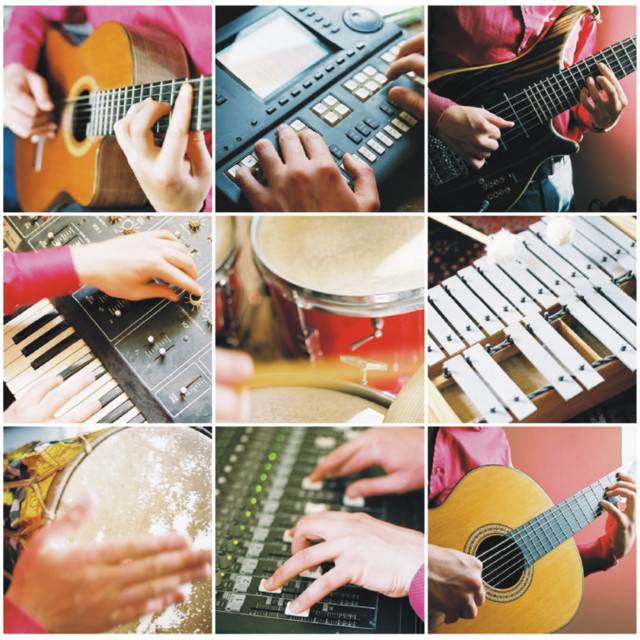
Squarepusher – Hello Everything
The music gear and equipment used by the artists, producers, engineers, and more involved in the making of the 2006 album Hello Everything.
Music from Hello Everything
Artists on Hello Everything
Gear Used On Hello Everything
Explore the instruments, equipment, software, and production tools used in the making of Squarepusher – Hello Everything (2006). Click more on each item to see exactly how it was used.
.png?v=1784755332)
Squarepusher
Roles:
Effects Pedals used by Squarepusher on Hello Everything

On this Sound On Sound interview, in the "Jumble Sale Studio" section, a bunch of gear from Jenkinson's studio is mentioned. Among them, the Roland VB-99. "It's a ragtag collection of stuff, and there's no discernible overall 'vintage' rationale behind the collection as a whole. The most significant pieces are a Roland TR909, TB303, SH101, V?Synth XT and V?Bass 99, Neve 1073 mic pre, AKG BX15 spring reverb, TC Electronics D2 delay, DBX 1066, a self?made mechanical reverb, Tom Jenkinson's custom?made spring reverb: "The reverb uses four pairs of Accutronics type 1, 4, 8 and 9 springs. The stereo input stages incorporate a soft-clip circuit, high shelving EQ and spring selectors that send the input to a given pair of springs. There are four output stages to which the springs can be assigned. Each output stage has signal invert, volume and pan controls. The springs can be used in parallel or series, where one spring signal is fed into another. The circuit grounding uses star topology. It was used extensively on the album Hello Everything, in conjunction with my AKG BX15 and BX20 reverbs. It is clearly audible at the starts of 'Bubble Life', 'Circlewave' and 'Plotinus'.” Tom Jenkinson's custom?made spring reverb: "The reverb uses four pairs of Accutronics type 1, 4, 8 and 9 springs. The stereo input stages incorporate a soft-clip circuit, high shelving EQ and spring selectors that send the input to a given pair of springs. There are four output stages to which the springs can be assigned. Each output stage has signal invert, volume and pan controls. The springs can be used in parallel or series, where one spring signal is fed into another. The circuit grounding uses star topology. It was used extensively on the album Hello Everything, in conjunction with my AKG BX15 and BX20 reverbs. It is clearly audible at the starts of 'Bubble Life', 'Circlewave' and 'Plotinus'.” Axon AX100 MIDI bass module, MOTU 24I/O audio interface, Dynaudio Acoustics M1 monitors, Yamaha CS80, TX81Z and FS1R synths and QY700 sequencer. A huge amount of gear has also been and gone, like the Yamaha VSS80 8?bit toy keyboard sampler shown in some late '90s television footage of Jenkinson."


Studio Equipment used by Squarepusher on Hello Everything

In this Sound On Sound interview (Jumble Sale Studio section), upon detailing and explaining how he made his own spring reverb, he mentions that the AKG BX-15 and AKG BX-20 spring reverb units were also extensively used on the album "Hello Everything". He even specifies certain tracks. Quote from Tom himself: "The reverb uses four pairs of Accutronics type 1, 4, 8 and 9 springs. The stereo input stages incorporate a soft-clip circuit, high shelving EQ and spring selectors that send the input to a given pair of springs. There are four output stages to which the springs can be assigned. Each output stage has signal invert, volume and pan controls. The springs can be used in parallel or series, where one spring signal is fed into another. The circuit grounding uses star topology. It was used extensively on the album Hello Everything, in conjunction with my AKG BX15 and BX20 reverbs. It is clearly audible at the starts of 'Bubble Life', 'Circlewave' and 'Plotinus'.”

In this Sound On Sound interview (Jumble Sale Studio section), upon detailing and explaining how he made his own spring reverb, he mentions that the AKG BX-15 and AKG BX-20 spring reverb units were also extensively used on the album "Hello Everything". Quote from Tom himself: "The reverb uses four pairs of Accutronics type 1, 4, 8 and 9 springs. The stereo input stages incorporate a soft-clip circuit, high shelving EQ and spring selectors that send the input to a given pair of springs. There are four output stages to which the springs can be assigned. Each output stage has signal invert, volume and pan controls. The springs can be used in parallel or series, where one spring signal is fed into another. The circuit grounding uses star topology. It was used extensively on the album Hello Everything, in conjunction with my AKG BX15 and BX20 reverbs. It is clearly audible at the starts of 'Bubble Life', 'Circlewave' and 'Plotinus'.”

Avg price: $401.25
In this Sound On Sound interview, precisely on the "Jumble Sale Studio" section, a bunch of Jenkinson's gear is mentioned. Among them, the TC Electronics D-Two Delay. The item can also be seen in the photo gallery of the interview, along with other pieces in a rack (from top to bottom, TC Electronics D-Two Delay, DBX 1066, Drawmer LX-20 and the Eventide Orville). It is the 8th photo, here's a quick link to it: http://dt7v1i9vyp3mf.cloudfront.net/styles/news_large/s3/imagelibrary/S/Sq_09.jpg?3CE8TrbIbKGqUfDboUWA_6We1exoFnHv=&itok=6tgbEa6N
From the interview: "It's a ragtag collection of stuff, and there's no discernible overall 'vintage' rationale behind the collection as a whole. The most significant pieces are a Roland TR909, TB303, SH101, V?Synth XT and V?Bass 99, Neve 1073 mic pre, AKG BX15 spring reverb, TC Electronics D2 delay, DBX 1066, a self?made mechanical reverb, Tom Jenkinson's custom?made spring reverb: "The reverb uses four pairs of Accutronics type 1, 4, 8 and 9 springs. The stereo input stages incorporate a soft-clip circuit, high shelving EQ and spring selectors that send the input to a given pair of springs. There are four output stages to which the springs can be assigned. Each output stage has signal invert, volume and pan controls. The springs can be used in parallel or series, where one spring signal is fed into another. The circuit grounding uses star topology. It was used extensively on the album Hello Everything, in conjunction with my AKG BX15 and BX20 reverbs. It is clearly audible at the starts of 'Bubble Life', 'Circlewave' and 'Plotinus'.” Tom Jenkinson's custom?made spring reverb: "The reverb uses four pairs of Accutronics type 1, 4, 8 and 9 springs. The stereo input stages incorporate a soft-clip circuit, high shelving EQ and spring selectors that send the input to a given pair of springs. There are four output stages to which the springs can be assigned. Each output stage has signal invert, volume and pan controls. The springs can be used in parallel or series, where one spring signal is fed into another. The circuit grounding uses star topology. It was used extensively on the album Hello Everything, in conjunction with my AKG BX15 and BX20 reverbs. It is clearly audible at the starts of 'Bubble Life', 'Circlewave' and 'Plotinus'.” Axon AX100 MIDI bass module, MOTU 24I/O audio interface, Dynaudio Acoustics M1 monitors, Yamaha CS80, TX81Z and FS1R synths and QY700 sequencer. A huge amount of gear has also been and gone, like the Yamaha VSS80 8?bit toy keyboard sampler shown in some late '90s television footage of Jenkinson."


Avg price: $199.00
In this session, Squarepusher performs alongside drummer Alex in his own private studio, as he describes at the introduction scene. Throughout the video, there's a mixer that can be seen in Tom Jenkinson's main desk (which features a computer monitor). Many hints indicate that the mixer is indeed the Mackie 24.8.2: * In the Sound On Sound interview, Tom mentions having the Mackie 28.8 before having the Euphonix CS3000. It's very likely that there was a mistake in this interview, as there is no such Mackie 28.8 mixer. * 0:27 into this video we get a zoom at the mixer's panel, showing the levels as well as some buttons and (partiatly) knobs, which greatly resembles the ones seen in the 24.8.2. * In the Hello Everything album cover, there's a picture of a pair of hands operating a mixer. Again, the knobs, faders, buttons and overall design do match the ones of the 24.8.2.

Avg price: $1,100.00
By using the Internet Archive Wayback Machine (available at https://archive.org/web/) and searching for the page "http://www.squarepusher.net/justasouvenir/data/interviews.xml", it is possible to find various interviews that were gathered together over the years and kept at squarepusher.net until around the year of 2012, when the site was updated. In one of those (precisely the 2006 Rockin On' Magazine [Japan] interview), Tom is asked: "In ULTRAVISITOR, you revived the authentic Squarepusher sound by integrating the free jazz approach in Music is Rotted One Note and laptop originated sound in Go Plastic, Do You Know Squarepusher. Would you say that having recorded ULTRAVISITOR had a positive effect on HELLO EVERYTHING?" In his answer, he reveals the setup used in the Go Plastic album: "First of all, I didn't use a computer on Go Plastic. It was made with a Yamaha QY700, TX81[Z] and FS1R, an Eventide DSP4000 and Orville, an Akai S6000 and a Mackie 16 channel desk. Second, precisely what is the "authentic Squarepusher sound"? Although you seem to have made up your mind, I would be entertained to see if anybody agreed with you or each other! Certainly if there was a consensus, I would feel like I had failed to fufil my primary objective which is to rubbish the notion of the static artistic persona. The tendency to develop and change ideas, musical or otherwise is a hallmark of an active and intelligent mind -yet it is not prevalent in the sphere of music. Once musicians establish their "style", it appears that many feel compelled to take the safe option of sticking to it. The ironic thing is that repeating the same ideas over and over again gets pretty uninteresting and inevitably leads to stagnancy; thus their career is sabotaged by these very attempts to safeguard it. For me, to stick to some sort of style is to prematurely throw your artistic potential down the drain. Thus I assert that nobody could coherently state what the "Squarepusher sound" is. After recording the Ultravisitor material, I felt it was time to shift the compositional focus to simpler ideas."
Studio Monitors used by Squarepusher on Hello Everything

In this Sound On Sound interview, on the "Jumble Sale Studio" section, a bunch of Jenkinson's gear is mentioned. Among them, the Dynaudio M1. Two instances of this item can be seen on the second picture of this interview's photo gallery. The subtitle reads: "Tom Jenkinson's living room: not your average home studio." The item is mentioned in this fragment: "It's a ragtag collection of stuff, and there's no discernible overall 'vintage' rationale behind the collection as a whole. The most significant pieces are a Roland TR909, TB303, SH101, V?Synth XT and V?Bass 99, Neve 1073 mic pre, AKG BX15 spring reverb, TC Electronics D2 delay, DBX 1066, a self?made mechanical reverb, Tom Jenkinson's custom?made spring reverb: "The reverb uses four pairs of Accutronics type 1, 4, 8 and 9 springs. The stereo input stages incorporate a soft-clip circuit, high shelving EQ and spring selectors that send the input to a given pair of springs. There are four output stages to which the springs can be assigned. Each output stage has signal invert, volume and pan controls. The springs can be used in parallel or series, where one spring signal is fed into another. The circuit grounding uses star topology. It was used extensively on the album Hello Everything, in conjunction with my AKG BX15 and BX20 reverbs. It is clearly audible at the starts of 'Bubble Life', 'Circlewave' and 'Plotinus'.” Tom Jenkinson's custom?made spring reverb: "The reverb uses four pairs of Accutronics type 1, 4, 8 and 9 springs. The stereo input stages incorporate a soft-clip circuit, high shelving EQ and spring selectors that send the input to a given pair of springs. There are four output stages to which the springs can be assigned. Each output stage has signal invert, volume and pan controls. The springs can be used in parallel or series, where one spring signal is fed into another. The circuit grounding uses star topology. It was used extensively on the album Hello Everything, in conjunction with my AKG BX15 and BX20 reverbs. It is clearly audible at the starts of 'Bubble Life', 'Circlewave' and 'Plotinus'.” Axon AX100 MIDI bass module, MOTU 24I/O audio interface, Dynaudio Acoustics M1 monitors, Yamaha CS80, TX81Z and FS1R synths and QY700 sequencer. A huge amount of gear has also been and gone, like the Yamaha VSS80 8?bit toy keyboard sampler shown in some late '90s television footage of Jenkinson."
Keyboards and Synthesizers used by Squarepusher on Hello Everything

Avg price: $453.16
Bits of Jenkinson's gear can be seen in the cover of his 2006 album "Hello Everything". The synth at the left is the Octave CAT Synth. Other confirmed examples of his gear present in this image include the Yamaha QY700 Sequencer (middle top) and his custom six-string Zoot bass (top right).
