.png?v=1784984897)
Squarepusher
Role
Genre
Role
Genre
Squarepusher's Gear


"Tom Jenkinson much prefers to work with hardware sequencers, and specifically his Yamaha QY700," reads the caption to this photo, in this article.
Find it on:


"I made my first records using the Boss DR660," says Tom, in this article.
Find it on:


"To this day, nobody believes that the tracks on Big Loada were a single pass of me sequencing my Akai S950 from my DR660," Tom says, in this article.
Find it on:
-m.webp?v=1785077880)

Bits of Jenkinson's gear can be seen in the cover of his 2006 album "Hello Everything". The synth at the left is the Octave CAT Synth. Other confirmed examples of his gear present in this image include the Yamaha QY700 Sequencer (middle top) and his custom six-string Zoot bass (top right).
Find it on:


In this 1996 interview, Tom is seen performing "The Swifty" with what appears to be a Fender Jazz Bass. The performance starts at the 6:12 mark, and the headstock can best be seen in the 7:31 mark. There's also a 1997 interview and performance video in which Tom can be seen playing in another Fender Jazz Bass. Performances occur in the 0:52 (Cooper's World) and 12:21 (Beep Street) marks.
Find it on:

"As well as unusual and custom?built gear, Tom Jenkinson retains some of the staple instruments of '90s dance music, among them a Roland TB303," reads the caption to this photo, in this article.
Find it on:

"...I bought the DSP4000, and I'm still finding new things to do with that and with the Orville," says Tom, in this article.
Find it on:

Key to this type of song creation is gear that has been in Jenkinson’s studio for decades. Mainstays include a Roland TB-303, TR-909 and SH-101, Eventide Orville and DSP4000 harmonizers, a Yamaha QY700 sequencer, and Yamaha CS80, TX81Z and FS1R synths.
Find it on:

Key to this type of song creation is gear that has been in Jenkinson’s studio for decades. Mainstays include a Roland TB-303, TR-909 and SH-101, Eventide Orville and DSP4000 harmonizers, a Yamaha QY700 sequencer, and Yamaha CS80, TX81Z and FS1R synths.
Find it on:
-m.webp?v=1785078350)
The artist can be seen using this gear in the video. It’s difficult to tell, but the color scheme of the buttons on the RD-8 is a dead giveaway. That and it being paired with the Behringer TD-3 and the Behringer MS-1.
Find it on:

In this long interview from Sound On Sound, Tom Jenkinson explains how he made the track "50 Cycles", from the 2004 album "Ultravisitor". Note that he mentions it being "the Vegas software, made by Sonic Foundry at the time". According to Wikipedia, "Sony Creative Software is a developer of various media software suites. Sony Creative Software was created in a 2003 deal with Madison media company Sonic Foundry in which it acquired its desktop product line, hired roughly 60% of employees, paid $18 million in cash, and took on certain liabilities and obligations." The link to Sonic Foundry even redirects to the Sony Creative Software page. Here's the quote from Jenkinson himself: "The track '50 Cycles' on Ultravisitor is a monster that took me a month to make. I used the Vegas software, made by Sonic Foundry at the time, to assemble literally thousands of edited pieces of audio, and it became something of monstrous complexity. I wanted cutting?edge digital signal processing and I wanted the most awkward, difficult, angular sounds."
Find it on:
-m.webp?v=1785065016)
In the 1996 interview featured in the video "DnB 1996 (LolaDaMusica) part1: Squarepusher" by prestonloyola on YouTube, Squarepusher (Tom Jenkinson) showcases his "full-time residential studio." At 3:15, his Ibanez RB950 Blue-Burst Roadstar II Series 4-String Bass, adorned with an Aphex Twin sticker, is prominently displayed.
Find it on:


-m.webp?v=1784958150)
Jenkinson likes the challenge of coaxing unfound sounds from gear, even as he recognizes the shortcomings of something like the QY700’s timing in comparison to a digital sequencer. He doesn’t crave perfection, which he considers an old-school approach. Exact timing would only retain its meticulous nature for so long once the outboard units are coupled with the self-taught programmer’s “hacks,” which he cobbles together in SuperCollider, Pure Data, and Reaktor.
Find it on:

In this 1996 interview, Tom Jenkinson briefly explains his (at the time) layer-by-layer method of making music (1:53 mark). The mixer that he utilizes appears to be a Soundcraft Spirit Folio 12/2 Mixer with switched (and even missing) faders. After comparing with the original product, the different colored faders can be noticed.
Find it on:

This 1998 Squarepusher interview is present on the documentary named "Modulations". Here, the Yamaha VSS-30 is shown at the 0:16 mark, followed by Tom's description of it: "I've actually got a little Yamaha sampler. It's a little keyboard, like a toy. It's got an input and an output, so basically you can use it on the studio or whatever, make up sounds in it. Loads of stuff from my new album were done in this. People forget how amazing that is and what you can do with it." Also, one of the interviewer's quotes from Squarepusher's Sound On Sound interview (http://www.soundonsound.com/people/squarepusher) refers to this 1998 interview, as well as the VSS-30: "A huge amount of gear has also been and gone, like the Yamaha VSS80 8?bit toy keyboard sampler shown in some late '90s television footage of Jenkinson." It was, however, clearly mispelled. First, there is no such VSS-80 Yamaha sampler. Second, the characteristics mentioned by Tom Jenkinson perfectly matches the ones present in the VSS-30: "Little keyboard, like a toy", "It's got an input and an output" (which can also be seen in the VSS-30 manual). The back part (with the Yamaha logo) is identical to the VSS-30's, and the two orange buttons at the upper-right side of the keyboard (OVERWRITE and SAMPLE) can also be briefly spotted in this video (0:22 and 0:31 marks).
Find it on:
-m.webp?v=1785077873)
"I unearthed the 909 and was surprised by how good the straight-out-of-the-box sounds sounded on my monitors," Tom says, in this article.
Find it on:

Jenkinson likes the challenge of coaxing unfound sounds from gear, even as he recognizes the shortcomings of something like the QY700’s timing in comparison to a digital sequencer. He doesn’t crave perfection, which he considers an old-school approach. Exact timing would only retain its meticulous nature for so long once the outboard units are coupled with the self-taught programmer’s “hacks,” which he cobbles together in SuperCollider, Pure Data, and Reaktor.
Find it on:

Jenkinson likes the challenge of coaxing unfound sounds from gear, even as he recognizes the shortcomings of something like the QY700’s timing in comparison to a digital sequencer. He doesn’t crave perfection, which he considers an old-school approach. Exact timing would only retain its meticulous nature for so long once the outboard units are coupled with the self-taught programmer’s “hacks,” which he cobbles together in SuperCollider, Pure Data, and Reaktor.
Find it on:

On this Sound On Sound interview, in the "Jumble Sale Studio" section, a bunch of gear from Jenkinson's studio is mentioned. Among them, the Roland VB-99. "It's a ragtag collection of stuff, and there's no discernible overall 'vintage' rationale behind the collection as a whole. The most significant pieces are a Roland TR909, TB303, SH101, V?Synth XT and V?Bass 99, Neve 1073 mic pre, AKG BX15 spring reverb, TC Electronics D2 delay, DBX 1066, a self?made mechanical reverb, Tom Jenkinson's custom?made spring reverb: "The reverb uses four pairs of Accutronics type 1, 4, 8 and 9 springs. The stereo input stages incorporate a soft-clip circuit, high shelving EQ and spring selectors that send the input to a given pair of springs. There are four output stages to which the springs can be assigned. Each output stage has signal invert, volume and pan controls. The springs can be used in parallel or series, where one spring signal is fed into another. The circuit grounding uses star topology. It was used extensively on the album Hello Everything, in conjunction with my AKG BX15 and BX20 reverbs. It is clearly audible at the starts of 'Bubble Life', 'Circlewave' and 'Plotinus'.” Tom Jenkinson's custom?made spring reverb: "The reverb uses four pairs of Accutronics type 1, 4, 8 and 9 springs. The stereo input stages incorporate a soft-clip circuit, high shelving EQ and spring selectors that send the input to a given pair of springs. There are four output stages to which the springs can be assigned. Each output stage has signal invert, volume and pan controls. The springs can be used in parallel or series, where one spring signal is fed into another. The circuit grounding uses star topology. It was used extensively on the album Hello Everything, in conjunction with my AKG BX15 and BX20 reverbs. It is clearly audible at the starts of 'Bubble Life', 'Circlewave' and 'Plotinus'.” Axon AX100 MIDI bass module, MOTU 24I/O audio interface, Dynaudio Acoustics M1 monitors, Yamaha CS80, TX81Z and FS1R synths and QY700 sequencer. A huge amount of gear has also been and gone, like the Yamaha VSS80 8?bit toy keyboard sampler shown in some late '90s television footage of Jenkinson."
Find it on:

"If it's possible to single out one piece of gear as being crucial to Jenkinson's way of working, it's the Eventide Orville multi?effects unit," Tom says, in this article.
Find it on:

This rare picture shows Tom Jenkinson actually DJing. His headphones appear to be the Beyerdynamic DT-100, especially when compared to this picture, which shows the item with a cable connection pretty similar to the one seen in the source picture.
Find it on:





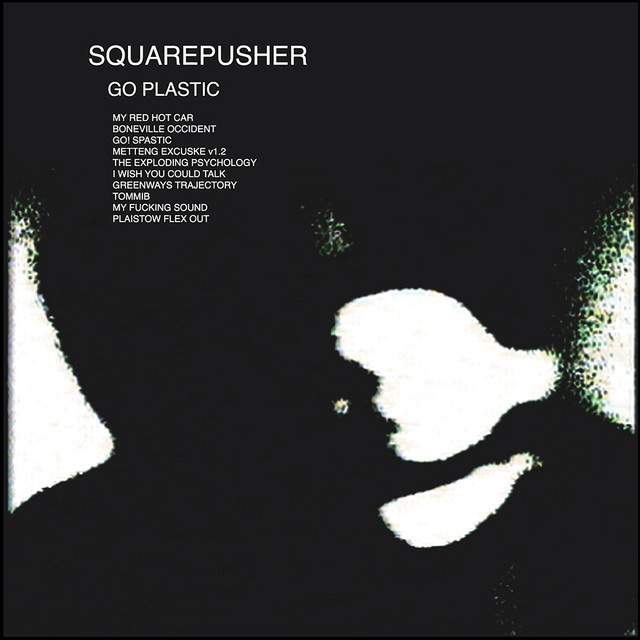
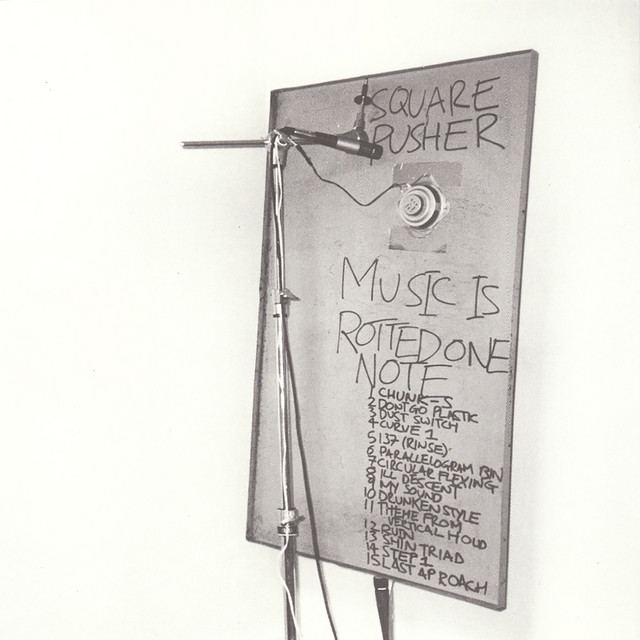
By using the Internet Archive Wayback Machine (available at https://archive.org/web/) and searching for the page "http://www.squarepusher.net/justasouvenir/data/interviews.xml", it is possible to find various interviews that were gathered together over the years and kept at squarepusher.net until around the year of 2012, when the site was updated. In one of those (precisely the 2006 Rockin On' Magazine [Japan] interview), Tom is asked: "In ULTRAVISITOR, you revived the authentic Squarepusher sound by integrating the free jazz approach in Music is Rotted One Note and laptop originated sound in Go Plastic, Do You Know Squarepusher. Would you say that having recorded ULTRAVISITOR had a positive effect on HELLO EVERYTHING?" In his answer, he reveals the setup used in the Go Plastic album: "First of all, I didn't use a computer on Go Plastic. It was made with a Yamaha QY700, TX81[Z] and FS1R, an Eventide DSP4000 and Orville, an Akai S6000 and a Mackie 16 channel desk. Second, precisely what is the "authentic Squarepusher sound"? Although you seem to have made up your mind, I would be entertained to see if anybody agreed with you or each other! Certainly if there was a consensus, I would feel like I had failed to fufil my primary objective which is to rubbish the notion of the static artistic persona. The tendency to develop and change ideas, musical or otherwise is a hallmark of an active and intelligent mind -yet it is not prevalent in the sphere of music. Once musicians establish their "style", it appears that many feel compelled to take the safe option of sticking to it. The ironic thing is that repeating the same ideas over and over again gets pretty uninteresting and inevitably leads to stagnancy; thus their career is sabotaged by these very attempts to safeguard it. For me, to stick to some sort of style is to prematurely throw your artistic potential down the drain. Thus I assert that nobody could coherently state what the "Squarepusher sound" is. After recording the Ultravisitor material, I felt it was time to shift the compositional focus to simpler ideas."
Find it on:

In this article, this photo of Squarepusher's Yamaha CS80 is included, along with the caption, "A recent addition that goes against Jenkinson's usual principles is his vintage Yamaha CS80 polysynth."
Find it on:

According to a list of gear from the official website, Squarepusher owns the following: Bass guitars: Music Man / Rickenbacker 4001 / Custom built 6 strings.
Find it on:

In a "Future Music" magazine interview, a photograph shows Squarepusher using the Roland V-Synth XT, positioned centrally at the lower section of the image.
Find it on:

Normal Stingray has 4 knobs(vol, treble, mid, bass). but his playing 3-Knob equipped models.
Find it on:

In the "Old School" section of this interview, Jenkinson explains his experiences with recording mediums throughout the years. According to Tom Jenkinson himself, "[...] As for recording, I used tape recorders exclusively until 2001. I first had a Fostex M80 quarter?inch eight?track, and in the late '90s I obtained a half?inch Tascam MSR16. I still use that, though it's being repaired at the moment. I have to say that I'm not obsessive about it. Recording to tape, or to a computer?based multitrack, is a means to an end. I mix and match now. I've used Sonic Foundry's Vegas, and more recently Nuendo, but I don't endorse or recommend them. There's no love in it for me, they really are just tools."
Find it on:

The gear can be seen throughout the entirety of this video that the artist released of themselves making music in a studio.
Find it on:

The artist can be seen twiddling the knobs about of the TD-3 in this self-released video.
Find it on:
This is a community-built gear list for Squarepusher.
- Find relevant music gear like Bass Guitars, Amplifiers, Effects Pedals, Studio Equipment, Software Plugins and VSTs, Headphones, and other instruments and add it to Squarepusher.
- The best places to look for gear usage are typically on the artist's social media, YouTube, live performance images, and interviews.
- To receive email updates when Squarepusher is seen with new gear, follow the artist.
-
Added to Equipboard on by
 odysseyeurobeat
GearIQ 1708
-
Updated
Discography
Album Credits
-
GoGo Penguin · 2021
Producer -
Squarepusher · 2009
Producer -
Squarepusher · 2009
Producer -
Squarepusher · 2008
Producer -
Squarepusher · 2004
Producer -
Squarepusher · 2001
Producer -
Squarepusher · 1999
Producer -
Squarepusher · 1999
Producer -
Squarepusher · 1998
Producer -
Squarepusher · 1997
Producer -
Squarepusher · 1997
Producer -
Funki Porcini · 1996
Producer






.webp)