Latest Activity on Equipboard
 Nate Mendel uses Darkglass Electronics Vintage Ultra Preamplifier
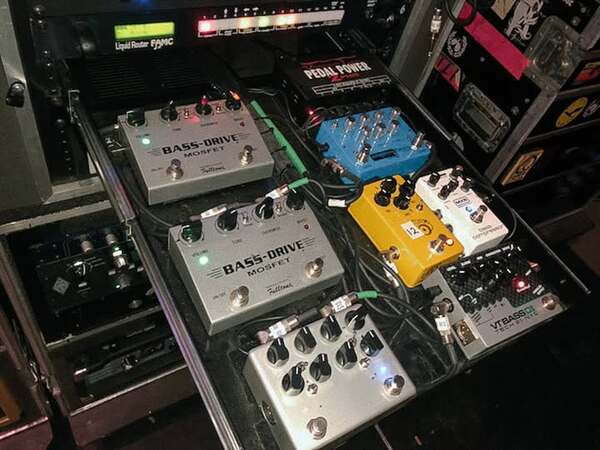
In a photo shared by Darkglass on their Facebook account, an unlabelled pedal can be seen in the bottom left corner. Based on the number of knobs and switches visible, it is identified as the Darkglass Electronics Vintage Ultra Preamplifier used by bassist Nate Mendel.

Submission status:
Needs Review3 months ago
Submitted by

bernardduur
Submitted by
bernardduur
3 months ago
via Photo
Nate Mendel uses JHS 4 Wheeler V2
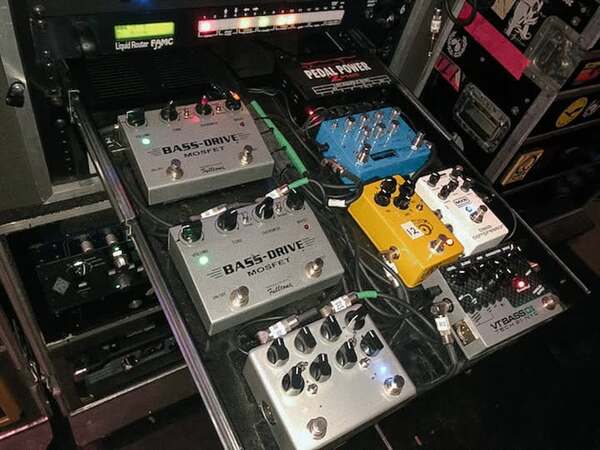
In a photograph shared by Darkglass on their Facebook account, Nate Mendel is seen using the JHS 4 Wheeler V2 pedal. The specific version can be identified by the detailed labeling of all the knob functions.

Submission status:
Needs Review3 months ago
Submitted by
bernardduur
Submitted by
bernardduur
3 months ago
via Photo
Nate Mendel uses Empress ParaEq
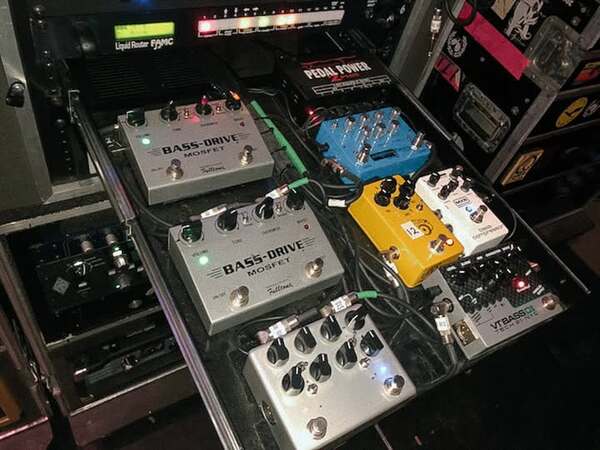
In a picture shared by Darkglass on their Facebook account, you can clearly spot Nate Mendel using the Empress ParaEq pedal.

Submission status:
Needs Review3 months ago
Submitted by
bernardduur
Submitted by
bernardduur
3 months ago
via Photo
Nate Mendel uses MXR M87 Bass Compressor
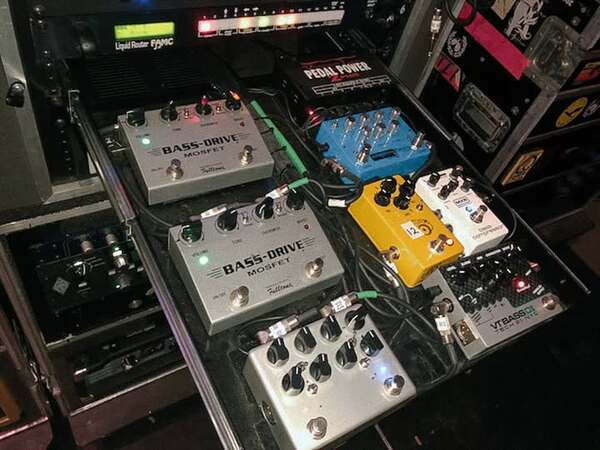
In a photograph shared by Darkglass on their Facebook account, Nate Mendel can be seen using the MXR M87 Bass Compressor.

Submission status:
Needs Review3 months ago
Submitted by
bernardduur
Submitted by
bernardduur
3 months ago
via Photo
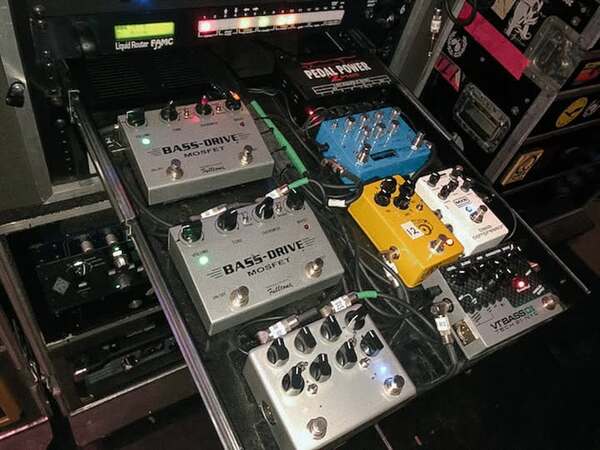
Nate Mendel uses Tech 21 VT Bass DI
In a photograph shared by Darkglass on their Facebook account, the Tech 21 VT Bass DI pedal is clearly visible, confirming its use by bassist Nate Mendel.

Submission status:
Needs Review3 months ago
Submitted by
bernardduur
Submitted by
bernardduur
3 months ago
via Photo
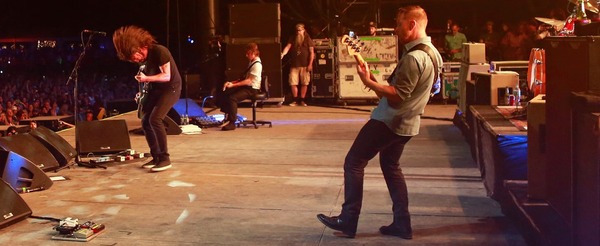
Nate Mendel uses Ashdown Engineering James Lomenzo Hyperdrive
In a live shot of his pedalboard, bassist Nate Mendel is clearly using the Ashdown Engineering James Lomenzo Hyperdrive. This pedal is identifiable by its distinctive black color, chrome handles, and red sides, as shown in the image provided.

Submission status:
Needs Review3 months ago
Submitted by
bernardduur
Submitted by
bernardduur
3 months ago
via Photo
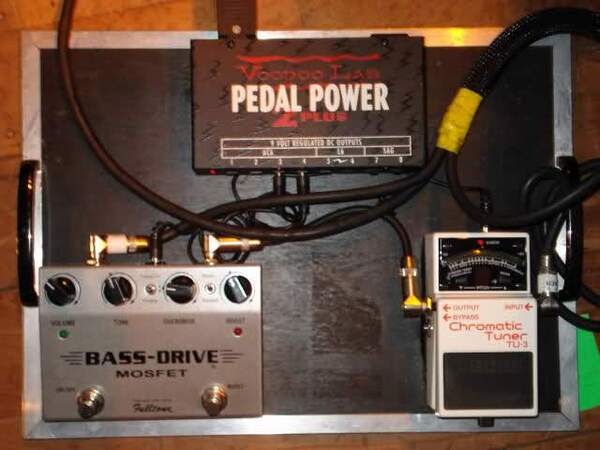
Nate Mendel uses Voodoo Lab Pedal Power 2 PLUS
In a picture of Nate Mendel's pedalboard, the Voodoo Lab Pedal Power 2 PLUS can be clearly seen, confirming his use of this power supply.

Submission status:
Needs Review3 months ago
Submitted by
bernardduur
Submitted by
bernardduur
3 months ago
via Photo
 Glenn McClelland uses Sequential Circuits Prophet-5
At 2:00 you can see McClelland using a Moog Synthesizer to play “The Mollusk” on ween’s Wah Wah performance.

Submission status:
Needs Review3 months ago
Submitted by
someguytockthenameadamjoemo
Submitted by
someguytockthenameadamjoemo
3 months ago
via YouTube
 dandaman
added band
Steady Earnest
to Equipboard
dandaman
added band
Steady Earnest
to Equipboard
3 months ago

dandaman
added band
The Cocky Bitches
to Equipboard
3 months ago
 Mila de la Garza uses Promark Rebound 5A .550" Hickory Tear Drop Wood Tip
In this Facebook post on The Linda Lindas official account, Mila De La Garza is seen holding a pair of ProMark Hickory Rebound 5A Activegrip drumsticks with the title reading
"We are pleased to announce that Mila is now a proud endorser of Pro Mark drum sticks!! @promarksticks Thanks to @aaron_vishria for your support!! Mila, aka “Sticks Twirlington”, is currently rocking the Hickory Rebound 5A Activegrip model."

Submission status:
Needs Review3 months ago
Submitted by

antz_band
Submitted by
antz_band
3 months ago
via facebookapp
 Carl Perkins uses The Ray Butts EchoSonic
According to Dave Hunter in Vintage Guitar® magazine, Carl Perkins is among the select few owners of The Ray Butts EchoSonic amplifier, of which fewer than 70 units were ever produced.

Submission status:
Needs Review3 months ago
Submitted by

shiba_inu_jedi
Submitted by
shiba_inu_jedi
3 months ago
via Vintage Guitar® magazine
 Scotty Moore uses The Ray Butts EchoSonic
Scotty Moore became aware of the EchoSonic around 1955 after hearing Chet Atkins use a similar echo effect on the radio. Recognizing its potential, Moore ordered a custom-built EchoSonic amplifier from Ray Butts. This acquisition marked a significant turning point, as it allowed Moore to bring the slapback echo sound from the studio environment onto the stage. From that moment onward, the EchoSonic became a central component of his guitar rig.
Moore’s use of the EchoSonic played a crucial role in shaping the sound of Elvis Presley’s music during the mid-1950s and beyond. While Elvis’s earliest Sun Records recordings, such as “That’s All Right,” relied on studio-based echo techniques, Moore’s adoption of the EchoSonic enabled a consistent and recognizable guitar tone in both live and recorded contexts. Songs like “Mystery Train” exemplify how this slapback echo contributed to the rhythmic drive and spaciousness characteristic of early rockabilly.
Technically, the EchoSonic was groundbreaking because it integrated a tape delay mechanism directly into the amplifier, with controls for echo intensity and delay time. This allowed guitarists to manipulate echo in real time during performance—something that had previously been impossible. However, the amplifier’s relatively low output power, around 25 watts, quickly became a limitation as Elvis’s performances grew larger and louder.
To address this issue, Ray Butts developed additional high-powered booster cabinets, effectively transforming Moore’s setup into a modular amplification system. By combining the EchoSonic with these external power units, Moore achieved a much higher overall output, reportedly reaching around 125 watts. This setup can be seen as an early precursor to modern multi-amp and rack-based live guitar systems.
The influence of the EchoSonic extended far beyond Moore’s immediate use. It laid the groundwork for later echo devices such as the Echoplex and contributed to the widespread adoption of delay effects in rock and popular music. Despite its impact, the EchoSonic remained an extremely rare piece of equipment, with fewer than 70 units ever produced.
Moore continued to use the EchoSonic throughout much of his career with Elvis Presley, including into the late 1960s, before eventually retiring it due to its fragility and historical significance.

Submission status:
Needs Review3 months ago
Submitted by
shiba_inu_jedi
Submitted by
shiba_inu_jedi
3 months ago
shiba_inu_jedi
added
The Ray Butts EchoSonic
to Equipboard
3 months ago
 Afroman uses Fender '65 Twin Reverb
In this TikTok you can see the twin Reverb in the background connected to his weed guitar
-m.webp?v=1782917874)
@saras.reptilians LEMON POUND CAKE🗣️ #Afroman
♬ Pyre (STEM synth) - Altitude Music / BMGPM
Submission status:
Needs Review3 months ago
Submitted by
someguytockthenameadamjoemo
Submitted by
someguytockthenameadamjoemo
3 months ago
via TikTok
 orcasynth
added their
gear photo
orcasynth
added their
gear photo
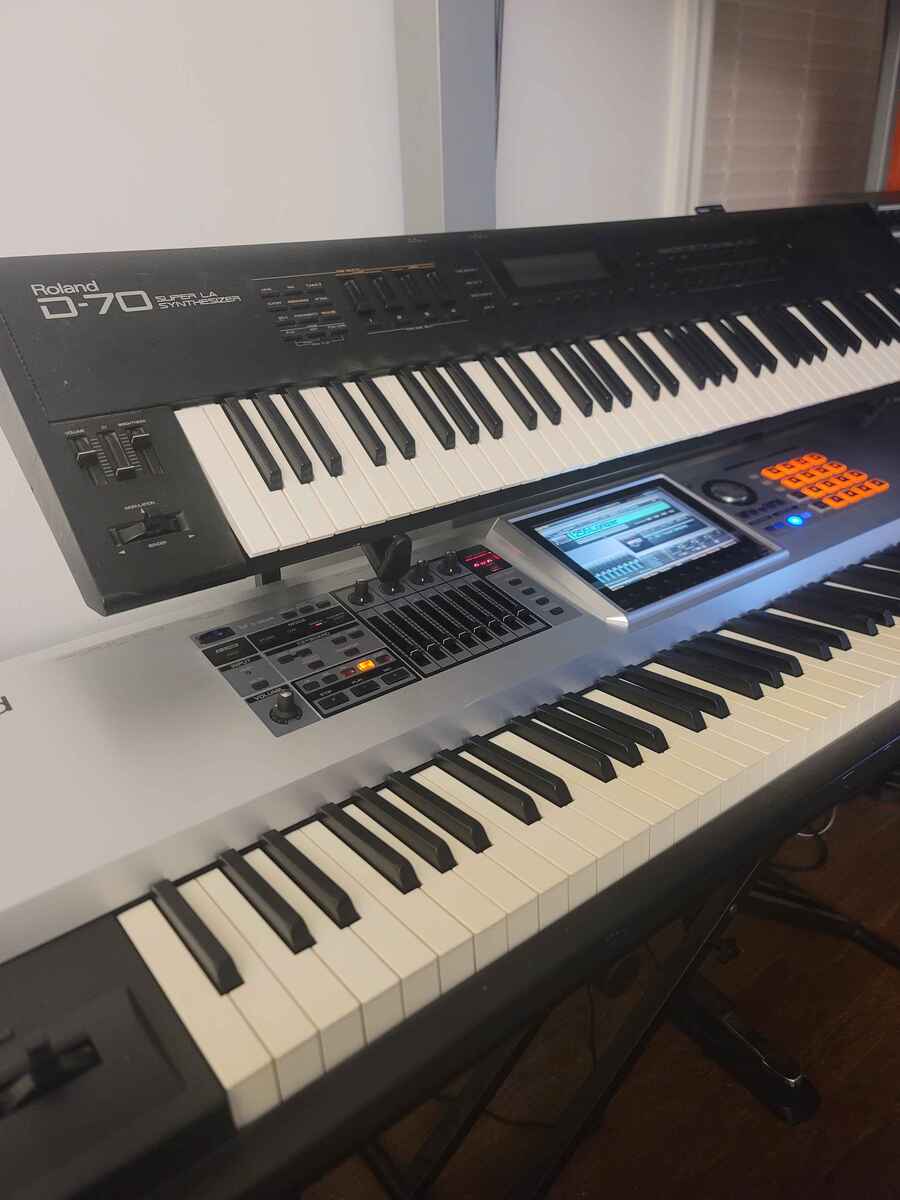


Had to rearrange my keyboard stands to accommodate for this massive workstation (Fantom G8)! Very fun, and the ivory key feel is nice! Reminds me of the piano I learned on back in primary school.
Total setup price: $1,225.00 View breakdown
3 months ago
 Bora Karaca uses IK Multimedia AmpliTube 5
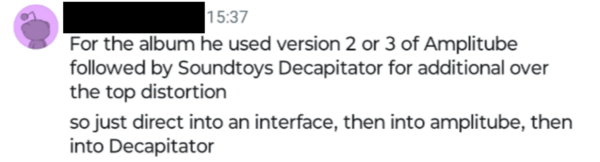
Stephan Wunderlich, a friend of Bora Karaca, confirmed in a Reddit message that Bora Karaca used a version of IK Multimedia AmpliTube (either AmpliTube 2 or AmpliTube 3) for Cojum Dip's self-titled album's main guitar tone.

Submission status:
Needs Review3 months ago
Submitted by

redfire512
Submitted by
redfire512
3 months ago
via Photo
Bora Karaca uses Fender Hot Rod DeVille 4x10
In an older listing for the gear page of Bora Karaca's studio, The Laboratory Audio, he lists the Fender Hot Rod DeVille 4x10 as an available amplifier.

Submission status:
Needs Review3 months ago
Submitted by
redfire512
Submitted by
redfire512
3 months ago
Bora Karaca uses Mesa Boogie F-50 combo Guitar Amplifier
In an older listing for the gear page of Bora Karaca's studio, The Laboratory Audio, he lists the Mesa-Boogie F-50 as an available amplifier.

Submission status:
Needs Review3 months ago
Submitted by
redfire512
Submitted by
redfire512
3 months ago