Nate Mendel
Nate Mendel's Gear


“For years I was really frustrated because my band is really loud; drummers loud, guitar players are loud, and in order try and reach that volume with that much low end, in trying to do that every amp I used would just fall apart, and the Ashdown didn’t.” - Nate Mendel at :50s.
Find it on:


"I played all of Wasting Light on a Lakland [Bob Glaub Signature]. We tried a few different basses, but we found the sound that worked best. We’d change the EQ to get the bass to fit in the mix. I love Lakland basses, and I’m using them on tour for drop-D tunings right now. But I’m a bit more comfortable playing Fender basses, so I’ve gone back to playing those for most of the set." This can be read at this link. http://www.bassplayer.com/artists/1171/nate-mendel-with-the-foo-fighters/26511
Find it on:

"I use a Fulltone overdrive pedal on one song, but I’m not using many pedals these days. Now that we have three guitar players [Grohl, Chris Shiflett, and Pat Smear]" / original link went down (http://www.bassplayer.com/artists/1171/nate-mendel-with-the-foo-fighters/26511)
In the added pic you can spot the Fulltone Bassdrive clearly visible on his board
Find it on:

In a February 28, 2013 interview for MusicRadar, Nate Mendel had this to say about his signature P Bass, based on his 1971 P Bass:
"I found this 71 Fender P-Bass back in the early 90s and I loved it. I discovered that it was this rare model that they'd made in 1971 with a different type of neck - it was like a thinner version of the P-Bass neck, perhaps a little bit closer to the Jazz Bass. I really liked it, it was super easy to play and it was just a great sounding bass and I played it on 10 years-worth of records.
"[Eventually] Fender made some copies for me, just in case something happened to that one. Then a couple of years ago I thought, 'This is a great bass, maybe they'd be interested in making some more of them and maybe stamping my name on it...' So I called them up and they were receptive to it and we got to work on all the details."
In 2012, Fender caught up with Nate Mendel to talk about his signature bass on YouTube.
Find it on:


In this Foo Fighters' video we can see Nate playing a Fender Precision Bass
Find it on:


Nate is an Ashdown artist. The Ashdown products he uses are detailed on their website, including images of him using them.
Find it on:

In this YouTube video at 4:53 Taylor Hawkins shows the Steinberger Spirit XT-2 of Nate Mendel.
Find it on:

In this picture of his pedalboard the TU3 is clearly visible
Find it on:


For the video of "Best Of You" Nate uses a Gibson Ripper Bass
Find it on:

In this video from Foo Fighters we can see an Ampeg SVT-VR head behind Nate, with the 810 SVT cabinet down
Find it on:

In this photo, one can see Mendel playing Ovation B778, in a natural finish.
Find it on:

In this video we can see an Ampeg STV 810 behind Nate, but with the logo covered
Find it on:

In this Foo Fighters' video, we can see an Ashdown 810 ABM cabinet behind Nate
Find it on:

In the video to the Foo Fighters new track "The Sky is a Neighborhood" Nate can be seen with an ampeg AEB-1 Scroll bass many times throughout the video.
Find it on:

Listed on Nate's official Ashdown artist page.
Find it on:

Used on "The Pretender", as stated by mix engineer Rich Costey in this March 2008 Sound on Sound interview. An image of the settings for bandmate Dave Grohl's intro vocals shows it to be the Bomb Factory plugin.
Bass: Neve 1073, Pultec EQP, Chandler TG1
"The bass consisted of three tracks: one recorded through an Ampeg SVT amp, one through a 4x12 Marshall cabinet, and one put through a Sansamp. I usually push all three tracks up and adjust their balance if I want different colours. I'll also mix in some side-chain compression, which in this case was a 1073, Pultec EQP, and Chandler TG1. The side-chain will usually be bright as hell and really compressed. One of the interesting things regarding mixing bass is that you may think that the bass sound on its own is fairly bright, but when you add the rest of the instruments you find that the top mid-range of the bass is usually missing. It's sometimes quite shocking to realise how much top end you need to add to a bass to make sure it cuts through a track. If you then hear the bass sound in isolation it may sound pretty uncomfortable, but in the midst of a swirling din of a dense track, that amount of top end usually works just fine."
Find it on:

Used on "The Pretender", as stated by mix engineer Rich Costey in this March 2008 Sound on Sound interview.
Bass: Neve 1073, Pultec EQP, Chandler TG1
"The bass consisted of three tracks: one recorded through an Ampeg SVT amp, one through a 4x12 Marshall cabinet, and one put through a Sansamp. I usually push all three tracks up and adjust their balance if I want different colours. I'll also mix in some side-chain compression, which in this case was a 1073, Pultec EQP, and Chandler TG1. The side-chain will usually be bright as hell and really compressed. One of the interesting things regarding mixing bass is that you may think that the bass sound on its own is fairly bright, but when you add the rest of the instruments you find that the top mid-range of the bass is usually missing. It's sometimes quite shocking to realise how much top end you need to add to a bass to make sure it cuts through a track. If you then hear the bass sound in isolation it may sound pretty uncomfortable, but in the midst of a swirling din of a dense track, that amount of top end usually works just fine."
Find it on:

Used on "The Pretender", as stated by mix engineer Rich Costey in this March 2008 Sound on Sound interview. An image of the item can be found here.
Bass: Neve 1073, Pultec EQP, Chandler TG1
"The bass consisted of three tracks: one recorded through an Ampeg SVT amp, one through a 4x12 Marshall cabinet, and one put through a Sansamp. I usually push all three tracks up and adjust their balance if I want different colours. I'll also mix in some side-chain compression, which in this case was a 1073, Pultec EQP, and Chandler TG1. The side-chain will usually be bright as hell and really compressed. One of the interesting things regarding mixing bass is that you may think that the bass sound on its own is fairly bright, but when you add the rest of the instruments you find that the top mid-range of the bass is usually missing. It's sometimes quite shocking to realise how much top end you need to add to a bass to make sure it cuts through a track. If you then hear the bass sound in isolation it may sound pretty uncomfortable, but in the midst of a swirling din of a dense track, that amount of top end usually works just fine."
Find it on:



His Candy Apple Red Precision bass has SPB-3 Quarter Pound.
Find it on:

Can be seen using this bass throughout the video.
Find it on:

During a live performance, Nate Mendel can be seen using a Boss ODB-3 Bass OverDrive pedal, identifiable by its distinctive color. This is confirmed by a user-uploaded photo.
Find it on:

According to the Fender specifications for the Nate Mendel Signature P Bass: "Middle Pickup - Seymour Duncan® Basslines SPB-3 Quarter Pound Split Single-Coil Precision Bass®." Additionally, these pickups can be seen at 0:05 into this YouTube video, identified by their large pole pieces.
Find it on:

The Guitar Geek rig diagram indicates that Nate Mendel uses a Korg DTR-1 Rackmount Tuner.
Find it on:

According to a Guitar Geek rig diagram, Foo Fighters bassist Nate Mendel used four Peavey TVX 410 bass cabinets before he was endorsed by Ashdown Engineering.
Find it on:

Used since the Sunny Day Real State days on his basses
Find it on:

According to the GHS website, Nate Mendel uses GHS Boomers Guitar Strings.
Find it on:


At approximately 1:58 in the video titled "Foo Fighters - My Poor Brain (live)" uploaded by 43Kouta, Nate Mendel can be seen holding a Dunlop Tortex Flow 0.88mm Guitar Pick. This performance was recorded at the Big Day Out in Sydney in 2000.
Find it on:

In a December 1999 EQ magazine issue, the engineer for There Is Nothing Left To Use, Adam Kasper, says Nate’s P-Bass was recorded through the Ampeg B15.
Find it on:

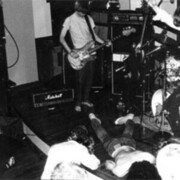
In a photo from a SubPop record gallery, Nate Mendel (crouching, bottom left) is clearly seen setting up a Tech 21 SansAmp Classic with his right hand , holding a power supply unit in his left hand.
Find it on:

In a picture of Nate Mendel's pedalboard, the Voodoo Lab Pedal Power 2 PLUS can be clearly seen, confirming his use of this power supply.
Find it on:
This is a community-built gear list for Nate Mendel.
- Find relevant music gear like Bass Guitars, Amplifiers, Effects Pedals, and other instruments and add it to Nate Mendel.
- The best places to look for gear usage are typically on the artist's social media, YouTube, live performance images, and interviews.
- To receive email updates when Nate Mendel is seen with new gear, follow the artist.







.webp)