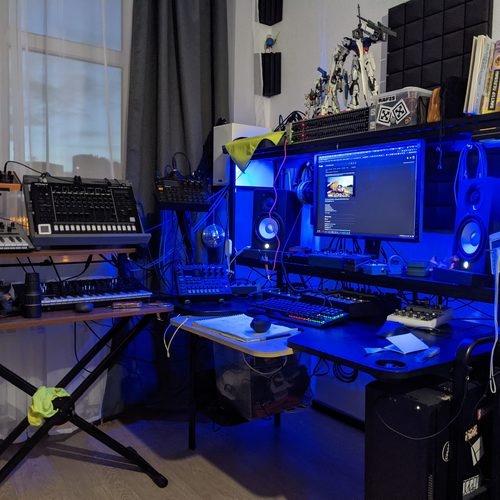
groovizm's Electronic Studio Setup

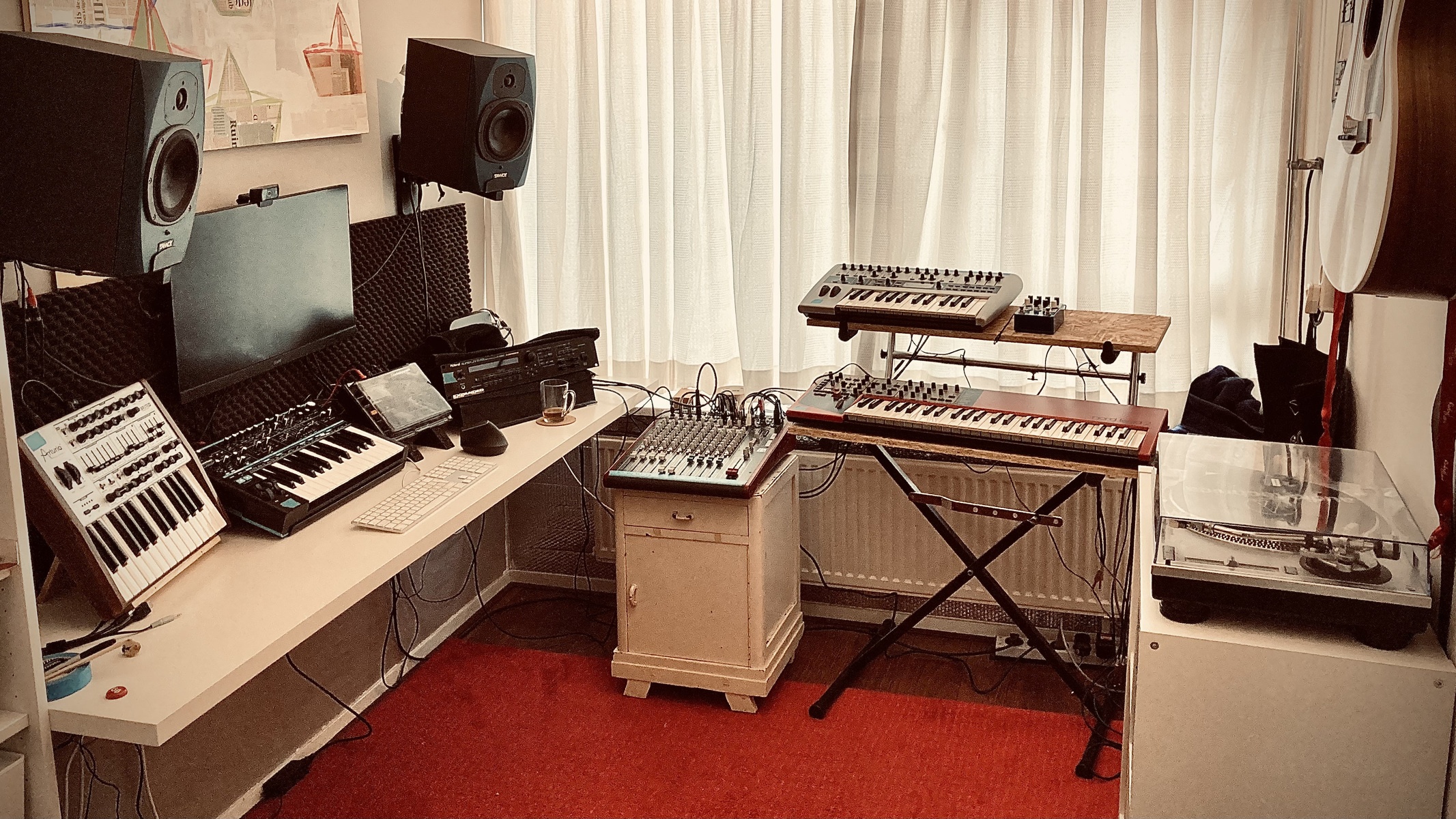
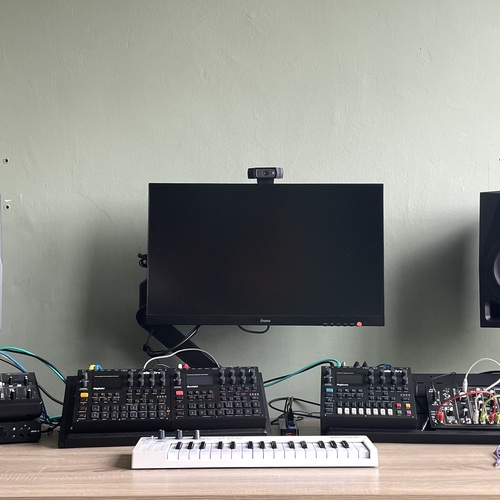
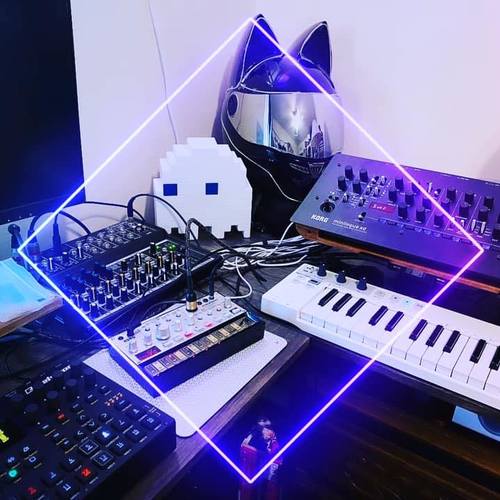
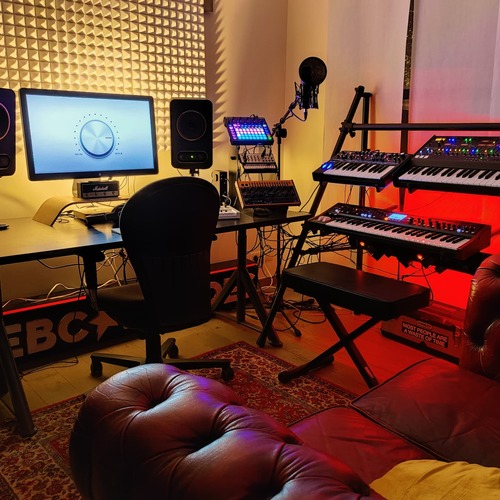
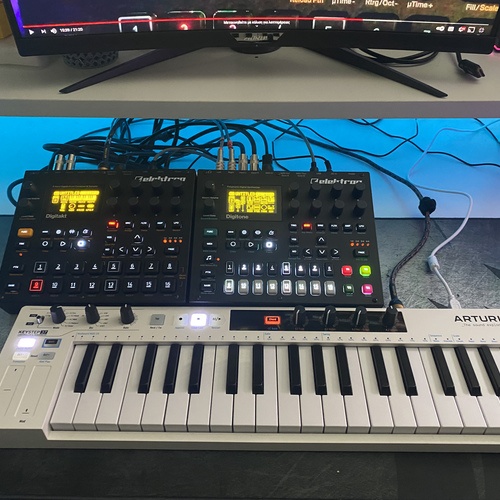
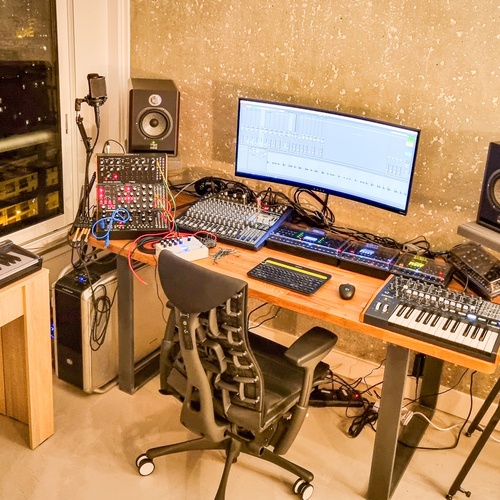
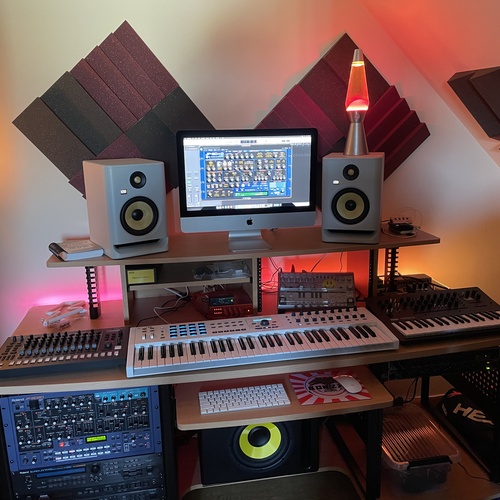
Dawless home studio setup based on Elektron Digitakt.
More gear photos from groovizm

Gear in this photo
This rig
~$3,366
Value by category
- Keyboards and Synthesizers 63.6%
- Studio Equipment 26.8%
- Effects Pedals 9.6%
Price mix
A wide range of price points
-m.webp?v=1784894621)
Avg price: $734.04


It changed everything about how I make music
I think this is a very inspiring instrument, either used on it's own or as part of a bigger setup. Absolutely worth the money.
What I love:
Sampling is mono and that is fine, because mono samples are easier to loop and easier to mix.
Each of the 8 voices is actually a complete synthesizer with one sample oscillator, 2 filters, 2 envelopes and 2 LFO's. It's very hands on, I think it sounds great and to me it is very inspiring!
The sequencer is a TR-style sequencer on steroids, different track lengths, different speeds, per trig parameter locks, probabillity and conditional trigs. I think this sequencer is a very inspiring tool to compose with.
There are 2 send effects; delay and reverb. Both pretty decent. And very usable because every track has its own send levels. Which you can trig lock...
It is beautifully designed and has excellent build quaility. Nice knobs. Very clear display. Good choice of IO on the back.
Major drawbacks:
The audio tracks are monophonic. So chords are only possible by using more than one track, which is very cumbersome, or (better option) sampling chords and than triggering those.
This drives me NUTS. I want the sounds to evolve during the track and so I'm constantly tweaking parameters like filter frequency, resonance, envelope decay, bitreduction, etc. This can sound AMAZING on Digitakt, BUT: the sounds are part of the the pattern. In other words, when I go to a differetn pattern my sounds get reset and all my tweaks are GONE, until I go back to the first pattern and they're suddenly back. UNBELIEVABLE!
Elektron kinda fixed this in Digitakt II with 'performance kit mode'.I'm still hoping the feature will make it into a Digitakt I upgrade...
Another big drawback of the DT (and other Elektron stuff as far as I know) is the confusing file handling using the 'soundpool' and '+drive'. This goes for both sounds and samples.
The sampling engines are not polyphonic. Digitakt II's sampling is stereo, but still monophonic. I'd rather have polyphony than stereo, but maybe that's just me.
Minor gripes:
Matching LFO speeds to musical values not intuitive at all.
Only 1 reverb and 1 delay is a bit limiting. 1 insert effect per track like chorus/flanger/phaser would be awesome.
The sequencer is missing some obvious tricks for such a device, I think; > Finer control over speed: not just double, halve or triplet speeds, but also 4/5 for instance. > Backwards and random playing directions > per trigger step length > different starting step > sequence reset > sequence transpose.
And the handling of pages is odd: 2 bars of 12/8 is currently 1 page of 16 and 1 page of 8. What you want is 2 pages of 12!
Control All: I can't find a way to lock it, so you have to hold the TRK button. Also, there's no way to exclude tracks from control all. There is on Digitakt II but you have to set it up under settings, meaning it is not easy to change in a performance. What I would have liked instead is holding down more than one track button to control multiple tracks. This would have the added benefit of being able to edit multiple tracks at the same time which also helps with faking polyphony...
Track selection: During performance you need to remember to hold TRK before selecting it, or you will be triggering the track. I wish this could be turned off.
Encoder "D" is starting to behave funny on my DT. DT seems to think I've touched it, when I've been nowhere near it... Other users have reported similar issues. Not a big issue, but when you think of buying a DT second hand check it out properly!
Preferred Settings + Usage:
I've DT hooked up to my make Noise 0-Coast. 0-coast can listen to midi on two separate channels allowing you to have the pitches (melody) on one channel and the triggers/gates (rhythm) on another. When using different pattern lengths for your melody and rhythm you get quite interesting stuff.

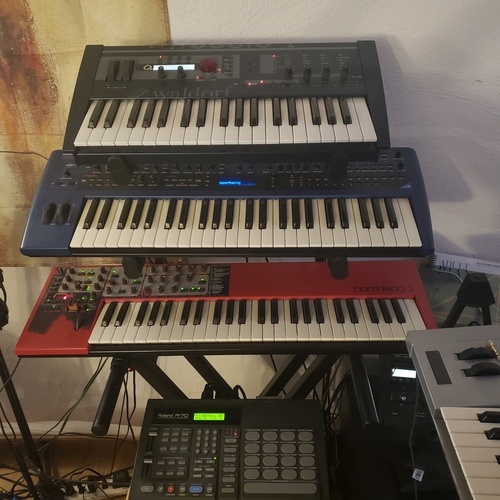
Clavia Nord Lead 2 Synthesizer
Avg price: $648.99


Classic Virtual Analog synth with great character and easy to use
I love the Nordlead. It's harsh and digital and it cuts through the mix like a knife. It's super easy to use, because it's a really simple synth and every sound-parameter is on the front panel. No menu diving to assign LFO's to destinations like on the Access Virus.
That alone would make it a killer synth in my book, but what really makes it stand out are the morph mode (via velocity or modwheel) and how it handles multitimbral operation.
Pro's
Easy to learn synthesis on
Great FM, sync and ringmod options
Midi echo creates echo's by repeating what you played
Morphmode + midi echo = morphing echo's..
Sturdy but compact and quit light for an all metal synth.
LFO and arpegiator can be synced to midi
Every knob sends midi cc's
Sysex dump one, or dump all, it's literally two button presses - very easy for saving your presets into your midi sequencer, or librarian.
4 outputs
Great color
No effects --- I kinda like that you have to use you own external FX, because build-in FX are often not that good and applied to liberally to the presets.
Con's
Keyboard feels spongy
Filter is a bit tame
There's no memory for saving user performances (multi's).
No effects --- Though there is room for a few stompboxes on the right hand side of the front panel...

Avg price: $307.03
Great little synth
It may be Virtual Analog but I think it sounds really good. The filter is nice and it's fun to program. It has 3 oscillators per voice, but also noise, ringmod and external input as separate signals in the mixer. There are 2 syncable LFO's and 2 Envelopes and an Arpeggiator.
It has 7 effects that also can be used simultaneously. They are delay, reverb, chorus/flanger/phaser, distortion, a single band EQ, panning and vocoder. The delay and modulation effects can be synced to midi or the arpeggiator.
It's also a great controller for the V-station plug-in. I simply do not understand this combination never got more attention. I personally can't hear any difference between the K-station and the V-station, so the V-station gives me multiple instances, while the K-station gives me the hands on control I like!
-m.webp?v=1784891424)

Nice first hardware synth with some unexpected twists
When I first had this thing in my hands I just could not believe how sturdily it's build and how well it looks with those wooden side cheeks. If you need something light to throw in a bagpack you'd better get yourself the Novation Bass Station 2, because the MiniBrute SE weighs a ton.
How ever much it seems different, and more classy, than the regular Minibrute on the outside, internally, the Minibrute SE is the same. The only difference is that the SE swaps the arpeggiator for a sequencer, but if you flash the firmware you can turn your SE into the regular Minibrute with arpeggiator.
Allthough the synth has no presets and there is one knob per function there are some additional settings that you need Arturia's Midi center software for, like changing the midi channel and setting up sync. It's a bit of a pity, but not a big deal as I almost never change these settings anyway.
I also found (by accident) that the synth reacts to midi controllers, as I was turning knobs on my Digitakt which screwed up the tuning on my Minibrute! However, I have not been able to find documentation on the midi implementation on the internet.
The sequencer is a doddle to use, but I never use it for pre-composed riffs. I just put in some notes/rests and then twiddle the playback settings swing, gate and mode and let the synth come up with a good groove. What I do like is that the sequencer lenght is not limited to regular beats. So a 5/8 or 13/16 riff syncing to your 4/4 track to add some interrest is easy.
Allthough the front panel look straight-forward, there are a few surprising features on this synth:
3 cv ins and 3 cv outs plus audio in
3 "gate mode" settings: "audio" (gate opens when there is signal on the audio in), "hold" (drone-mode: the gate is open, whether or not you press keys), "keyboard" (normal operation where gate is triggered by the keyboard)
fast and slow envelope modes; slow is really slow.
the saw, square and triangle waves have there own waveshaper each and they can be modulated. This adds some unexpected spice!
The LFO can be synced to sequencer, and the sequencer is always synced to clock. This allows setting up some funky grooves, like a 3/8 LFO to a 4/8 sequence.
Allthough the synth supposedly gets its name from the brutish sounds it emits I find the "Brute Factor" knob a bit of a misnomer; it is just controls a feedback loop from the synths output back into the filter. That is very usefull because it changes the character of the filter, and at extreme settings it can create strange random noises, but it's hardly brutal.
Compaired to the Novation Bass Station 2 I always think of the Minibrute as sweet and creamy. The Steiner Parker filter is just not as aggressive as the Bass Station 2 filter and the "Brute factor" does not make it so.
It is definitely different and that's a good thing!

EarthQuaker Devices Avalanche Run
Avg price: $321.88

Avg price: $579.69
A very nice, easy to use live mixer, but not practical for tracking.
This is a nice mixer for a band playing live, or for a electronic daw-less setup.
For recording, when you want to record just a stero mix to a computer or hardware recorder, it's great. You can record to the computer using the built-in 2-in, 2-out USB interface, which on my 2018 Mac mini works fine and with very low latency. Recording to a hardware recorder, or the inputs of an audio interface is easy using the record outs.
If however you want to record yourself playing different instruments one at a time (overdubbing) or you want to have multiple instruments going separately into a multi channel interface/recorder simultaneously , than you run into the limitations of the ZED14.
Pro's
Nice clean layout, very simple to operate.
Aux 1 & 2 can be switched to stereo.
Great sound quality.
Built-in 2x2 class compliant USB interface
Cons:
Phono's are ok for the rec-out, but for the stereo returns and the alt-out I really would have liked 1/4 inch jacks.
I would have liked more stereo instead of mono channels to connect synths and effects.
Aux 1 & 2 can not be switched post-fader, they are hardwired pre-fader.
I can't find a way to silence my speakers (connected to the main outs) while listening through headphones.
PS; I considered the Mackie 1402VLZ4 as an alternative. I like the Mackie's smaller footprint and the more flexible routing in general. I went for the ZED14 because of the more flexible EQ, 2 extra Auxes and the clearer layout of the front-panel.

-m.webp?v=1784876527)
Avg price: $322.00
This 90-ties classic has it's limits, but is still useful for atmospheric pads
When I first heard this synth back in 1994 all those patches mimicking 'real' instruments, like strings, piano's, organs and synths seemed pretty impressive. Nowadays these sounds seem outdated and a bit cheesy.
However, the JV-1080 is still a good buy for the absolutely fantastic pads this thing can do. Listen to the youtube demo of Don Solaris' JV-1080 sound set and you'll know what I mean.
Why the JV1080 can create such huge pads is evident as soon as you understand all that can go into a single patch. A patch consists of up to 4 tones. Each tone has it's own oscillator, multi mode filter, amp-, filter- and pitch envelopes and 2 lfo's. The envelopes are not simple ADRS's but are multi segmented. The LFO's have 8 different waveforms and can be synced to internal or external midi clock. There are 448 waveforms to choose from for each oscillator. The tones share an 1 insert effect plus reverb and chorus send effects. There are 40 insert effects to choose from.
PRO's
lot's of presets
lot's of sampled raw waveforms, both oneshots and looped multisamples.
really deep sounddesign possible
expandable
many soundsets still available
64 voice polyphony
16 parts multitimbral
cheap
Unique character
CON's
I'd have preferred simple ADSR envelopes over complex multisegmented ones, for ease of programming.
It's not easy to edit patches, because of the complex voice- architecture and the 2 line display.
Only one bank for user presets, and you can't overwrite the factory presets.
the filter is rather lame.
realtime control is limited.
the effects are not that good, luckily you can switch them off globally and use an external effects processor instead.
About this setup
This gear photo by groovizm features 9 pieces of gear, including Elektron Digitakt, Clavia Nord Lead 2 Synthesizer, and Novation K-Station 25. The setup spans Keyboards and Synthesizers, Studio Equipment, and Effects Pedals, with a wide range of price points. Artists with this kind of gear are most often found in the Electronic, Rock, and Pop scenes.










.png?v=1775046388)