a_k_watson's Metal Amp Rig

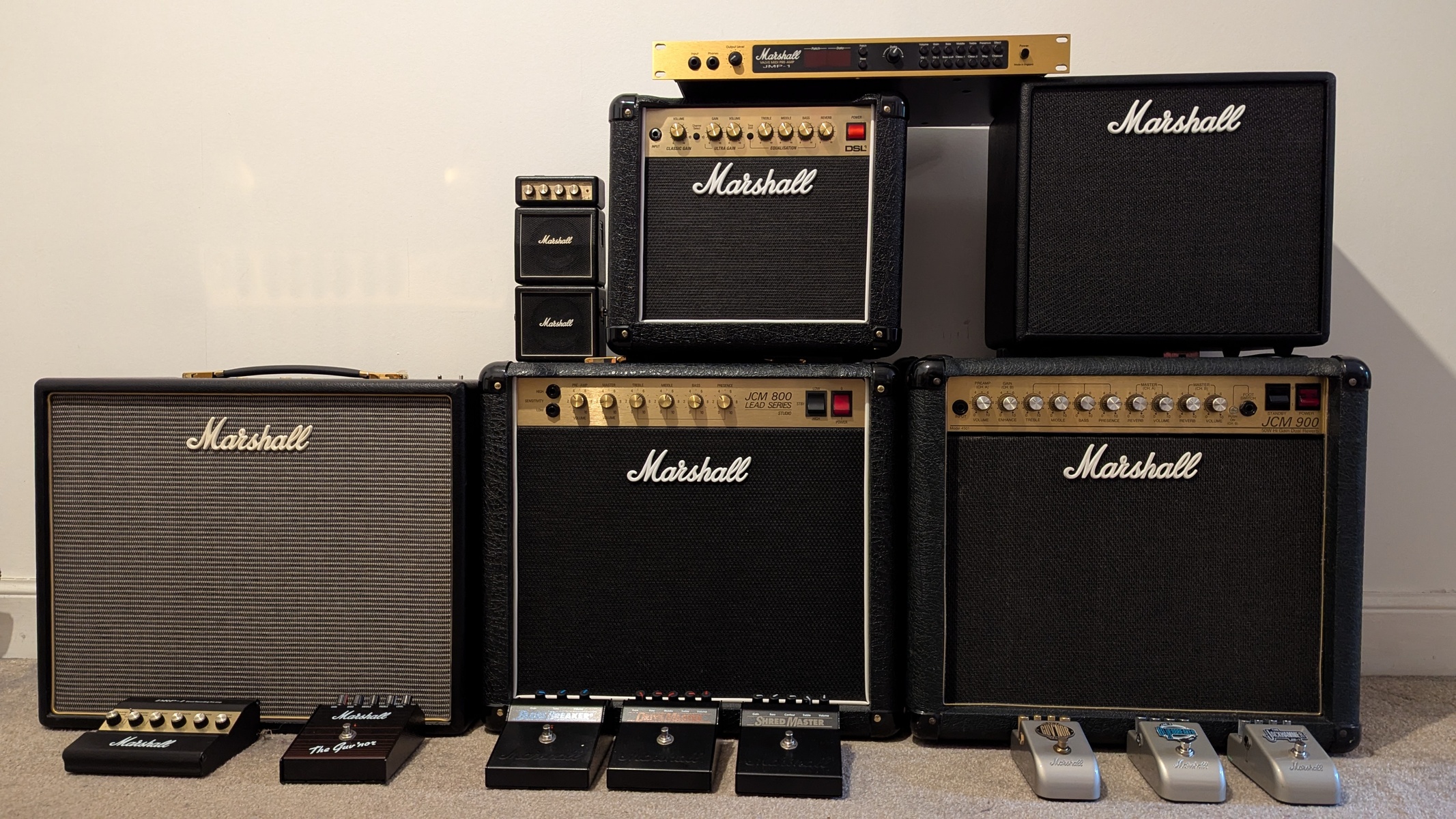
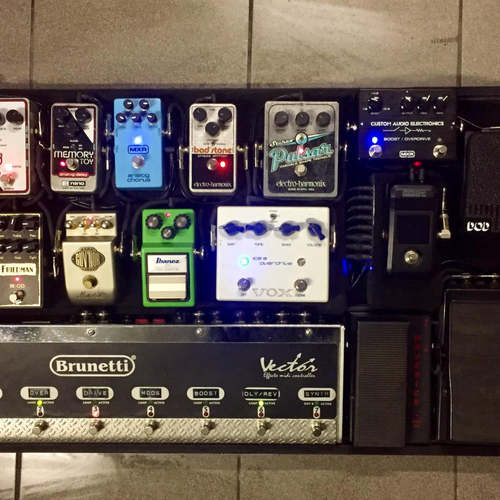
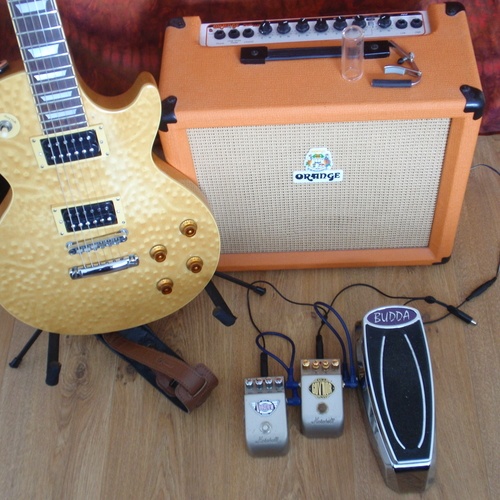
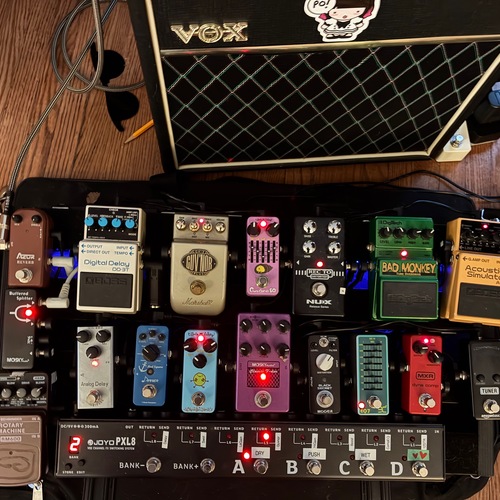
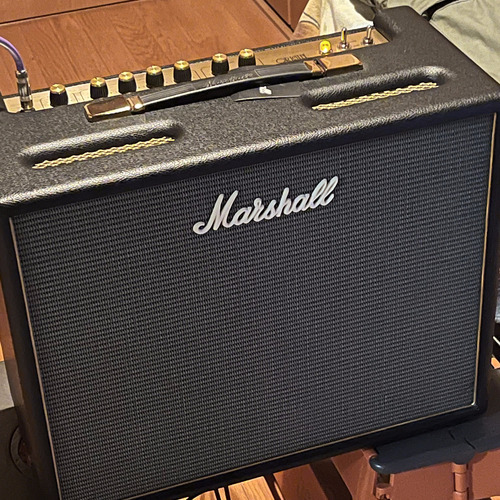
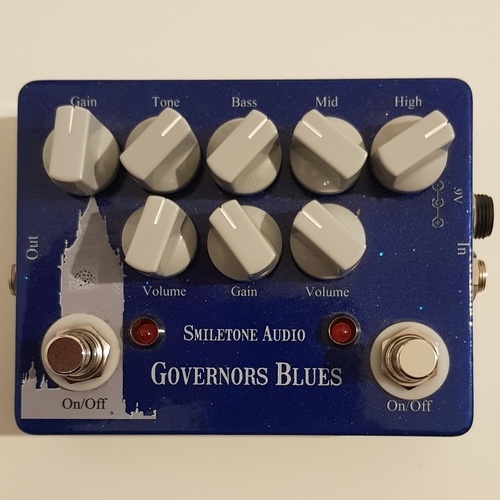
Top to bottom and left to right: JMP-1 Valve MIDI Pre-amp, MS-4 Micro Stack, DSL1CR, CODE25, Origin 20C, Studio Classic SC20C, 4501, DRP-1 Direct Recording Pre-amp, The Guv'nor, BluesBreaker, DriveMaster, ShredMaster, GV-2 Guv'nor Plus, BB-2 BluesBreaker II, JH-1 The Jackhammer
More gear photos from a_k_watson






Gear in this photo
This rig
~$4,598
Value by category
- Amplifiers 79.2%
- Effects Pedals 20.8%
Price mix
A wide range of price points

Marshall JMP-1 Tube MIDI Guitar Preamp
Avg price: $594.94


Avg price: $54.81


Avg price: $343.96

Avg price: $196.90

Avg price: $621.24

Avg price: $1,395.84
The crunch and roar of 1980s Marshall, at comfortable volumes, in the convenience of my lounge
The amp reviewed below was produced in early 2020 and has its stock speaker.
For full disclosure, I have never played a real 2203, or indeed any 50 or 100-watt JCM Marshall. I have however had the pleasure of experiencing the roar of JCM800 (and JCM900 and JCM2000) amps from stages, over the decades, albeit with mic'ing. There are also countless recordings in my music collection of JCM800 series amps. There is a tone imprinted in my mind of the general characteristics of the JCM800 2203.
This amp is the sound in my head of the '80s and '90s of EL34-powered rock. This is the tone I chased, spending a fortune on Marshall In A Box pedals and modelling equipment on my quest. My search for 2203 tone is over!
The uncompromising traditionalist cannot help but question the selection of the single 10-inch Celestion V-Type Junior over a 12-inch speaker. This the Studio Classic has in common with Marshall's Origin 20C and Studio Vintage combos (the Studio Jubilee Combo and Studio JTM Combo are fitted with the 12-inch G12M-25 Greenback and G12M-65 Creamback respectively). According to their Product Director Luke Green, Marshall "did a lot of testing with different speakers and cabs - and actually, for a small combo at that power, that 10-inch speaker was so much more honest in its tone" (in Guitarist Presents - 'Marshall - How Britain's greatest amp brand got its mojo back' (2019)). Nevertheless, at home levels, the 10-inch certainly does not lack the magic of classic Marshall crunch and roar of the past 40 years. It allows it to be enjoyed at volume levels that don't put the wind in your trousers or leave ringing in your ears or diminished hearing! It is never thin, metallic or raspy at low volumes.
Much is made about the Studio Classic Combo being TOO LOUD for bedroom practice. There is no doubt that the amp could upset other occupants and adjoining neighbours if you turned it up. You won't get the benefit of the EL34 power amp roar without getting painfully loud. However, with the Master at 1 on High Sensitivity (or upwards on Low Sensitivity) it is easy to get classic tones from the Pre-Amp. The Master volume is gradual enough to be controllable and not leap in level, unlike an amp I own from Fender. I do not have the experience to comment on the perennial questions about playing alongside drummers or headroom at performance levels.
With nothing plugged into the fixed-level series effect loop, engaging the loop causes a slight drop in volume. Given that the loop is not footswitchable, this does not cause concern. It can be convenient for bringing down the volume more around young family members. The fixed level does mean that some gear works better than others in the loop. I do get a bit of noise from certain items in the loop but I am putting those issues down to those items and/or their power supplies as it certainly is not universal across the devices I have tried so far. A buffer in the effects loop signal chain may be the answer.
Although revered as the archetypal sound of '80s British hard rock and metal, the real JCM800 2203 (and its 50-watt sibling, the 2204) have offered much more to music over the decades. It should not be forgotten that 2203 of the JCM800 variety have also appeared in the backlines of Buddy Guy, Andy Summers (The Police) and Jeff Beck. The JCM800 era 2203 are brighter and more aggressive than their JMP ancestors. Dialling back the gain and higher frequencies, to my ear, recalls the recorded tones of the mid to late 1970s, perhaps even close enough to the ballpark of the recorded tone of aggressive non-master volume JMP of the late 1960s.
The Low Sensitivity input should not be overlooked. It never crosses into the bright sparkle and mid-scoop of a Fender Blackface and does not do Hi-Fi clean. It does however offer plenty of clean territory with a Marshall tone.
A single channel amp (albeit with High and Low Sensitivity inputs), no onboard reverb and a fixed level, but not footswitchable, effects loop is not for everyone. There are other valve amps with more features for much less money. However, this amp convincingly conjures up JCM800 2203-like crunch and roar at the convenience of lower volume levels that do not wake up my children or bother my wife through the house and have the added convenience of the effects loop (but do note my observations about the loop).
Henning Pauly describes the differences between a real JCM800 2203 and the Studio Classic Head on video on his EytschPi42 YouTube channel (https://youtu.be/hgXwGIhuk14), noting that the Studio Classic was "a bit more mid-focused" and that the "low-end chunk is not quite there".
I was lucky enough to pick up the four-year-old Studio Classic Combo without a box or papers for £500 - approximately half the RRP of a new one. Would this amp be worth full RRP to me? No, because it would be the price of a secondhand DSL40CR (with its convenience of onboard reverb and its diversity of foot-switchable channels) plus change for a 6-button footswitch and other gear. But I doubt the DSL40CR gets quite this tone. The OD 1 channel of my JMP-1 VALVE MIDI PRE-AMP into the power amp of my Origin 20C (which shares the same speaker as the Studio Classic Combo) certainly does not touch it.
At the secondhand price I paid I am living the dreams of my teens and beyond. I imagine many dreaming of real valve JCM800 tones at family and neighbour-friendly levels would be happy with this amp at RRP.
The RRP and limited features are the only things preventing a 5-star scoring. If half stars were available I would have awarded 4.5 stars.
Preferred Settings + Usage:
Backing the Pre-Amp back to 4 serves touch sensitive classic Marshall crunch to roar and turning up to 6 can be plenty.

Avg price: $434.31

Ongoing appeal perhaps lies a little more through novelty as an actual 'Marshall In A Box' for the collector than as a stand-in for a JCM800 2203
Drawing upon the design team of Marshall's JCM900, Anniversary and Valvestate ranges, the Direct Recording Pre-Amp DRP-1 aims to recreate the tone and feel of a JCM800 2203 through micro-electronic techniques, with a contemporary power amp/loudspeaker emulation (relying upon a special filter).
A selection of outputs supports a range of applications. A buffered pre-amp output is designed to feed into a separate power amp and cabinet. Line Out and the separate headphone output add the power amp/speaker emulation for direct recording, plugging in a PA or use as a headphone amp. A two-mono jack Y lead allows an external effects processor between the headphone amp and output.
The controls could not be any more master volume Marshall In A Box. A switch selects between 'Normal' ('classic') and 'Boost' ('contemporary', for higher gain) modes. Place yourself back amongst Marshall range in 1995 for anticipating gain and tone. There is a 'Preamp Volume', 'Master Volume', three-band EQ and a Line Level.
The three-band EQ has passive Treble and Middle controls but with a wider sweep for more flexibility than would be typically found on a Marshall. The Bass control is active and designed to provide "resonant low end ‘Thump’ associated with a Marshall 4x12 cabinet"
An important consideration when comparing older analogue amp emulators with speaker emulation to digital models using Impulse Response (IR) is just how dry analogue emulation sounds in isolation without reverb or other ambience. That applies as much to the long-running Tech21 NYC SansAmp GT2 and other analogue emulators as it does to the DRP-1. This is quite prominent with headphones or other direct use.
Whether connecting Pre-amp Out to the effects loop return of Marshall Origin 20C, Line Out to a Yamaha HS8, or using with Sennheiser HD 201 headphones, distinctly Marshall tones can be dialled in which are distinctly analogue in warmth and character, but also distinctly solid state as opposed to valves.
It should not come as a surprise given the technology, it feels and sounds like a Marshall In A Box pedal running through a speaker emulator circuit rather than a valve-powered Marshall stack. The voicing and tone controls seem more Marshall amp-like than The Guv'nor or DriveMaster. The speaker emulator circuit is not any less convincing than the Marshall JMP-1 Valve MIDI Pre-Amp.
There is plenty of classic gain through to early '90s Marshalls between the Normal and Boost modes.
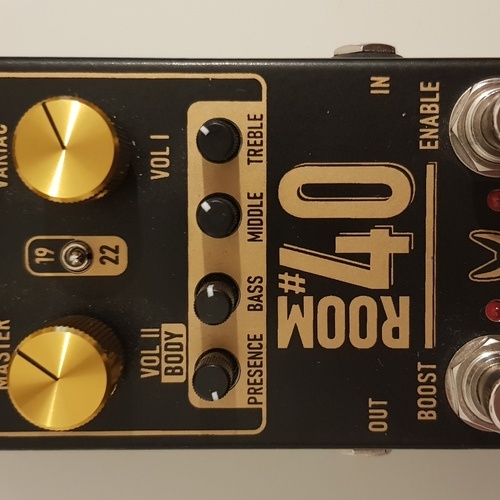
Heavier strumming and picking is tailed by the gritty crackly decay familiar and frustrating to users of many overdrive pedals (of all prices). Even the high-end Marshall In A Box Tskalis AudioWorks Room #40 has a distinct decay which betrays it as not being valves.
In the absence of other headphones to compare to, it is unclear as to how other headphones react, but harder strumming from the edge of breakup causes clipping through Sennheiser HD 201 headphones, even with the Line Level low.
If expectations are for something distinctly Marshall but not exactly valve-like and not exactly JCM800 2203 then this box delivers. There are many alternatives now, such as other Pre-Amps, Marshall In A Box voiced pedals or modellers, this is the only one in a box styled like a JCM and wearing the Marshall name. Perhaps that is the main magic and novelty of this three-decade-old technology. The DRP-1 will be enjoyed more by the Marshall enthusiast as a collection piece rather than those seeking the most convincing Marshall stack tone emulations available today.
It is a blast of history that will keep a Marshall enthusiast entertained.

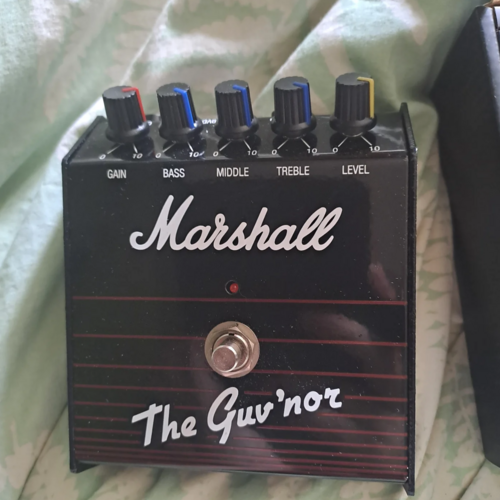
Marshall The Guv'nor Vintage Reissue
Avg price: $177.08


Marshall BluesBreaker Vintage Reissue
Avg price: $169.44

Marshall DriveMaster Vintage Reissue
Avg price: $193.12

Marshall ShredMaster Vintage Reissue
Avg price: $163.74


Avg price: $101.91

Avg price: $34.89

Avg price: $115.77
About this setup
This gear photo by a_k_watson features 15 pieces of gear, including Marshall JMP-1 Tube MIDI Guitar Preamp, Marshall MS-4 Micro Stack, and Marshall DSL1CR. The setup spans Amplifiers and Effects Pedals, with a wide range of price points. Artists with this kind of gear are most often found in the Rock, Metal, and Hard rock scenes.