
Al Watson
Chasing tone with budget guitars and affordable amps for 30 years. Collector of millennial amp modelling devices.
Every rig tells a story. Start yours.
Catalog your gear, wishlist what's next, and share the setups behind your sound — free.
Create your EquipboardGuitars 11


*The guitar being reviewed has a 2021 serial number, was bought new but was given a Plek set up by the shop before dispatch.*
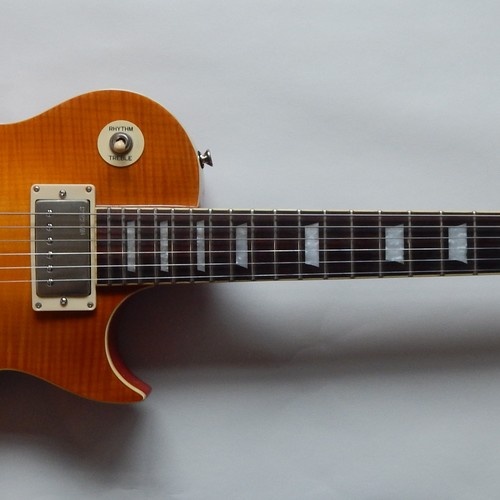
I was honestly bowled over by the craft and quality of this Made In China Epiphone compared to my Made In Korea 1997 G-400. The Korean instrument had, out of the box, a bumpy rosewood fretboard edge, squint tuning peg, a plastic nut, and still chokes out of bends on the 20th fret on upper strings (although comparison with an instrument which has been through a Plek is perhaps a little unfair). The only slight flaw I have detected in this Chinese Les Paul in almost three years has been the slight overspray of the cherry sunburst finish onto the binding under the fretboard where the binding of the neck and body meet. It is not in a position that would be seen by the player or the audience.
The '50s neck profile is chunkier than slim fast necks but in no way uncomfortable or clubby. It feels very comfortable to play in all positions. This long tenon neck appears to be one piece (including the heel) up to the scarf joint for the headstock.
Looking at either end of the 'mahogany' body, it appears to have been made from three pieces. The two-piece maple veneer covers an unknown number of pieces forming the maple cap.
I will never know how much should be put down to Epiphone or the Plek set up but it plays the most flawlessly and with the lowest action of any of my guitars. I don't know if it is by luck or set up but I honestly remain stunned as to how well it keeps its tuning relative to my other guitars.
The Epiphone ProBucker pickups (without any adjustment of height or screw poles to dial in) are not as clear and bright as my Wilkinson WVC humbuckers but are way more articulate than the dull lifeless Alnico V humbuckers on my 1997 Epiphone G-400. This Les Paul has plenty of classic humbucker power but remains relatively clear. Their output and voicing suit my classic rock noodling and strumming.
The pickup selector switch did start to become intermittent quickly so I have since upgraded to a Switchcraft short-frame toggle switch.
Between playability, comfortability, tone and quality of finish, this gets much more attention than my five other electric guitars. It was more expensive than several of them but it feels like the extra cost has been rewarded in quality. has been rewarded in quality.
My 1997 Made In Korea G-400 is blown completely of the water, despite being similar to the RRP of this Les Paul, when adjusted over the 23-year gap. With Epiphone more recently providing affordable quality like this, we have never had it so good!
-m.webp?v=1784213891)


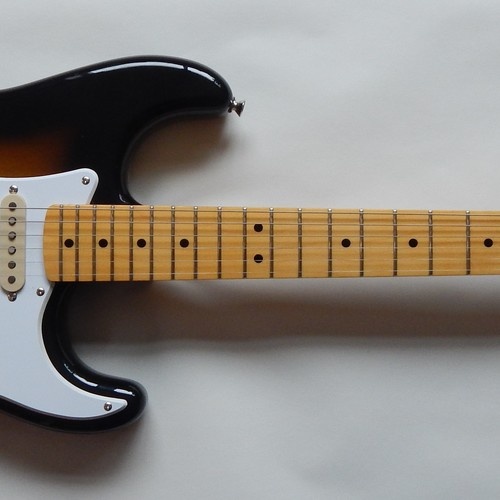
This review is of a **2018 Classic Vibe '50s with a two-tone sunburst alder body produced in the China Grand Reward factory**. Specifications vary from the successor crafted in Indonesia.
This version of the long running Classic Vibe '50s series is quite simply excellent value for money.
In the absence of a Fender Classic Series '50s Stratocaster to compare Fender Mexico to Squier China Grand Reward, the closest comparison I can make is with my Fender Classic Player Baja Telecaster, which was pitched at the higher prices accompanying the Fender decal on made in Mexico models.
The Stratocaster body appears to be made of four pieces of unspecified alder, which is the same number of pieces as the ash bodied Baja Telecaster. The four pieces are fairly well matched in terms of grain and finish and do not stand out.
In terms of the quality control and feeling in the hand, the Squier feels at least as good to me, if not better, than the Mexican Fender. You could honestly change the decal and convince me that the Classic Vibe is part of the made in Mexico Classic Series.
Forums report that the stock AlNiCo III pickups are very similar to the Tonerider Surfari TRS5 AlNiCo III set (possibly produced in the same factory). Surfari are voiced around the earliest ash bodied Stratocaster pickups (starting in 1954). Literally the only tweak I ever contemplate would to be add some more zing and trebly bite (more associated with AlNiCo V pickups) - that would have perhaps put the rating up to five stars.
Aside from the decal, the more critical traditionalist may note that the guitar does not attempt to be a particular year but to instead impart the vibe of '50s models by mixing elements of earliest AlNiCo III pickups (from 1954, changing to V by late 1956 ), with alder body (from mid-1956), a post late-1956 "butterfly" style string tree (a conspicuous difference from the round string retainer of this model's crafted in Indonesia nyatoh bodied successor), and the convenience of a modern fingerboard radius and frets.
It could have said Fender instead of Squier on the headstock and many may not have been any the wiser. An amazing instrument for the price.


Version being reviewed is a **2015 V100 PGM Reissued**
The Wilkinson hardware does the job, so much so that I have contemplated fitting WVC humbuckers to my Epiphone G-400. The pickups are clearer and brighter than stock pickups 1998 G-400 or my 2021 Epiphone Les Paul Standard '50s. Let your ears decide how stock Wilkinson pickups in a V100 Lemon Drop compare to those in a Gibson Custom Shop "Blues Master" Les Paul in the *astringuk* YouTube video *Ten Times The Tone? Gibson vs Vintage* ( https://youtu.be/iq-vik2qfME?si=Kht8c8aNfGyXaY6z ).
I get the sense that if I was going to review the currently listed specification (2024) that I would would be singing praises of the more traditional two piece "mahogany" body and one piece "mahogany" neck in comparison to other brands in the price bracket and possibly awarding 5 stars. My 2015 has a three piece back (not matched in grain) and three piece laminate neck. On the other hand the back is rarely looked at and if anything starting to collect superficial buckle rash anyway. I also take onboard that a laminate neck will be more stable and warp resistant than a one piece neck. I just highlight the difference in build for those looking at the secondhand market for versions of that era should these largely aesthetic matters be a concern. I love the maple veneer flame on mine and I think it is guitar (on a wall of six) that catches the attention of visitors too.
Honestly the only thing I would change would be to make the neck a bit thicker as it is skinnier than my other guitars. Perhaps fast thin necks are of course a matter of preference.
Buying this guitar was definitely the right decision. Presuming the 2024 is as good as mine in all other ways, a traditional two piece body and one piece neck may have pushed the rating to 5 stars.

Effects 59


Firstly, **this is not an overdrive pedal**. Secondly, older digital modelling should be considered in the context of the technology of its era. As a modeller from 2005, notably within a stompbox footprint, expect it to perform with the tone and dynamics of 20 year old modelling.
Even with its antiquity, this pedal still provides convincing enough plug and play emulation of classic Clapton tones.
Its digital modelling pedal covers the signal chain through to the mixed sound on specific recordings:
*"... Production Modelling was designed to help reproduce the studio and live sounds and effects of an artist as heard on their recordings. This includes modelling the speaker cabinets, microphones with their placements, pre/post effects, and the recording engineer's magic all in one pedal."*
*"The OUT 2 (MIXER) output has been specially designed to faithfully reproduce Eric’s studio guitar amplifier tones without having to use an amp."*
The weakness of the manual is that it does not tell users to set their amp very clean and flat, or to plug into effects return to bypass the colouration of the preamp. It was never intended or suitable for placing in front of overdriven / distorted preamps.
Bypassing the issues of colour from guitar amplifier, cabinet and speaker by instead running it into a studio monitor for almost flat response, it performs as with as much authenticity as other modelling devices (particularly other DigiTech) of its era. The modes clearly recall the songs that they set out to emulate. There will however always be an element of variability in the results coming from the guitar and the player.
If it had Bluesbreakers 'Beano album' and a mid-boost and chorus '24 Nights' or cocked 'Journeyman' settings then it would be quite comprehensive *Clapton In A Box*. Arguments about which recorded tones are missing or could have been swapped out aside, all settings are usuable as emulations or as platforms for other tunes.
If the price is right, mine certainly being so at £50 in 2020, this is worth a shot for the Clapton aficionado.


-m.webp?v=1784199767)


The ability to swap pre-amplifiers through the effects loop return of my combo amplifiers is a conscious space and budget saving solution.
The finish of the Vox Copperhead Drive is blatantly reminiscent of the control panels of Marshall amplifiers, leaving little doubt over its inspiration.
I personally like the Copperhead Drive Gain most between 11 and 2 o'clock, providing, to my ears, the tones in my head over the ages of JMP, through JCM800 to JCM900 (the 1970s to the 1990s).
In pre-amp mode, the three band active EQ has plenty of range to tweak to the power amp, speaker and the room.
The Bright switch adds a little more zing and sizzle, but not quite enough for my tastes for more modern tones through my usual arrangement into a Marshall Origin 20C combo 20W EL34 power amp into its 10 inch speaker. I dial the presence control on the receiving power amp up to taste.
I have the aforementioned Marshall Origin 20C which is fantastic at home levels at early Marshall clean, edge of break up and crunch but cannot do harder rock at sociable volumes. The maligned Marshall DSL1CR with its 1W output (using an ECC82 pre-amp valve in its power amp) has too modern voicing, for my taste, through its 8 inch speaker. In terms of *actual* Marshall pre-amp alternatives, I also have the JMP-1 Valve MIDI Pre-amp (which boasted it could cover from JTM45 to JCM900) and the lesser known DRP-1 Direct Recording Pre-amp (a completely solid state unit voiced with a 2203 in mind).
None of the above from Marshall themselves quite covers '70s and '80s classic crunch, bark and roar in my mind with such convincing tone and feeling as the Vox Copperhead Drive (or certainly not at such polite volumes).
I should make clear that as it is not a simulation, model or profile of a Marshall, it does not precisely emulate any particular Marshall. Rather it captures the vibe of the sound of rock over those decades propelled by various Marshall models.
Those not convinced about trying NuTube should watch the blind test comparison between a 12AX7 and NuTube in Landon Bailey's YouTube video *Classic Vacuum Tube VS New Korg Nutube - Tone Comparison*
https://youtu.be/KMCtOBAk4_o?si=0biRNcYp9oE4T9zW
It does becomes more compressed than I would desire from the point of heavier crunch onwards.
It sounds like valve, it feels like valve and most importantly it sounds like an amp brand whose control panels share their colour with this pedal.


Amplifiers and monitors 16


Drawing upon the design team of Marshall's JCM900, Anniversary and Valvestate ranges, the **Direct Recording Pre-Amp DRP-1** aims to recreate the tone and feel of a JCM800 2203 through micro-electronic techniques, with a contemporary power amp/loudspeaker emulation (relying upon a special filter).
A selection of outputs supports a range of applications. A buffered pre-amp output is designed to feed into a separate power amp and cabinet. Line Out and the separate headphone output add the power amp/speaker emulation for direct recording, plugging in a PA or use as a headphone amp. A two-mono jack Y lead allows an external effects processor between the headphone amp and output.
The controls could not be any more master volume *Marshall In A Box*. A switch selects between 'Normal' ('classic') and 'Boost' ('contemporary', for higher gain) modes. Place yourself back amongst Marshall range in 1995 for anticipating gain and tone. There is a 'Preamp Volume', 'Master Volume', three-band EQ and a Line Level.
The three-band EQ has passive Treble and Middle controls but with a wider sweep for more flexibility than would be typically found on a Marshall. The Bass control is active and designed to provide *"resonant low end ‘Thump’ associated with a Marshall 4x12 cabinet"*
An important consideration when comparing older analogue amp emulators with speaker emulation to digital models using Impulse Response (IR) is just how dry analogue emulation sounds in isolation without reverb or other ambience. That applies as much to the long-running Tech21 NYC SansAmp GT2 and other analogue emulators as it does to the DRP-1. This is quite prominent with headphones or other direct use.
Whether connecting Pre-amp Out to the effects loop return of Marshall Origin 20C, Line Out to a Yamaha HS8, or using with Sennheiser HD 201 headphones, distinctly Marshall tones can be dialled in which are distinctly analogue in warmth and character, but also distinctly solid state as opposed to valves.
It should not come as a surprise given the technology, it feels and sounds like a *Marshall In A Box* pedal running through a speaker emulator circuit rather than a valve-powered Marshall stack. The voicing and tone controls seem more Marshall amp-like than The Guv'nor or DriveMaster. The speaker emulator circuit is not any less convincing than the Marshall JMP-1 Valve MIDI Pre-Amp.
There is plenty of classic gain through to early '90s Marshalls between the Normal and Boost modes.
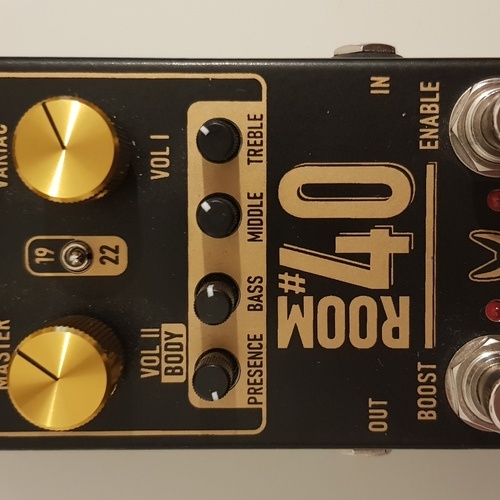
Heavier strumming and picking is tailed by the gritty crackly decay familiar and frustrating to users of many overdrive pedals (of all prices). Even the high-end *Marshall In A Box* Tskalis AudioWorks Room #40 has a distinct decay which betrays it as not being valves.
In the absence of other headphones to compare to, it is unclear as to how other headphones react, but harder strumming from the edge of breakup causes clipping through Sennheiser HD 201 headphones, even with the Line Level low.
If expectations are for something distinctly Marshall but not exactly valve-like and not exactly JCM800 2203 then this box delivers. There are many alternatives now, such as other Pre-Amps, *Marshall In A Box* voiced pedals or modellers, this is the only one in a box styled like a JCM and wearing the Marshall name. Perhaps that is the main magic and novelty of this three-decade-old technology. The DRP-1 will be enjoyed more by the Marshall enthusiast as a collection piece rather than those seeking the most convincing Marshall stack tone emulations available today.
It is a blast of history that will keep a Marshall enthusiast entertained.


*The amp reviewed below was produced in early 2020 and has its stock speaker.*
For full disclosure, I have never played a real 2203, or indeed any 50 or 100-watt JCM Marshall. I have however had the pleasure of experiencing the roar of JCM800 (and JCM900 and JCM2000) amps from stages, over the decades, albeit with mic'ing. There are also countless recordings in my music collection of JCM800 series amps. There is a *tone* imprinted in my mind of the general characteristics of the JCM800 2203.
**This amp is the sound in my head of the '80s and '90s of EL34-powered rock. This is the tone I chased, spending a fortune on *Marshall In A Box* pedals and modelling equipment on my quest. My search for 2203 tone is over!**
The uncompromising traditionalist cannot help but question the selection of the single 10-inch Celestion V-Type Junior over a 12-inch speaker. This the Studio Classic has in common with Marshall's Origin 20C and Studio Vintage combos (the Studio Jubilee Combo and Studio JTM Combo are fitted with the 12-inch G12M-25 Greenback and G12M-65 Creamback respectively). According to their Product Director Luke Green, Marshall *"did a lot of testing with different speakers and cabs - and actually, for a small combo at that power, that 10-inch speaker was so much more honest in its tone"* (in *Guitarist* Presents - *'Marshall - How Britain's greatest amp brand got its mojo back'* (2019)). Nevertheless, at home levels, the 10-inch certainly does not lack the magic of classic Marshall *crunch* and *roar* of the past 40 years. It allows it to be enjoyed at volume levels that don't put the wind in your trousers or leave ringing in your ears or diminished hearing! It is never thin, metallic or raspy at low volumes.
Much is made about the Studio Classic Combo being TOO LOUD for bedroom practice. There is no doubt that the amp could upset other occupants and adjoining neighbours if you turned it up. You won't get the benefit of the EL34 power amp roar without getting painfully loud. However, with the Master at 1 on High Sensitivity (or upwards on Low Sensitivity) it is easy to get classic tones from the Pre-Amp. The Master volume is gradual enough to be controllable and not leap in level, unlike an amp I own from Fender. I do not have the experience to comment on the perennial questions about playing alongside drummers or headroom at performance levels.
With nothing plugged into the fixed-level series effect loop, engaging the loop causes a slight drop in volume. Given that the loop is not footswitchable, this does not cause concern. It can be convenient for bringing down the volume more around young family members. The fixed level does mean that some gear works better than others in the loop. I do get a bit of noise from certain items in the loop but I am putting those issues down to those items and/or their power supplies as it certainly is not universal across the devices I have tried so far. A buffer in the effects loop signal chain may be the answer.
Although revered as the archetypal sound of '80s British hard rock and metal, the real JCM800 2203 (and its 50-watt sibling, the 2204) have offered much more to music over the decades. It should not be forgotten that 2203 of the JCM800 variety have also appeared in the backlines of Buddy Guy, Andy Summers (The Police) and Jeff Beck. The JCM800 era 2203 are brighter and more aggressive than their JMP ancestors. Dialling back the gain and higher frequencies, to my ear, recalls the recorded tones of the mid to late 1970s, perhaps even close enough to the ballpark of the recorded tone of aggressive non-master volume JMP of the late 1960s.
The Low Sensitivity input should not be overlooked. It never crosses into the bright sparkle and mid-scoop of a Fender Blackface and does not do Hi-Fi clean. It does however offer plenty of clean territory with a Marshall tone.
A single channel amp (albeit with High and Low Sensitivity inputs), no onboard reverb and a fixed level, but not footswitchable, effects loop is not for everyone. There are other valve amps with more features for much less money. However, this amp convincingly conjures up JCM800 2203-like *crunch* and *roar* at the convenience of lower volume levels that do not wake up my children or bother my wife through the house and have the added convenience of the effects loop (but do note my observations about the loop).
Henning Pauly describes the differences between a real JCM800 2203 and the Studio Classic Head on video on his EytschPi42 YouTube channel (https://youtu.be/hgXwGIhuk14), noting that the Studio Classic was *"a bit more mid-focused"* and that the *"low-end chunk is not quite there"*.
I was lucky enough to pick up the four-year-old Studio Classic Combo without a box or papers for £500 - approximately half the RRP of a new one. *Would this amp be worth full RRP to me?* No, because it would be the price of a secondhand DSL40CR (with its convenience of onboard reverb and its diversity of foot-switchable channels) plus change for a 6-button footswitch and other gear. But I doubt the DSL40CR gets quite this tone. The OD 1 channel of my JMP-1 VALVE MIDI PRE-AMP into the power amp of my Origin 20C (which shares the same speaker as the Studio Classic Combo) certainly does not touch it.
At the secondhand price I paid I am living the dreams of my teens and beyond. I imagine many dreaming of real valve JCM800 tones at family and neighbour-friendly levels would be happy with this amp at RRP.
The RRP and limited features are the only things preventing a 5-star scoring. If half stars were available I would have awarded 4.5 stars.


Bass Guitar 1

Owned previously 3


Wishlist 2
Gear Photos 24







Top artists 22
The artists Al Watson has added the most gear to.
 #1
#1
Gwyn Ashton
Guitarist
15 submissions #1
#1
Peter Green
Singer, Guitarist · Fleetwood Mac
7 submissions #1
#1
Louise Wener
Singer · Sleeper
6 submissions
#1
Mark Yates
Guitarist · Terrorvision
5 submissions
#1
Owen Powell
Composer · Catatonia
4 submissions #3
#3
Steve Cradock
Singer, Guitarist · Ocean Colour Scene
3 submissions
#1
Jon Stewart
Composer · Sleeper
3 submissions
#1
Mark Roberts
Guitarist · Catatonia
3 submissions #2
#2
Charlotte Hatherley
Singer, Guitarist · Ash
3 submissions #1
#1
Simon Katz
Guitarist, Music Producer · Gorillaz
3 submissions #2
#2
Tora Dahle Aagård
Singer, Guitarist
2 submissions
Gary Moore
Singer, Guitarist · Thin Lizzy
1 submissionShowing the top 12 of 22 artists.