This page about ASC AttackWall is a stub. You can help improve it:


Pricing and availability




* Product prices and availability are updated by Equipboard every 24hrs and are subject to change. Equipboard may receive compensation for purchases made at participating retailers linked on this site. This compensation does not affect what products or prices are displayed, or the order of prices listed. For more information, please refer to our affiliate disclosure.
Description
Description
A mid-field AttackWall develops the punch and power of far-field mains, with the detailed accuracy of near-field monitors.
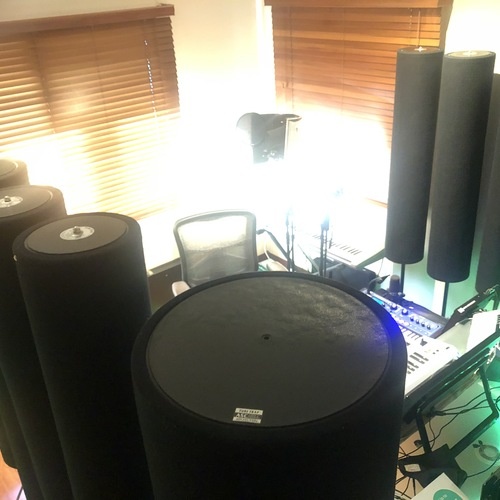
Wrap the console with StudioTraps and add a few behind the mix position to create a repeatable, isolated, acoustic subspace, independent of the room. The absorbing side of the traps face the engineer to stop early reflections. The reflecting side of the traps (with the silver button) face the walls of the room to provide a time-delayed diffusive ambient kick. Speakers are mounted on MonitorStands which decouple the monitor from the vertical modes of the room. The speakers are snug fit into an acoustic wall formed by StudioTraps. The resulting AttackWall opens at the floor and ceiling to provide venting for the bass wave just prior to impact which further reduces (LF) coupling to the vertical modes. Best of all, it makes any room into a consistently reliable environment.
StudioTraps to the outside of the monitors control side wall reflections. StudioTraps are set up behind the engineer to provide diffusion and isolation off the back wall. With the diffusive sides facing the walls, an LEDE-type sonic signature is created and is suitable for any monitoring system from dual 15’s to a single 6.
The Attack Wall delivers the kind of mix that will stand up anywhere.
Without good acoustics the engineer can’t hear the full content of the tracks and can’t get the mix right. In the AttackWall, we get a fantastic, clear perception of signal from the mix position, that stays independent of the room. It is so quick and easy to set up that traveling engineers just ship their Wall and monitors from job to job. They know they will have the same mixing environment no matter where they set up. Engineers like control and familiarity. And when they have to studio hop with the AttackWall, that’s exactly what they get.
The AttackWall was developed by collaboration over many years between recording engineer Sam Lynn and acoustic engineer Art Noxon. It is a tried and proven self-standing acoustic space that delivers a professional mixing environment, certainly as good as and possibly even better than the big downtown studios. It is a freestanding mixing engineer’s workstation, a control room that can owned by the engineer, torn down and moved and setup into another location in a matter of hours and still sound exactly the same as before.
How It Works
Early Reflection Control
The AttackWall wraps around the console and engineer so neatly that very little sound escapes outside of the Wall. Broad-band early reflections are controlled by the StudioTraps’ absorptive sides, creating a reflection free zone (RFZ) right at the mix position, in any room. The diffusive sides of all StudioTraps (the side with the silver button) should face away from the mix position to create a true RFZ.
The side sections of the AttackWall extend approximately to the engineer’s head. This casts a huge acoustic shadow onto the wall, eliminating wall reflections which can cause comb filtering, cross-talk, and phase interference. Traditional wall-mounted sound absorbing/diffusing panels are not necessary when an AttackWall is used. The imaging allowed by this arrangement is unparalleled, and your mixes will gain a spatial accuracy never before achieved. Sound stages can be built in both the horizontal and vertical dimensions, with only your creativity as the limit.
A tight pattern of StudioTraps fits between the monitors and a loose pattern of StudioTraps is placed behind the engineer. The reflection free zone at the mix position is now complete. The rear StudioTraps control reflections through the use of acoustic shadow casting, allowing the pattern to be looser than that of the front and side arrays of StudioTraps. For optimal early reflection control, all StudioTrap diffusers should be pointed away from the mix position.
Technical
Time-Delayed Ambient Backfill
The AttackWall absorbs image-smearing early reflections, but lets others escape to provide time-delayed backfill. Without an ambient tail to the energy-time-curve, a reflection-free recording studio would be exhausting to work in. The ambience is provided by the diffusive sides of the StudioTraps, which scatter sound at 500 Hz and higher.
The AttackWall is setup to vent treble in two ways. Some sound travels over or under the StudioTraps. Sound also passes through the openings to the side and behind the engineer. Escaped sound reflects off the room walls and back into the diffusive side of the StudioTraps. The acoustic crossovers go to work, absorbing excess bass energy while scattering mid and high frequencies back toward the wall. Eventually the original escape path of the sound is reversed, and the time-delayed, diffuse, high-pass filtered ambience reaches the mix position. Through this process, the AttackWall creates an LEDE-type of sonic signature in any room.
The listening environment of the AttackWall is so comfortable and natural, you may find yourself mixing for much longer sessions and re-mixing old projects for the sheer joy that using the AttackWall brings.
Vertical Mode Control
A typical monitor on a stand is located about halfway between the floor and the ceiling. The floor and ceiling reflections couple with one another, imposing strong phase interference. This typically causes a drop in sound level around 70 hz for 8′ ceilings, and a boost in level around 140 hz. The engineer will apply equalization to compensate, leading to poor mix translation. The solution is the ASC MonitorStack.
In the AttackWall, a monitor speaker sits on a MonitorStand Base, which is designed to extract sound power out of the downward moving section of the bass wavefront. A MonitorStand Top rests on top of the speaker to absorb the vertically expanding section of the bass wave front.
The MonitorStack reduces the sound power buildup of vertical resonance between speaker, floor and ceiling. Phase cancel and add effects disappear at the speaker and mix positions without resorting to monitor equalization. Your mixes hang together no matter where they are played.
The MonitorStack Bases and Tops are purpose built TubeTraps, multi-chambered for strength, vibration resistance and rapid attenuation of bass wavefronts traveling down the length of the TubeTrap. Monitor Stacks are designed and built for axial wave attenuation which differentiates them from the radial attenuation provided by standard TubeTraps. All contact surfaces are fit with edge loaded felt spring isolators. The MonitorStacks are also made to endure the tremendously high sound levels that can only occur so close to the high power drivers in recording studios.
Wall-Loaded Mains
Midfield loudspeakers sit on speaker stands which allow the spherical wavefront of the bass range to illuminate the entire room, creating strong early reflections and late reverb.
The front surface of the AttackWall absorbs both the lateral and rearward expansion of the spherical bass wavefront. The upper and lower edges of the AttackWall facilitate diffractive diffusion of the bass wavefront as it expands around the edges and into the acoustic shadow space behind the AttackWall.
This bass diffusing technique of edge diffraction converts a portion of the vertical expanding spherical wavefront in front of the AttackWall into a pair of tumbling bass wavefronts behind the AttackWall. Back venting the bass wavefront weakens the vertical wavefront just as it begins to impact the floor and ceiling thereby minimizing the buildup of vertical reflection and reverberation.
Most engineers do not work in a properly designed and built control rooms. More often than not, they are working in less than ideal locations; live mixing back stage, off site tracking and mixing sessions and all too often just mixing in your own living room. The early bass reflections create standing waves and a lumpy bass response curve due to phase add/cancel effects. The late bass reverb buildup weakens the signal to room noise ratio which blurs musical dynamics and masks musical clarity. The ASC AttackWall is engineered and time proven to turn any room into a world class control room without having to listen to the sound of even one hammer blow.
Videos

RSPE Audio Solutions
Mix Engineer Stuart White on the ASC AttackWall - RSPE Audio
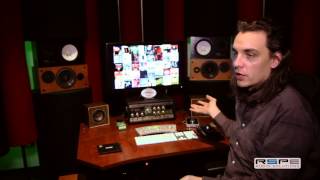
Mix Engineer Stuart White on the ASC AttackWall - RSPE Audio
RSPE Audio Solutions
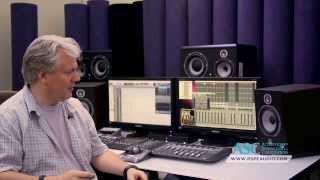
Re-recording mixer Jonathan Wales on the ASC AttackWall - RSPE Audio
RSPE Audio Solutions
Reviews
Owner Insights
We analyzed real musician discussions from forums and Reddit to find what players love, question, and tweak about ASC AttackWall.
Features and functionality
Mods and upgrades
Comparisons
-
DIY fiberglass pipe covers can achieve approximately 80% of the effectiveness of AttackWall modules, with modifications.
Source
Use cases and applications
-
The AttackWall is designed for those prioritizing optimal acoustics, often used in professional mixing environments.
Source -
AttackWall is recommended for creating an "acoustically perfect" mix area; it's highly endorsed for combining with other soundproof solutions in studios.
Source -
AttackWall is particularly recommended for rooms not suitable for extensive structural changes, serving as an effective alternative for achieving optimal acoustics.
Source
User experience
-
Users report the importance of hiring acoustical designers/consultants to ensure AttackWall's effectiveness, emphasizing that general contractors may not follow detailed acoustic plans.
Source -
It's advised to avoid contractors who don't immediately understand soundproofing requirements, as mistakes can severely impact the AttackWall's effectiveness.
Source
Critic Reviews
Based on 0 Reviews and 0 Ratings
Artist usage
Add artist
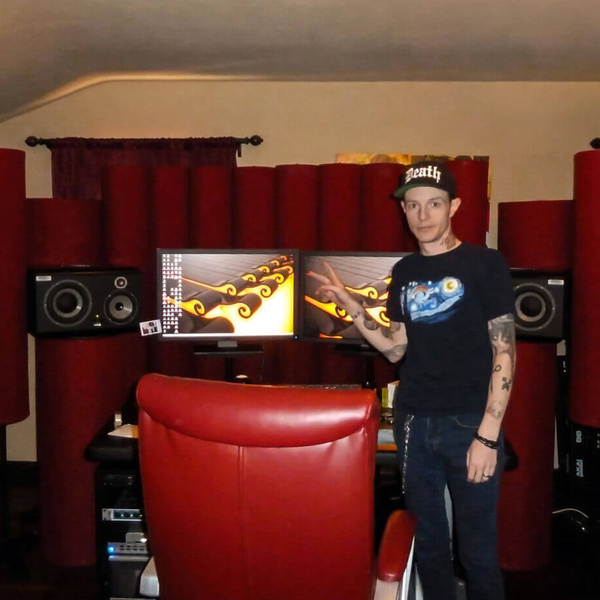
Deadmau5 can be seen using the AttackWall when he was living in Hollywood Hills on ASC's Instagram page.
Further evidence could once be found at https://www.rspeaudio.com/Attack-Wall-Webboutique-a/276.htm. There, a picture of Deadmau5 with the AttackWall could be seen. Hovering over the picture brought up the following description:
Grammy nominated progressive-house music producer and performer Deadmau5's management group contacted us because he needed to work on his newest project from his home studio in the Hollywood Hills. They needed to make sure the album had a big sound, so we recommended the world-class acoustic environment of the ASC AttackWall. After months of working on the project, he moved his studio to a room at Capitol Records. He loved working in his red ASC AttackWall so much that he took it with him to continue production.
Genre Usage
Based on how artists on Equipboard use this gear, it is most commonly found in the following genres.
Community setups
Show yours
More Acoustical Treatments

$29.99 - $39.99
in Acoustical Treatments Rank


$159.00 - $209.00
in Acoustical Treatments Rank


$60.00 - $99.00
in Acoustical Treatments Rank


$219.00 - $405.00
in Acoustical Treatments Rank


$107.00 - $135.99
in Acoustical Treatments Rank


$167.75 - $199.00
in Acoustical Treatments Rank


$150.00 - $265.00
in Acoustical Treatments Rank
.jpeg?v=1784640200)


$29.99 - $39.99
in Acoustical Treatments Rank


$378.00 - $799.00
in Acoustical Treatments Rank


$159.99
in Acoustical Treatments Rank


$102.13 - $114.99
in Acoustical Treatments Rank

$159.00 - $209.00
in Acoustical Treatments Rank


$240.00 - $319.99
in Acoustical Treatments Rank


$149.00 - $194.99
in Acoustical Treatments Rank

$165.00
in Acoustical Treatments Rank


$58.99 - $95.00
in Acoustical Treatments Rank


$229.99
in Acoustical Treatments Rank

$90.00 - $124.99
in Acoustical Treatments Rank

$364.00
in Acoustical Treatments Rank


$212.00
in Acoustical Treatments Rank

$403.00 - $2,949.99
in Acoustical Treatments Rank

$14.30
in Acoustical Treatments Rank

$86.99
in Acoustical Treatments Rank


$52.00
in Acoustical Treatments Rank

$69.00
in Acoustical Treatments Rank

$75.00
in Acoustical Treatments Rank

$59.99
in Acoustical Treatments Rank

$1,276.99 - $1,359.99
in Acoustical Treatments Rank


$742.00 - $999.99
in Acoustical Treatments Rank

$77.00 - $689.99
in Acoustical Treatments Rank

$333.00
in Acoustical Treatments Rank

$359.00 - $789.00
in Acoustical Treatments Rank

$477.00
in Acoustical Treatments Rank

$196.00
in Acoustical Treatments Rank

$37.99
in Acoustical Treatments Rank

$79.99
in Acoustical Treatments Rank


$279.00 - $475.00
in Acoustical Treatments Rank


$2,444.00 - $3,125.00
in Acoustical Treatments Rank
Similar


Gear Guides








Most Popular Brands
-
Added to Equipboard on by
 thatlkjguy
GearIQ 4716
-


