
jimmarchi1's Reviews
801 reviews Back to jimmarchi1's Equipboard


41028
they work alright
These cans do not sound particularly good, but they do not sound bad. The isolation is more than adequate for most applications. I original bought my 1st pair to DJ after blowing out a set of Stantons with bad isolation. My buddy recommended them for DJ sets so I went for it and they are ideal for that purpose because they are VERY comfortable to wear for hours on end. For studio work there are better options. I also wore out my 1st pair after a few years ut I ahd a backup pair. If those die on me I will not buy these again as I no longer DJ and would prefer isolation cans that sound better and isolate more effectively.
41028
!
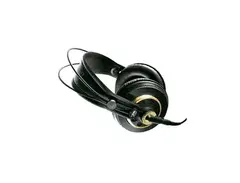
These are my favorite cans for my own listening pleasure and ALWAYS will be. They are the classic semi-open backed option. The drivers sound great and thanks to the open backs they have fantastic, speaker-like fidelity and are less fatiguing than cans typically are. Their drawbacks are strictly a lack of isolation from loud sources like guitar amps when you are tracking next to them and a little bit of spill out their open backs into sensitive microphones when you laying down takes on an acoustic instrument. Often the spill is so negligible you can use them over a closed-back headphone anyway...
buy some.
41028
WOW
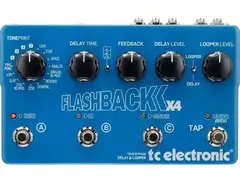
I have owned many TC products and their proprietary digital delays like the 2290 are great while their models of analog gear usually left a bit to be desired having what I can only describe as a "plastic and artificial" quality that hurt my ears. The Line 6 models have this quality too, but at elast they model some of the other quirks of the real gear very closely. That said, I prefer TC for their pure analog dry signal path in all their higher end effects. So I bought an X4 on a whim, total impulse but thru ebay....
and now I have changed my tune. From personal experience I can assure you the Flashback delay series CLOSELY replicates the following pieces of gear (at least to my ear, which is pretty discerning): WEM Copicat 60s version (tube mode), Roland Space or CHorus Echo (Space mode), Boss DM2 & 3 as well as Ibanez's AD80 & 9 (Analog mode), EHX DMM (Analog Mod mode), MXR and Roland's grainy 8 bit rack delays from the late 70s and the crunchy sounding digital delay from the Yamaha SPX90 (LoFi mode)... the tap tempo s super responsive to quick, light toe touches even with my shoes off. The pedal is built like a tank too. Knobs are huge and easily tweakable with a J toed cowboy boot. Reverse mode sounds better than the line 6 DL4 reverse.
Bypass sounds transparent at factory setting (supposedly true bypass, must be true) and with the buffer engaged for trails there is very minimal tone coloration (I used a true bypass looper to test, I always do this with new gear to be sure its not stealing from or adding to my signal in undesireable ways and I built this small looper box from some spare jacks and a big toddle switch back when I first got my Radial Switchbone ABY so I could dial in the drag control to sound just like my bypass signal, but I digress). If you want complete transparency in trails mode make sure you hit a tube stage or reactive input like the Radial Dragster first. Running my ABY box out front of the X4 made the highs sound right to me again (not that the buffered top end is bad, just not the same as plugging straight in).
I have 2 complaints with this pedal, 1 it needs to be able to receive MIDI program changes to switch to ANY delay model, not just the 3 saved on your footswitches AND it needs to accept MIDI program changes to go into bypass. Its kinda annoying that in order to integrate this pedal with mthe MIDI setup I am working on I will have to leave her on ALL the darn time. Fuck me.
Overall? nice job TC!
UPDATE: I am so fond of this as a bread and butter delay swiss army knife that I got another one...
41028
Nice passives...
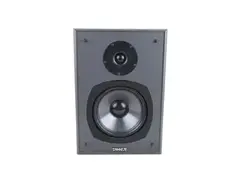
These speakers are what the NS10 aspires to be. Notthat I don't like NS10s, but you can muxa whole record on these tannoys and you will need some less midrangey speakers if you primarly use tha yamahas.
41028
Awesome beyond the $100 I paid.
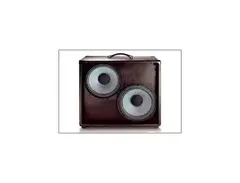
I am unsure i anyone will ever run into one of these. Its an off brand sealed 2x12 with diagonal speakers. Got it unloaded on ebay as a local pickup. Its a powerful, punchy cab made of super thick plywood. Front liading in the 80s style.. I ttok thw dampening fiberfill out so she has some resonances now. Can get boomy with 55hz bass cone speakers. But she sounds great right now loaded with a cts alnico and celestion greenback. Truly a rock n roll cab. Gets some 4x12 punch! Kinda heavy though. Bad tolex and grill cloth work though. I still will never part with this cab. She records really well.

2249
Wow. I am gonna find me one of these someday. Look out below, eardrums.
41028
its just an okay cab with really thick playwood and stuff.... but for like 100 bucks she is a great cab. You'll NEVER find one
just get a diagonal 4x12 from a company like stagecraft, it ll do the same thing. The diagonal style is underrated

2012
I love the look of old-style cabinets. I'd like to try one of these out because I don't have any speaker cabs at the moment.
41028
just go on stagecraft.com and order a diagonal 4x12, its almost the same as this cab, just a little bigger so the front's a square...it'll be like 350 bucks I think and then you'll need 12"s.
you'll probably want some nice tube heads too.... not sure why one would need a big, sturdy closed back cab unless they have some powerful tube amps that need speakers... I really like 50 watt british type amps with this style 2x12
41028
upping my points...
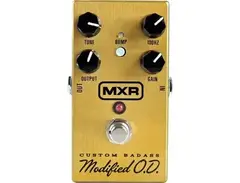
I traded this thoughtful riff on the venerable Boss SD1 overdrive to a friend along with all my drive pedals. This here is the one I missed. Not the amp in a box pedals and not the clones of klons.... I found myself digging through my stuff looking for my 80s sd1 to scratch my itch for assymetrical clipping in the feedback loop of a 4558 opamp! Fortunately my buddy didn't care fot his one (hes a TS9 man when it comes to this style of OD) and he returned my MXR with the stupid name. I am glad to have her back. She really combines well with an AC30 and the 100hz knob allows you to directly match the bass response of your clean or 'cleaner' dry amp setting and juidicious use of the toen control can prevent a jangly dry sound from being harsh when driven. It gives a lot of extra compression that maybe an ac30 does not need, but hey, its part of the whole SD1 thing and I for one have re-embraced it! It sounds like a pedal and sometimes that's okay. This pedal is great at being itself -- an SD1 with true bypass, better components, and the ability o work with any amp and any setting easily transitioning from clean to crunch or crunch to soaring LA strip solo without changing where you sit in the mix too much viz-a-viz bass and treble response! If you play a fender thru a fender or just plain prefer a TS9 or 808, the symmetrical version with the midhump centered in that Ibanez range is the Way Huge Green Rhino mk2 or later. George Tripps designed both of these pedals. The Way Huge versions are TS inspired with the bass ut/boost and adjustable mid-hump level. This takes some fo the same ideas and applies them to the SD1 for those of us who mostly play Gibson style guitars thru Marshalls and Voxes.
41028
reactive load? are ya sure Randy Smith?
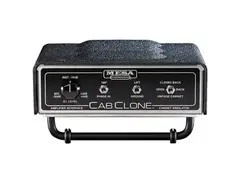
I am not blown away by this amp load/DI box and cabinet sim. I actually like Mesa's analog cab simulations more than I expected to, much better than the H&K redbox that used to be the industry standard and also nicer than the ADA microcab of the 80s/90s....
that said, the reactive laod in this is no better sounding than the semi-reactive resistor/coiled wire arrangement of the THD hot plate. That's fine for a few dB attenuation, but it don't cut it to fully load down an amp to use it as a glorified effects processor. Ya need some speaker-like reaction! Its a shame Mesa and Weber VST can't get together. Weber's mass attenuator had a great speaker-motor-based reactive load, but the build quality sucked and their line out is crap. If ya took all of mesa's handy line out features like variable output Z, great level control and the nice cab simulaltions you would have a really nice all analog slent recording solution. As it stands I am not knocked out. I think this is another load box that's getting sold. Oh well.
41028
I always write my negative reviews whenever I take a long weekend to clean out my piles of gear and unload crap on ebay, reverb and craigslist.... EVERYTHING MUST GOOOOO!!!!!!
41028
wow
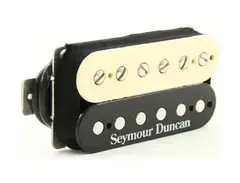
Everyone is into the Pearly Gates bridge PUP and the PG plus.... I decided to try the neck pickup in my Washburn.... wow. What a great vocal quality to this PAF-style neck. I would bet this would excel as a vintage output bridge with an even weaker PAF clone or T-Top at the neck. The more time I spend with this pickup the more I like it.
-s.webp?v=1784891015)
41028
a 303 by any other name would won't sound so sweet...
This is a cool little bassline monosynth in the TB303 tradition. I think she is actually fueled by analog oscillators. I am not sure if the filters are analog or some sorta digital thing, but theya re okay in a mono-poly way, not the same as the Roland 80s LPF though.... The layout will feel familiar to anyone who ahs used rebirth though you cannot program in accents when using the built in loop sequencer, you have to use midi through yer DAW which feels weird and wrong for a gasget like this. This synth is fun to play with and sounds as good as a lot of 303 plugins, but having puttered with a friend's 303 and SH101 extensively back in the day I have to say that you are probably better off investing in the popular x0x b0x tabletop synth. It apparently does a much better squawky acid thing....
I did really like this synth, when I puttered with her, especially through guitar distortion pedals but I just never power her up and I've owned her for months! SO I put her for sale and hopefully will break even (I bought her from a store on reverb at a deep discount because mine was their floor sample).
UPDATE: rebought this guy, not as 303ish next to the TT303 TB-clone... but great in its own right! When I am thinking 2 or 3 303 lines one needs to be this, maybe 2 of them if I hit up some mixdwon ringmod or other timbre warping effects to expand the sonic palette. Now that I have a Cyclone Bassbot 303 clone I am able to appreciate this bass machine on its own merits and its very cool and well worth the tiny buy in.
BUY THIS! fun-per-dollar (pound, euro) rating is 11 out of 10!
41028
bought another one for under $100 this time... fun with the 303! double acid....

261
Scored one for 70 bucks and it's a blast! I'm trying to see if I can have his little guy transcend its acid roots. It plays very well with additional processors and effects. It's also proven to be quite good for fat leads. Once I delve deeper, I might get around to reviewing it.

413
This is the only Volca from the first series of three (Keys, Beats and Bass), I like. I don't have any of the following Volcas, but I think the sampler and the FM are pretty good buys. The Volca Bass is the killer with its 3 oscillators and a unique sound. The Volca Keys has not such a variety and the Volca Beats has to weak kicks for me.
41028
holy mother of loud
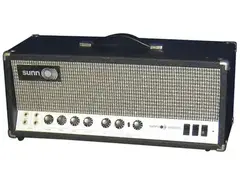
The Sunn amps are real mutts form a design perspective. Everyone knows the Sunn Model T, America's first attempt at a high gain design, but Sunn was cranking out more vintage featured amplifiers (particularly bass amps) for a long time before attempting to innovate too heavily. Like most of tis cousins the Solarus has a Fender inspired preamp. It has the global 2 band EQ of a tweed era Bandmaster, Pro or Super, but the implementation of the EQ and gain stages is more blackface in nature. The power section of the Solarus is a vintage Hifi affair based around the old Dynaco ST70 featuring dual 6550 output tubes pushing a good 70 to 80 watts of clean headroom with extraordinary transient response (though Sunn rated them conservatively at 60 watts RMS). You can cut the power on these amps by modifying them to accept EL34 tubes. The bass will tighten and the headroom will decrease making them sound a bit Hiwatty. That said, they make such a bold statement stock that I would personally leave well enough alone if I ever owned another one.
The Solarus is one of Sunn's few guitar models and like its cousin the Scepter (still not sure what the difference between these 2 really is) it features tremolo and spring reverb in the Fender style that sound pretty decent. this is a wonderful platform for pedals as it has huge bandwidth and monstrous headroom. If you can stand the SPL the Solarus can produce some nice overdrive tones once you start driving the PI and output stage. The biggest fault of this amp is that it uses the Dynaco PI circuit which, while a wonderful design, requires a rare, out of production 7199 tube or needs to be modded to accept the slightly more common 6AN8 tube. I believe electroharmoix has reissued the 6AN8, but I do not know if its up to snuff as this tube contains a hi mu preamp pentode similar to the EF86 and 5879, and for reasons that escape me no one can make decent current production EF86.
Still a real sleeper and a great amp in the mold of the twin reverb... only bolder and cleaner. Sunns are like America's answer to Hiwatt. This amp will make you very uncomfortable if you don't wear ear plugs and will cause the audience to back up a few feet if you can get her turned up to the sweet spot for optimal clean tone. Pushed into overdrive she holds her own with a 100 watt Superlead and is an effective device for killing bratty children without leaving fingerprints on their bodies. Too much amp for most people, but still a mighty offering from one of America's best and least respected manufacturers.
41028
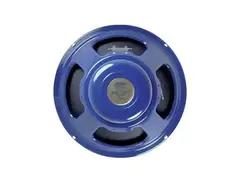
This is a review of the UK made reissue G12 Blue
What can one say about the venerable Blue Alnico G12 speaker. Vox, early Marshall stacks, the 1st purpose-built guitar speaker in history. 1st off, blues are extremely efficient. This is one of the 3 oudest Celestions currently in production. Unless you are using a V30 or H30, they WILL make your amp louder. 2nd, the blue is extremely bright. Some people say the reissues are brighter than the vintage originals, but in my experience this is only true of vintage examples that have been exposed to a lot of humidity or that are on the edge of blowing up... ie old Vox branded G12s that are ready for a recone. The rated power handling of this speaker is 15 watts, but they can handle a good 20 watts in my experience as long as you are not pummeling that hard every night for a year. Now that my reissues are broken in they sound JUST LIKE old ones in good condition. I have done a blind listen (similar cabinets powered by the same Ceriatone head) with discriminating tone junkies like myself and no one can tell which is which including me. These speakers are reputed to be low on bass, but I think that reputation comes from their use in open back combos like the ac30 and jtm45 where the alnico compression character coupled with the open back design makes them seem weaker in true low end than they actually are. When loaded in a closed back cab they kick out easily as much bass as a G12M greenback and can even contend with 75hz lead cone G12H for low end response. When front loaded in a sealed cab the bass can be downright thumpy with the right amplifier and tonestack settings, but it is always controlled and well-defined.
I'm going to come out and admit it, I love this speaker. It may displease some people though because it breaks up pretty early, is heavily compressed unless powered with less than 5 watts, and reproduces distorted sounds in a chimey way that's heavy on the upper midrange versus a G12M's distortion reproduction which has compressed bass and a very woody presence in the true midrange, however this helps them to cut thru the mix on stage like a hot knife through butter. The Blue cannot be made to sound harsh. There is something magical in the treble compression that makes even the brightest amplifier settings pleasant and appealing. The Blue seems incapable of reproducing ANY unpleasant overtones and can make an ostensibly bad tone good. It just sounds great all the time unless you are playing poorly. Being fairly compressed but very detailed, this is a very unforgiving speaker. Weak fretting and sloppy right hand technique will be heard in the back row.
Heads up, if you want more dynamics from it, pair it with a high efficiency ceramic speaker with higher wattage handling in a 2x12 or 4x12 configuration. I like it with a G12H lead cone speaker in a closed back or a G12H bass cone in an open back like an ac30 combo. If you want to sound less vintage, pairing it with a vintage 30 or a G1265 will do wonders. You'll get more of a modern marshall thing going but with that sweet vintage speaker compression and superior detail...
I could wax lyrical about my G12s all day, but I'll spare you. Just try them for yourself.
41028
under-the-radar vintage greenback tone
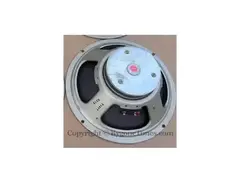
In the 60s when Celestion first started producing ferrite magnet speakers they had 3 varieties based on magnet size, G12L, G12M, G12H. The G12L is really inefficient, has very low power handling and is generally the least suitable as a guitar or bass speaker for modern playing hence why its the only vintage greenback speaker that hasn't been reissued. It has a sound that's not bad, but there's a reason its failed to garner the religious devotion of guitarists that the original M and H have. Enter the G12S. I had never heard of this celestion until I found them lurking in my '62 ac30 about 15 years ago. The original Blues had blown or been stolen years ago and the seller told me these were the later silver painted alnico speakers with no bell covers. I knew that sounded fishy, but the price was fair for the amp even with the wrong speakers so I bought it anyway.
Long and short of it, they sound really good. While the letters of the standard series ferrite celestions stand for Light, Medium and Heavy (magnet weight), I believe the S in G12S stands for Special (as in special order) and were supplied as an OEM product for amp manufacturers (like Watkins and Selmer) who wanted something cheaper than an M, but more durable and powerful than an L. This is probably why you never see the S speakers with the famous green magnet covers of the era, hey were left raw so the amp builder had the option of badging them themselves. At this time Celestion was facing their first real competition since the 50s from Fane who were supplying affordable ferrite speakers of very high quality to Hiwatt and Sound City. The G12S was clearly a bid from celestion to keep all their existing OEM contracts.
The G12S sounds like a slightly punchier Blue Alnico with a different compression character when pushed. The G12S speakers are ceramics (aka ferrite magnets) that are somewhere between a G12L and M in construction. Mine have the old pulsonic cones and the cone appears to be the same exact one as the 60s Ms and Hs I've owned. The S speakers are said to handle 15 to 20 watts. I'm not sure what to say about these other than to point out that they are around and command lower prices than G12M's with pulsonic cones (and are even comparable in price to a brand new scumbuck G12M copy), so I would highly recommend buying them as long as they can meet your wattage requirements. They have a chimier top than a Greenback evne when pushed, but like the Blue they are never harsh. When you get the cone to break up it produces that great pre-rola celestion cone crunch you know from so many 60s and 70s records. Scoop yourself a pair or Quad of these while they are still under $500 a speaker, prices are rising, people are catching on. Its hard to describe tone, but I really quite like these speakers as a compromise between an alnico blue and a 25watt greenback.... they really sound the way I wish that a V30 sounded....
41028
not bad, not durable
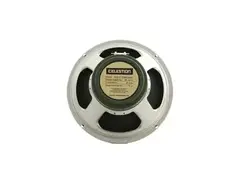
these current production, made in china 25 watt greenbacks will do if you don't have any old G12M's around.... there are plenty of better clones on the market these days, but I got my pair of current production greenbacks for free, so I use 'em in my sealed 2x12 for the time being. They are a little louder and harsher than even the black backed G12M of the 70s and exhibit a nasal upper midrange compression when driven hard that even the 90s UK-made Ms didn't exhibit to this degree (and pulsonic coned M's don't have AT ALL, its a Kurt Mueller cone thing). But overall they are okay. I don't mind them and they have a different flavor than my usual blue/G12H pairing. Keeps life interesting and there are much worse british voiced speakers out there.
UPDATE: I had sold 2 of these and kept one paired with a vintage alnico speaker. I recently blew that one out with 15 to 20 watts of power. A UK greenback can take its full 25 and then some. It doesn't just have a voicecoil rub, it is BLOWN. Low farting/growling sounds only. So that's where the difference between UK and Chinese celestions is. Durability. I docked a star for the poor power handling.

1310
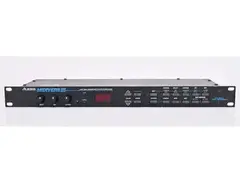
obviously you don't know a thing about using this piece of gear... there is no remote control unit for the midiverb 3 so I don't know what you were trying to use on it. This is a very old unit, you cannot expect much from a 16 bit 15 kHz unit from 1990 except character. This isn't to be used as a convolution reverb nor should one expect sound effects that rival something costing thousands of dollars; that said when used judiciously I've fooled many professional engineer's listening to mixes with this a Roland 12 bit DDL that I was using much more expensive signal processing. Spend 10 minutes with the manual and you can easily tweak and program with the front panel and save easily.
41028
Posted my review to the wrong alesis unit years ago. I still don't like the midiverb but the Iii is the most usable one. Still sounds terrible
41028
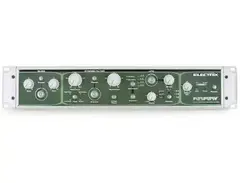
totally fun
all the electrix units were designed for DJs during the rave culture explosion of my youth so they could augment the vinyl they were spinning and the filter factory is by far the best of the bunch.... I should do a better review of this bad boy but its too depressing because I recently sold her (who else hates being a responsible adult? I know I do).... she has some great analog filters and an awesome LF.... oh my god I am tearing up! I almost never used this awesome processor but it was so nice knowing I had her just in case I wanted to get crazy filtering a guitar or DX7 live... anyway, the filter factory is a really high quality product and its a shame electrix went out of business
I will update this review at some point when the scab heals

41028
found a 10 pack of yellows while I was cleaning....
I found an opened pack of these while I was cleaning the other day and I have really been enjoying the happy medium width, sweet.... just enough flex when I choke back on the pick and plenty of stiffness if I choke up and grip it with more authority! Great material as always from tortex and a really good width for both hybrid and flatpicking styles.

Perfect size, flexibility, and grip. Good for speed picking or soft strumming. My favorite guitar pick for years.
41028
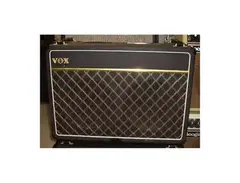
almost awesome
This 80s vox combo is very much in the marshall 18 watt camp rather than the ac15 camp. She features a JCM800ish preamp stapled to a dual el84 power section that incorporates negative feedback.... stock it sounds okay, not terribly voxy and a little stiff. If you adjust some component values you can get it to sound a bit like a Marshall 18 or 20 watter or if you lift the negative feedback loop completely it will get more ac15 character, though due to its marshally preamp topology it will still do its own thing. I really want to pick one of these up and perform some surgery. They are very affordable vox combos that fly way udner the radar.

I have been lucky by purchasing 2 Vox v15. I played them for just a few month before cutting the brown negative feedback lead, going to the 820 Ohm resistor. The result was quite astonishing, as the Amp suddenly started to play at least twice as loud as before, and next that especially one of the amps started to sound very microphonic when turning up the volume. I managed one of them to play all way up volumw wise, by dampening the baltic birch chassic with divided cloth pins, for leaving out unwanted resonance, which immediatly would start the tubes to go microphonic, and it really helped on the one of them, but I am almost giving up on the other one - at least for now. As already being mentioned ... they do sound very much like Marshall, and perhaps not that weird, as the Marshal factory did build the Vox amps in a period, where Rose Morris were the owner of the brand. Still the V15 sounds terrific, aand I am truly happy about having them, though they do not have quite the chime as my Vox Ac15 ccx1.
41028
I know, if you look at the circuit it needs a reduction in the amount of NFB to be more like a high gain marshall 18 or 20 watt in my opinion, taking the NFB out may not be the best thing for an amp with extra gain that's not laid out internally to prevent oscilaltions and microphonics without feedback to surpress it... its interesting to know that you had this problem cutting the feedback loop everyone like everyone talks about because I always suspected it would be a potential problem, especially if any parts have drifted over the years. But anyway I suspect you should just retube and then add the feedback back but in a smaller dose so change that resistor value before running the NFB elad. You will probably be very pleased with what you get then. Surpressed squealing, nice tight bass, amrshally midrange.... go take a look at the values in marshall's 18 watt and 20 watt treble/bass amps, the so-called miniplexis that were the hot homebrew amps 10 years ago.
just a heads up, I own a couple vintage ac30s (JMI, arbiter) and the custom classics are chimier than them.... they are chimier than the current handwired fawn ones.... they are chimier than my matchless, they are chimier than the marhsall-made 90s reissues... and all those amps chime it up. Vox got carried away revoicing the custom classic to sound like a Beatles recording forgetting that the Beatles mainly sued other amps. AC50s, AC100s, those vox hybrid amps, vox solid state amps, blonde and blackface fenders, selmers... ac30s and 15s are only on the earliest recordings and I think they traded their fawn ones in for a couple of factory top-boosted 30s in black by the time they did meet the beatles. I would have to dig up Babiuk's book to be sure. But seriously, the CC1X is going to outchime any amp so its not a great reference. Its got some really screwy value caps shaping the abss and treble on both channels to be extra bright. Its not bad, I think they sound rather good, but they don't have the mids of the old voxes to be sure, nor do they have the bass.
You are so absolutely right about the brightness of the ccx1, and as a result of annoyance by this screaming treble, I did cut the capacitor on the pcb board - placed at position c26. And it has become a very different beast by now...more sweet sounding, more bass...I had to re position the treble and bass chicken knobs to more normal positions, and I am so delighted by the result. To go back to my troubled v15...I will try buy some tubes/valves less agressive to what I have now, and try damp the vibration of the chassis with yet more split clothespins, and also perhaps take up your fine idea about a pot, instead of the nfb switch I have at present....or else I dont know what to do...the other v15 I have do not make any trouble anymore...but gawd how I love the sound of them - a mix between Marshall and chimey Vox
41028
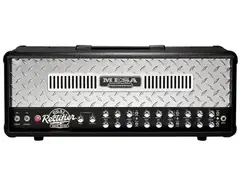
ugh
this is like a triple rectifier with less output section options... see my review of the triple if you want to know how I feel about this over-featured, over-gainy paper-weight....
You could use a dual rec to amplify your guitar if you didn't have an amp that actually sounds good. I will say this though, if you are the indecisive sort and you don't have a strong idea what you want your guitar to sound like, mesa's dual and triple rectifier amps give you about a million knobs and switches to dicker with instead of actually playing guitar. That's kinda my feeling about most mesa stuff after the MK III...
41028
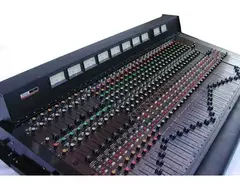
Under the Radar but pretty solid overall.
My Teac Model 15 is a full size frame with 18 channels built in, 2 stereo/4 mono 'echo' sends and 4 stereo/8 mono busses depending on how you configure things but no dedicated mix bus. Mine is set up opposite of the one pictured. The bus/master section is to the right and the channels start at the elft after 6 spacers filling where the other channels would be if it had a full 24 modules.
The meter bridge has a needle meter for each mono busand the meters way to the right that you would expect to be for the master mix bus monitor the headphone amp and you can basically assign anything to that. You can run any channel into any bus for mixing and link any 2 mono buses that are side by side. You can assign any echo return to any bus or even to an unused channels strip so you can enjoy the nice EQ across effects you are running in parallel. There's an insert on every channel as well as an effects insert on every bus strip. If you mix down on this board completely (which I generally don't) you have to assign your last pair of buses as the master and route any other busses you are using as submixes into it. Generally whe I have mixed with this board I use it to create groups using the nice, warm analog busses onto a reel-to-reel 1" 4 track and then record them all into a DAW and to finish my mix through the DAW's mix bus. Or I just give the stems from the tape to the Mastering Engineer.
The weird thing about the Model 15 is its outputs to the recorder are all RCA jacks! I've never had any issues with this, but the next time I set this guy up I plan to take the output section apart and hardwire EVERYTHING to a patchbay.
The preamps on each channel sit somewhere between API 300 series pres and some of the post-A-series Trident stuff. It has a more American flavor to the pres, think Calrec preamps, but not as fat. Solid bass response, clear mids, slightly muted top end that really lends itself to condenser mics over ribbons and dynamics if you are not using the EQ section while tracking. Suffice to say they are not my favorite preamps, but they sound full and detailed enough to track an entire album with nothing else. The preamps feature a -10dB pad but my board does not have phantom power (this would have been an upgrade option for the HUGE power supply that the guy who ordered mine musta thought was unnescasary). Also, if you track everything through these pres your mix will really glue together easily as they have a serious sonic signature.
The EQ section is a 4 band affair with low and high shelving and 2 mid-bands with selectable center frequencies on 3 way rotaries like a Neve. Also like Neve's early EQ there is no width (Q) switch to toggle between wide for boost or narrow for cut. I feel like the mid-bands get narrower as you cut but feel wide and gentle as you boost, so maybe there's something going on with the Q that's inherent to the circuit like some Neve-style inductor based EQs. Regardless, the EQ section is very musical and sweet and the fixed mid-bands keep you from fuckng up a good thing. I definitely like to use the high shelf to boost while tracking to add a little air to dynamics and ribbons since the pres are so warm. Because of the lack of phantom on my 15 I tend to put a little 5k or 8k boost on most tracks while recording because its quite a sweetener. The pres do lend themselves to Neumann style capsules and LOVE acoustic instruments from guitar to cello!
When mixing, overloading the buses produces a lovely lower mid-range growl across a group. One of my favorite ways to use this board in mix down is to create stems (as I previously mentioned), but sometimes I make 8 stems on a rock record. 5 stereo stems will be submixes of drums, bass tracks, guitars/keys, and vocals in whatever combinations tickle my ear and then I wills et up 3 stereo parallel compression busses. Each stereo compression bus will feed an outboard EQ feeding a Compressor that excels at a certain frequency spectrum. Of course the EQ will be tweaked to eceentuate some of the best frequencies of my raw tracks and to omit or at least subdue anything I am trying not to compress. So I will create a low mid and high compression stems and print those as independent stereo tracks to belnd in later to make certain things pop without resorting to mis or even overt submix bus compression. BANG! Dynamics preserved while getting all the benefits of compression artifacts.... yeah, I am nuts, but its a great trick that only a mid-format console can do. If you try it in a computer you will get phasing issues. Even the fastest system with independent DSP cards has latency, but electrons move at the speed of light guys.
Anyway, Teac Model 15 consoles are solid and affordable mid-size consoles in an easy-to-understand in-line format. Lots of features and really good design make this a good buy if you can find one that's working.
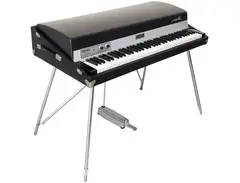
41028
I have never missed a piece of gear more than this!
I have never missed a piece of gear more than this! Me and my boss at a small studio were once paid for live sound and a location recording with a Rhodes Mk1 73 key. It needed love but I fixed her up well and used her at that little studio on countless projects. When we parted ways and divied up our gear I somehow was fool enough to let him keep it because I lacked space at my apartment at the time... what a fucking mistake. I miss it so much. Every time I see one in a shop for huge money I want to cry. While I prefer the Hohner and Wurli electric piano sound just a bit, the MK1 Rhodes is literally the best sounding fender electric piano. They never improved on it. They are a maintenance nightmare and the action takes some getting sued to, but they sound amazing and are just fun to play once you get the whole Rhodes groove down. And they are easy to run into guitar effects as they send a Hi Z signal like an electric guitar.... Rhodes thru a phaser and a vox? Been there, done that, love it! The built in trem circuit sounds great too... I am getting misty eyed right now yearning for that 73 key beauty. While it must be nice having the full 88 you don't miss them because the Rhodes is all about the midrange and super-high chime notes occasionally (think Wichita Lineman by Glen Campbel... I think the telegraph lick is played on a Rhodes)... anyway. ARGH! I miss this badass keyboard.