Dave Rawlings
member of Swedish dance production duo Quartz
Dave Rawlings' Gear



"Wielding his unmistakable 1935 Epiphone archtop, Rawlings showcases a little of that improvisational, single-note-driven playing, riffing off his recent sophomore release as Dave Rawlings Machine, Nashville Obsolete. The songwriter is almost never seen with any other instrument, and, as it turns out, it wasn't a purchase from some luxury vintage guitar shop — it was scavenged from the dirt of a friend's attic."I just picked it up. It was filthy, and it didn't have strings," he says. "You could just see the shape of it under the sawdust." Rawlings took it home, tuned it up and brought it to the recording session for the first Gillian Welch record, Revival. It was the last instrument he tried in the studio, but he's barely put it down since. "As soon as I heard it through the microphone and through the speakers I was like, 'I love this guitar.'"" - Rawlings in an Interview for D'Addario's Guitar Power series which was also featured on Rollingstone.com (http://www.rollingstone.com/music/news/see-dave-rawlings-show-off-his-scavenged-vintage-guitar-in-new-series-20151014#ixzz42mrlt79U)
- Dave Rawlings kind of made this line of Epiphone guitars famous among bluegrass and americana guitarists.
Find it on:


How do you record your acoustic guitar?
The method that Matt Andrews, who has engineered most of the records I’ve done, and I came up with has been gradually dialed in over the years. I’ve always used a Sony C-37A microphone—a tube microphone made in the late ’50s and early ’60s—and an old Neve 1055 preamp module.
The sound of my and Gillian’s guitars is a combination of what bleeds through the vocal mics—we use a Neumann M49, usually—and the mics we use on our guitars. We’re usually sitting close enough that every sound blends through every microphone. So the sound is a composite.
The only other constant in my guitar chain is a Fairchild compressor I bought years ago that has a particular tone. I’m not interested in the compression as much as the sound its transformers add to the chain. It gives a little point to the midrange that makes it easier to poke out from Gill’s guitar and be present under the vocals.
Find it on:

According to Premier Guitar, Rawlings uses the Gibson F-12 Mandolin (http://www.premierguitar.com/articles/23231-dave-rawlings-harmonic-monster?page=2).
Find it on:

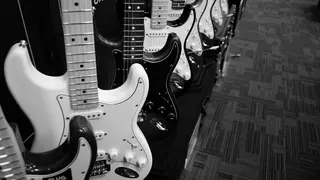
In this video (2:41min) from 2016 Dawes member Taylor Goldsmith says that Rawlings had recently bought a '58 Stratocaster.
Find it on:


Dave Rawlings is associated with the Fairchild 660 Compressor, as highlighted in an article from Izotope. The piece discusses how this iconic compressor/limiter became known to artists like Rawlings during the late '60s, particularly at Olympic Studios, where it was integral to the signal processing chain for recording on 1, 2, and 4 track tapes.
Find it on:


According to Premier Guitar, Rawlings uses those strings on his guitars.
Find it on:

According to Premier Guitar, Rawlings uses Fender Heavy Picks.
Find it on:


How do you record your acoustic guitar?
The method that Matt Andrews, who has engineered most of the records I’ve done, and I came up with has been gradually dialed in over the years. I’ve always used a Sony C-37A microphone—a tube microphone made in the late ’50s and early ’60s—and an old Neve 1055 preamp module.
The sound of my and Gillian’s guitars is a combination of what bleeds through the vocal mics—we use a Neumann M49, usually—and the mics we use on our guitars. We’re usually sitting close enough that every sound blends through every microphone. So the sound is a composite.
The only other constant in my guitar chain is a Fairchild compressor I bought years ago that has a particular tone. I’m not interested in the compression as much as the sound its transformers add to the chain. It gives a little point to the midrange that makes it easier to poke out from Gill’s guitar and be present under the vocals.
Find it on:

Dave Rawlings utilizes the Neve 1055 Channel Amplifier, as evidenced by its technical specifications shared on Avedis Audio Electronics' Instagram. The amplifier features an octal input transformer (7529) and an external output transformer, with B100 preamp and B105 output components, enhanced by external transistors and transformers.
Find it on:

In this performance of "Bells of Harlem" for KEXP, Rawlings, Willie Watson, and Gillian Welch can all be seen using Kyser capos.
Find it on:



In this Youtube video of Dave Rawlings performing with Gillian Welch, he can be seen playing a 1925 Vega Whyte Laydie No. 2 Banjo. He shares this banjo with Welch and they alternate playing it during live shows.
Find it on:
This is a community-built gear list for Dave Rawlings.
- Find relevant music gear like Microphones, Guitars, Amplifiers, Effects Pedals, and other instruments and add it to Dave Rawlings.
- The best places to look for gear usage are typically on the artist's social media, YouTube, live performance images, and interviews.
- To receive email updates when Dave Rawlings is seen with new gear, follow the artist.
-
Added to Equipboard on by
 lexman
GearIQ 6823
-
Updated