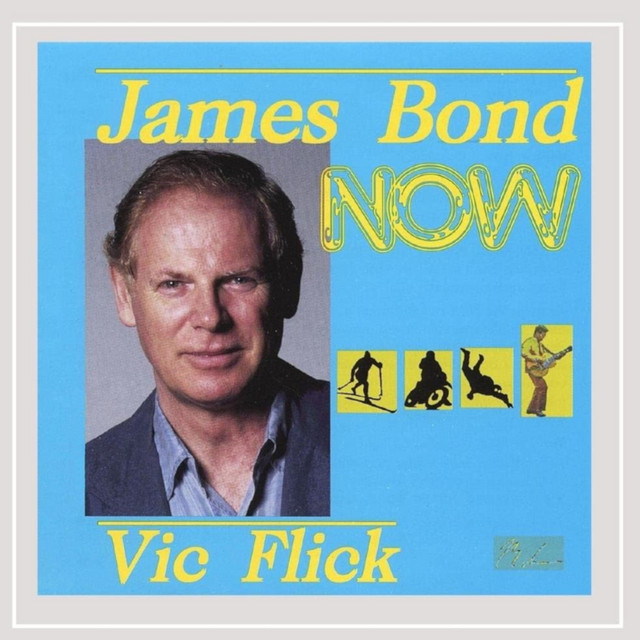
Vic Flick
Vic Flick's Gear

-m.webp?v=1784646040)
Visible in this photograph of Flick. It is specified in the 2020 interview on his official Vox artist page.
Was the classic bond guitar riff already written when you went to record it or was it something inspired at the time, in the studio?
When the producers of the Bond films wanted a more dynamic theme for James Bond the commissioned composer, Monty Norman found a piece of music from an old show which John Barry arranged. The session was hurriedly organised and the urgency and energy of the finished product has carried it down through the last 50 plus years.
Why did you choose the AC15 for this?
Vox and Fender were doing a big promotion through Macari’s Musical exchange on London’s Charing Cross Road and the John Barry Seven, the Shadows and a couple of other groups were given amps and guitars. I got the Vox 15 which was a wonderful versatile amp. Unfortunately, to my dismay, it fell off a high stage, landed on a corner and completely disintegrated. I was given a Vox 30 to replace it.
(...) We read that on the original Bond theme, you played a Clifford Essex Paragon deluxe acoustic guitar with a DeArmond Pickup through the AC15! Most people would think that the guitar part was played on an electric guitar. Did you have to spend a lot of time getting the tone right?
The pick up on the DeArmond was fully adjustable from the neck to the bridge. So, with a Senior Service cigarette packet stuck under the pick-up close to the bridge, the type of strings, the way I played and the way the acoustics of CTS Studio worked all contributed to ‘the sound.’ The sound also had a lot to do with the open mike recording techniques that were often used in the 50s and 60s for film music. I have to say that most of the people who swear they know what happened and appear very knowledgeable about the recording scene back then weren’t even born. I leave it to the reader to decide who to believe.
Find it on:


Mentioned in the 2020 interview on Flick's official Vox artist page.
Vox and Fender were doing a big promotion through Macari’s Musical exchange on London’s Charing Cross Road and the John Barry Seven, the Shadows and a couple of other groups were given amps and guitars. I got the Vox 15 which was a wonderful versatile amp. Unfortunately, to my dismay, it fell off a high stage, landed on a corner and completely disintegrated. I was given a Vox 30 to replace it.
Find it on:


Visible this October 5, 2012 performance of the "James Bond Theme" and this 1989 photograph, among other visual media. Originally slated for an eBay auction on February 2, 2013, as reported in this January 20, 2013 Blogcritics interview, it was auctioned via Julien's on November 7, 2015.
Blogcritics, January 30, 2013, "Interview: Axeman Vic Flick Tells Why He's Selling the Guitar That Made "The James Bond Theme" Famous"
Where and when did you get the Clifford Essex? What attracted it to you?
It was 1959 and pure chance how I came to own the Clifford Essex guitar. London musicians used to gather "up the street" every Monday to get work, get paid, talk and maybe have a beer or two in the Red Lion Pub. "The street" was Denmark Street adjacent to Charing Cross Road where I met a very dejected looking Diz Dizley.
Diz and I had worked together in the Bob Cort skiffle group and it was unusual to see him unhappy. Money problems were forcing him to sell his beloved Clifford Essex guitar, so I bought it from him and we both went to the Red Lion Pub to try and cheer him up.
What recordings does the Clifford Essex appear on before the "James Bond Theme"? How about after?
I can't remember any specific recordings but it was always in the trunk of my car along with a 12-string guitar, Spanish guitar, banjo and an amplifier. I definitely used it on Dr. No, From Russia With Love, and Goldfinger.
After the "Bond Theme," the Clifford Essex shared the 007 honors with my second Fender Stratocaster. The first Stratocaster was stolen a couple of months before the Dr. No session.
Did you use the Clifford Essex on your 2000 solo album, James Bond Now, where you updated and rearranged many 007 title songs?
As the guitar has many qualities, and one of them is as a great rhythm guitar, I used it in the back ground of a few tracks just to "authenticate" the CD. I used to enjoy playing the Clifford Essex in the rhythm sections of big bands, like Ted Heath, Eric Winston, etc. Its large cello body makes for a sound that melds well with the bass and drums.
Can you share the story about the guitar going to the Rock and Roll Hall of Fame and why you took it back? I forget where it was displayed after that.
A very good friend of mine, Bob Rush [of the Ripchords] thought the guitar should be in the R&R Hall of Fame and contacted the Museum with his request. The R&R Museum quickly requested the guitar for an exhibit in the foyer where it resided for two years. The Museum rotates its exhibits and asked if I wanted the guitar back or would I donate it to the Museum. I opted to have the guitar back as Harvey Newquist, Director of the National Guitar Museum, wanted the guitar for his touring exhibition. Harvey sent the guitar to me as soon as the auction process started.
Why did you finally decide to sell it? Is this at all pulling on your heartstrings to part with it?
I have had some good offers for the guitar and decided to put it up for auction under the auspices of Matt Sherman of commanderbond.net.
The Clifford Essex is a great guitar with a lot of memories and a lot of historic provenance but the time is right to sell it. I think the price of the guitar will ensure it goes to a good home. Plus, my wife and I can enjoy the results.
Julien's, 2015, November 7, 2015 "LOT #206VIC FLICK PLAYED JAMES BOND GUITAR"
A Clifford Essex Paragon De Luxe guitar circa 1950 owned and played by Vic Flick. Flick used this guitar for the James Bond theme song recording that was used in the first few Bond films, including Dr . No (Eon Productions, 1962), From Russia with Love (Eon Productions, 1963), Goldfinger (Eon Productions, 1964), and Thunderball (Eon Productions, 1965). Serial number 1056. Accompanied by a certificate of authenticity signed by Flick and John Barry, composer of the theme songs; two photographs of the guitar at the Rock and Roll Hall of Fame in Cleveland, Ohio; two photographs of Flick with the guitar; a copy of Vic Flick Guitarman (Georgia: BearManor Media, 2008); and a hardshell case.
PROVENANCE From the Collection of Vic Flick
EXHIBITED The Rock and Roll Hall of Fame Museum, Cleveland, Ohio
Find it on:

Mentioned and pictured in this April 2012 Vintage Guitar interview.
In the studio, I rarely changed volume, as the sound man had all his knobs adjusted for the mix. Mostly, I used a DeArmond pickup through a DeArmond pedal and then into a Fender Vibrolux amp. I purchased the Fender amp in ’62, just prior to the Bond recording that June. There’s a picture of the amp and an original Maestro Fuzz Tone pedal in my book. I did have a 15-watt Vox at the time, but it fell off a stage.
Find it on:


Mentioned and pictured in this April 2012 Vintage Guitar interview. According to this November 2009 Guitarist interview with Gary Hurst, Flick gave his unit to Hurst for modification, becoming the basis of the Sola Sound Tone Bender.
Guitarist, November 2009, "Bend It Like Beck Can"
“Vic Flick walked into the shop with his Maestro Fuzz-Tone and said, Listen, I can’t do much with this – can you have a look at it for me?” says Hurst. “I’ve still got it actually – he never took it back! Anyway, I took it to pieces, but I couldn’t get any more sound out of it than it was already making, that is until I modified it. And then I said to him, I could build you a better one.
“I’m not trying to hide anything here, the Tone Bender was based on the Fuzz-Tone, but that’s what things were like back then.
Vintage Guitar, April 2012, "Vic Flick - 007 Guitar Man"
In the studio, I rarely changed volume, as the sound man had all his knobs adjusted for the mix. Mostly, I used a DeArmond pickup through a DeArmond pedal and then into a Fender Vibrolux amp. I purchased the Fender amp in ’62, just prior to the Bond recording that June. There’s a picture of the amp and an original Maestro Fuzz Tone pedal in my book. I did have a 15-watt Vox at the time, but it fell off a stage.
Find it on:

A white 1961 Stratocaster is visible in this photograph of Flick, in addition to this one and this one among others. After an appearance in Season 8 of Pawn Stars, it was auctioned via Julien's on December 5, 2014. A predecessor is mentioned in this January 20, 2013 Blogcritics interview.
Blogcritics, January 30, 2013, "Interview: Axeman Vic Flick Tells Why He's Selling the Guitar That Made 'The James Bond Theme' Famous"
After the "Bond Theme," the Clifford Essex shared the 007 honors with my second Fender Stratocaster. The first Stratocaster was stolen a couple of months before the Dr. No session.
Julien's, December 5, 2014, "LOT #596VIC FLICK OWNED AND PLAYED 1961 FENDER STRATOCASTER"
A 1961 Fender Stratocaster, Olympic White, owned and played by guitarist Vic Flick. This guitar was played by Flick on numerous popular recordings, including “Ringo’s Theme (This Boy)” from the classic Beatles film A Hard Day’s Night (Proscenium Films, 1964); both the score and the Shirley Bassey theme song for the hit James Bond thriller Goldfinger (Eon Productions, 1964); “Downtown” by Petula Clark; “Shout” by Lulu; “It’s Not Unusual” by Tom Jones; and was even sampled in FatBoy Slim’s 1998 hit “Rockafeller Skank.” This guitar was originally factory Olympic White, but was later repainted non-factory white. It has been refretted, and a new nut has been installed. Serial number 65810. The neck dates are 10/61, indicating October of 1961, and the potentiometer codes are 3046134, indicating the 34th week of 1961. The original switch has been changed to a 5-way switch. Accompanied by additional parts, a document listing the numerous songs it was played on, and a hardshell case. This item was featured on the History Channel series Pawn Stars.
PROVENANCE From the Collection of the World Famous Gold & Silver Pawn Shop
Find it on:


Visible in this late 1950s photo with The John Barry Seven and mentioned in this April 2012 Vintage Guitar interview.
In the studio, I rarely changed volume, as the sound man had all his knobs adjusted for the mix. Mostly, I used a DeArmond pickup through a DeArmond pedal and then into a Fender Vibrolux amp. I purchased the Fender amp in ’62, just prior to the Bond recording that June. There’s a picture of the amp and an original Maestro Fuzz Tone pedal in my book. I did have a 15-watt Vox at the time, but it fell off a stage.
Find it on:

While there is no photos or film of Vic using a Sola Sound Tone Bender MK-1 it’s been recollected by Gary Hurst and Vic himself that he got Gary to modify a Gibson-Maestro FZ-1A “Fuzz-Tone” for more sustain and with a second jack instead of a built in cable so he could play farther away from the pedal (the “Fuzz-Tone”s cable is only around 8 feet long) and Gary produced the original prototype “Wooden Box” 1965 Sola Sound “Tone-Bender” (Mark 1) which was later developed into the Mark 1.5 (The Fuzz Face circuit) and Mark 2 “Professional” which would be used by players like Jimmy Page and Jeff Beck, without Vic, most modern fuzzes probably wouldn’t exist and I’m really suprised this pedal isn’t on his equipboard page to be honest. NOTE The photo I used is just to show the prototype Vic had next to the production model Tone Bender Mark 1’s
Find it on:
This is a community-built gear list for Vic Flick.
- Find relevant music gear like Guitars, Amplifiers, Effects Pedals, and other instruments and add it to Vic Flick.
- The best places to look for gear usage are typically on the artist's social media, YouTube, live performance images, and interviews.
- To receive email updates when Vic Flick is seen with new gear, follow the artist.
-
Added to Equipboard on by
 eyeseeofficial
GearIQ 161592
-
Updated
Discography