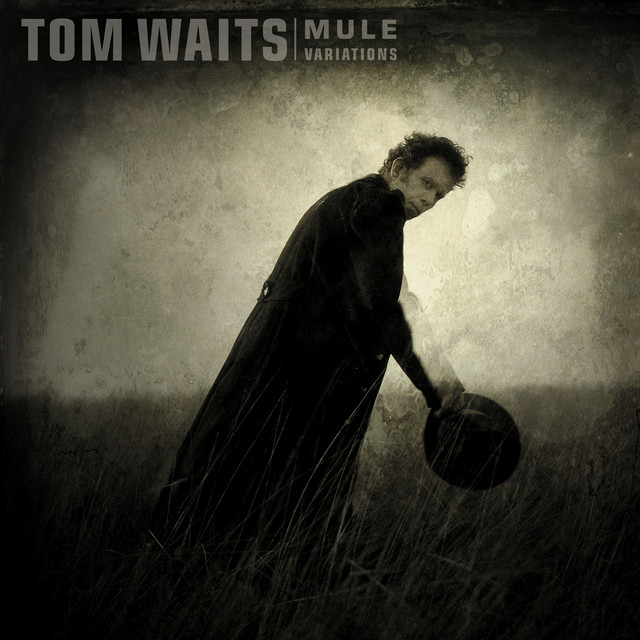
Tom Waits – Mule Variations (Remastered)
The music gear and equipment used by the artists, producers, engineers, and more involved in the making of the 1999 album Mule Variations (Remastered).
Music from Mule Variations (Remastered)
Artists on Mule Variations (Remastered)
Gear Used On Mule Variations (Remastered)
Explore the instruments, equipment, software, and production tools used in the making of Tom Waits – Mule Variations (Remastered) (1999). Click more on each item to see exactly how it was used.

Tom Waits
Roles:
Microphones used by Tom Waits on Mule Variations (Remastered)

Avg price: $112.64
Used for vocals and piano on Nighthawks at the Diner, as stated by producer "Bones" Howe in this February 2004 Sound on Sound interview. The image shown from the interview is "Bones Howe's original layout diagram for the live recording that would become Nighthawks At The Diner."
For Waits' and Howe's first collaboration, it seemed logical to move up to the larger track configurations that were quickly becoming popular, and Heart Of Saturday Night and Nighthawks At The Diner, the first two albums they made together, in 1974 and 1975 respectively, were done on the 3M 16-track deck at Wally Heider's Studio 3. Nighthawks was an especially interesting project. (...) Howe used a similar microphone setup as for previous sessions, although he had to make a few exchanges based on what Record Plant had available those nights. Electro-voice RE16s replaced the Shures he was used to, and Howe set up a Shure SM57 for Waits's vocal. "It was easy to use as a hand microphone," he says. "I also had a RE16 for him to use if he wanted." Howe ran the 3M 16-track deck at 15ips. "I knew the high end sounded better at 30ips, but I didn't like how it emasculated the overall sound and thinned out the low end. All the jazz records I recorded I did at 15ips. I actually went from 15ips on tape right up to the moment I started working in digital."
An SM57 was later used for the electric guitar on Mule Variations, as stated by producer Jacques King in this interview from issue 9 of Audio Technology Magazine.
Acoustic guitars were miked with a Neumann KM84 or AKG 451, guitar amps were either a Shure SM57 or Sennheiser 421, bass amp with a Neumann U47, and acoustic bass with an Neumann M49, U47 or 582, routed via a Neve 2254 compressor.


Avg price: $9,765.50
Used for the electric guitar and most vocals on Bone Machine, as stated by engineer Biff Dawes in this February 26, 2015 Mix Online interview.
Dawes describes what he recalls about placing those mics in 1992: “Usually I would take Tom’s guitar direct and I would close mike his amp [either a Princeton Tweed or a Fender Deluxe Reverb],” he says. “Sometimes I would tape mics to the guitar, and then we would add in the more distant mics from the room. Prairie Sun has a wide selection, so we used a lot of Neumanns: U 67s, U 87s, M 49s, that kind of thing. (...) Rennick says that Waits used one main vocal mic pretty consistently at Prairie Sun: “He gave every vocal on one Neumann that we still own, an M 49,” Rennick says.
However, Dawes remembers switching things up more: “It depended on the song,” he says. “A ballad, we would have a nice warm condenser, and sometimes the louder pieces we might use a [Sennheiser MD] 421, a dynamic to cut through. There was no standard. On ‘I Don’t Wanna Grow Up,’ it probably would have been something like a 421 close to him, but there also would have been a 67 or something like that, two or three feet away."
The microphone would later be used for vocals on Mule Variations, as stated by producer Jacquire King in this interview from issue 9 of Audio Technology Magazine.
"Tom’s vocals were always recorded with an Neumann M49, through a Neve mic pre and Teletronic LA2A tube limiter – although we often altered the sound of it afterwards."

-m.webp?v=1784991525)
Avg price: $396.89
Used for some vocals on Bone Machine, as stated by engineer Biff Dawes in this February 26, 2015 Mix Online interview.
Rennick says that Waits used one main vocal mic pretty consistently at Prairie Sun: “He gave every vocal on one Neumann that we still own, an M 49,” Rennick says.
However, Dawes remembers switching things up more: “It depended on the song,” he says. “A ballad, we would have a nice warm condenser, and sometimes the louder pieces we might use a [Sennheiser MD] 421, a dynamic to cut through. There was no standard. On ‘I Don’t Wanna Grow Up,’ it probably would have been something like a 421 close to him, but there also would have been a 67 or something like that, two or three feet away.
A 421 was later used for the electric guitar on Mule Variations, as stated by producer Jacques King in this interview from issue 9 of Audio Technology Magazine.
Acoustic guitars were miked with a Neumann KM84 or AKG 451, guitar amps were either a Shure SM57 or Sennheiser 421, bass amp with a Neumann U47, and acoustic bass with an Neumann M49, U47 or 582, routed via a Neve 2254 compressor.

Used for the piano and acoustic guitar on Mule Variations, as stated by producer Jacquire King in this interview from issue 9 of Audio Technology Magazine.
The upright piano was recorded with an AKG 414 or a 451, and often put through the Sony reel to reel ‘mic preamp’. Acoustic guitars were miked with a Neumann KM84 or AKG 451, guitar amps were either a Shure SM57 or Sennheiser 421, bass amp with a Neumann U47, and acoustic bass with an Neumann M49, U47 or 582, routed via a Neve 2254 compressor.
The lack of specification suggests an original E version (given that the rest of the microphones are XLR, the 451 would be, too, most likely, as opposed to the DIN-based C version).


Avg price: $2,224.90
Used for the acoustic guitar on Mule Variations, as stated by producer Jacques King in this interview from issue 9 of Audio Technology Magazine.
Acoustic guitars were miked with a Neumann KM84 or AKG 451, guitar amps were either a Shure SM57 or Sennheiser 421, bass amp with a Neumann U47, and acoustic bass with an Neumann M49, U47 or 582, routed via a Neve 2254 compressor.

Avg price: $3,978.78
Used as a room mic for Mule Variations, as stated by producer Jacquire King in this interview from issue 9 of Audio Technology Magazine.
"Prairie Sun has three separate buildings. There’s Studio A, which has a Trident TSM desk, Studio B with a Neve Custom 80 desk from the early ‘70s that came from Pete Townshend’s Eel Pie Studios and that has 1073-style EQ and mic pre modules. Then there’s a converted barn that contains three live rooms. We only used Studio B and the converted barn, which had a huge room that we used as an echo chamber, a medium-sized room of 35ft by 20ft, and a small room of 12ft by 15ft and a 15ft high ceiling – that was called the Waits Room, because Tom likes to record in there a lot. There is no acoustic treatment, just a concrete floor, and big double doors that open right into the driveway by which you enter the ranch. Almost all of Tom’s parts, including the vocals, were recorded in that room. In all, 90% of the recording took place in the barn, which is about 50 yards from the control room, so we needed to have a good communication set-up. We had about 20 Neve 1073/1272-style outboard mic preamps in the barn, so that the mic signal could bridge the 50 yards and come into the desk at line level. (...) Room mics for the drums were a pair of Neumann U87s and a pair of Neumann 582s, and often we’d open the doors from the live area into the echo chamber and put a Shure SM69 there. Another room mic that we used in the medium-sized room was the Neumann 582.
The reason for all the room mics is that Waits is not a fan of digital reverbs or delays. In some cases plate or spring reverbs were used, but preference was always given to the natural ambience of the room mics, which included the method of sending a signal back to the speakers in the live room and re-recording them."

Avg price: $3,552.39
Used for the piano on Mule Variations, as stated by producer Jacquire King in this interview from issue 9 of Audio Technology Magazine.
The upright piano was recorded with an AKG 414 or a 451, and often put through the Sony reel to reel ‘mic preamp’. Acoustic guitars were miked with a Neumann KM84 or AKG 451, guitar amps were either a Shure SM57 or Sennheiser 421, bass amp with a Neumann U47, and acoustic bass with an Neumann M49, U47 or 582, routed via a Neve 2254 compressor.
One may note that Prairie Sun Studios' equipment list has two C414 models, the C414EB and the C414B-ULS, offering confusion as to which version was used. Yet, this March 28, 2006 Pro Sound Network feature on Prairie Sun Studios offers an equipment list with only the C414EB, evincing that this was the microphone Waits used.
Studio Equipment used by Tom Waits on Mule Variations (Remastered)

Used to record Bone Machine, as stated by engineer Biff Dawes in this February 26, 2015 Mix Online interview.
The album was recorded on a Studer A80 24-track machine, with Dolby SR selectively used on certain tracks.
The same A80 was used to record Mule Variations, as stated by producer Jacquire King in this interview from issue 9 of Audio Technology Magazine.
As a result of using these various room mics, King sometimes ended up with a full 24-track, which meant that choices had to be made upon which room mics to use. The 24-track that was used was a late ‘70s Studer A80 MkIII, with BASF 900 tape, no Dolby, 30ips, recorded at +6, "hit very hard, which gives more tape compression". The album was mixed to analogue, an Ampex ATR102, on a half-inch tape running at 30ips, without Dolby.

Teletronix LA-2A Leveling Amplifier
Avg price: $5,431.17
Used for vocals on Bone Machine, as stated by engineer Biff Dawes in this February 6, 2015 Mix Online interview.
"Prairie Sun had a lot of good outboard equipment, too,” the engineer continues. “Along with the Neve mic pre’s, I would have also used an LA-2A or 1176 on his vocal.”
It was also used for vocals on Mule Variations, as stated by producer Jacquire King in this interview from issue 9 of Audio Technology Magazine.
"Tom’s vocals were always recorded with an Neumann M49, through a Neve mic pre and Teletronic LA2A tube limiter – although we often altered the sound of it afterwards."

AMS Neve 2254/E Stereo Compressor
Avg price: $4,834.25
Used extensively on Mule Variations, as stated by producer Jacques King in this interview from issue 9 of Audio Technology Magazine.
Acoustic guitars were miked with a Neumann KM84 or AKG 451, guitar amps were either a Shure SM57 or Sennheiser 421, bass amp with a Neumann U47, and acoustic bass with an Neumann M49, U47 or 582, routed via a Neve 2254 compressor.
In the far left of this image of Prairie Sun Studios' Studio A, the 2254 is seen to be the E version.


Used for sampling into Pro Tools for Mule Variations, as stated by producer Jacquire King in this interview from issue 9 of Audio Technology Magazine.
All this tape detail brings us to the questions about the reasons for Mule Variations’ analogue bias, whether Waits is an analogue stalwart, and if so, why his interest in using ProTools?
Jacquire King: "I think Tom definitely feels that analogue has a better overall sound, though I don’t think he looks down on digital. For this album he wanted to experiment with playing loops, and the possibility of changing the arrangements on the songs. I suspect he’d been hearing from friends and associates how powerful ProTools was and wanted to check it out. But the overall sound of the album is analogue. ProTools is just a component. I did some loops, such as Tom’s mental hotel bashing on Big In Japan, the Optigan keyboard sound on Lowside Of The Road, and the vinyl needle sound on Black Market Baby. On Filipino Box Spring Hog I actually changed the arrangement of some of the overdubs, though the drum and vocal performance are true to the take. In the latter track there were also some voices that Tom had recorded into a small toy sampler for kids, and I sampled that into ProTools. All this was manipulated in ProTools and then laid back to tape.
"I have a large ProTools system – 24 I/O, with three 888 interfaces and 40GB of hard drive space. I just love the things I can do with it, in terms of looping, vocal comping, pitch correction, changing arrangements and so on. I’m not a big fan of ProTools’ plug-ins though. I believe real life analogue effects sound better. I love the way analogue sounds. What’s so great is that it’s possible to get a reaction from analogue, by overloading the tape. Also analogue reigns supreme for transient sounds, like drums and percussive-type things. But the advantages ProTools offers you, in terms of being able to manipulate sound and fine tune things, are awesome. So I strongly believe in using them both together. Because I did almost only looping, I used ProTools very minimally on Mule Variations."
King laid down all ProTools elements to the analogue 24-track for the mix, which also took place at Prairie Sun, without automation.

Avg price: $4,342.71
Used for the stereo mix of Mule Variations, as stated by producer Jacquire King in this interview from issue 9 of Audio Technology Magazine.
"I also used a Neve 33609 for bus compression over the stereo mix."
Studio Gear used by Tom Waits on Mule Variations (Remastered)

Avg price: $3,867.50
Used for vocals on Bone Machine, as stated by engineer Biff Dawes in this February 6, 2015 Mix Online interview.
"Prairie Sun had a lot of good outboard equipment, too,” the engineer continues. “Along with the Neve mic pre’s, I would have also used an LA-2A or 1176 on his vocal.”
It was also used for vocals on Mule Variations, as stated by producer Jacquire King in this interview from issue 9 of Audio Technology Magazine (which specifies the 1073).
"Prairie Sun has three separate buildings. There’s Studio A, which has a Trident TSM desk, Studio B with a Neve Custom 80 desk from the early ‘70s that came from Pete Townshend’s Eel Pie Studios and that has 1073-style EQ and mic pre modules. Then there’s a converted barn that contains three live rooms. We only used Studio B and the converted barn, which had a huge room that we used as an echo chamber, a medium-sized room of 35ft by 20ft, and a small room of 12ft by 15ft and a 15ft high ceiling – that was called the Waits Room, because Tom likes to record in there a lot. There is no acoustic treatment, just a concrete floor, and big double doors that open right into the driveway by which you enter the ranch. Almost all of Tom’s parts, including the vocals, were recorded in that room. In all, 90% of the recording took place in the barn, which is about 50 yards from the control room, so we needed to have a good communication set-up. We had about 20 Neve 1073/1272-style outboard mic preamps in the barn, so that the mic signal could bridge the 50 yards and come into the desk at line level. (...) Tom’s vocals were always recorded with an Neumann M49, through a Neve mic pre and Teletronic LA2A tube limiter – although we often altered the sound of it afterwards."
DJ Setup used by Tom Waits on Mule Variations (Remastered)

Avg price: $749.99
Used for the mixdown of Mule Variations, as stated by producer Jacquire King in this interview from issue 9 of Audio Technology Magazine.
As a result of using these various room mics, King sometimes ended up with a full 24-track, which meant that choices had to be made upon which room mics to use. The 24-track that was used was a late ‘70s Studer A80 MkIII, with BASF 900 tape, no Dolby, 30ips, recorded at +6, "hit very hard, which gives more tape compression". The album was mixed to analogue, an Ampex ATR102, on a half-inch tape running at 30ips, without Dolby.

BASF/RMG/EMTEC Studio Master 900 Maxima (1/2")
Used to record Mule Variations, as stated by producer Jacquire King in this interview from issue 9 of Audio Technology Magazine.
As a result of using these various room mics, King sometimes ended up with a full 24-track, which meant that choices had to be made upon which room mics to use. The 24-track that was used was a late ‘70s Studer A80 MkIII, with BASF 900 tape, no Dolby, 30ips, recorded at +6, "hit very hard, which gives more tape compression". The album was mixed to analogue, an Ampex ATR102, on a half-inch tape running at 30ips, without Dolby.