sofamusician's Studio Setup

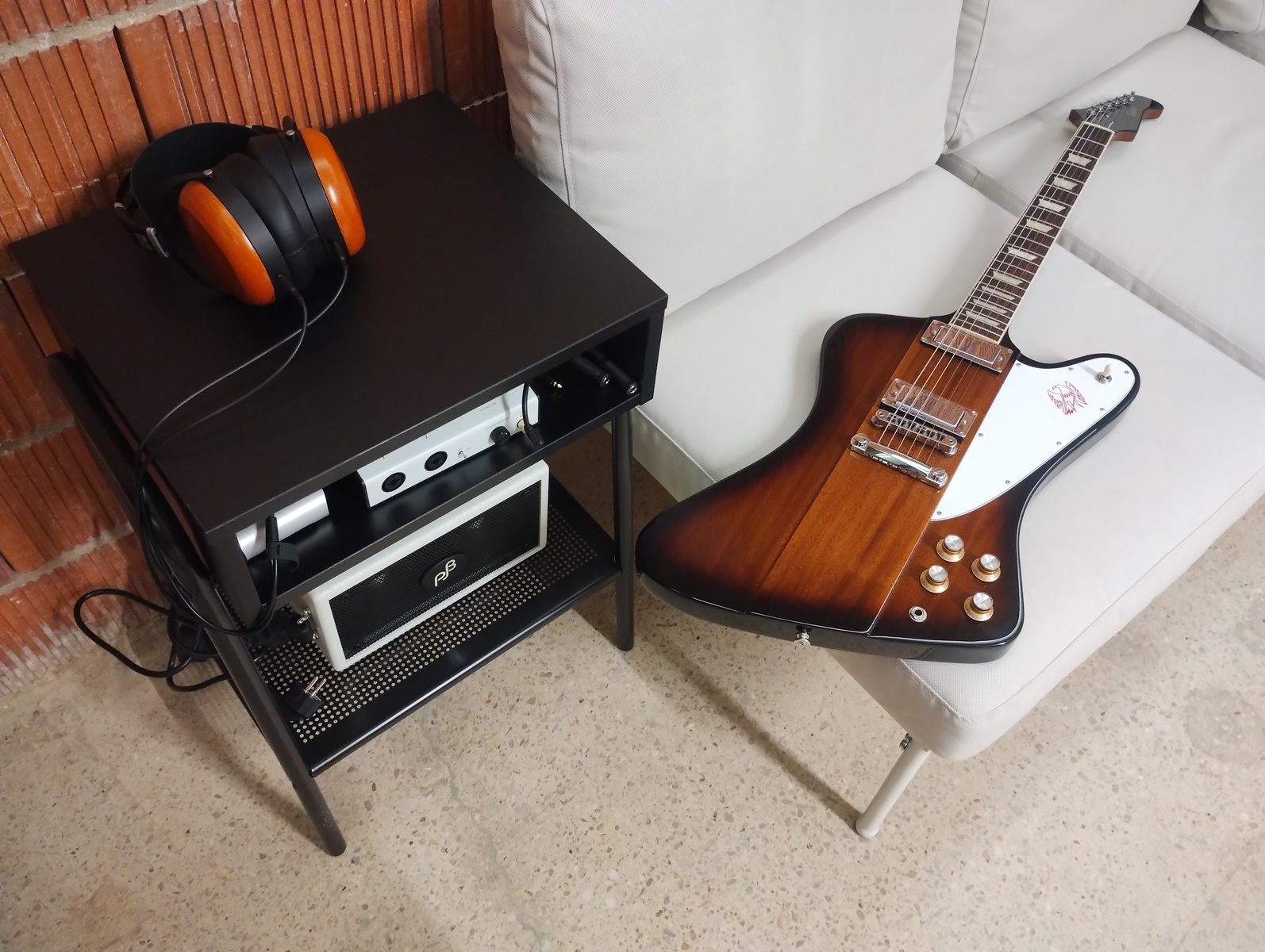
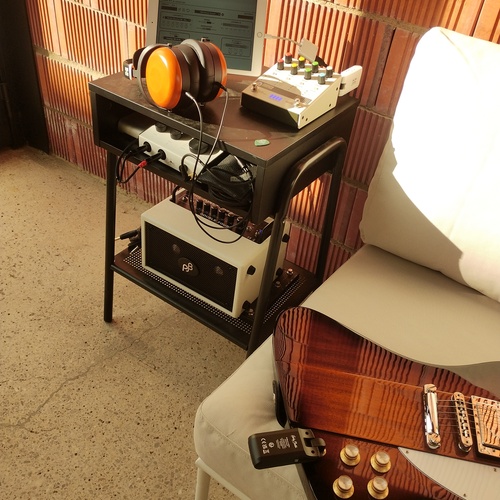
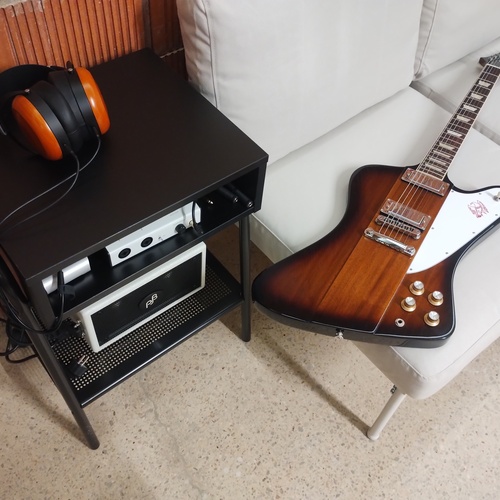
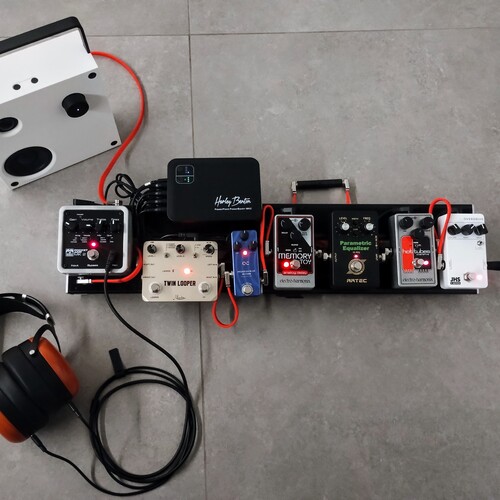
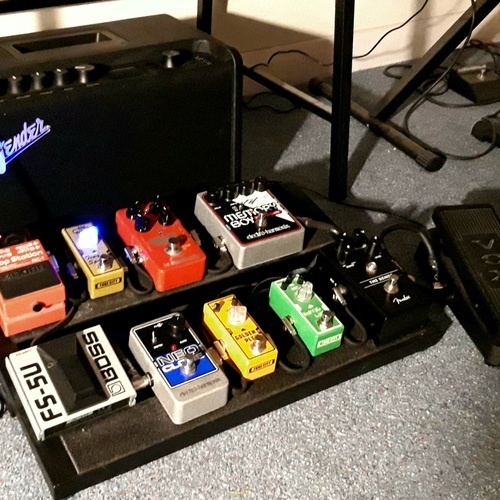
Gibson Firebird Platypus next to the mini recording station with interface, headphones and clean amp. Ready to plug the guitar and an iPad for recording and using amp simulation.
More gear photos from sofamusician



Gear in this photo
This rig
~$3,101
Value by category
- Guitars 72.2%
- Amplifiers 15.7%
- Studio Equipment 7.1%
- Headphones 5.0%
Price mix
Mostly standard

Gibson Firebird Platypus Electric Guitar
Avg price: $2,239.29


A modern Firebird with amazing tone, playability, and looks.
The Platypus is a special incarnation of the Firebird, combining some aspects from the classic "reverse" model (body shape, and pickups) and other aspects from the later "non-reverse" model ( set-neck construction, flat six-on-top headstock design, and lack of banjo tuners).
The result is a modernized version of the Firebird that keeps the great classic looks and sound, while improving some aspects contributing to the neck playability, avoiding neck-dive, keep pickups parallel to strings, and improving tunning stability. I'd have appreciated the new model to still be nechk-through, but it was not a deal breaker for me since this has not much practical impact.
The pickups are true Alnico 5 Firebird pickups, and they sound great. Dynamic and great note clarity. The volume and tone knobs allow to get a wide range of usable tones, which makes the guitar really versatile.
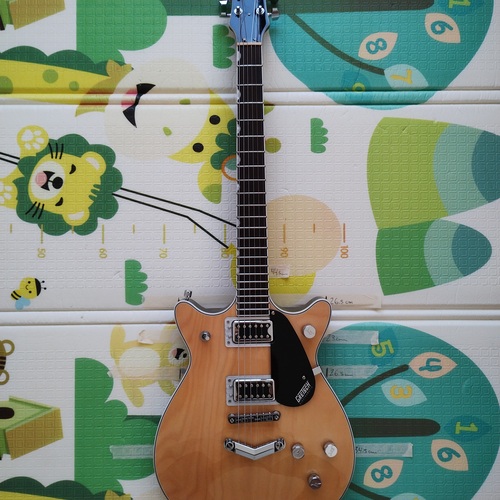
Versatility was important in my case, since I want to keep my guitar collection quite minimal with just two guitars: an affordable Gretsch electrònic double jet (my first guitar, which being affordable I've been comfortable taking anywhere) and, the Firebird Platypus (to play at home).
I play mainly seated, and found the Firebird quite comfortable. The ergonomics of Firebirds have always been a mystery to me. The Firebird horn on the treble side helps to keep the neck higher (less horizontal to the floor) which makes it comfortable and facilitates fret access when playing seated. On more conventional guitars you may need to shift to "classic" position to achieve this. However, comments and reviews often describe Firebirds, as huge and "shifted to the left".
Interestingly, when I was finally able to try a Firebird in a store, it didn't feel that different from my Gretsch G5222 (for which you won't read such comments). So I guess it depends on which types of guitars you are used to play, in which position, and how it fits your body.
Being a less common model, it is priced a bit high. However, with some research you may find good opportunities for a discount (I got mine at a 24% discount of the official price).

Blackstar Polar 2 2-channel Guitar Interface
Avg price: $219.28

Great simple interface for use with mobile devices
Great interface to capture audio with good quality. Compact, solid and simple to use. I use it with an iPad to capture the audio of an electric guitar for different purposes: record the audio, record videos using the interface input as their audio, and using virtual amps and effects. I used it successfully when both, connecting the guitar directly, and also using a pedalboard.
The "enhance" feature provides a subtle but nice improvement. So I keep it on. Despite some added amp qualities with the "enhance" option, the clipping is still something to avoid. In any case, the level indicators make it easy to adjust the right amount of input gain to avoid clipping easily.
For my setup, using it with an old iPad (5th gen), it is great to see that it just works when connecting it (using the camera adapter since older iPads lack USB ports). The only drawbacks in my case is that the control app is not available for mobile devices. So it is not possible to change the default settings (which is not an issue for my uses). For advanced adjustments I'd need to connect a laptop. For example, activate direct monitoring or separate the inputs to different outputs require the use of the control app. Fortunately, the changes made, are preserved in the interface until it is turned off, even when connecting it back to the iPad. So this can be used as a workaround if needed.
I mention that the interface is very silent. However, that will depend on the quality of the power supply you use with it. Using a regular USB phone charger, or connecting the unit directly to my old laptop resulted in the interface to capture audio with a lot of electric noise. I had a similar experience with the another audio interface (Universal Audio Volt 2) and I returned it because it was noisy. Then, I found the Polar 2 with the promise of the silent FET-based preamps, and I was disappointed to get the same noise initially. So this may be a common issue with USB powered interface.
The noise issues were completely solved when I used a spare USB hub by elgato that has a power supply with ground connection and I no longer needed for my computer. This is a bit overkill, since the hub provides many ports for connecting a computer (USB, USBC, network, HDMI) and I'm using just one to power the audio interface. However, the result is exceptional. Total silence, unless the input gain is turned really high (over 80%).
I also tried a Harley Benton battery that works well for pedals and has a USB connection too. Although the noise was reduced to usable levels, the hub from elgato worked much better.
I think that manufacturers should provide a good power supply for users to experience their products at their best, or, at least, provide some recommendations for power supplies that work well with their device.

Phil Jones Bass Double Four BG-75 Bass Combo Amplifier
Avg price: $487.42

Avg price: $155.00

Affordable planar headphones with quality sound
I'm not an audiophile, and I lack experience with high-end headphones. My point of reference are the Bose Quiet Comfort headphones with noise cancelation, which I use for work meetings and listening to music.
I was looking for some headphones for silent guitar practice (which I could use for listening to music too).
I did not need Bluetooth or noise cancellation. Actually, I preferred to be able to hear the environment (in case someone talks to me) while not disturbing others. I was attracted to the idea of trying some headphones using planar technology, and most of the options were quite expensive.
The Sumdara Closedback have been a clear improvement in sound quality over my previous headphones.
Currently the Sumdara Closedback are available at less than one third of their original price. After launch, the Sumdara Closedback got bad reviews due to the comparisons with the open back version. However for someone who has not tried the open back version, I find the Sumdara Closed backs to be very good headphones at an affordable price.
They are easy to drive. I have been able to use them on all kinds of devices from mobile phones to amps and headphone amp pedals.
The only drawbacks are minor:
- Weight. The use of nice materials such as metal and wood make them more heavy than the previous headphones I had, which were made mostly out of plastic. Wearing them feels comfortable, but after a long practice session, I have a slight feel of relief when taking them out.
- Cable connection. A Y-shaped cable is used to connect each side of the headphones. This makes it a little harder to get the cable out of the way when playing guitar compared to other headphones where the connection is only done to one side of the headphones.
About this setup
This gear photo by sofamusician features 4 pieces of gear, including Gibson Firebird Platypus Electric Guitar, Blackstar Polar 2 2-channel Guitar Interface, and Phil Jones Bass Double Four BG-75 Bass Combo Amplifier. The setup spans Guitars, Amplifiers, and Studio Equipment, with mostly standard pieces.






.jpg?v=1784736721)