miguel_angelo's Metal Pedalboard

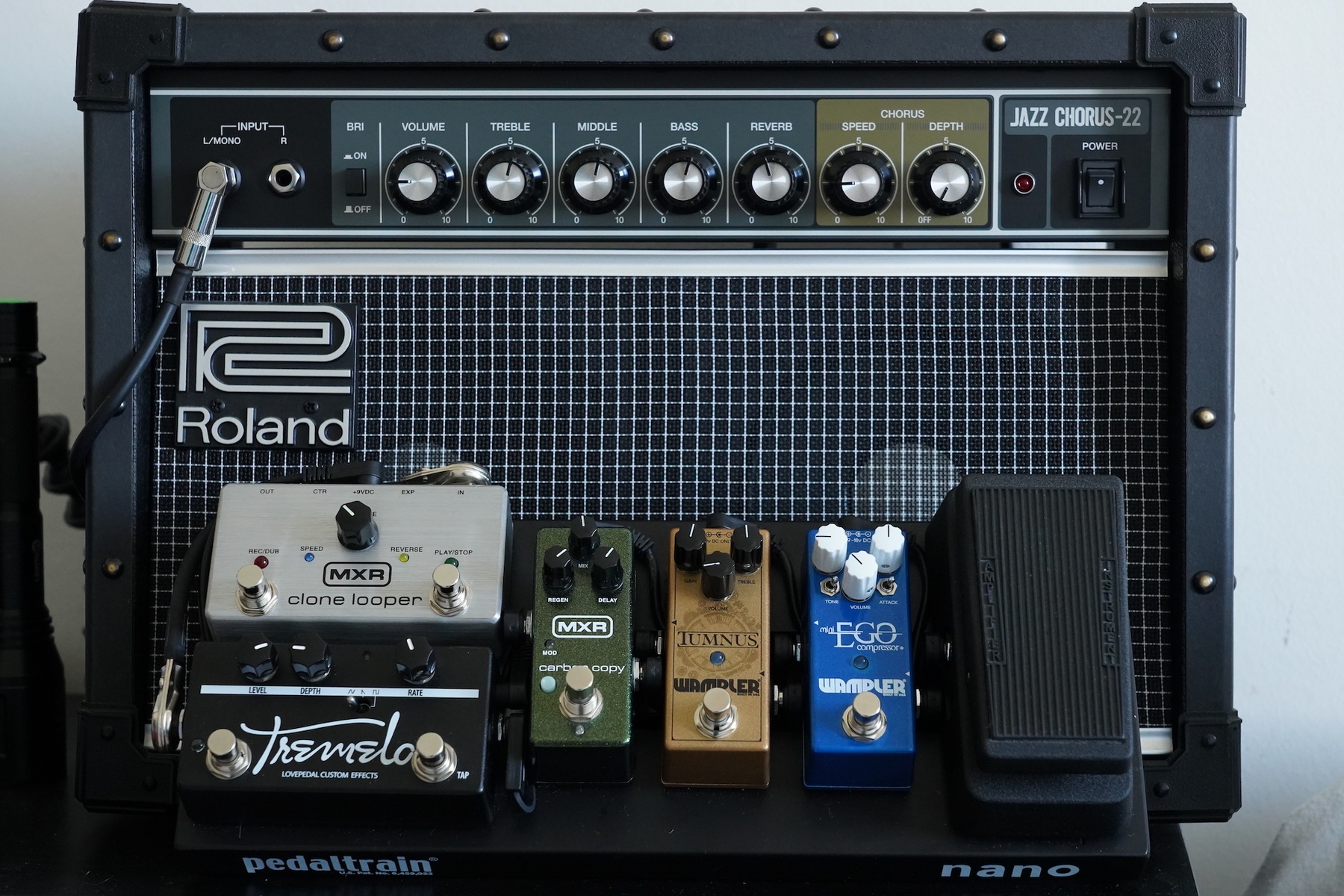
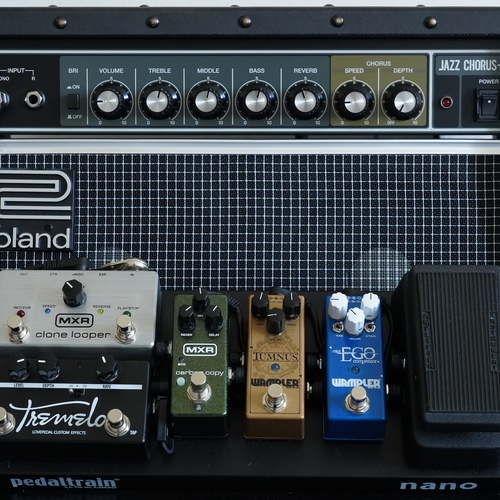
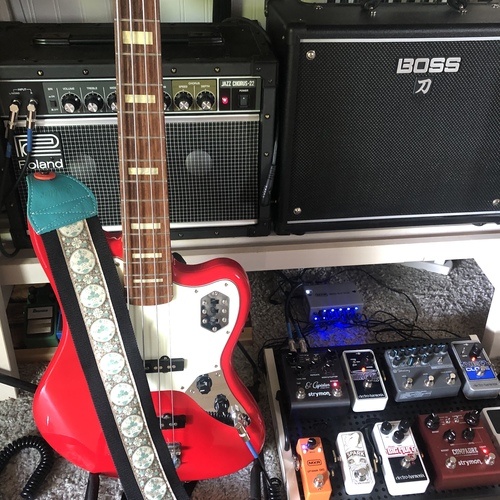
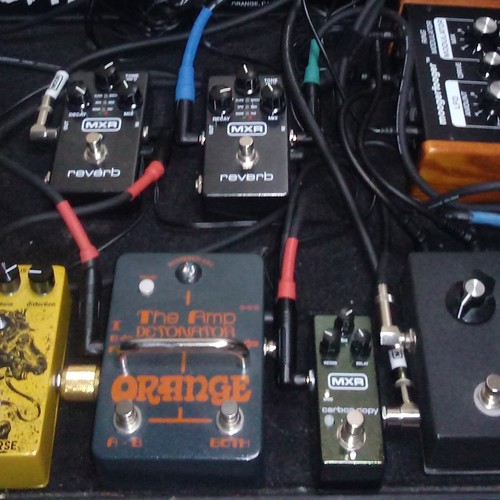
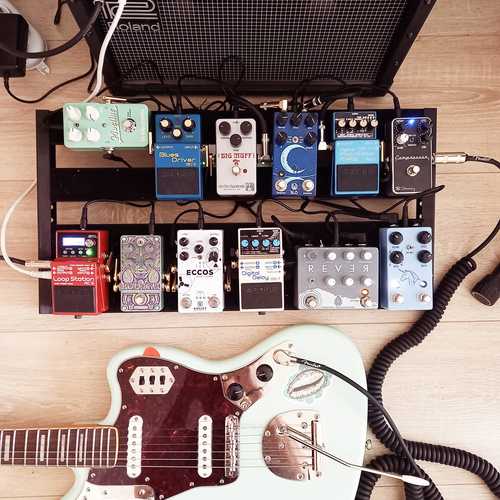
Mini pedalboard. Less is More. > Dunlop Mini CryBaby > Wampler Mini Ego > Wampler Tumnus > MXR Carbon Copy > Lovepedal Tremelo > MXR Clone Looper > Roland Jazz Chorus 22
More gear photos from miguel_angelo

Gear in this photo
This rig
~$1,343
Value by category
- Effects Pedals 59.1%
- Amplifiers 40.9%
Price mix
Mostly standard

Boldest pick: Wampler Mini Ego Compressor
Only 9 pro artists on Equipboard own it, but it's ranked #20 in Compressor Effects Pedals.

Avg price: $549.97


Great classic tone in small shell
Finally made the move to a Jazz Chorus! I wanted a small amp mainly for home use, of course I was testing and looking at all the Yamaha THR's, Boss Katana's... And although they all sounded great and were really versatile I was not really that engaged or excited about them, maybe because of too many options. I wanted something simple to focus on playing and not on tweaking. I never truly considered buying a Jazz Chorus, but when I saw the little JC22 sitting by it's bigger brothers JC40 and JC120 at my local music store it was love at first sight.
It's an amazing little amp that really lets the true tone of the guitar and pickups come out, unlike the other modelling amps which make all guitars sound identical. Very dynamic and refined sound. EQ is flexible and has a reasonable impact on the tone, but for the most I just leave everything at noon. Reverb is digital, definitely not spring inspired, I would say something more like Hall Reverb, sounds very good and has a decent range from subtle to quite spacious, not missing a dedicated reverb at all. Kicking the chorus in (wich is also probably digital) drops the bass in the right speaker in a noticeable way, but sounds great. Basically what the amp does is pure pitch vibrato to the right speaker, and when the sound of both speakers mix in the air you get this great spacious chorus effect. I use it all the time and always feel transported to the 80's. If you plug your guitar to the right input only the right speaker works so the chorus is gone and you're left with pure vibrato.
Like it's bigger brothers it has stereo inputs, stereo line out's, and stereo return FX Loop that you can toggle from series to parallel, although I never quite understood the advantages of parallel loop. Headphone out is a welcome, it turns the speaker off when you plug your headphones and works OK, it has no Cab Sim but it's much better then DI since you have pre amp stack, reverb and chorus. I say OK because with my Beyerdynamic DT990 headphones (250 ohms) I really need to crank it to get reasonable volume, I recommend using lower impedance headphones. Also has external jacks to switch Chorus and Reverb off/on.
I can confirm the stereo line outs sound amazing direct into an audio interface. Really good.
The 6.5 inch speakers deliver more than enough for home or studio use, and for a jazz gig I bet you wont be needing to go past 6 on the volume... Its a 30 watt class D amp and can get really loud. It has a gigantic headroom that just wont clip or even compress (well it actually overdrives a bit but only past 14 o clock, sound really sweet but I really can't truly enjoy it in my apartment) , so I enjoy using a compressor in front once in a while. I can't stress enough of how organic and defined it sounds at loud volumes, it kind of reminds me the Deluxe Reverb cleans, but without the negative feedback pulling on those mids, it feels more true to your pickups and guitar, more "hi-fi".
As far as taking pedals, Tumnus and Carbon Copy are sounding great in the front, although there are no valves to be pushed the JC's preamp responds very well and surprisingly dynamic to overdrive. Ended up leaving the carbon copy in front since the FX Loop caused the delayed repeats to trail out in an unnatural way, like if a noise gate was being applied making the trails disappear in a crumbly manner instead of fading out progressively and smoothly.
It's great to see the Roland expanding their Jazz Chorus family, it's a great amp used by many great artists. I fell transistor amps are certainly a technology that will not be overshadowed by the new digital modelling type amps/plugins, the simplicity and authenticity of a guitar combo amplifier is invaluable. Digital modellers are really great, but they kinda take away some of the magic of having to sound good with the gear you have, which is always possible, even with the simplest and cheapest gear. For me digital modelling is mainly useful for studio or session musicians on the fly who need more than one amp tone or lots of effects, but for live practicing or gigging most of times it just gets in the way of your playing with so many options. it's really about feel and interaction with your gear and not so much about tone.
Anyway, I highly recommend this amp for anyone who wants a great clean tone and build upon that with pedals, semi-hollow guitarists who praise their acoustic abilities and picking/fingerstyle dynamics are also going to love it, specially with vintage open sounding pickups.

Dunlop CBM95 Cry Baby Mini Wah
Avg price: $108.99
My 1st wah pedal
This is my first ever wah pedal. It sounds great, it's super sturdy, takes an internal 9v battery and its tiny! Looking at the inside it seems to be wired in True Bypass. Consumption at 0.9 ma should give very long operation time on a 9V battery. I like the middle voicing, not too dark, not too bright, probably not messing with that any more. The footswitch was very crackly and rusty and hard to press, not giving much feedback on my foot, but nothing a little spray of good'old WD40 wouldn't fix right away. Included is an allen wrench to adjust drag. Loving it!

Avg price: $132.35

Easily the best mini compressor out there
Super versatile unit, from subtle tone enhancer, to peak limiting, studio parallel compression, classic squash and with infinite sustain. It really does it all! Way better than the SP in my opinion. Much less bloom/thump on the Ego at higher compression settings, and far more transparent, especially with the tone switch to the right (which is bypassing a capacitor that removes very high frequencies - aka presence). It's also super quiet, really impressed. Works as a standalone boost to further excite overdrive pedals or preamps. Perfect compromise of flexibility, simplicity great sound in a small form factor thanks to choise of tiny 2 way switches over rotary potentiometer. Superbly tuned, super straightforward, yet super tweak-able. One of the best modern Ross type compressor, sounds great with blend at 100% compressed. Certainly the new king of mini sized compressors. EDIT: This is my third Wampler pedal, I gotta say I'm a fan of the brand: nice packaging, great sound, flexible settings, great build quality, great quality parts (switches, pots, jacks) and very neat and clean soldering of the surface mount components. All for a competitive price overall, in Europe Wampler is actually cheaper than MXR.

Avg price: $146.28
Hands down my favourite overdrive
Almost a year after I got this pedal, and after experimenting lot's of different circuits (Tubescreamer and many variations, Blues Breaker, Timmy, etc) I'm happy to say this is my favourite overdrive pedal. I love it, kinda feels like playing a Class A amp, super quick attack, super responsive to pick/fingerstyle dynamics, very rich harmonics. I wouldn't say it is "transparent", only if you have the drive knob all the way down, when you start going up on the gain those mids start warming up, not adding anything on top of your sound, just making it warmer like on the verge of breakup, stacks wonderfully before or after some distortion and makes valve amps sing. Sounds really cohesive and genuine, instead of multi layered or "parallel" like a TS where your dry signal feels like it's sitting under the overdriven signal (great for some applications but not what I was looking for). It really makes you "dig in" and play with pick dynamics. Sometimes at higher gain settings I wish I could take out some of those mids since it gets really pronounced, but anyway I just embrace it or dial a bit back the mids on my amp.
It's not meant to be a 100% exact copy of a Klon/KTR, although it is very similar. it employs silicon diodes instead of the "mythical" germanium ones, which is a sensible decision in my opinion. I never tried a germanium klon clone, but from what I hear the difference is that silicon has more gain available, "harsher" clipping, more pronounced low end for a chewier sound, and simply allows more consistency during production and less prone to temperature changes. Maybe someday when I try an Archer or other germanium clone I will change my mind, or maybe not.
Overall compared to the Tube Screamer (which I owned) I would say the Tumnus is way more open and dynamic, whereas the TS is more articulate and compressed. Gain knob is way more responsive on the Tumnus, it's a dual gang potentiometer that adjusts gain and signal summing (not really traditional blend), progressively increasing dirt dynamics and warmth. Full on gain sounds absolutely rock n'roll! Oh and the tone knob is perfect, it's an active high pass shelving filter, very usable throughout its entire range. Thanks to this it can be used as an efective treble booster (kind of).
Brian Wampler confirmed in an Instagram post that the circuit on the V2 is exactly the same as in the V1, just newer graphics to avoid copyright conflicts with CS Louis I recon. Looks really cool... Some kind of watchmaking signs going on. I really recommend it to any guitarist, jazz, fusion, country, sludge, rock n'roll... It just delivers, it's simple and small, hard not to fall in love. BTW it sounds great through my little Roland Jazz Chorus (which has no valves to push).

Avg price: $166.32
Simple and great sounding
Gotta love 3 knob pedals. From all the way down to around 2 o'clock on the delay knob the repeats sound great. Past 2 o´clock repeats become more gritty and drop volume, also noise and aliasing artefacts increase, actually I never heard these artefacts on the original version tho. For me past 2 o'clock is not really usable, only for ambient/psychedelic stuff. Regen oscilation is very predictable and controllable, and the trails have that distinct Carbon Copy filtering which sound super cool. The bright switch is a great bonus, I feel like it boosts a bit of the highs and definitely cuts low end, so it has more of a tape echo vibe to it, after alternating monthly between both modes I think I settled in the bright mode, for my own surprise. Modulation works great, I like to just set it to slowish rate and lowish depth for a subtle moody movement. It feels super well built and the knobs have a nice tough drag (maybe a bit to tough for such tiny knobs) and feel high quality, the pointers glow in the dark. Only thing I can complain is that tiny son of a gun of the bright switch, once you engage i's kinda hard to disengage it, you really need a super small screw driver or toothpick to take it out or else you will ruin it very soon... Would much prefer to see other type of switch, like the modulation switch, maybe someday I will try to mod it. Oh, and it comes with a power supply, adding nice value to the purchase, 188€ in Portugal. A bit on the expensive side. Anyway, if you want mini delay pedal and don't need modulation I would recommend the Ibanez Mini Delay.
Edit: I just noticed it comes with the more recent Bucket Brigade Chips by Cool Audio V3205D (like the SD Vapor Trail and Boss DM2W) instead of the old Beilling BL3208. Dunno how that affects overall sound though since I never tried the original Carbon Copy. You can check it in this image https://frankmeffert.de/wp-content/uploads/unnamed.jpg

Avg price: $146.22
Straightforward and Fun
For 180€ in Europe this is certainly a looper on the expensive side, compare it to the RC30 by Boss (which is the same price) and Boss gives you just way more features. But some times less is more, and this was one of the cases. I went on a musicstore and tried the RC30... I really didn't like it, so many buttons and tweaking and crazy zapateado instructions of tap twice on right and tap once on left... Then I tried the clone looper, instant musicality. No doubt it appealed to me much more than the RC30, and it sounded way better also. It's a really clever no frills MXR design, because it has all the features (undo, redo, half/double speed, reverse, buffer/true-bypass, analog dry-through) and it only has a goddamn knob!
No more double taps to stop a loop!! I never imagined this would feel so right! It just instantly stops whenever you tap the right footswitch, and instantly restarts from the beginning once you tap again! Everything is just right on this pedal, it's small, it's simple and easy to operate, it has the most basic features and effects, and sounds great! I think MXR really nailed it right, I've had tiny complaints about other loopers I owned, but the Clone Looper I just can't find any flaw really.
But if I reaaaaally have to point something (very picky stuff...) this would be it: - It's machined out of aluminium I believe, it makes the pedal lighter, and although it is sturdy it's just not as war resistant as other mxr enclosures, such as the M134 Stereo Chorus for example... Easily collects dents if you drop something on it. - Volume knob is kinda small and low height. Just replace it with a bigger knob... Also the tapper on the knob is not as silky smooth as usual, it's like the M300 Reverb, rotating it you feel this grainy friction. - The press to reach reverse effect or silent erase takes a bit of a long time to engage, 1 and half second for reverse, and 4 seconds for silent erasing. Also it has a bit of a delay when engaging half/double speed. Anyway, via the External input you can engage any effect instantly.
It's assembled in China but feels solid and well made as any MXR product. I think it was a great idea having a dedicated start/stop footswitch and dedicated rec/dub. Everything just flows way better, I can stop my loop and launch it again instantly with no crazy zapateado. Effects work great, you can record a loop with speed set to double time for more resolution, and then you can do a double octave down which is crazy. Another thing I personally love is the silent delete of a loop, long press volume knob and when Rec/Dub starts to blink just hit it and your loop is deleted silently (great!). The fact it has True Bypass / Buffered option was another selling point for me since I'm running long cables through my fx loop. Analog Dry-Though and 88.2kHz of max resolution (when double speed is engaged, also shortening by half the max recording time to 3 min) proves MXR's commitment on putting out a great future proof looper that's simple, fun and reliable. Highly recommend!
*issues I had with other loopers: Double tapping the mini TC Ditto to stop it just on time requires a bit of effort/concentration that I disliked while playing, because you have to double press relatively quick. Of course you can press and hold once to stop it, but that also erase your loop. Not good if you want to restart it later - The Clone Looper just hit once to stop!;
With the Ditto X4 if I stoped all loops and then resumed their playing, undo function is not possible, it just erases the loop. - Clone Looper ALWAYS allows you to Undo or Redo, no matter what instructions you gave it before. It even does so after power cycling! Bravo MXR!;
Boss DD8 / EHX Canyon - Are great pedals and the looping capability is just a great feature for the money! But you can't have any delays while looping...
2020 EDIT: I noticed while playing quieter loops the unit is susceptible to capture noises/interferences, Including the press of the rec switch. Solved it by inserting small foam washer under the footswitch head, so the metal parts dont bang on each other when pressing

Compact and refined
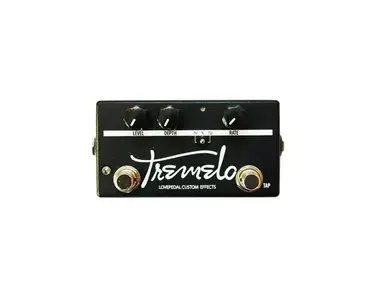
Great sounding tremolo, 3 wave selector (smooth sine, downward saw and square), depth is like a wet/dry mix, level knob is handy and has just enough gain to compensate for any apparent volume drop (it's pretty transparent and very low noise also), and rate knob has great range from really slow to almost ring mod territory. Bypass is a hard switch and tap tempo is a sort of softer switch, not like a relay bypass switch, only slightly clicks at the end of the travel, so it's silent, precise, and gives just a hint of haptic feedback. I Like it. It's great because if you only tap it once it resets the start of the tremolo, in case you want to re-sync it, which proved a great feature not mentioned anywhere. This is one of those pedals that just handling it you can tell that it's a high quality device, even the little blinking led on tempo with the tremolo responds to the amount of Depth dialled, also depending on the type of LFO shape selected the light pulsates in the same fashion, damn classy touch on an superb analog device. And it sounds sooo freakin lush! Wow. I had a look inside and can confirm it employs the vtl5c9 optocoupler. Superb and simple unit.

Avg price: $93.15
About this setup
This gear photo by miguel_angelo features 8 pieces of gear, including Roland JC-22 Jazz Chorus, Dunlop CBM95 Cry Baby Mini Wah, and Wampler Mini Ego Compressor. The setup spans Effects Pedals and Amplifiers, with mostly standard pieces. Artists with this kind of gear are most often found in the Rock, Pop, and Metal scenes.





.jpeg?v=1784034453)
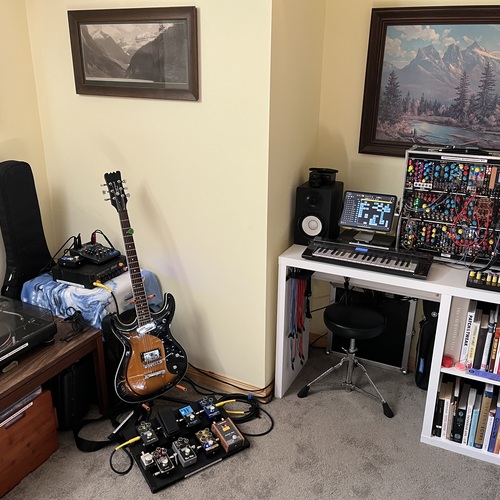






One of the cleanest mini boards I've seen. Well done 👌