
Dan Williams
A guitarist from Central Florida. Has played metal, prog, surf, and jazz fusion for over 26 years. Current projects are an instrumental 3-piece called 'Subtropic Mutiny' and a solo guitar-and-machine project called 'Doctor Sandman and His Strange Machines'.
Every rig tells a story. Start yours.
Catalog your gear, wishlist what's next, and share the setups behind your sound — free.
Create your EquipboardGuitars 4


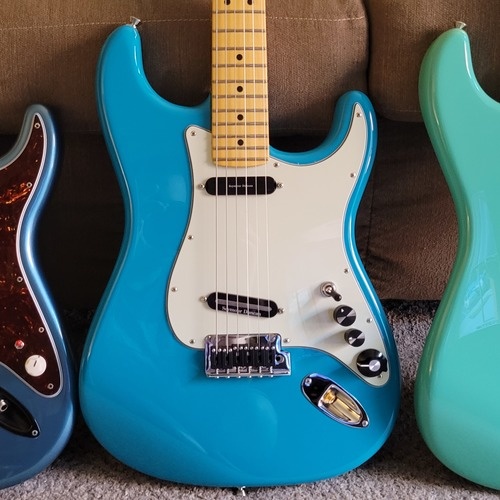
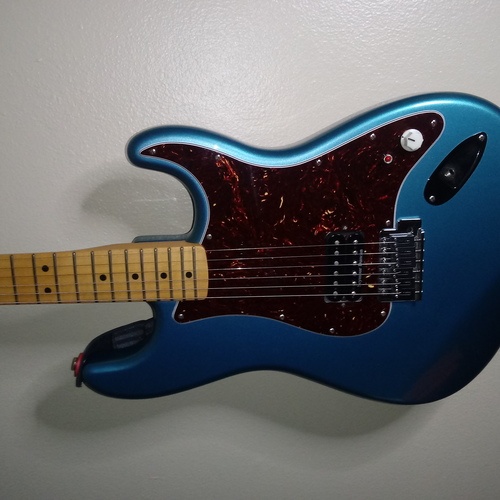
DISCLAIMER: As with all my strats, everything under the hood electronics-wise has been modded.
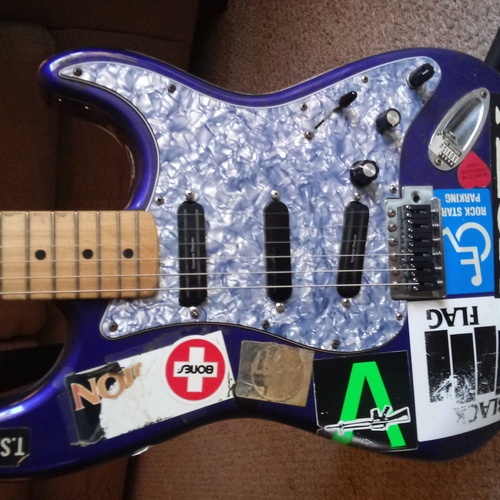
However as far as the guitar itself, this is by far my favorite stratocaster. I was on the fence in terms of going for another soft V-shape neck strat since I really enjoy playing my Fender Vintera 50s model. After reading up on all of the improvements of the American Professional II, I had to see what the fuss was about. The attention to detail and the additional features puts this thing way out in the forefront of Fender's modern implementation of this classic guitar. The staggered tuning posts, beveled neck and fret edges, 22nd fret (thanks to the over-hang fretboard), adjustable neck shim post, carved-out neck cavity and shaped bolt plate, and the surprisingly (for me) modern C-shape neck blow me away.
Sure, you can get a more affordable model, something that is a GREAT guitar like a Custom Shop series, but after 5 minutes of playing this thing I knew immediately where the extra money went. Stock, it has a pickup-coupling push-push switch on one tone knob, and a treble bleed in the volume knob. It sounds great with the V-Mod single coils, but I had other plans and dug in with some serious mods I have wanted to do for a while. I'm glad I picked this model, because now I can't put this guitar down.
Amp Heads and Cabs 6

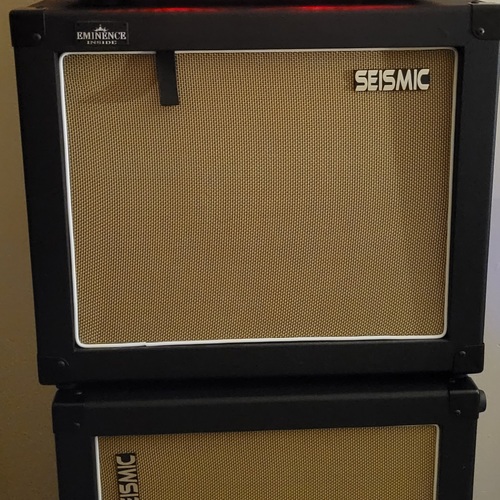
I swapped out the stock preamp tube with an Electro-Harmonix Gold-Pin 12AX7 High Gain tube, and this amp can give me perfect cleans for surf music or crank up to a very decent crunch. Decent enough to record with, and when layering tracks it sounds like a much more powerful amplifier. It responds very well to running distortion pedals through the front, and the FX loop is indispensable. Being able to run a reverb pedal in the loop on a sturdy 1x12 cab makes this amp sound larger than life, and at 20 watts it can certainly hold its own.

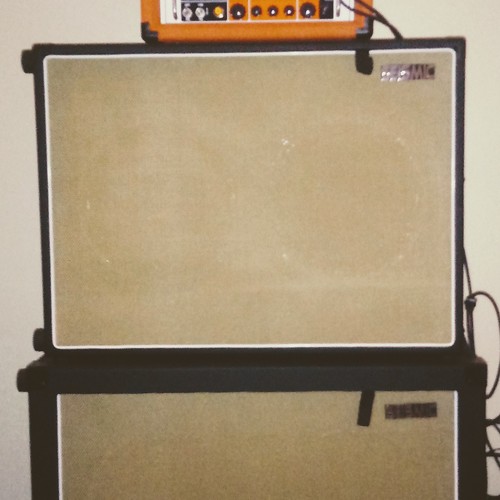
I own a few Orange amps, and rather than buy a Rocker 15, I took a shot on the Brent Hinds Terror since they are often compared. The dynamic range of the mids was particularly attractive, and after swapping the stock tubes out for a matched trio of Electro-Harmonix gold-pin 12AX7 tubes in the pre-amp and matched pair of Tungsol EL84s in the power stage, this is one of my favorite amps to play. Aside from modular effects in the effects loops, I don't really like running anything through the front of my Orange OR-15. With this thing, however, the two channels provide me with enough tonal comparison, not to mention the headroom/bedroom switch, so I can run effect outputs up the scale from half a watt to 15 watts to try things out. A simple Seismic Amp 2x12 open-back with a couple Celestion Rocket 50s loaded in actually make a really neat and cost effective combo.

With the stock tubes replaced with a matched trio of Electro-Harmonix gold-pin 12AX7 pre-amp tubes and Tungsol EL84s in the power stage, this amp is a 15 watt fireball. I play a lot of really heavy music, and this amp has been an absolute monster with my tube setup. Running through a pair of Celestion cream backs in a closed-cab, this amp has a 16 ton punch without the tapering sizzle that tends to give these types of amps a bad name. Orange has a truly unique amp on their hands with this one, and I am glad to fire this thing up on a regular basis. Whether I want to dial up some scorching leads or dial back the gain and get some silky tones, this amp has been a straight go-to for me.

This was the first solid state amp head I owned in the late 90s, and I have to say it is great at what it does. At 100 watts it can put out the power with a ton of headroom, and it takes a full compliment of pedals through the front as well as the highly versatile effects loop. There is a padding button and level control for effects, not to mention the VERY decent spring reverb that's onboard. I replaced the stock with a MOD long spring, long decay over a decade ago, and at high enough volumes it has the right amount of "washiness" if you care to dial it in via knob. As a "four" channel (two channel, each with press-button option), it can stand on its own. But I love modding pedals and running it through this thing first on a 4x12 cab.

I bought one of these about 20 years ago, and I have to say it has got more than the job done. The top two speakers are canted outward, so you can stand to the side of your amp while playing live and hear what the audience is hearing. I placed two beam blockers on the bottom two straight speakers, and this thing has RIPPED for years now. I eventually replaced the stock speakers with Cream Backs, and it started screaming all over again. This thing stays on stand-by in my shop, because with a Marshall MG 100RCD running any pedal board you can dream up through it, you've got yourself some great solid-state sound.

I started out chasing a few deals on the 120w and 60w versions of the Laney Ironheart, and backed out because I realized I mostly gravitate towards amps in the15w range. It's not the 90s anymore, and I don't need a gigantic wall of sound behind me, because:
A) Competing with the entire band at those volumes from the backline makes you sound like gravel in a blender.
B) Most venues have modern house systems that allow you to mic a great lower-watt setup that has amazing tone that translates to the entire room.
The features of the larger class Ironhearts were really enticing, but when I had the opportunity to jump on a mint 15w version for nearly half the price, I couldn't say no. Especially since this amp is discontinued, I figured it would be a good idea to grab one before it was too late. It complements my existing pool of amps in this power class, but has an unmatched tonal range.
It's a single channel amp, which works for me because I'm not into the clean/distortion/clean/distortion foot-rocking grunge stuff. I like to shred, so this beast being dialed in just where I like it gives me such a dynamic, responsive feel to my playing. The 'Tone' and 'Dynamics' settings help clean up your preferred EQ settings for treble-mid-bass. It's not as flat and gerneric sounding that way, you really get a truly unique sound characteristic just from balancing these two knobs to find your perfect response zone.
The pre-boost setting is actually really great, the fact that it is footswitchable gives you that option if you just need to bump the push on the gain for leads or just a little extra crunch. I can say the onboard reverb isn't bad, in fact it can get really deep and washy, but given that I already have my favorite reverb effects I like to run through the FX loops of my amps, I keep it dialed down to a modest "room" setting just for some depth to the sound so it's not so flat sounding. It's a personal preference, but if that's what you like it's there.
So overall, I'm definitely impressed with this amp. Laney makes killer equipment, and the Laney Ironheart IRT15H2 (also 1w input so you can really crank it in the bedroom) not only met but exceeds my expectations.
Combo Amps 3

This amp has been hanging around my collection for quite some time, and while it's not the greatest amp in the world, I keep it around. It definitely comes up a little "gutless" in the gain department, there just isn't a lot of those mids you typically look for in a guitar amp. The on-board digital effects are adequate given the class of this amp, but I'm not a huge fab of (early) digital effects anyways. I swapped the stock speaker out with a Peavey Blue Marvel speaker, which actually gave it a nice enough upgrade in tone to be tolerable. I know they aren't exactly rolling these things out of the factory on pallets or anything these days, but if one comes up for sale and you just need a small livingroom amp to noodle around on, go for it.


While this isn't the greatest amp of all time, it's still really good at what it does. It's a two channel, which doesn't matter much to me since I don't do the whole Kurt Cobain clean-distorted-clean-distorted-clean cycle while I'm playing. The clean channel actually sounds really nice, especially if you run a good reverb in the FX loop, which is foot switchable. I call that effect out specifically because the on-board reverb is a little lacking for my personal taste, but I'm sure it's enough for the average player.
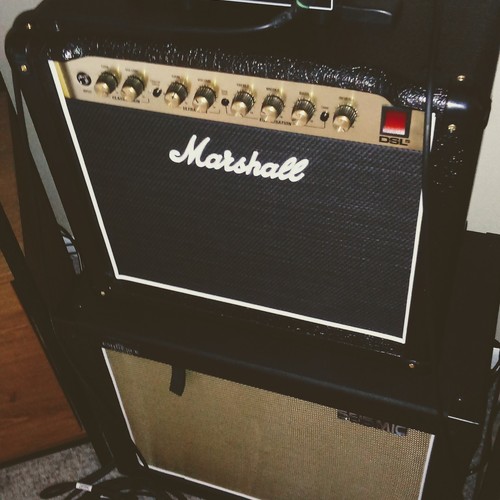
The low power mode that brings the 5 watts down to 0.5 watts is an awesome feature to have. Especially if you want to drive the extra dirt on the tubes and get some interesting lead sounds. Otherwise the full 5 watts is what I prefer, because I like the extra headroom, it just suits my playing style and tonal preferences much better. The stock speaker is a Celestion Ten-30, so I wasn't scrambling to jam in a replacement speaker, I think it sounds fabulous, although the speaker-out option into a 1x12 Eminence Wizard gives this thing a whole other layer of tone you didn't know was there. 12 inch speakers always sound better compared to a weenie 10 inch in my opinion, especially since I like to drive the power up when playing, the additional surface area gives chords less of that "fart" sound and the voice coil is typically a little bigger, so you get more open output.
The 'tone shift' and 'deep' buttons are not necessarily an "always on" type of deal for me, but they are fun to experiment with, it definitely gives you some extended options that most combo amps lack. Remember also, this is a Marshall, not an Orange, so the treble starts to get really tinny at around 1 O'clock, but if you're going for a really shrill treble sound, this amp has it. I replaced the stock Marshall power tube (12BH7) with an Electro-Harmonix gold pin, and it put this amp in that class of shredability in terms of where my hands are expecting a certain amount of reactivity at different volumes.
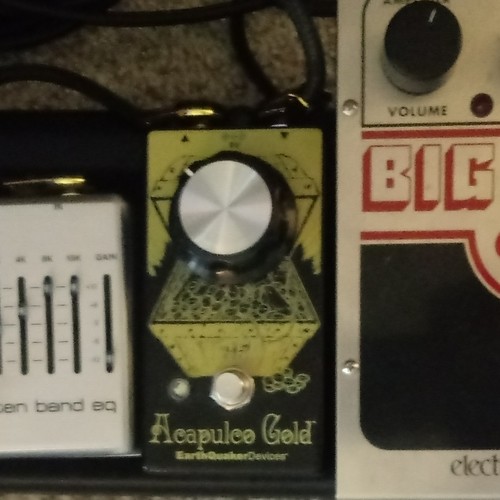
This amp was purchased to have another smaller amp around my house for when I just want to shred a little, so I'm not running 16 effects pedals through this thing. I pretty much just play as-is, with the occasional exception of a Big Muff Pi pedal that I modded to get those syrupy, long-sustain guitar solos with some reverb to splash it around.
I bought this thing brand new, and it has a volume drop problem. I replaced all the tubes, and eventually troubleshot it down to a problem with the FX loop's relationship to the power amp stage. As long as I keep the footswitch plugged in and the FX loop turned off, I don't have any problems (at least for now). This isn't my daily driver or anything, so there's no urgency to rip it apart a second time and get into heavy diagnostics. I've actually heard a few players complain about this problem, so I suppose this is my "buyer beware" caveat.
Pickups 7

A little over a decade ago, I picked one of these up to drop into a Fender Custom Shop that I was modifying the electricals with using a custom pickguard. When I rolled up the volume knob while plugged into a Marshal full-stack, this thing instantly became my favorite. It is high output, but not so high that you get that fizzy chainsaw sound when playing. Doing mostly prog and jazz influenced finger patterns, the level of articulation I got out of this thing was unparalleled to any other pickup. The Seymour Duncan Hot Rails are a very close second, but the f-spacing design and the adjustable posts let me slowly tweak the pickup over time to get it right where I want it.
-m.webp?v=1784440007)
I first bought one of these maybe 17 years ago or so, and put it into one of my earlier model Fender Stratocasters in both the neck and bridge position. The output on these pickups is really great for solo work on the higher note strings, and depending on how much gain and the tone you're working with you can get some really crunchy rhythm sounds out of them. The neck pickup is my favorite for noodling around with, if you back off the tone a little bit you get those round, syrupy runs with a great amount of sustain. The only downside is when I plug into an amp after jamming on a different guitar/pickup, I have to do some knob tickling to get that hot mud sound out of the low E string. It's not a fault of the pickup, they just run hotter and have different tonal characteristics than stock pickups, so they're definitely purpose-built for shredding on a certain setup to get the most out of them. I have an older stratocaster I've had for over 20 years that I'm going to clone soon, and if it's any indication of how I feel over the long-term about these pickups, I'm going to drop a set of these in the clone.
-m.webp?v=1784413489)
I dropped one of these in as a middle pickup on a Fender Stratocaster around 17 years ago, and this is my favorite middle pickup I've used. A lot of the Stratocasters I've modified over the years don't even have a middle pickup, but in the guitars I do have them on, this is by far the best sounding one. It has a really shimmery, "glassy" sound for a middle pickup, and the output and tonal characteristics give you that ambient "pecking" sound when you're doing some faster runs. I can either couple it with a high output bridge pickup (setting '2' on a 5 position blade switch) or couple it with the bridge pickup with more modulated effects and get some very interesting tones to be produced. Needless to say, I definitely recommend.

This pickup has an incredible tone. I have a modded 10k neck version of this pickup, and it has a really great tone in the stratocaster I have it in. With mine being a bit hotter than average, rolling back the tone knob just a couple ticks really dials in the sweet spot. As this is a slightly demagnetized pickup (done to mimic an aged pickup), it has a mellow, smooth tone, but still has that spanking bite to it with more aggressive picking. On several Orange and Marshall amps I've played this pickup on, finding just the right amount of gain to draw out the tone but keep the muddiness down makes this a versatile option to drop in your favorite guitar.

After playing Seymour Duncan Hot Rails for many years, I decided to give this pickup a shot in a new Fender Vintera 50s Stratocaster I just bought. I have to say, with the option to coil split, this is definitely the right pickup for more bold sounding surf music. The output is not as high as a Hot Rails pickup, and it's a little more crisp in some respects. I actually used a 7.8k neck pickup in the bridge position, and it provided me with the surf tone I was looking for. Just to test the limits, I ran this thing on a couple Orange and Marshall amps with the gain fully cranked, and while it sounds a little skimpy for a modern metal sound, it still had a great tone. If you're just playing harder rock, the proper bridge pickup in the bridge position will suit your needs, especially if you play through a speaker like an Eminence Wizard that has really great breakup for rock.

I like to experiment with single-coil size pickups that are built around humbucker architecture. The Hot Stack seemed like a unique combination of Seymour Duncan's previous iterations of things like Hot and Cool Rails, but with a different approach. I like the single bar magnet for the same reason I like the stacked blade designs in my Hot and Cool Rails: less drop-outs when going for those big bends that I'm a fan of.
The way the coils are stacked in this model give it a really hard punch for higher output, but one thing I noticed is there is still a very traditional single-coil sound laying across the signal, but much thicker. Between coil tapping (I used the variable pot versus binary switch this time) and using a lower value filter capacitor on the tone knob, I was able to get some Greg Howe tones out of this pickup.
For the much heavier stuff I still defer to my Seymour Duncan TB-15 pickup, but the Hot Stack is still way up there in terms of shredability, and has that nice snappy sound that raises your tone above an overly lower-mid range pickup that plays a little muddy on certain amps.

Pedals of All Sorts 27
-m.webp?v=1784331456)
While this pedal is far from being a one-trick pony, it definitely has it's left and right lateral limits as far as where you can go with it. As much as you can chalk it up as "just a really expensive ring mod", the quality of the pedal itself as well as the sound is amazing. I can dial in tremolo sounds or get really high-pitch laser gun noises all by just adjusting a few knobs. And the knobs are not in constant need of adjusting by hand to keep things interesting, there are dedicated inputs for foot controllers. That way with a small string of expression pedals, you can sit on a stool and take this thing for a ride. The sine and square wave switch as well as the low and high grant you the ability to completely shift the parameters of a given setting. The LFO is a a nice touch, as you can dial in just the right amount of effect from one of the signals you have dialed in. Great control over what some see as a single dimensional effect. Word of caution: like a lot of ring modulators on the market, this one "bleeds" into the bypassed signal when disengaged, so I used a home-made loop bypass pedal to take it completely out of my signal chain when not in use.

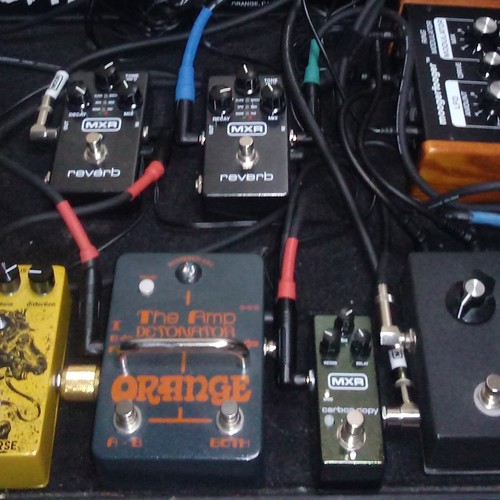
I've built several unbuffered ABY pedals and used a few different buffered ones in the past, but this is the best one yet. It's built with that typical Orange tank-like quality, and the buffered aspect doesn't deplete tone for pedals I have running in front of it. I ran some pretty rigorous tests to get measurements off of a Walrus Audio Deep Six v3 compressor pedal, and there was no remarkable change in signal quality. The phase button on this pedal is the perfect compliment, especially when you're splitting your signal between two larger, high-end amps and don't need any signal anomalies diminishing the quality of your sound. If i ever need to do another dual-amp setup, I'll be buying a second one of these for sure.

I'm not a big fan of digital pedals, and especially ones that are not true bypass, but this is a really iconic pedal that I've heard on several popular tracks. If you just need something to fool around with and get some wild sounds out of, it's worth plugging into from time to time. It has a really harsh digital fizz to the top-end of the signal, and unless you're into that or using another effect to take advantage of the sound characteristic, it falls short of similar yet more modern pedals. The technology is definitely showing its age these days, especially since these re-issues came out around the time all the "budget friendly" digital effects of the late 90s were getting a lot of attention by people that thought they could buy a pedalboard in a box.

So I have traditionally used a Boss CS-3 that I performed the Monte Allums mod on, and even gave the Keeley 4-Knob Compressor a shot, but there was something lacking in both. I held out long enough for Walrus Audio to craft this masterpiece, and I'm glad they did. You have the same perceived ailments as most compression pedals as far as higher output pickups, non-isolated power supplies, and untamed settings giving you grief, but take 5 minutes to noodle around with this thing and you'll be glad you did. Where this pedal really fills the void is the amount of precision control over your sound in regards to picking dynamics. Having the level to help achieve unity gain in your signal chain, tone, attack, and sustain are all expected, but the concept of the blend knob helps to precisely control how much of the dry signal you want to preserve. Some setups are near-perfect, and just need that little extra coat of sonic polish to really tighten them up. Others are a dismal and anemic, and require something with the robust amount of tonal control offered by the Walrus Audio Deep Six V3 to give them some life. Regardless of your use-case, you should try to drop one of these in your signal chain to see what it can do that your existing compressor comes up short on.

I was surprised not only by the diverse, punchy-yet-rich sounds this thing was capable of producing, but realistically the simplicity of the circuitry. Built around the LM308 opamp, it's the quality components and overall craftsmanship that makes this pedal so great. The three-position switch that swaps out what diode combo path is used is actually really interesting, you can tell a major difference between all three if you use a lot of dynamic picking with varying levels of pick attack in your playing. The distortion setting will actually over-saturate a higher gain amp really early, but when you can tame some of the unwanted warms that start to blanket the sound with the articulate tone knob on this pedal, you can reach some very unique tonal regions of your amp you didn't think existed.
I've only tried this on lower wattage tube amplifiers (20 watts max), but it has earned a permanent place on my pedalboard, even through amps that are "too good for pedals".

While there are chorus pedals out there that are feature-rich with 20 knobs, 7 jacks, and an array of switches, this pedal is a straight-forward all analog chorus pedal that's easy to use and has some tonal options. Matching the line level of your signal chain and dialing in just the right amount of chorus is easy, plus you can either shave off or boost highs and lows. This allows you to experiment with the chorus effect and given that it's a stereo-out, you can get some really amazing sounds out of this thing. I love MXR's modular effects, and for my purposes this is the perfect chorus pedal when I need to add some icy overtones to my sound.

That's right, I loved the first MXR M300 Reverb I purchased so much, I bought another. Why? Because running a stereo setup and being able to dial in two different types of reverb that compliment the amp-cab combos they run on allowed me to sculpt dreamy sonic soundscapes. Being able to blend the dry signal (like in some on-amp reverbs) allows you to help pull back on the leash a bit when you're trying to maintain control over the base signal. However, if you're into the whole "lost at sea" thing with really washy reverbs, there are settings you can dial in with this pedal that can create other-worldly sounds. The more conventional plate and spring settings are absolute gold, MXR did an excellent job at capturing the nuances of these tried and true reverb modes. If you're looking for more synth-like sounds, you can leap across the divide and obtain a totally unreal effects that can hardly still be considered "reverb".
If I bought two, you should buy at least one.

I actually sold my original full-size Carbon Copy so I could gain some space back on my main pedalboard. This thing has all the features of the original, and takes up far less space.
It's an analog delay, so there are functional limitations to the delay effect itself. One example being you cannot summon up the infinite blackhole looper-like delay that you could with a digital delay, but that's not a downside. That's not why you want to toss one on your board. Those mild, more musical types of delays that guitarists have used throughout history is what this reminds me more of. It makes it so much more desirable for my purposes, because I'm not the kind of guitarist that strings together 19 different pedals to essentially make my guitar play itself.
There's a certain tactile connection with this delay, you can get a really tight, short ricochet effect, or draw out the longer trails and create really interesting soundscape for those lead moments. It just really responds to more of a "guitarist's guitarist" style of playing versus the cosmic arcade drone playground style.

DISCLAIMER: I use this pedal with guitar, not bass, so your experience may differ.
I actually came into this pedal by happenstance. I had originally ordered the MXR Sub-Machine to fool around with when I was going through a fuzz cycling phase, and was sent the MXR Sub Octave Bass Fuzz by mistake. Just before I initiated the return process for the item, I decided to give it a test drive. I'm glad I did, because I think this is much more what I had in mind when I was shopping around for fuzz pedals that have more boom-and-doom.
Since I used this thing for guitar and not bass, I know the circuit architecture doesn't accommodate some of the frequencies I'm passing through it. With that being said, I don't really get a lot of range from the 'Mid-Level' knob, and the 'Bass' knob eventually stops giving at a certain point. These aren't really "downsides", per se, but it's functionality I can't fully utilize with a guitar.
The rest of the features are outstanding and give me a lot of options when dialing in fuzz from all angles. There is a "Fuzz" and "Gain" knob, which is actually switchable to a "Distortion" mode from a push button. This can help you either go for that tinny, fizzy original fuzz sound, or dive bomb way down on some Sabbath sounding riffs. I prefer to keep things at the lower end and use this pedal as a really deep fuzz. The Octave setting helps generate a cool double octave vibe, and is footswitchable. So if you are using this as an always-on type of pedal, you can toss a dash of that in with a single stomp.
All in all I keep this thing around, and swap it between my smaller pedalboards for giving practice rigs around my house a heavy fuzz option, especially when I'm experimenting with different tube combos in the amps. There are plenty of sweet spots to be found, and while I'll never ditch my Big Muff Pi, I can say this pedal is certainly high up on my list.

Up until a few years ago, I refused to stray away from analog reverb tank-based units. I've never been a fan of digital pedals, because in the 90s everything I came across sounded really thin, anemic, and lifeless. Now that modern pedal manufacturers are leaning more towards the method of blending dry and wet signals in conjunction with higher quality digital technology, I decided to give them a shot.
I purchased one (and eventually two) MXR Reverb pedals, and was really impressed with them. Running a stereo amp set-up, having a pair of these in both amp's FX loops meant I could dial in different types and amounts of reverb to get really ethereal soundscapes. Then I got curious and wondered what else I could try, and that's when I eventually came across the Crazy Tube Circuits Splash Mark IV.
Full disclosure, I had to give it 4 out of 5 stars because some of the mode settings are a little too "digital" sounding, and when you're talking about reverb nothing bruises the signal like a fizzy, choppy sound. However, based on the various knobs that allow you to taper certain settings, there are modes that actually sound really great. The ability to plug in an external expression pedal to control aspects of the reverb, as well as a built-in switch, places this pedal in a higher class of modern reverb pedals. These are features that I have come to expect, and the versatility of the Splash Mark IV keeps this thing off the shelf and on a pedalboard at all times for me.
The decay setting goes from subtle to drastic, which I like. Some pedals have such a limited range on the settings, which is always a bummer. The mix and volume knobs allow you to get a good line level setting, as well as dry/wet blend so you can make the reverb sound way more organic than some cheaper alternative. The excite setting (complimented by a push button switch to swap between decay) is where you get the versatility here. Being able to press down on the excite switch to give your sound those long tails is a great way to have an otherwise usable, traditional reverb sound without it having that wishy-washy drowning effect where your playing just gets lost.
For the money, I say this is a great pedal. While all the modes won't necessarily be your favorite, there are still plenty of settings you'll be able to get some interesting reverb effects out of.

Disclaimer: I gave this pedal 4 stars instead of 3 because I have modified mine substantially. So buying one stock will not be the same pedal that I know this to be.
It gets a lot of grief over being a crummy pedal, but then again there are players that say it's all in how you use it. While I feel as though I exhausted my knob-tickling options in stock form, it may have just been the gear combo I was running it on, or maybe I didn't do my due diligence and work hard enough to unlock that magic, golden sweet spot people claim is hidden in there. I my opinion it shouldn't be that hard, nor should the sound shaping be so limited in anything you would consider a great pedal.
After increasing the gain, a little headroom, and giving the EQ sweep a major extension, this pedal is able to be ran into the front of a more modestly priced solid state amp and sound decent enough to shred on. It doesn't make it sound like a $4000 tube amp, but it's redeemable with a little bit of work.
What I'm really trying to say here is that some pedals are easily upgraded, while others simply cannot be saved and are trapped in mediocre mode eternally. If you are just getting into pedal modifications, find some popular mods on the internet for this pedal, and try the Keely mods on the Boss DS-1 to get some experience.

Sure, it's a tube-based tremolo/vibrato pedal, but it is entirely too noisy to play unless you are running a 100% clean channel. Even then, turning certain settings up too far will cause this really loud humming sound.
The switches for the various "modes" are useful to get different types of sensations out of the "wobble" effect, but the knobs for the variable settings just can't be pushed too far.
At best, this thing is most playable when you're running totally clean, and just need a subtle effect. I have gotten those Leslie-esque sounds out of the pedal, but at the cost of overbearing hum and hiss the second I stop playing.
I'm sure there are applications that are appropriate for this pedal, and the welcomed, warm tube sound certainly is nice, it just isn't for me. I even bought a new one after selling my first years ago just to see if I was missing something, but will likely end up selling this to someone that wants to experiment with it. I even swapped out the stock tubes for some high quality ones and replaced carbon resistors with metalized ones in the power stage, and it wasn't enough to clean it up to my standards.

I'm sure there have been some industry-standard improvements in these types of all-in-one pedalboards over the last 12 years, but my SKB PS-45 hasn't given me a reason to look elsewhere.
Between enough on-board power for 11 pedals, and the fact that it's stereo output with independent external FX loop relays for each channel, this has served my purposes for over a decade. The ability to plug your guitar in and pass the end of your pedal run back to the patch deck, a handful of velcro cable ties means I can keep things neat and in place without it looking like a plate of spaghetti.
The locking latches for the case cover have lasted me over the years, and I can cram this thing anywhere and know my setup will show up at the destination ready to snap off the lid and plug it right in. That's the type of convenience I have come to depend on using this thing. The fact that it has an in-line fuse to protect your setup means you can plug this thing up to a surge protector and know you're hiding your gear behind dual layers of defense should the power situation become unstable.
This is one of the best investments I have made, and while I have other smaller pedalboards that I Frankensteined with external pedal power supplies for other setups, this pedalboard is on my main rig and likely won't be going anywhere any time soon.

I've owned two of these over the years. The first one I had was in the mid-90s, and I held onto it for a long time until it magically grew legs and walked off. There's nothing too special about this pedal, but when I had the opportunity to snag one on Reverb for like $25 I just had to buy another. This is in the class of pedals that I typically do mods on, and replacing certain caps with stacked metalized film ones is a cheap way to make it sound more solid and rich.
I'll use this one on certain amps for a more "classic" type of overdrive sound, since it's not the most distorted of distortion pedals, and actually gets too warm and muddy depending on the settings.
I wouldn't necessarily tell everyone to go track one down just to do so, but if you're looking for a pretty straightforward distortion pedal that has a less modern sound, I'd get one. Even if you can find one cheap and want to get into modding pedals, this would make a good place to start.

There isn't much you can milk and spin into a review about a pedal with one knob, but this pedal does its job really well. I like to run this pedal through the front of an Orange Micro Dark into a 1x12 cab with an Eminence Wizard in it. Turning the knob up to 8 O'clock and playing with the gain knob on the amp to find the sweet spot can give you that stressed Sunn Model-T sound that everyone likens the sound quality to. It is definitely an effect that needs some pampering while you play, because if you want a lead sound that doesn't sound breathless, you'll need to dial it in, but when you go back to playing those sludgy chords, it'll take some adjusting to get it back. Needless to say, find the one thing you want to get out of this pedal, and make it do its job well.

A lot of wahs on the market, especially early ones, were one-trick ponies as far as "wah on, wah off". Well, that's not the case with the Dunlop 535q Wah. The ability to change the wah range, 'Q' setting, volume, and the fact there is a controllable overdrive kick-switch to give your signal a boost makes this thing the Swiss army knife of wah pedals. If you're not into 9v battery-cycling drama, you can wire this thing for power. It has a typical stomp switch right on the very tip of the rocker plate that can take some getting used to, but I have to say this pedal is far from being out-classed by some boring wah of yesteryear.

Rather than give a detailed review about what I hate about this pedal, I'll just say over 26 years of playing it never did anything for me, really. This was however an introductory pedal I used when I first started modding pedals. So it gets 3 stars, because any of the Keely Mods make it good enough to drive an amp or push a subsequent pedal in your signal chain. Otherwise it's just a little dead and weak to me.

I've kept this compressor around to offer options to players that want to use my gear to record with. I personally do not think this is a good compressor. It's noisy, big, clunky, has a special power adapter/jack, and doesn't seem to... compress. Again, it is worth keeping in the collection if you want to use it for something really experimental, like the "squash" feature to kill the bandwidth of your signal prior to running it into some wacky modulated effect. Otherwise it's just not the same as a quality compressor with the research and craftsmanship behind it like a Walrus Audio Deep 6 V3 compressor.
-m.webp?v=1784440002)
This was actually the first pedal I ever owned maybe 25 years ago. I had seen it pop up not so much awash in a sea of pedals on the stage, but as a single pedal running through the front of the amp. I too was like many that viewed it as a severely limited pedal with two knobs, but years later I finally realized what this pedal was. It's not meant to be dropped in-line into an economy amp so you can sound like Eddie, it's definitely an augment for an already great amp. You can get those sizzling hot leads, and even those fuzzy, fat chords out of your amp with one kick of the switch. If you can tame certain aspects with noise reducers or sculpt it out a but with an EQ pedal, you can take your sound some place it's never been before while staying in your comfort zone. Or you can just slam it through the front of that favorite high-end amp you've played for years and give it a second life with this classic pedal.

Synth and Electronic 4
-m.webp?v=1784444534)
A way cheap way too get some sequenced tracks out for some pre-pro work. If that's not your thing, this is an excellent means of setting up an advanced metronome for those really tricky practice runs. The stutter feature is neat because it helps spread patterns out with that skipping delay effect. The sound is huge on headphones and translates VERY nicely to a mixer for recordings. The quality is crazy. There are tons of videos out there that go into depth on each little feature, and to be honest I basically get use out of them all here and there. Syncing with other units on a time-clock level is incredibly useful, these are worth a shot.

Firstly, I didn't buy the Monotron to integrate into a professional studio or anything. I build a lot of analog synthesizers and picked this up out of curiosity more than anything. It's really neat for the first day or so, but to be honest the size if probably the biggest issue. Since the ribbon track is so small, it's hard to manipulate with a great deal of precision. That and I personally don't really like overly tactile electronic instruments, so that's a downside for me when playing it. You can however patch it into other devices via patch cable and use it as a fun supplement to create some interesting sounds.
Like I say, it's more of a "gee-whiz" toy that loses its novelty fairly quickly, but I don't think any of us would realistically purchase one to record an album with anyway, so maybe give it a try if you're into low-cost gadget experimentation.

-m.webp?v=1784440684)
Recording Gear 7

-m.webp?v=1784440622)


Speakers 6


There isn't much to say in terms of the tonal quality of this speaker, and it's certainly not worthy of a deep dive into its dynamics. Plain and simple, this speaker offers a sensible upgrade if you have a small combo laying around that you find yourself playing occasionally. While it doesn't make it sound like a completely different amp, there is enough difference in tone to add playability to something you'd otherwise end up throwing out during your next round of Spring cleaning.

Tubes 4


I bought this as a replacement in a Marshall DSL5CR, and it gave me more of the tonal characteristics and reactivity I was looking for. It doesn't give you that muddy, over-taxed sound that some tubes will give you, and it compliments the tone features of that amp really well. The 'deep' switch has a little less flatness to it, and the classic tinniness of a Marshall really shines through without sounding overwhelming when you start to crank the treble.

Wishlist 3
Gear Photos 12



Top artists 3
The artists Dan Williams has added the most gear to.


