Igor Klemann
GearIQ 277
Joined Jan 2024
I play Guitar and sing for Triss.
Every rig tells a story. Start yours.
Catalog your gear, wishlist what's next, and share the setups behind your sound — free.
Create your EquipboardGuitars 3

I bought this guitar in July 2025, second-hand, for only 200 reais (around $40 USD), because I needed a guitar with a humbucker to complement the clean tones of my P90 — and I was genuinely blown away by what I found.
This model hasn’t been produced in years; mine, for example, is over 12 years old. Back when it was sold, it was priced very cheaply, but that is by no means a reflection of its quality. On the contrary, it’s an incredibly surprising instrument. The pickups deliver a full, balanced tone that far exceeded my expectations. Its playing comfort is remarkable, and its tuning stability is unexpectedly solid.
My specific unit does have a few issues — the neck pickup sits a bit too high, and the G string tends to go out of tune when bending near the 12th fret — but I recognize these are just signs of age and neglect from the previous owner, and they’re easy fixes for a luthier.
Overall, this guitar has impressed me far more than I expected, and even though it can only be found second-hand nowadays, it’s worth every penny.

Excellent value for money!
I bought this guitar as my first one in mid-2023 and was very satisfied overall. The biggest highlight is definitely the P90 pickups, which deliver a beautiful clean tone and a rich, pleasing distortion. However, one thing that really bothered me was the noise when using high gain — it becomes quite noticeable and can get in the way, especially if you enjoy heavier tones or high-drive settings. In some videos I’ve seen, this issue didn’t seem as present, so it might vary from unit to unit.
Overall, it’s still an excellent guitar, especially considering its very affordable price. I’d even say it’s one of the best options in its category and would recommend it to both beginners and more experienced players.

This guitar belonged to my father and was where I first started playing music. It’s a simple beginner model, but very well made. It plays smoothly, feels light and comfortable to hold. Its volume is a bit low, and while the tone is pleasant, you can tell it’s an entry-level instrument. Even so, it’s a great guitar for anyone just starting out.
Keyboards 1

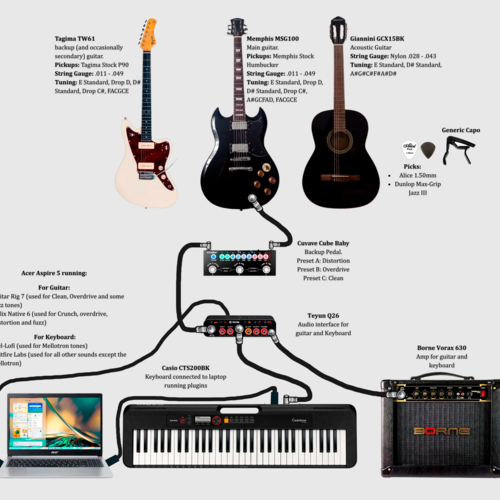
This is an entry-level Casio keyboard with many functions and a wide range of sounds. Some of them are very good, while others sound weak and artificial. However, it can also be used as a MIDI controller, and since that’s how I use it, I must say it performs very well in this role. It’s responsive, comfortable to play, and provides a great experience for its purpose.
Amps 1

This is my first amplifier, the Borne Vorax 630, and it’s quite basic, featuring Gain, Bass, Mid, Treble, and Volume knobs. In Clean mode, it produces a pleasant and clear sound. However, when switching to Distortion, the tone leaves something to be desired. Despite that, I use it to connect instruments for live performances, and it serves this purpose well, providing convenience and a clean enough sound for playing on stage.
Pedals 5

The Cube Baby is a multi-FX unit that impresses with its very low price and promises amp simulation, modulation, delay, reverb, and an IR loader. It serves as my backup unit, and I have to say, despite the low cost, it delivers a lot.
Its amp simulations are basic, but with proper tone shaping, you can achieve some really good sounds. The modulation effects are simple, the delay is decent, and the reverb does its job well. But the true highlight of this unit is its IR loader, which can store up to 8 IRs. The factory IRs are okay but a bit plain; however, you can load your own, including high-quality IRs, which greatly increases the unit’s versatility.
Compared to other IR loader pedals, which are often more expensive, the Cube Baby offers more features at a lower price. Its footswitches are smooth and satisfying to press, though the unit does have some noise, which might be bothersome in certain situations.
Overall, it’s a multi-FX unit that provides excellent value for money and is especially recommended for beginners or anyone looking for a good IR loader without spending a fortune. It’s hard to find another unit with so many features at this price, and the flexibility to use high-quality IRs really makes a difference.

The Boss ML-2 is easily one of Boss’s most underrated pedals — even more so than the famous Metal Zone. It provides an excellent tone for very heavy distortion, with plenty of gain and clarity. I didn’t have to work hard to dial in a really good sound on both of my guitars. The controls are straightforward and effective, making it quick to find the right tone. If you’re into metal or heavy music, this pedal is definitely worth trying out.

I know this might be a controversial opinion, but I think the Boss DS-1 is a bit overrated. Don’t get me wrong — it’s a very good pedal, used by countless legendary guitarists, and it definitely has its place in music history. However, it just didn’t work as well for me as I had hoped. Maybe my expectations were too high, but the sound simply didn’t click with me. That said, I really like it when used with low gain, where it delivers a more pleasant and versatile tone. It’s still a great pedal, especially for those who enjoy that classic distortion sound.

This delay pedal is decent — nothing extraordinary, but also far from bad. What bothers me a bit is the time knob: at its maximum setting, it couldn't offer a longer delay in milliseconds. Overall, it’s functional and gets the job done, especially for anyone looking for a simple, straightforward delay.

Digital 3

I use this laptop to run plugins for both guitar and keyboard. Everything goes through Reaper, and my main plugins are Bias FX2 and Guitar Rig 7 for guitar, and Spitfire LABS for keyboard. It comes with a Ryzen 7 5700U, a very powerful processor that handles all tasks effortlessly.
Originally, the laptop had 8GB of RAM, a 256GB SSD, and Linux. I made some upgrades: increased the RAM to 24GB, added an extra 1TB SSD, totaling 1.2TB of storage, and switched the operating system to Windows 11. With these upgrades, its performance has become even more robust and reliable for music production.

This interface is very affordable and offers a lot for its price. It has 2 input channels with individual gain controls and 4 different outputs for various uses.
The drawbacks are:
It may produce a somewhat annoying hiss and It doesn’t have its own dedicated driver, requiring the use of a generic ASIO, which can result in higher latency.
Overall, it’s a great option for anyone looking for a basic, functional interface without spending too much.

Reaper is a relatively simple and intuitive DAW, but light and very good, it has become my main DAW.
Plugins 13

Bias FX2 is the main plugin in my entire guitar setup. It provides everything from clean tones to distortion, crunch, overdrive, and fuzz, as well as all the effects I use. It’s my favorite because it’s highly intuitive and offers a huge variety of tone options, allowing me to create unique sounds quickly and easily. Its flexibility and sound quality make it the centerpiece of my rig, serving as my primary guitar plugin for both recording and live performances.

Spitfire LABS is my main plugin for keyboard. It provides a wide range of virtual instruments that I use for both atmospheric sounds and lead or melodic parts. It’s an incredibly comprehensive plugin: both the free instruments and the paid LABS+ expansions deliver stunning sound quality, which is why I always choose it whenever I need realistic and inspiring tones.

This plugin is developed by Roland itself, ensuring remarkable fidelity to the classic RE-201 analog tape echo unit. The result is an authentic, rich sound that accurately captures the character and texture of the original.

Axiom is part of the Blue Cat plugin suite, renowned for its high-quality sound. It serves as the amp and effects modeler within the suite and delivers exceptional sonic quality. The only drawback is the very limited number of effects that can be added to the signal chain. However, its pitch shifters are extremely accurate, making it my go-to choice for simulating a pitch shifter or Whammy effect.

This is Re-Guitar, the pickup simulator from the Blue Cat suite, known for its exceptional sound quality. It allows you to transform, for example, a humbucker into a single coil or a P90, greatly expanding your guitar’s tonal possibilities. The only downside is that if your guitar has a P90, you can’t select it as the pickup to be transformed, slightly limiting the fidelity of the final sound.

Acoufiend is the feedback plugin from the Blue Cat suite, known for its high-quality sound. It generates realistic feedback when a note or chord is held for a certain amount of time, simulating the natural behavior of the instrument. My only drawback is that it offers few feedback tone options, and in some cases, the feedback can take a little while to appear.
-m.webp?v=1784612384)
Guitar Rig 7 is one of the most renowned plugins in its category. It simulates amplifiers and effects with high fidelity, allowing you to create complex and fully customizable signal chains. I use it both for certain songs and in specific cases where I want highly detailed effects or unique tones. Its versatility and sound quality make it an essential tool for anyone seeking realism and flexibility in guitar modeling. The only drawback is that I’m not very fond of its distortion tones.

Reatune is by far the best tuner plugin I’ve ever used. It’s extremely accurate and allows you to adjust the reference in Hz. The only downside is that it doesn’t perform as well on very low tunings, but aside from that, it’s a reliable and efficient plugin for any situation.
-m.webp?v=1784612964)

The MT-A by Mercuriall simulates the controversial Boss Metal Zone pedal, loved by some and hated by others. I really like this pedal, and this plugin, besides being free, does its job perfectly. I usually use it together with the Roland JC-120 plugin.

This is, without a doubt, one of the best amp and effects modelers available, delivering extremely high sound fidelity and a wide variety of tones. For me, the main drawback is the limited number of effects that can be added to the signal chain, which makes me use this plugin more for specific cases, particularly to take advantage of the feedback pedal.

Archetype Gojira delivers an outstanding amplifier simulation for heavy distortions, easily one of the most praised in this category. Since it’s specifically focused on heavier tones, I use it only in certain cases when I need that kind of intense distortion.

Extra 4

The Jazz III is a pick widely praised for its ease in playing solos and lead lines. I’ve noticed a significant improvement in my leads using it. However, it doesn’t work very well for chords and rhythm parts at first — but once you get used to it, it actually becomes a great pick even for chords and rhythm playing.

This cable offers exceptional quality. It’s thick, preventing twists that could damage it, and delivers a very clean and faithful sound.

This strap is very comfortable, durable, and easily adjustable in height, all at a very affordable price.

These strings have always been my go-to, as I never had the budget for something better. They do their job and are extremely cheap, costing only R$40 (approximately $8 USD). However, they have their drawbacks: they age quickly, lose their brightness even faster, and their quality is inconsistent — sometimes they arrive in good condition, sometimes not, and occasionally they even come old inside the packaging.