Every rig tells a story. Start yours.
Catalog your gear, wishlist what's next, and share the setups behind your sound — free.
Create your EquipboardGear 30

I have been around recording studios for a while now and I frequently ask the engineers I'm working with questions about what they're doing. One consistent bit of advice I've been given is that a quality DAW is worth the money. They have also told me that you don't need to commit to something expensive right away. So I took my time learning Pro Tools in school and messing around with GarageBand and Reaper (among others) on my own time. It was worth cutting my teeth on those so I could learn the basic similarities between all DAWs.
Fast forward to now: I love Logic. I have only had the DAW for a short time but I am thoroughly impressed thus far. Apple boasts of a seamless transition from GarageBand to Logic and I can verify this. The framework appears to be the same but LPX is on another level. There is a lot more horsepower in Logic so it can handle many more raw tracks, automation, plugins, etc.
My favorite feature that I am playing with right now is Flex Time and Flex Pitch. It's unreal how powerful of a tool this is. Having said that, it's not quite pro level when it comes to fixing tracks. It will handle minor errors beautifully but I have noticed little audio artifacts in the background of tracks once I have applied Flex Pitch. For $200 it's incredible and it does its job. However, pro studios that use LPX are likely going to use Melodyne for heavy duty pitch correction. This isn't really a knock on Logic as it is an acknowledgment that any big studio will have a lot of avenues open to them. The same goes for the amps. They sound really good. But I really like BIAS and Amplitube as well. These are tastes that are completely individual and you'll need to find out what software/gear you want to acquire to augment your DAWs capabilities.
For a musician on a budget this is the answer. If you've reached the point where you want to take another step in the artistic realization of your music, or to enhance the quality of your band's demos give Logic Pro X a try. It's certainly worth every penny that you pay for it.


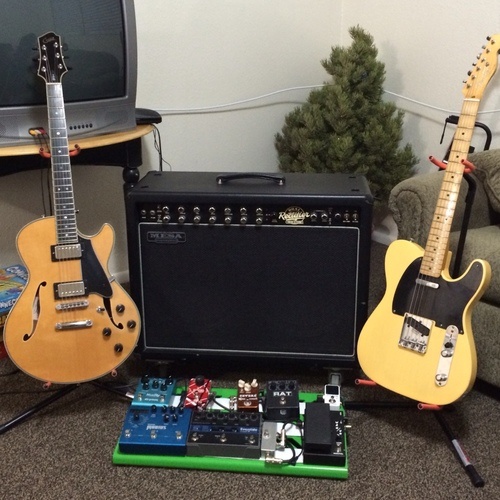
I purchased my new PRS Custom 24 this week. It features a breathtaking 10-Top, Mahogany Back and Pattern Thin neck, PRS V12 finish over a striking Eriza Verde, and 59/09 uncovered humbucking pickups with a 5-way selector. All I can say is wow. The quality level of this guitar is far above what I am accustomed to performing on. The guitar plays so well. Balanced tones that sing through my Mesa amp. This guitar is very versatile and I can get a lot of different tones by experimenting with pickup positions and the tone/volume knobs. I'm sure that I will have more to say about this guitar further down the road but for now I will just say that it was worth the wait.

I want to make it clear that I am in no way an expert when it comes to recording gear. That should help illustrate the intuitive nature of the 2i2 because I was able to pick it up with a minimal learning curve. I bought this interface after extensive homework and encouragement from the equipboard forum contributors. Focusrite really has something decent going for them with their compact interfaces. The main benefit to the 2i2 is that it is easy to use. If you know how to plug in a USB cable, press record in Garageband (or whatever DAW), and can work a volume knob you are well on your way to recording quality tracks in no time. The gain controls are insanely easy to use with a simple red/green, bad/good clip-indicating light around each knob. I was worried about the mic preamps but those fears for unfounded. Every mic that I tried sounded excellent through the 2i2. I bought the 2i2 because I wanted to record individual tracks and I didn't see the need for more inputs. I was also on a budget. If you want to upgrade to more in the future then simply put your 2i2 on a local classified listing and watch the texts/calls roll in.


This guitar is one with a long backstory which you can find online and sadly, not here. The M-77 is a phenomenal guitar at whatever price you are asked to pay. The name Squier on the headstock will temper most expectations but don't be fooled, this is a DeArmond guitar. The only truly negative thing I can say is that it's heavy. Because of this you could make pancakes in the time it takes for a note to decay on this guitar. The tone is pristine and punchy and even all the way up the fingerboard. The stock pickups (Duncan Designed humbuckers) are a fair quality but once I swapped out the neck pickup with a Bill Lawrence the thing came to life in a freaky way. Solid Mahogany set neck and body along with a carved flamed mapel top make for the closest Squier will ever come to being called a work of art. If you ever see one on sale for under $500 do yourself a favor and pick it up.

This guitar has a really nice tone. The only drawback is that it is quiet by typical classical guitar standards. Because of it's lack of projection it is easy to get buried when playing with others (like a small guitar ensemble). I primarily use my Takamine for playing wedding gigs which almost always requires the use of an amp or a small PA system. Once I am plugged in I rely heavily on the onboard parametric equalizer which enables me to make extra fine adjustments on my tone to match the surrounding environment. I play a variety of styles and this guitar is able to compliment my playing in a dynamic way.

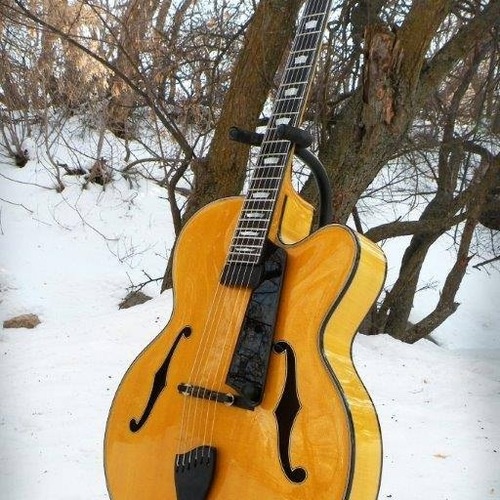
Phil Secrist is a luthier of high quality guitars based in Northern Utah. His custom guitars are the finest I have ever played. Phil is the kind of guy who measures twice and then measures again and then cuts. Great care and detail went into the construction of this guitar and I am proud to own it. The guitar is 100% hand-carved and the tap tone sings. This is the loudest archtop I have ever played. It is perfectly suited for all types of Jazz guitar (including gypsy). Phil installed a Kent Armstrong pickup on the neck which is simple and elegant in its construction. I can vary my tone greatly by tweaking the volumes of my amp and my pickup respectively. The asthetics of the guitar are breathtaking. A gorgeous figured maple body is enriched with a honey blonde finish and accentuated by an ebony tailpiece, pickguard, fingerboard, headstock, and bindings. Please visit his website and contact him about a custom guitar. http://secristguitars.com/

This pedal is decent. It offers a good (not great) sounding optical wah and functions well as a volume pedal too. I'm not a huge fan of the level knob being placed so near the switch itself because it is easy to alter it if you aren't careful. The biggest benefit to owning this specific pedal is in pedalboard space. Space is invaluable and I was tired of having two dump truck gas pedals on my board. That alone makes it worth it. There is a tone mod that I have heard of but I haven't looked into yet.


Bill Comins is a luthier of fine guitars based out of Philadelphia, PA. He decided to design and release a series of guitar that would be more affordable but still worthy of the Comins name, and the Guitar Craft Series was born. Shortly following the initial success, the Ebony and Spruce line was put into production.
All of the guitars in the GC series are high quality instruments. The ES line in particular appealed to me as I was looking for a jazz guitar to gig with. The tone is rich and dark which is perfect for that style. When I first played it I just wanted to play Wes Montgomery tunes because it reminded me of hearing Smokin' at the Half Note for the first time. The pickups are good but if you want to take the instrument to the next level you will want to replace the pickups (easier said than done on a semi-hollow). I dropped in a custom set of Florance Humbuckers and now the axe really sings. It became more versatile than before. The hardware on the guitar is very good and the action is fairly good on arrival. The tone is bell-like and pristine while the sustain is quite long. For $1.5K you can do a lot worse than a Comins guitar.

There are a lot of opinions regarding acoustic guitars. It's up to you to determine your brand preferences. Having said that, I believe that a Taylor 314ce is the best value for an acoustic. It is a fantastic guitar especially if you happen to like the feel of Taylor guitars over others.
The 300 series is the entry to Taylor's line of all solid-wood guitars. It has the building specifications and attention to detail that all of their other guitars have but lacks the ornamentation which drives the price of a guitar up. Sepele wood on the back and sides isn't as beautiful as Koa per se but I find beauty in a simple guitar which rich tone. It utilizes the patented Taylor Expression System which is still amazing after the guys at Taylor released the unreal ES2. The playability of the instrument is the Taylor par for the course that we've come to crave.

This tc electronic polytune mini is perfect for my board. The single most important feature is that it is an accurate tuner. After that I can't say enough about how little real estate it takes up. Other tuners are massive compared to this. It's helpful that you can strum your guitar and get a quick idea of which string(s) is out. The display is bright which is essential to anyone that plays with the lights down. It's design is simple and it stays out of the way. What more could you ask for in your tuner?


-m.webp?v=1783843010)