

By Gear Experts
Table of Contents

Equipboard
Equipboard is the world's largest community of artists and their gear. Read our review process.
We are reader-supported. When you buy through links on our site, we may earn an affiliate commission. Learn more.
Our Picks


MIDI is the backbone which lets us control hardware and software synths with a keyboard controller, and lets us make complex songs with tons of individual tracks using our DAW. MIDI Cables are essential to hook up our gear equipped with a MIDI IN and MIDI OUT port. While many newer devices transfer MIDI messages via USB, any music studio should be equipped with some MIDI cables to hook up older and vintage gear.
Buying the right MIDI cable seems like a simple purchase - and in many ways it is - but there is still some confusion to be had with dozens of models available on the market today. We’re here to clear up some MIDI confusion and make recommendations for the best MIDI cables for your hard earned money.
What is MIDI?
Before jumping into MIDI cables specifically, let’s take a moment to make sure you’re fully up to speed on what exactly MIDI is and does. MIDI is an acronym for Musical Instrument Digital Interface, and it’s a technology that was standardized in 1983 which allows electronic musical instruments to “talk” with each other (this includes instruments being able to communicate with computers, and vice versa) - essentially it’s a language.
The MIDI language is like a blueprint, or instructions. Imagine you have a synthesizer capable of playing all sorts of different sounds. You can give it a MIDI file, which is a set of instructions which will tell the synthesizer what to play and how to play it: On track 1, use a piano sound to play notes X Y and Z with this velocity. On track 2, use a drum kit to play notes A B and C with this velocity. This is a common misconception, so we’ll put it in bold - MIDI is NOT digital audio. Digital audio is the end result of what you hear. MIDI is more like the recipe, or set of instructions for what to play and how to play it. Because of that, MIDI takes up way less disk space than audio.
When MIDI entered the mainstream in the early 1980s, it was a game changer. The music industry was revolutionized, since now that computers and electronic instruments could all communicate with one another, it not only decreased the amount of gear that was needed by a musician to record music, but recording music itself became a one-man job. Whereas it used to take 5 musicians to play 5 instruments, MIDI sequencing allowed just one person create a complex musical arrangement on their own, using however many instruments they pleased.
MIDI continues to be used today, and such a seemingly simple technology is the backbone which allows us to create music quickly and easily using keyboard and pad controllers, hardware and software synths, and sequencers/DAWs. MIDI cables are the original way MIDI messages were transferred between devices. They are 5-pin DIN connectors, and MIDI messages are one-way traffic, meaning that a cable can only carry messages in one direction. That’s why devices have separate MIDI IN and MIDI OUT connections, and two MIDI cables are needed. Often there’s also a MIDI THRU port which just copies everything received in the MIDI IN port, so you can daisy chain devices.
What to Look for in a MIDI Cable
Now that we’ve done a crash course on MIDI, let’s talk about MIDI cables in particular. There are dozens of them available from all sorts of manufacturers, and just like everything in the music gear world, some are better than others. Don’t worry, we’ll make some recommendations for what we think are the best ones, but first here are some things to look for in your MIDI cable:
Brand: Typically, it’s a good sign if you’ve heard of a brand before. Roland or Monster are much more familiar to most musicians than BudgetCables4U (we made that one up, but you get the point). The more reputable the brand, the better the chance they will stand behind their product in case of a faulty cable.
Warranty: Make sure the manufacturer of your cable offers a warranty that covers against defects. The best warranties will last a lifetime and the manufacturer will replace a bad cable no matter what happened to it.
Build Quality: Cables undergo stress and wear and tear, so it’s important that they are built to last. The first place where budget cables skimp is build quality. We tested the 5 MIDI cables we’re recommending ourselves and put them through some strain to make sure they hold up well.
Secure Connection: Make sure your MIDI cable provides a firm and secure connection when plugged into your MIDI port. The last thing you want is for a loose cable to come unplugged during a live show or recording session.
Why Should You Trust Us?
In short, because we do the work! Not only do we put in many hours of research to see what the best reviewed MIDI cables are, we also purchase them ourselves and put them through their paces. Testing a MIDI cable is not the most exciting thing in the world, but we think it’s important that any amount of money you spend on gear - no matter how much or how little - should be well thought out!
Hosa MIDI Cable

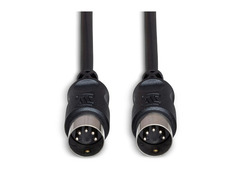








- Affordable option without compromising performance
- Perfect for organizing and decluttering setups
- Provides reliable control for complex MIDI setups
- Short length ideal for compact spaces
- See 4 more
- None
Lengths Available: 1 ft, 3 ft, 5 ft, 10 ft, 15 ft, 20 ft, 25 ft
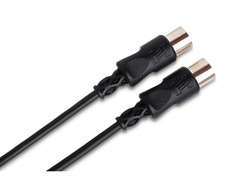
Hosa MIDI cables are some of the most cost-effective, no-frills MIDI cables out there today. Best of all, you can select from several lengths, from 1 foot to 25 feet, to make sure you have just the right amount of cable for your needs.
Hosa has been around since the mid-1980s, and they pretty much only make cables and adapters. Making reliable and inexpensive cables is what they specialize in, which makes us trust them when it comes to MIDI cables. Almost all of us here at Equipboard have Hosa cables and adapters laying around somewhere in our studios.
In terms of stand-out features, these are pretty basic. They are all black, which should match most music studio aesthetics. The 5 pins in the connector are sturdy, which is great because some cheaper budget cables have pins that tend to be more flimsy and bend easily (thus potentially ruining the cable). The plugs are nickel-plated. Connecting this cable into a MIDI port feels good. It doesn’t wiggle too much and we are confident they wouldn’t unexpectedly fall out. We stepped on, pulled, and tugged this cable every which way and it remained functional. It looks to be built well.
Keep in mind these are single cables, meaning that for both a MIDI IN and OUT connection you’ll need two cables. To us that’s not a big deal, since these cables are just about the cheapest cables we could find that still have a very high quality standard.
Bottom Line: Not much to say here - this is very highly reviewed cable that is simple and does its job. It’s also amongst the best sellers on reputable stores like Musician’s Friend and Sweetwater. We like that the brand is trustworthy, and that the cable comes in many different lengths to accommodate whatever studio space you have. Best of all, it’s a very budget-friendly cable! You can’t get a quality MIDI cable for much cheaper than this.
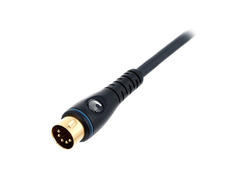
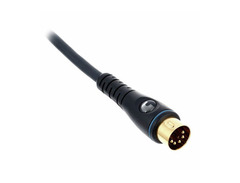
D'Addario MIDI Cable
5.0 (6)

Lengths Available: 5 ft, 10 ft, 20 ft
The D'Addario MIDI cable is a premium option. D’Addario have been in the business of making making very high quality products for musicians for quite some time.
D'Addario MIDI cables are highly reviewed everywhere we look, from Amazon to Musician’s Friend. The molded plugs feel very sturdy and provide a secure connection, and for whatever it's worth they are gold plated. They come in a variety of lengths, and like Monster cables, are covered by a limited lifetime guarantee. In reading through the fine print, it seems like Monster's lifetime warranty might be a little more lenient than D'Addario, but we trust that if your D'Addario MIDI cable stops working, the company will stand by their warranty and make it right.
Bottom Line: Again, a D'Addario MIDI cable will cost you 2-3 times more than a Hosa cable for an equivalent length. Whether that’s worth it to you or not depends on if you value the superior build quality and feel, and value the lifetime guarantee.
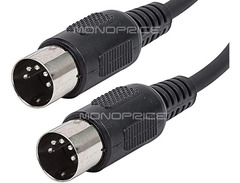
Monoprice MIDI Cable
3.0 (1)

Lengths Available: 3 ft, 10 ft, 15 ft, 20 ft, 25 ft
After Hosa cables, Monoprice MIDI cables are the most popular ones out there. This is largely because Monoprice has the same advantages as Hosa - good quality, no-frills cables at a relatively low cost.
This cable is available in lengths from 3 feet to 25 feet. It’s all-black, and feels pretty durable. We tried our best to put it through some abuse and make the cable malfunction but weren’t able to, which is a testament to their good build quality.
Bottom Line: Unlike Monster and Planet Waves, there’s no lifetime warranty on these, but that’s what you give up to pay such a low price upfront. Both Hosa and Monoprice are reputable brands, and if price is a factor you’ll be glad to have their MIDI cables to choose from. As one reviewer puts it:
Get the cheapest and most reliable cable you can find, and for me this is either Hosa or Monoprice.
Roland MIDI Cable
4.5 (2)

- Black and orange color makes identification easy
- Good cable weight, not cumbersome
- Solid connectors with good grip
- Excellent Roland quality throughout
- See 6 more
- Tie wraps in packaging can damage cable
- Not the highest-end cable available
Lengths Available: 10 ft, 15 ft, 10 ft (dual)
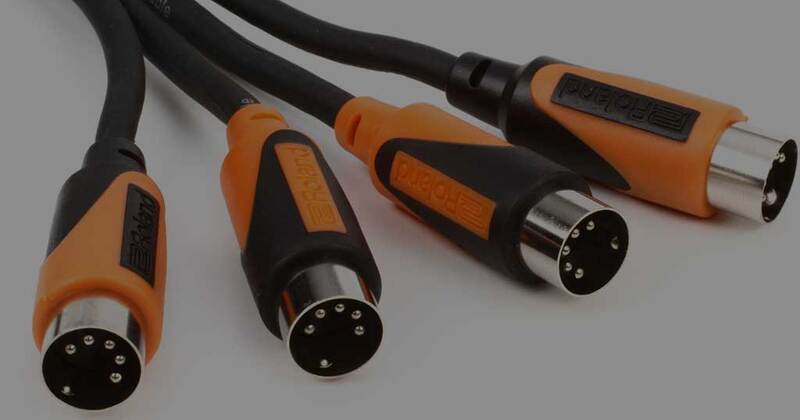
If you’ve been a musician for any length of time, you’ve probably heard of Roland. We were aware they made legendary synths and drum machines, but had no idea they made some fine MIDI cables as well. Roland MIDI cables hit a sweet spot between a budget price tag and quality; in the spectrum they’re in between Hosa/Monoprice and Monster/Planet Waves.
These cables are rock solid when it comes to performance, and they look pretty nice too with their black and orange color scheme. The connector feels very solid and provides a nice and snug connection into a MIDI port.
Bottom Line: Roland’s MIDI cable is a great compromise between an affordable price tag and a premium cable. Best of all, just like Monster and Planet Waves, it comes with a lifetime warranty.
Top Ranked MIDI Cables on Equipboard


About the authors
Michael R. Pierce is the co-founder of Equipboard and a lifelong musician with over 25 years of experience as a guitarist and gear enthusiast. He blends solid music theory chops (thanks to formal training in guitar, piano, and trumpet) with real-world experience, always exploring and experimenting across genres like rock, blues, and hip-hop. Michael launched Equipboard in 2013 after graduating from The University of Texas at Austin, leveraging his unique blend of musical passion, technological acumen, and community building. His current go-to rig features a Fender American Original ‘50s Telecaster, Analogman King of Tone, Strymon Flint, and a Fender ‘57 Custom Champ. Read more
Giulio Chiarenza is the co-founder of Equipboard and a lifelong multi-instrumentalist with a deep passion for music gear. Born in Italy and raised in the U.S., he holds a Computer Science degree from The University of Texas at Austin and blends technical acumen with decades of hands-on experience across guitar, piano, drums, and electronic production. Early in his career, Giulio was signed to a San Francisco-based EDM label, releasing both remixes and original tracks. These days, he helps steer Equipboard’s vision while personally testing and reviewing gear. He's never too far from his go-to guitar: a vintage 1978 Fender Telecaster Custom. Read more
Comments
Sign Up or Log In to add comments

41013
heads up, I use hosa and monoprice.... I recently managed to break a monoprice cable but have never killed a hosa




.webp)