Trey Gunn
Trey Gunn's Gear


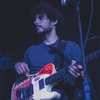
Trey Gunn can be seen in this photo holding an Ashbory Bass.
Find it on:


The Smokey amp by Zlinky. I originally got turned on to this concept by producer David Bottrill (Crimson, Tool, Peter Gabriel). David would mic up the smokey and then feed things from the track to it. Often times he would use it to re-record vocals through. But guitars or percussion, pretty much anything totally changed into something else. And whatever it ended up as always sat in the track in a totally new way. Believe or not, the output of this tiny amp can drive a Marshall cabinet. It isn't loud but it does work. I have had some customized ones made that have different gain structures for the in and outs. I use them in a peculiar way that you can see on the track "Sozzle". Instead of bringing the guitar to the amp to create feedback, I bring the amp to the guitar.
Find it on:

Trey Gunn got a Mini Bicomp in 2012 for playing with The Security Project, playing early Peter Gabriel music with members of Peter's band
Find it on:

Alembic F-2B bass pre-amp. It has tubes in it. I bought this originally to run two sides of the Chapman Stick through it. Hadn't used it for about a decade when I pulled it out to sell three years ago. I actually did sell it, but the guy who bought it had reservations about really wanting it and I had reservations about wishing I had it back. So we did an unsell and I got it back. Now it sits as one of my main ways to bring guitar or bass into Logic Audio. I'm replacing it's tubes this week.
Find it on:

Trey Gunn is listed on Keith McMillen Artists page. He is quoted for using the 12 Step, Soft Step and K-Mix.
Find it on:


Trey Gunn is listed on Keith McMillen Artists page. He is quoted for using the 12 Step, Soft Step and K-Mix.
Find it on:


-m.webp?v=1784818687)
The Electro-Harmonix Microsynth. I love this sound. I just love it. It does the cool thing that guitar players just can not do: sound like a cello. And a fuzzed out crazy cello it we want. I give David Bottrill credit for getting me hooked on this one, too. We were mixing the cd "The Joy of Molybdenum" when some of the master tapes got lost in the mail. Which meant we didn't have enough material to complete the record. While Bob Muller was hunting down the UPS guy, Bottrill, Tony Geballe and I went into "fury" mode and recorded a new track. This became "Brief Encouter". Bob and I had already made the foundation months ago, but the track wasn't completed enough to warrant inclusion on the cd. However now we had no choice. David and I came up with a possible form and Tony laid down the acoustic guitar solo near the beginning. Then David pulled out his Microsynth which he got me to solo on for the ending. I was sold 1000%. It was a totally synthy sound that David didn't put any reverb on. David was like that - he could made an extremely dry sound fit into the mix. I've had one in my rig ever since. And while I must admit that Native Instruments Guitar Rig has a microsynth module that I now use onstage (because it is totally programmable), I still have to keep the analogue one here in my home studio, ready to go.
Find it on:


The Empirical Labs Distressor. Geez, another compressor. But I'm a sucker for colored lights and this unit has a blue LED next to the Nuke button. I can't say anything but YES to that. I began using the Distressor in my King Crimson touring rig. Since the attack of my tapped instrument is so intense on the bass strings, I would put this compressor right at the front. I would set it to 20:1 and sort of soft limit the highest energy notes. If I didn't do this, then I would have to turn down the input on the pre-amps far lower than they liked. Then I would split the signal into a clean line and distorted line. This two would come back together with the Raven Labs 2 channel (yes, I am selling that one) and into a final compressor: the DBX 160. The last compressor turned all the disparities of the two lines back into one big sound. Now I just use the Distressor in my studio for recording bass and guitar and vocals and percussion and harmonium and violins and bagpiges and.....
Find it on:

The Godin Glissentar. I first came across this around 2000 and I had to try it. It is modeled on the oud, which I love the sound of. And I loved the string configuration: Eleven strings in six groups. The top five strings are doubled in unison and the low string is on it's own. I had never played a fretless instrument before and felt a bit dubious about taking it on now. I had heard so many different musicians complaining about fretless bass players that played out of tune. But... screw it, I had to try this guy and ordered one. It wasn't so hard to play in tune at all. OK, I'm sure I am not perfect on it and I can totally hear when I am really out, but it is wonderfully fun to play. I tune it in fifths like a cello so the low string is a C. Oh wait, no it isn't. I tune it down a whole step from that, so the low string is a Bb. That is pretty weird for me, but it works. The thing I like most about it is that it makes me think and hear so much more melodically than any other instrument. Plus it is real ear opener to to hear what a true major 3rd or minor 7th sounds like. You can't do that on a fretted instrument
Find it on:

TC artist page insists that Trey uses the MojoMojo.
Find it on:

TC artist page insists that Trey uses the Dark Matter distortion.
Find it on:

Trey Gunn Signature Series TGSS
14 Degree Tilt-back Headstock: This steeper angle increases sustain and tone. It is a superior design to the non-tilt-back style headstock. It takes more wood and labor to achieve the construction of this type of headstock. Furthermore, it is more difficult to locate the proper quarter-sawn laminates to achieve this design. Though this increases the cost of wood and labor, the resulting quality in tone is noticeable and worth it!
Graphite Neck Reinforcement: Our findings show that an all graphite neck tends to be a bit sterile sounding, lacking the warmth of wood. However, using graphite as a structural reinforcement increases the rigidity of the neck, adding deeper tone while maintaining the warm characteristics of the wood. This design also increases sustain, making it the optimal choice!
Bridge placement on the node: There is a place on the guitar body, that when tapped, you will hear a focused resonant note. This is where we place the bridge on the TGSS model. The advantage to this is, that it further reduces any dead notes, and helps to produce even volume levels from string to string. This results in a larger body design with increased mass. More mass, more tone.
The Drum Theory: The body of the TGSS has been elongated with bridge placement nearer to the center. Imagine a drum. When the drum is struck on the edge, you get a thin drum tone. When it is struck in the center, you get a full drum tone. The same applies to instrument design.
Weighted Tuned Headstock "WTH": We have added a proprietary technology to the construction of the TGSS model headstock. The design consists of a tuned placement of mass contained within the headstock. The result is a fuller, deeper bottom-end, heard on all notes. Furthermore, It helps in producing a more even volume level from string to string.
The Warr "TGSS" series comes with 18-volt active electronics, dual truss rod adjustment, custom designed saddles and bridge plate, Sperzel locking tuners, slider strap, and a soft gig bag.
Many wood choices are included with your Warr Guitar including loosely figured wood tops. 5 to 7 piece laminate neck and an added pin stripe laminate between the top and body core. We do have highly figured or hard to get interesting wood choices for guitar tops at extra cost.
Find it on:

TC artist page insists that Trey uses the Polytune 2.
Find it on:
-m.webp?v=1784818716)
TC artist page insists that Trey uses the Flashback delay.
Find it on:
-m.webp?v=1784804736)
TC artist page insists that Trey uses the Corona chorus.
Find it on:


TC artist page insists that Trey uses the Vortex.
Find it on:

TC artist page insists that Trey uses the G-force.
Find it on:

Trey Gunn is listed on Keith McMillen Artists page. He is quoted for using the 12 Step, Soft Step and K-Mix.
Find it on:

"Trey Gunn uses the Phil Jones Briefcase Ultimate 150-Watt Combo Bass Amp for his Warr guitar with Jason Everett's Deep Energy Orchestra."
Find it on:

Trey Gunn is shown using the Neural DSP Quad Cortex during a Security Project performance in Portland, as seen in a photo on Facebook.
Find it on:

Trey Gunn is an early adopter of Gig Performer. There are lots of images and YouTube videos supplying this fact. I'll list here some of the videos.
Backstage with Gig Performer show with Trey Gunn Link: https://www.youtube.com/watch?v=kX22s8VwAcA
Trey Gunn's YouTube channel Link: https://www.youtube.com/watch?v=tjLshcwCCjc
Other videos across YouTube, e.g. Link: https://youtu.be/Uorh9X4FVBM?si=fhXahaLv7dXyPzUA&t=470
Lots of photos can be found here: Link: https://community.gigperformer.com/t/trey-gunn-and-gig-performer/7557
Find it on:

Listed on the official Lovetone "Clients" page.
Trey Gunn (King Crimson) MB
Find it on:
This is a community-built gear list for Trey Gunn.
- Find relevant music gear like Guitars, Amplifiers, Effects Pedals, Bass Guitars, and other instruments and add it to Trey Gunn.
- The best places to look for gear usage are typically on the artist's social media, YouTube, live performance images, and interviews.
- To receive email updates when Trey Gunn is seen with new gear, follow the artist.
Discography