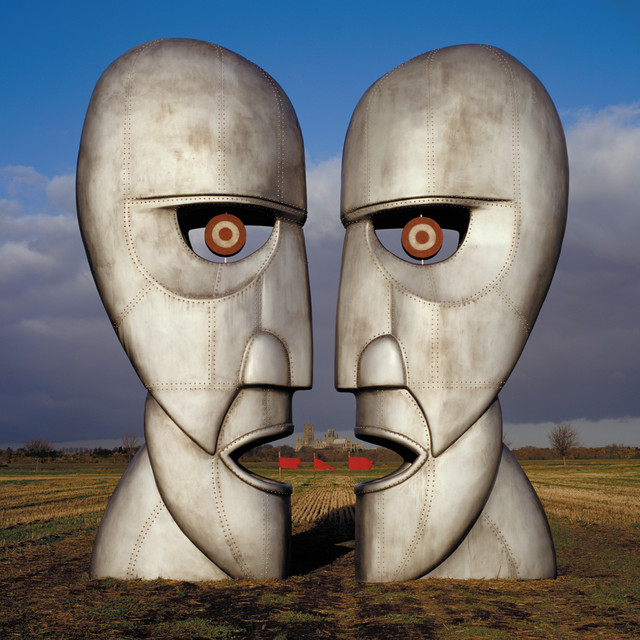
Pink Floyd – The Division Bell
The music gear and equipment used by the artists, producers, engineers, and more involved in the making of the 1994 album The Division Bell.
Music from The Division Bell
Artists on The Division Bell


Gear Used On The Division Bell
Explore the instruments, equipment, software, and production tools used in the making of Pink Floyd – The Division Bell (1994). Click more on each item to see exactly how it was used.

David Gilmour
Roles:
Effects Pedals used by David Gilmour on The Division Bell

Avg price: $276.24
This replaced David's Coloursound Powerboost overdrive around the 80's. Two of these are part of his Momentary and Division bell setup in 1993 and 1994, and are still used in his solo shows.
(The source lists these as Chandler Tube Drivers.) Photo of David Gilmour's pedalboard with both Tube Drivers: http://www.kitrae.net/music/Division%20Bell%20pedals_enhanced.jpg
"I currently have two BK Butler Tube Drivers on my pedalboard, and I just use one or the other. If I need a little something more, I’ll stomp a compressor with a bit of drive onto the beginning of it, and that will turn things up another whole gear." - Guitar Player interview.


Boss CS-2 Compression Sustainer
Avg price: $93.83
Used in the Momentary Lapse of Reason Tour and the Division Bell tour alongside the MXR Dynacomp. (http://www.kitrae.net/music/David_Gilmour_Tone_Building.html#ToneBuildingPulse http://www.gilmourish.com/?page_id=156)
"Additional pedals include a Boss CS-2 Sustainer, MXR Dyna Comp, Iba- nez CP9 Compressor-Limiter, Boss Hyperfuzz, Electro-Harmonix Big Muff, two Chandler Industries Tube Drivers and three Boss Graphic Equalizers. He also operates several master volume pedals: one for his 4x12 cabinets, another one for his rotating speakers, another for his voice box and a speed control for the doppolas." - Phil Taylor, David Gilmour's guitar tech.
"After extensive tests David decided on the following list of effects to be incorporated: Boss CS-2; Pete Cornish G-2 Fuzz; EH Big Muff; Pete Cornish Soft Sustain-2; Chandler Tube Driver; Pete Cornish Tape Echo Simulator; Pete Cornish Custom Stereo Chorus using a modified Boss CE-2." - from Pete Cornish website


Harmonizer & Octave Effects Pedals

Avg price: $213.79
David Gilmour has used the pitch shift Digitech Whammy since early 90s recording the Grammy-winning song Marooned from the Division Bell album. In his solo album On An Island and in the recently Pink Floyd last album Endless River, he stills uses the same pedal. Of course, he always gets the best from every effect he uses and the Whammy isn't the exception.

Avg price: $111.42
David Gilmour used an Ernie Ball Volume Pedal, which was modified with a 10K pot to reduce high-end loss, during The Division Bell Tour and The Pulse. This information is supported by Kit Rae's detailed analysis in "David Gilmour Tone Building" on Kitrae's website.
-m.webp?v=1784732298)
Avg price: $650.00
David Gilmour used the Univox U-1095 Super-Fuzz during the 1993 recording sessions at Olympic Studios, as documented by Bjorn on Gilmourish, a comprehensive resource on Gilmour's tone.

Ibanez TS10 Tube Screamer Classic
Avg price: $326.62
David Gilmour used the Ibanez TS10 Tube Screamer Classic during the 1993 recording sessions at Olympic Studios, as detailed by Bjorn on Gilmourish, a comprehensive resource for David Gilmour's tone.

Tube Works 903 Blue Tube Enhancer
Avg price: $125.00
David Gilmour used the Tube Works 903 Blue Tube Enhancer during the 1993 recording sessions at Olympic Studios, as documented by Bjorn on Gilmourish, a leading resource on Gilmour's tone.
-m.webp?v=1784991638)
Tube Works 901 Real Tube Overdrive
Avg price: $185.16
David Gilmour used the Tube Works 901 Real Tube Overdrive during the 1993 recording sessions at Olympic Studios, as documented by Bjorn on Gilmourish, the largest David Gilmour tone resource on the net.

Avg price: $291.79
David Gilmour used the Boss BF-1 Flanger during the 1993 recording sessions at Olympic Studios, as confirmed by Bjorn on Gilmourish, the largest David Gilmour tone resource on the net.

Avg price: $407.36
David Gilmour used the Roland AP-7 Jet Phaser during the 1993 recording sessions at Olympic Studios, as confirmed by Bjorn on Gilmourish, a prominent resource for information on Gilmour's guitar tone.

Demeter Amplification TRM-1 Tremulator
Avg price: $210.00
David Gilmour used the Demeter Amplification TRM-1 Tremulator during the 1993 recording sessions at Olympic Studios, as confirmed by Bjorn on Gilmourish, the largest David Gilmour tone resource on the net.
Other Gear used by David Gilmour on The Division Bell

Avg price: $134.73
Gilmour used EMG SA single coils on his Red Strat during the Division Bell era of Pink Floyd, usually with a EXG and SPC connected to them.

Music Accessories used by David Gilmour on The Division Bell

Avg price: $99.95
David Gilmour talks about it in an interview with Guitar World Magazine. It appeared on "Take It Back" and "Keep Talking" from the album "The Division Bell."
"Are you using an E-bow on "Take It Back"? Yeah! On a Gibson J-200 acoustic guitar that is processed through a Zoom effects box, then directly injected into the board. That' s a pretty bizarre configuration. Well, I guess I experiment more than I think I do! I had a Zoom in my control room one day and I was mucking about with something. Suddenly, I thought I should stick the E-bow on the strings and see what would happen. It sounded great, so we started writing a little duet for the E-bowed acoustic guitar and a keyboard. We never finished the piece, but [keyboardist] Jon Carin decided to sample the E-bowed guitar part. We kept the sample and ended up using it as a loop on "Take It Back," and again on "Keep Talking."
Microphones used by David Gilmour on The Division Bell

Avg price: $3,499.99
Two were used on Gilmour's Yamaha RA-200R for The Endless River, as is visible in this photo from this February 10, 2015 Music Radar interview with guitar tech Phil Taylor about the contents of Astoria and Medina.
Left to right: 1958 FENDER Tweed Twin, 1976 Yamaha RA200 Rotary speaker with Alembic preamp, 1970s Hiwatt SA212, Alessandro Redbone Special, Leslie Model G27 cab
“These were David’s main amps on The Endless River,” comments Phil Taylor on the beautiful array of vintage and modern amps in the studio’s live room. “He also used the Leslie Studio 12 cab with the Allesandro Redbone Special 55-watt model.”
Taylor also mentioned a single KM 86 being used on The Division Bell for the same purpose in this September 1994 Guitar World interview by Brad Tolinski, one of a trio from the same issue.
GW: What about microphones?
PT: It varies, but primarily Neumann U-87's and Shure SM-57's. We've also used a Neumann KM-86 on his rotating speaker.
Guitars used by David Gilmour on The Division Bell

Gretsch 6121 Chet Atkins (1957 Model)
David Gilmour scholar Bjørn Riis notes that the 6121 was used during the 1993 sessions for The Division Bell, particularly for the track that would become "Nervana" from The Endless River, featuring photographic evidence.
David employed a number of guitars for the 1993 Division Bell/Endless River sessions. Here at the Olympic Studios playing a Gretsch 6121 during Nervana and a ’52 Telecaster for Allons-y.
In 2019, Gilmour's 6121 was auctioned off for $175,000 as part of Christie's The David Gilmour Guitar Collection auction. The item description confirms its use during the recording of The Division Bell and The Endless River, particularly for "Nervana".
THE FRED GRETSCH MANUFACTURING COMPANY, BROOKLYN, 1957 A SOLID-BODY ELECTRIC GUITAR, CHET ATKINS, 6121 Inlaid at the headstock with the logo Gretsch and applied at the pickguard, along with Chet Atkins, the control cavity cover inscribed 23490, with original hardshell case bearing a label inscribed GRETSCH 6121 ORANGE - CHET ATKINS #23490 SERIAL NO. DG1067; accompanied by the original sales invoice from Gruhn Guitars, Inc. to Pink Floyd, dated 26th June 1978, a letter from Dave Gilman to Pink Floyd, dated 27th June 1978, confirming that the instrument had been placed on hold, a facsimile air waybill addressed to Pink Floyd, dated 11th July 1978, a shipping invoice from Dacair Service Limited to Britannia Row Leasing Ltd., dated 27th July 1978, a handwritten note on a Pink Floyd headed compliments slip reading Dear Vic, Please find enclosed the invoices for the two guitars that should be arriving shortly, Phil, a facsimile repair receipt from Charlie Chandler’s Guitars, Middlesex to David Gilmour Music Ltd., dated 27th July 2009, a handwritten note to David Gilmour by guitar technician Phil Taylor on a sheet of Astoria headed notepaper outlining the repair and modification work performed on the guitar, and a color screenshot of David Gilmour playing this guitar at Olympic Studios, London, circa July 1993 [not illustrated] Length of back 17 7/8 in. (45.3 cm.)
The 6121 is the solid-body companion to Gretsch’s famous hollow-body guitar the 6120 Chet Atkins (lot 40). Purchased by David Gilmour from Gruhn Guitars, Nashville, Tennessee, in June 1978, the guitar has seen a good deal of studio use, notably during recording sessions for Pink Floyd’s 1994 album The Division Bell at Gilmour’s Astoria houseboat studio and Olympic Studios, London, circa July 1993. Between 2013 and 2014, material from the 1993 recording sessions for The Division Bell was revisited and reworked with 21st Century digital technology and supplemented with new material for the last Pink Floyd album The Endless River. Studio footage exists of Gilmour playing the 6121 during a 1993 jam session at Olympic that would become the instrumental Nervana, the third and final bonus track on the deluxe edition of The Endless River. Following a distorted intro, Gilmour plays a heavy metal riff and ends with a two-minute solo on the Gretsch 6121. Released in November 2014 as a tribute to keyboardist Richard Wright, who had passed away in 2008, the predominantly instrumental album debuted at number one in the UK, France, Germany, Portugal, Ireland, the Netherlands, Belgium, New Zealand, and Canada.
Amplifiers used by David Gilmour on The Division Bell

Used for The Division Bell and The Endless River, as reported by Gilmourish. The Rover was the basis for Gilmour’s Doppolas speakers, which replaced it on tour.
The Doppolas
David had been using a Maestro Rover rotating speaker on the Division Bell sessions and this inspired Phil Taylor and Paul Leader to design the Doppola speakers that featured on the 1994 tour. These were custom built rotating cabinets with two 6″ 100W speakers in each powered by – and running in conjunction with – the Hiwatts. Leslie cabinets or the old Yamahas might have seemed the obvious choice, but Gilmour was after a slightly different sound and something a bit lighter to carry around.
The Maestro Rover
The Maestro Rover rotating speaker is a small rotating cabinet mounted on a stand, featuring a 6″ 35w speaker and controls for volume, speed and a foot control for switching the unit on/off. The Rover was reportedly employed by David during the Dark Side of the Moon recording sessions in 1972, although no footage can confirm this.
The Rover was featured in David’s 1993 setup for the Division Bell and Endless River recording sessions. The rig consisted of a duplicate combination of Fender Bassmans and Hiwatt SA212 amps, with the Rover standing on top mic’ed for stereo.
.jpeg?v=1784656821)
Richard Wright
Roles:
Keyboards and Synthesizers used by Richard Wright on The Division Bell

Avg price: $290.99
Another instrument used by Wright since A Momentary Lapse, It was one of the keyboards more used into the Division Bell Sessions