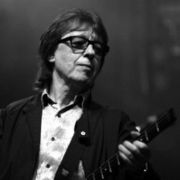
Bill Wyman
Role
Role
Bill Wyman's Gear

-m.webp?v=1784645891)
Wyman can be seen in this photo tuning up his Fender Mustang Bass.
Find it on:





This was the Japanese Bass that Bill Wyman transformed into a fretless. He used this in their very early gigs in 1963. He last used it to mime The Last Time in the Top of the Pops. https://youtu.be/27ouOE4RvUc
Find it on:


This photo shows Wyman with a Vox Teardrop Bass.
Find it on:

Wyman can be seen playing a Bass Centre Wyman Bass in this photo.
Find it on:

Bill nicknamed this bass "Humbug" because he thought the finish resembled a British striped candy by that name.
Find it on:

Bill used them for years starting in 1969 when the whole band used the first 5 made, he used them at least throughout the 70's with The Rolling Stones. I'm surprised no one here has put this in yet as he is much more well known for SVTs than anything else. I have posted a picture from their 1969 U.S. tour where they all used them, Bill is on the other side of the stage but they all used them throughout this whole tour. They used them on Their Get Yer Ya Ya's out Madison Square Garden live album from 1969 and also they used them at Altamont in 1969. If you have the Get Yer Ya Ya's album look on the back, it says amplification by Ampeg and you are listening to all SVTs, including the guitars. The Voodoo Guitar site I got the picture from has several stage shots with them using Ampeg SVTs. The whole story of the Stones and their SVTs is at this link:
http://www.voodooguitar.net/2016/09/american-muscle-ampeg-svt.html
Find it on:

In this video Bill Wyman is seen playing a violin bass made by vox in the rock n roll circus.
Find it on:

Bill Wyman had several custom short-scale Travis Bean TB2000 bass guitars made for him, as shown in a Getty Images photo of The Rolling Stones.
Find it on:

Bill Wyman needed a higher quality bass guitar as opposed to his Japanese homemade one. He used this extensively, since it fit his short-scale stature, from 1963 to 1965 and predominantly in 1964.
Find it on:

By the mid to late 1970's Bill had migrated from the heavier acrylic bass to the Dan Armstrong 'London' series bass. Here he can be seen playing a 342 short scale bass. Notice the newer type body styling - though with the words 'London' still on the headstock.
Find it on:

Much to Keith's dismay he played this most uncool looking thing for the '81/'82 tour. They have a good sound. He stuck with Steinbergers, but changed model
Find it on:

In the YouTube video titled "THE ROLLING STONES/Shake Your Hips," Bill Wyman is seen performing with his Ampeg Dan Armstrong Plexi Electric Guitar. This guitar was a staple in live concerts during the 1970s, often used alongside Keith Richards' Armstrong guitar.
Find it on:

In this photo from 1964 we can see Bill playing his bass guitar into a Vox AC-100.
Find it on:

In this live performance in late 1964, Bill is seen playing into a Vox Foundation Bass Speaker Cabinet.
Find it on:

Used on "Brown Sugar", as stated by mix engineer Jimmy Johnson in this September 21, 2018 ProSoundWeb interview.
And guess what we came up with for Bill Wyman? Do you remember those Plexiglas body basses that were around then?
I checked with David Hood later and he says it was a Dan Armstrong. So to the best of our recollection, that’s what it was. He played through David’s Fender Bassman setup, the tube head and separate box.
(...) Did you have a mic on the bass amp?
Yes, the bass guitar mic was an RCA 44. We didn’t have direct back in those days.
An image of Hood's Bassman rig, taken from this March 1, 2019 al.com interview, reveals that it was an AB165.
That said, the bass amplifier rig Hood used for his classic Muscle Shoals Sound Studios work is a Fender Bassman amp head and blonde Fender speaker cabinet.
In 2016, Muscle Shoals Sound reopened at original Sheffield location 3614 Jackson Hwy. and restored to retro ’60s/'70s prime. Hood’s rig was returned to the same spot it was during many vintage sessions. Against the studio wall, just left of the drum booth.
Hood thinks he acquired the Fender head and cabinet in the mid to late '60s.
"My father was in the tire business and got hooked up with a purchasing-agent-type place who would connect you with people to buy things wholesale," Hood says. "They hooked us up with Manny's Music in New York, on 48th Street. It's no longer there, but it was a famous music store. I would call and order things from them. I could hardly talk to them because they spoke so fast, but I started buying amps and would sell them to somebody and buy another one, things like that."
(...) From Manny’s, Hood purchased the blonde cab, containing two 12-inch speakers, originally to use as an extension cabinet with the bass amp he was using. He ended up selling that amp. Now he had an extra cabinet. He then purchased a black Tolex-covered Bassman piggyback amp. “And I can’t remember why I did it, but I brought the blonde cabinet to 3614 (Jackson Hwy.) and we started recording that and using the black Bassman head with it, to monitor myself. Sometimes they’d mic it and sometimes we’d go direct. But I used it always as a monitor. In a studio full of loud guitars and keyboards and everything, you just can’t hear the bass well, even with the headphones. It’s getting where nowadays they have so many channels on the recording stuff they can use several channels for a bass. A long time ago you were lucky if you’d get one channel.”
Find it on:


A 6G6 cabinet was used on "Brown Sugar", as stated by mix engineer Jimmy Johnson in this September 21, 2018 ProSoundWeb interview.
And guess what we came up with for Bill Wyman? Do you remember those Plexiglas body basses that were around then?
I checked with David Hood later and he says it was a Dan Armstrong. So to the best of our recollection, that’s what it was. He played through David’s Fender Bassman setup, the tube head and separate box.
(...) Did you have a mic on the bass amp?
Yes, the bass guitar mic was an RCA 44. We didn’t have direct back in those days.
An image of Hood's Bassman rig, taken from this March 1, 2019 al.com interview, reveals a blonde 6G6 cabinet as part of the stack.
That said, the bass amplifier rig Hood used for his classic Muscle Shoals Sound Studios work is a Fender Bassman amp head and blonde Fender speaker cabinet.
In 2016, Muscle Shoals Sound reopened at original Sheffield location 3614 Jackson Hwy. and restored to retro ’60s/'70s prime. Hood’s rig was returned to the same spot it was during many vintage sessions. Against the studio wall, just left of the drum booth.
Hood thinks he acquired the Fender head and cabinet in the mid to late '60s.
"My father was in the tire business and got hooked up with a purchasing-agent-type place who would connect you with people to buy things wholesale," Hood says. "They hooked us up with Manny's Music in New York, on 48th Street. It's no longer there, but it was a famous music store. I would call and order things from them. I could hardly talk to them because they spoke so fast, but I started buying amps and would sell them to somebody and buy another one, things like that."
(...) From Manny’s, Hood purchased the blonde cab, containing two 12-inch speakers, originally to use as an extension cabinet with the bass amp he was using. He ended up selling that amp. Now he had an extra cabinet. He then purchased a black Tolex-covered Bassman piggyback amp. “And I can’t remember why I did it, but I brought the blonde cabinet to 3614 (Jackson Hwy.) and we started recording that and using the black Bassman head with it, to monitor myself. Sometimes they’d mic it and sometimes we’d go direct. But I used it always as a monitor. In a studio full of loud guitars and keyboards and everything, you just can’t hear the bass well, even with the headphones. It’s getting where nowadays they have so many channels on the recording stuff they can use several channels for a bass. A long time ago you were lucky if you’d get one channel.”
Find it on:

Used for "Brown Sugar", as stated by mix engineer Jimmy Johnson in this September 21, 2018 ProSoundWeb interview.
(...) Did you have a mic on the bass amp?
Yes, the bass guitar mic was an RCA 44. We didn’t have direct back in those days.
Find it on:

A small box head is visible in this May 17, 1964 photo, as documented by this page from a website dedicated to the Vox AC-50.
Above, a detail from a picture of the Stones on stage, Folkestone, 17th May, 1964. Bill Wyman has a new thick-edged small-box AC50, perhaps consigned to him by JMI earlier in the month, or perhaps even in April '64.
Find it on:

Used for the bass amp on Beggars Banquet, as stated in The Rolling Stones All the Songs: The Story Behind Every Track by Philippe Margotin & Jean-Michel Guesdon.
Technical Details
In the spring of 1968, Olympic Sound Studios acquired an Ampex eight-track, which represented a technological revolution at the time. Glyn Johns and Eddie Kramer shared the position of sound engineer, with Phill Brown, who went on to have a prestigious career recording with Jimi Hendrix, David Bowie, Led Zeppelin, Roxy Music, and many others, as assistant engineer. The main mic employed was Neumann U67, although the AKG C12A was used for the bass amp and the Hammond organ, and the AKG D12 for the bass drum and the Hammond. In addition to the Neumann U67, it seems that an AKG D224 and a Shure SM57 were used for Mick's voice. Reverb was provided by an EMT Echo Plate, and Tannoy/Lockwood monitors were used.
Find it on:

In a user-uploaded photo, Bill Wyman is seen holding a 1974 Prototype Ampeg Dan Armstrong Bass with a Cherry Finish.
Find it on:

Bill Wyman can be seen playing the Höfner 500/1 Bass in this post. According to the information on this link, he performed at Peter Seller's House in 1976.(https://sfae.com/Artists/Terry-O-Neill/Bill-Wyman-Ronnie-Wood-and-David-Bowie-at-Peter-Se). It is unknown whether he used the bass elsewhere.
Find it on:

"This is a special, one-of-a-kind bass built for Wyman in a short scale by arrangement through Alan Rogan. Steinberger L-Series basses were all built with 24 frets. Wyman's custom Steinberger has only 22 frets by eliminating the last two frets. (Partially omitted) The bass has the cap from a Bic pen affixed to the top of the bass where the headstock would be so that Bill could place a cigarette there while playing on stage. With custom road case and guitar strap from the Rolling Stones 1981 American Tour in support of their album Tattoo You. Bill also used this bass onstage with the Rolling Stones during the 1982 European tour and during the 1988 A.I.M.S. charity concert held at the Royal Albert Hall. The bass was also photographed backstage leaning up against a Stones road case during the 1982 tour."
Find it on:
-m.webp?v=1784335172)
"This is a very rare instrument, as only about 200 were ever made. Bill used a Staccato bass in the music video for the Rolling Stones single "One Hit (To the Body).""
Find it on:

"Recording engineer Chris Potter, who worked on the Steel Wheels LP, described the Rolling Stones studio gear, remembering a new Wal MIDI bass that Wyman had for the sessions: "On 'Almost Hear You Sigh,' Bill used his Wal bass with a combination of DI and FET 47 mikes in front of a small Ampeg B15 Porta-flex bass amplifier placed in the stall next to Charlie [Watts]; this typified his setup for the duration of the session." This bass was also on the road for the Rolling Stones 1989-1990 tour."
Find it on:

Bill Wyman is in the promotional photos for the Yamaha BB3000. According to a post on Yamaha's Instagram, he used the bass in Bill Wyman's Rhythm Kings. The URL for Yamaha's post is here: https://www.instagram.com/p/DFpPD0myun2/?img_index=1&igsh=MXh6bXN5bTZtazM2ZA==
Find it on:
This is a community-built gear list for Bill Wyman.
- Find relevant music gear like Bass Guitars, Amplifiers, Effects Pedals, and other instruments and add it to Bill Wyman.
- The best places to look for gear usage are typically on the artist's social media, YouTube, live performance images, and interviews.
- To receive email updates when Bill Wyman is seen with new gear, follow the artist.
Discography
.jpg?v=1784640199)