
Pricing and availability
We compare 600+ stores and found this item at 3 stores. Prices updated .
Store
Reviews
Price




Average Price: $1,019
High-end/Boutique
$299
$700+
Price Tier
Budget
Standard
High-end
Price History
Based on price data from 1 merchant for "Shure ULXD4=-X52". Prices shown reflect NEW condition. Tracking began Apr 22, 2026.
* Product prices and availability are updated by Equipboard every 24hrs and are subject to change. Equipboard may receive compensation for purchases made at participating retailers linked on this site. This compensation does not affect what products or prices are displayed, or the order of prices listed. For more information, please refer to our affiliate disclosure.
Description
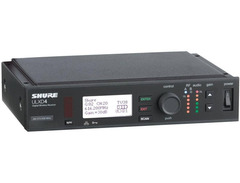
Introducing the Shure ULXD4=-X52, a powerhouse in the world of wireless digital audio. Perfect for both large live venues and intricate A/V installations, this single-channel digital receiver from Shure's ULX-D series is designed to deliver rock-solid RF signal stability and pristine audio quality. The ULXD4=-X52’s 24-bit/48 kHz digital audio ensures every note, word, and sound is captured with unparalleled clarity across an extensive range of frequencies.
Operating within the UHF band, it employs Digital Predictive Switching Diversity to expertly prevent interference and dropouts. Whether you're in Standard mode, managing up to 17 channels per 6 MHz TV channel, or pushing the limits in High-Density mode with 47 channels, this system adapts to your needs. Security is also at the forefront with AES-256 encryption, keeping your audio transmissions secure.
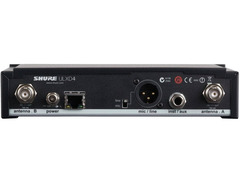
The ULXD4=-X52 is user-friendly with its large LCD screen, intuitive controls, and audio/RF meters, making adjustments a breeze, even in low light. You can manage gain with precision, thanks to 60 dB of independently adjustable gain and optimize frequencies with automatic scanning. For seamless integration, the Ethernet port allows networking multiple receivers, all manageable through Shure's Wireless Workbench software or the Channels Mobile App for iOS.
Key Features:
- 24-bit/48 kHz digital audio for clear sound reproduction
- Operates in the 902 to 928 MHz UHF band
- Digital Predictive Switching Diversity for interference protection
- AES-256 encryption for secure audio transmission
- Up to 60 dB of independently adjustable gain
- XLR and 1/4" outputs with audio and RF meters
- Ethernet networking for easy system management
- Compatible with Shure's Wireless Workbench and Channels Mobile App
- Includes hardware mounting kit and various antennas and cables
Product specs
| Brand | Shure |
| Model | ULXD4=-X52 |
| Year | 2010s |
FAQs
-
What frequency band does the Shure ULXD4=-X52 operate on?
-
The Shure ULXD4=-X52 operates in the X52 frequency band, which ranges from 902 to 928 MHz, making it suitable for use in environments where other frequencies might be congested.
-
Does the Shure ULXD4=-X52 support multiple transmitters?
-
The Shure ULXD4=-X52 is a single-channel digital wireless receiver, meaning it is designed to work with one transmitter at a time per receiver unit.
-
Is the Shure ULXD4=-X52 suitable for professional live performances?
-
Yes, the Shure ULXD4=-X52 offers high-quality digital audio and robust RF performance, making it well-suited for professional live performances and events.
-
What are the RF power levels available on the Shure ULXD4=-X52?
-
The Shure ULXD4=-X52 supports three RF power levels: 1mW, 10mW, and 20mW, allowing flexibility in various RF environments.
-
Does the Shure ULXD4=-X52 require a license to operate?
-
Most users do not need a license to operate the Shure ULXD4=-X52 wireless microphone system, but it's important to check local regulations regarding wireless frequency usage.


Reviews
Owner Insights
We analyzed real musician discussions from forums and Reddit to find what players love, question, and tweak about Shure ULXD4=-X52.
Features and functionality
-
ULX-D offers High Density mode, encryption, and Dante support; these are not available in QLX-D but enhance scalability for larger setups.
Source -
QLX-D handhelds have a "power lock" feature, while ULX-D adds a "mute mode" option, providing additional control for live applications.
Source -
ULX-D's support for Wireless Workbench offers valuable frequency scanning and management tools, essential for troubleshooting in complex RF environments.
Source
Comparisons
-
While QLX-D and ULX-D share the same audio/RF hardware, Axient offers lower latency and features like quadversity, enhancing performance in RF-dense environments.
Source
User experience
-
Owners confirm that QLX-D and ULX-D transmitters and receivers are compatible with each other if on the same frequency band, though advanced ULX-D features are not supported.
Source -
Despite potential for higher channel counts, QLX-D is recommended for smaller deployments due to limited features like absence of Dante and High Density mode.
Source -
Users report signal artifacting when RF signals rapidly switch between antennas, suggesting potential setup or positioning issues.
Source
Use cases and applications
-
In high channel count environments, ULX-D is favored for its scalability and reliable performance, especially with Dante integration for seamless audio routing.
Source -
Interference may originate from unexpected sources like LED walls or neon lighting; even familiar environments can present new challenges over time.
Source
Value and pricing
-
The ULX-D system is considered a high-value investment due to its performance and features at its price point, making it a preferred choice over Axient for some users.
Source
Setup and maintenance
-
Ensure antennas are connected to correct BNCs and bias is enabled for active antennas to prevent artifacting issues.
Source -
Antennas should be oriented at 90 degrees relative to each other; when using paddles, aim for 45 degrees off the back for optimal reception.
Source -
Ensure antennas match the receiver's frequency band to avoid interference; mismatched bands can still receive audio but may cause interference issues.
Source -
Excessive gain on antenna systems can worsen interference; inline attenuators can help manage gain effectively, particularly in RF-dense environments.
Source
Based on 0 Reviews and 0 Ratings
More Shure Wireless Microphones

$241.00 - $399.95
in Wireless Microphones Rank


$186.00 - $329.00
in Wireless Microphones Rank


$521.68 - $659.00
in Wireless Microphones Rank


$299.00 - $348.00
in Wireless Microphones Rank


$269.00 - $811.25
in Wireless Microphones Rank


$175.00 - $209.00
in Wireless Microphones Rank


$455.00 - $509.00
in Wireless Microphones Rank


$7,873.00
in Wireless Microphones Rank


$299.00 - $329.00
in Wireless Microphones Rank


$929.00 - $955.05
in Wireless Microphones Rank

$449.00 - $729.00
in Wireless Microphones Rank

$1,421.00
in Wireless Microphones Rank

.jpg?v=1783082401)


$1,089.00
in Wireless Microphones Rank


$690.00 - $849.00
in Wireless Microphones Rank


$239.00 - $263.00
in Wireless Microphones Rank

$311.00 - $323.00
in Wireless Microphones Rank

$405.00 - $699.00
in Wireless Microphones Rank

$125.99 - $164.00
in Wireless Microphones Rank

$668.83 - $725.00
in Wireless Microphones Rank

$639.00 - $699.00
in Wireless Microphones Rank

$316.38 - $329.00
in Wireless Microphones Rank

$589.00
in Wireless Microphones Rank

$429.00 - $459.00
in Wireless Microphones Rank

$349.00 - $389.00
in Wireless Microphones Rank

$49.00 - $82.00
in Wireless Microphones Rank


$315.65 - $329.00
in Wireless Microphones Rank

$629.00 - $689.00
in Wireless Microphones Rank

$689.00 - $699.99
in Wireless Microphones Rank

$99.00 - $169.00
in Wireless Microphones Rank


$150.00 - $186.00
in Wireless Microphones Rank

$659.00
in Wireless Microphones Rank

$307.00 - $425.00
in Wireless Microphones Rank


$329.00 - $359.00
in Wireless Microphones Rank

$429.00
in Wireless Microphones Rank

$411.31 - $429.00
in Wireless Microphones Rank

Artist usage


Community setups


Similar


Gear Guides






Most Popular Wireless Microphones
Most Popular Brands
-
Added to Equipboard on by
 equipboard
Gear IQ 4934
-