-s.webp?v=1784818849)

-xl.webp?v=1784818849)
Pricing and availability
We compare 600+ stores and found this item at 1 store. Prices updated .
Store
Reviews
Price




Average Price: $160
Standard/Professional
$100
$301+
Price Tier
Budget
Standard
High-end
* Product prices and availability are updated by Equipboard every 24hrs and are subject to change. Equipboard may receive compensation for purchases made at participating retailers linked on this site. This compensation does not affect what products or prices are displayed, or the order of prices listed. For more information, please refer to our affiliate disclosure.
Description
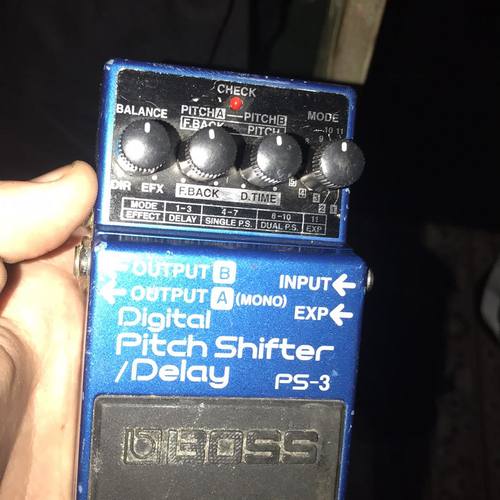
Introducing the Boss PS-3 Pitch Shifter/Delay, a compact yet potent addition to your pedalboard. This remarkable pedal houses two distinct capabilities within its durable casing: a versatile pitch shifter and a malleable delay. Boasting seven pitch settings with a 26-step pitch shifting range, it offers an extensive sonic palette for your creative exploration. The PS-3 also provides three delay modes, with the ability to reach up to two full seconds of delay time. Its blend of shift and delay effects is easily customizable, encouraging tweaking and experimentation. Whether you're into garage rock, psychedelia, or grunge, this pedal is designed to cater to a wide array of musical styles.
Key Features:
- Seven pitch settings with 26 steps of pitch shifting
- Three delay modes with up to two full seconds of delay time
- Combined pitch shift and delay functionalities
- Encourages user experimentation for unique soundscapes
- Ideal for a variety of musical genres from garage to grunge.
Product specs
| Brand | Boss |
| Model | PS-3 Digital Pitch Shifter/Delay (Pink or Dark Gray Label) |
| Finish | Blue |
| Year | 1994 - 1999 |
| Made In | Taiwan |
| Categories | Delay Pedals, Octave and Pitch-Shifting Pedals |
FAQs
-
What are the main functions of the Boss PS-3 Pitch Shifter/Delay pedal?
-
The Boss PS-3 combines pitch shifting and delay effects, allowing you to create harmonies and layered sounds. It offers multiple modes for pitch shifting, delay, and a combination of both, making it versatile for creative soundscaping.
-
Can the Boss PS-3 be used with a bass guitar?
-
Yes, the Boss PS-3 can be used with a bass guitar, providing pitch shifting and delay effects that can enhance your bass lines with harmonies or rhythmic delays.
-
What type of power supply does the Boss PS-3 require?
-
The Boss PS-3 requires a 9V DC power supply, such as the Boss PSA adapter, or it can be powered by a 9V battery for portable use.
-
How does the Boss PS-3 differ from other pitch shifter pedals?
-
The Boss PS-3 offers a unique combination of pitch shifting and delay effects, with multiple modes to blend both effects seamlessly. Its ability to create complex harmonies and layered soundscapes sets it apart from standard pitch shifters.
-
Is the Boss PS-3 suitable for live performances?
-
Yes, the Boss PS-3 is well-suited for live performances, offering reliable pitch shifting and delay effects in a compact pedal form. Its intuitive controls make it easy to adjust settings on the fly during gigs.
Videos

Brian Lynch
Boss PS3 Pitch Shifter / Delay
Boss PS3 Pitch Shifter / Delay
Brian Lynch
Boss PS-3 - Pitch Shifter / Delay Demo

GuitarWithGabe
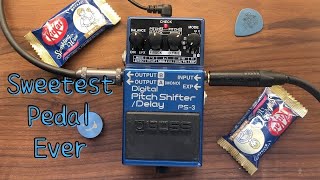
Weirdest BOSS pedal ever? - BOSS PS-3 Pitch Shifter/Delay | A Journey Through Sound (Stereo)

wazu

Video Manual: Boss PS-3 Pitch Shifter/Delay

Pedal Experiments
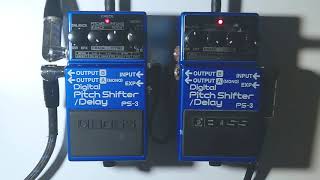
Boss PS-3 Pitch Shifter / Delay demo (single and dual / stereo)

Depotgear
Boss PS-3 Pitch Shifter Delay

Noise Merchants
Boss PS-3 Pitch Shifter / Delay

Filth & Echoes
Reviews
PROS
-
Offers lush chorus tones and versatile delay options
-
Unique pitch-shifting with tuneable specific notes and speed changes
-
Features like cascading pitch-shifted trails and glitchy sounds for experimental sounds
-
Dual outputs for expansive sound routing options
-
Compatible with an expression pedal for enhanced control
-
Can produce a wide range of effects from conventional to bizarre
-
Durable and reliable, suitable for touring musicians
-
Some presets closely replicate famous sounds from songs
-
Can act as a Swiss Army Knife for bedroom musicians with multiple modes
CONS
-
Wet sound slightly delayed from the dry sound, which may be bothersome
-
Changing delay time does not change pitch, limiting some experimental effects
Owner Insights
We analyzed real musician discussions from forums and Reddit to find what players love, question, and tweak about Boss PS-3 Pitch Shifter/Delay.
Features and functionality
-
Mode 7 is highlighted as a standout 'shimmer' delay, offering a unique, inspiring sound compared to other modes, making it a favorite among users.
Source -
The expression input allows the PS-3 to function like a Whammy pedal, though the tone of the octave algorithm in this mode is criticized for its quality.
Source -
Mode 11, when paired with a toggle footswitch, allows instant switching between a fifth and octave up, enhancing versatility in live performance.
Source -
Owners suggest that the PS-3 would greatly benefit from having preset capabilities, given its wide range of sounds and modes.
Source -
The pedal's versatility is emphasized by its ability to produce a wide array of effects, from shimmer and stereo detune to digital delay and unique 'weirdo' sounds.
Source
Use cases and applications
-
Mode 8, known as the double detune mode, is praised for creating a thick pseudo-chorus effect by subtly detuning two voices.
Source -
Mode 4, with its spiraling octave effect, is noted for its eerie sound, reminiscent of songs like Pavement's "The Hexx."
Source -
Some users achieve complex layered pitch shifting by combining the PS-3 with a Meris Hedra, finding new creative uses.
Source -
The PS-3 is used in conjunction with a Tri Parallel Mixer for running multiple units in parallel, expanding creative possibilities.
Source -
The PS-3 is noted for emulating glitchy octave-up effects similar to Radiohead's "My Iron Lung," showcasing its versatility in creating experimental sounds.
Source -
A comprehensive guide on Harmony Central offers specific settings for achieving Cave In-style riffs, indicating the pedal's use in replicating niche tones.
Source
Comparisons
-
Users note that the Boss PS-3's unique pitch-shifting sounds can be replicated with multi-effects units like the Zoom MultiStomp or Line 6 Helix, potentially influencing long-term ownership.
Source -
Owners compare the PS-3’s reverse delay and octave shimmer favorably against Whammy, noting cleaner pitch tracking.
Source -
The PS-3 is compared to a Sunn Model T amplifier setup, highlighting how a dirty preamp can enhance the pedal's effects, making them sound less sterile.
Source
User experience
4.5 out of 5
Based on 3 Reviews and 26 Ratings

3982
Crying out for a reissue
If ever there was a BOSS compact pedal crying out for a reissue, it's this beast!
In 1994, as a callow 20 year-old, I blew my student loan on a four track. I had just enough dosh left for one pedal. First I tried the reverb, the RV-3, which was nice. I was about to get that when the bloke in the shop said, 'I think you should try this too.'
I was immediately gobsmacked by it. BOSS had somehow managed to fit a sophisticated rack-mounted 16 bit DSP engine into a guitar pedal. As I skipped through the 11 modes on offer, I realised that it was something of a Swiss Army Knife for the bedroom musician. Three modes gave you standard digital delay, and eight more gave you what were, at the time, groundbreakingly weird pitch and delay effects. It split the signal into two voices, each of which could be shifted independently; so you could do so much stuff with it. Debussy whole-tone cascading fairy ascending motifs; octaver effects; harmonist effects; bass imitations; robotic shimmery electronic noises; reverse delay, useful as a psuedo reverb; chorus-like detunes. And I never even got round to exploring the expression input. If I had, I'd have discovered that it can also be a whammy pedal.
There was so much it could - and still can - do. The only thing I missed was that changing the delay time didn't change the pitch, like on the DD-3. So, you can't do that spiralling feedback thing with it; you'll just get nasty clicks when you change the delay time as the clock gets reset.
But apart from that, this pedal was a masterpiece. It was discontinued in 1999. If there's one pedal I'd like to see BOSS reissue one day, it's this one. I put everything through it! Guitar, drum machine, synth. It made everything sound interesting - almost like a Rainbow Machine before there was a Rainbow Machine. Highly recommended for experimentalists.

575
Sounds like sleeping at the bottom of the ocean
This is a quirky pedal. It has a some nice digital delays and then several pitch shifted delays that get progressively weirder with each preset you try. Weird....and beautiful. Preset 7 is the famous one, a kind of pitch-shifted reverse reverb that sounds incredible when set fully "wet" and detuned one octave. I ran a chord progression out of my Ditto Looper into it...and when I closed my eyes I imagines I was floating just off the bottom of the ocean looking up at the surface. Dark and shifty.
One of the higher presets is either the effect used on the lead part in Radiohead's "My Iron Lung" or dead close to it. Really great pedal.
One quirk, the wet sound is slightly delayed off the dry. This bugs me a bit.

306
Unique and weird
I've got this pedal on my board since the late 90's. It does many interesting things, combining delay and pitch shift. When I go on tour and arrange a minimal pedalboard to saveweight and space it is the only modulation pedal I take. It has a straight ahead digital delay, a digital chorus (detune) and with an expression pedal it can do Whammy too. The most unique mode is # 7 and it combines reverse delay with pitch shift. The resulting shimmering voice is pretty unique and it's the more I use the most. Very versatile and sturdy box, if you like strange noises and weird things - go get it.
Artist usage
Add artist
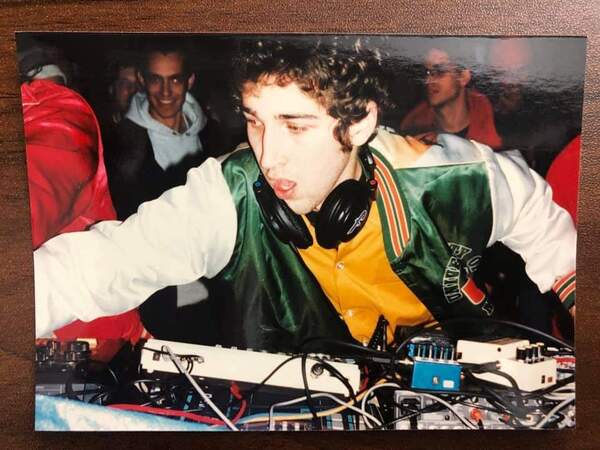
This photo shows Thomas Bangalter of Daft Punk at a live show circa 1996. What appears to be a Boss PS-3 is visible in the foreground. Of the blue 4-knob Boss pedals available at the time, the CS-2 has white knob tops and the DC jack surround was flush with the bottom of the casing, the PS-2 has white knob caps, and the VB-2 has different shaped knobs with red position markers. Some DigiTech pedals such as the DigiTech Screamin' Blues use a similar enclosure, but have a split line level with the bottom of the DC jack surround.


In the third photo in this Twitter post, by Dot Hacker, Josh Klinghoffer's Boss PS-3 can be seen.

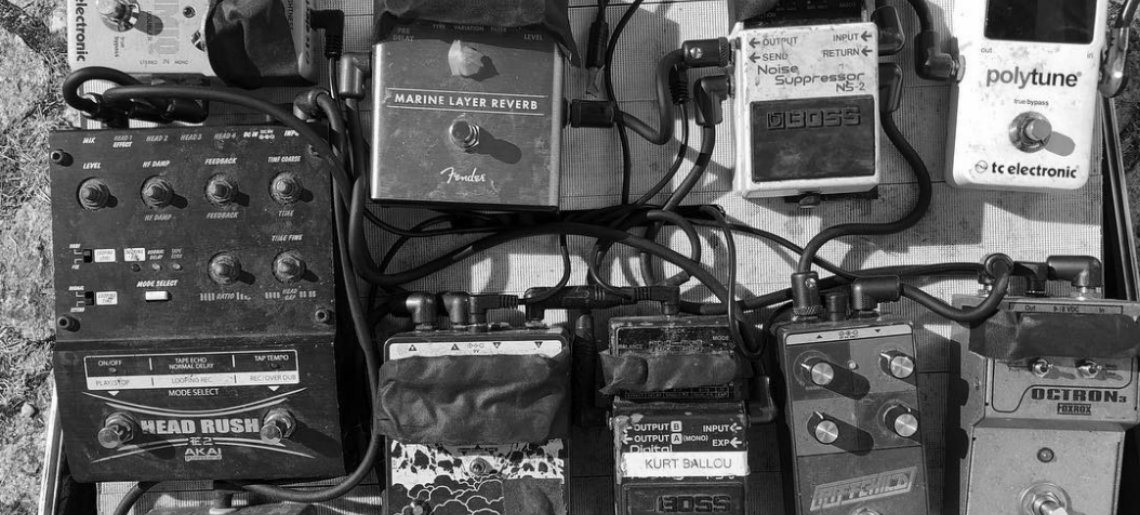
In a 2018 rig rundown featured on Arte Sonora, Kurt Ballou is shown using the Boss PS-3 Pitch Shifter/Delay pedal on his pedalboard, identified by its distinctive color.

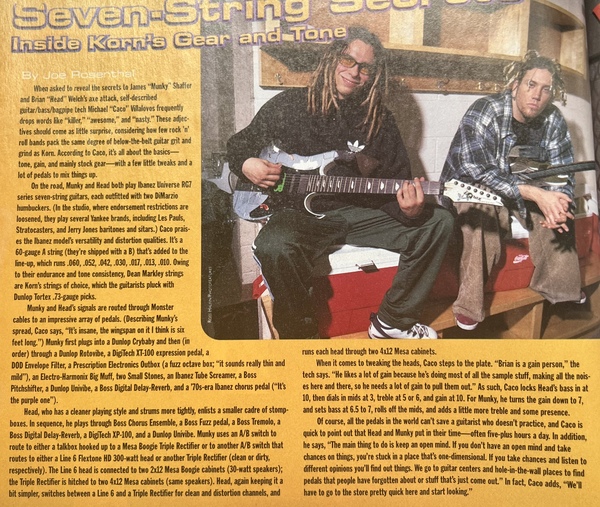
The article says he is using a a "Boss Pitchshifter" which began production in 1994 and was used on albums 2 and 3

In a YouTube video titled "Legowelt - Studio Tour" by MusicRadar Tech, Legowelt refers to the Boss PS-3 Pitch Shifter/Delay as "really freaky," indicating its use in his setup.

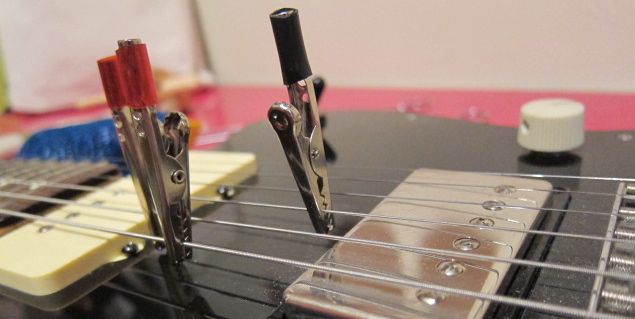
"I experiment and am always changing things in the studio, but when I play live or begin recording I use the same signal path. I start with a Fender guitar—a Stratocaster or a Jazzmaster, into a Boss FDR-1 Fender Deluxe Reverb pedal, which is a cheap preamp. It goes into a Boss PS-3 Digital Pitch Shifter/Delay pedal. From there the signal goes into my custom distortion box, and then directly into the laptop through an Apogee Duet (in the studio I use the Apogee Ensemble). On the laptop I have the Max/MSP patch, which is like a modeler/sampler/synthesizer thing. From the laptop, I go into a Mackie mixer, which sends a mono signal to an amp and a stereo signal to the house."
From an article describe a collaboration between Ian Bellamy and Thomas Strønen.

.jpg)
In this pedalboard photo posted by Knudson on his official Instagram profile, the Boss PS-3 can be seen.


I’m having this love affair with the Boss PS-3 Super Shifter. One thing about playing with a whammy bar is that I really can’t stand constantly going out of tune. For a singer, it’s just about the absolute worst thing you could have to deal with. Those pedals are great because I can avoid using a whammy-equipped guitar. But they are also a rad creative tool.


In this GuitarGeek rig diagram, made by Adam Cooper, Agata's rig includes a Boss PS-3 Pitch Shifter/Delay pedal.


Briggs took a more svelte approach for his pedalboard on the Coma Ecliptic tour. His stomp station includes a Boss TU-2 tuner, a Wamper Faux Tape Echo (used for a constant warbling tone), an Electro-Harmonix Bass Micro Synth (ideal for “Tom Sawyer”-ish bass-synth washiness), a Boss DD-3 Digital Delay, Boss TR-2 Tremolo, Boss PS-3 Digital Pitch Shifter/Delay (Briggs’ favorite pedal, which he currently uses as a chorus), and a Darkglass Electronics Duality Fuzz (which replaced a Keeley-modded Ibanez Tube Screamer because the Duality has a mix knob that allows Briggs to keep a more natural tone of low-end fury)


Keiji Haino used the Boss PS-3 Pitch Shifter/Delay as part of his pedalboard during a 1999 performance with Fushitsusha, as documented by Arcane Candy.


One can see a Boss PS-3 at 2:59 in this video of Peter showing "how he uses guitar pedals to create the sounds of his solo self-titled debut album."
Album Usage
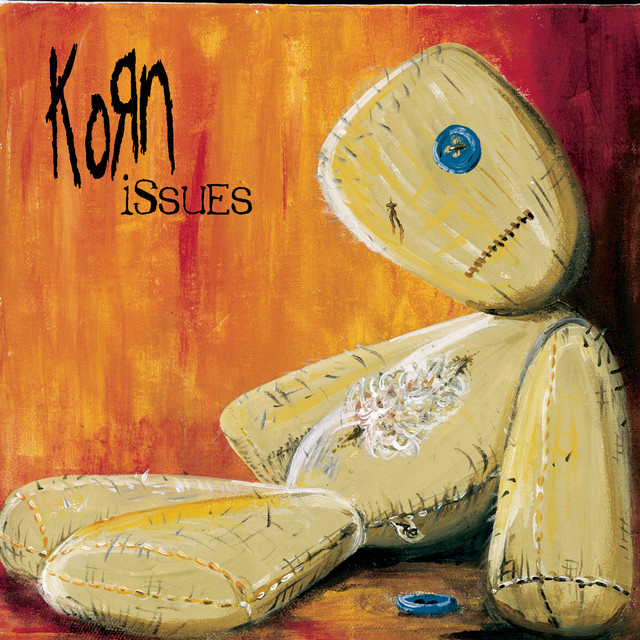
The Boss PS-3 Pitch Shifter/Delay has been featured on the following albums:


Genre Usage
Based on how artists on Equipboard use this gear, it is most commonly found in the following genres.
Used With
Based on how musicians on Equipboard use Boss PS-3 Pitch Shifter/Delay, it is most commonly used with the following gear.


-s.webp?v=1784905196)

-s.webp?v=1784905089)
-s.webp?v=1784818688)

Community setups
Show yours


Similar
Add recommendation2 alternative and related items for Boss PS-3 Pitch Shifter/Delay, curated by the Equipboard community.
-m.webp?v=1784905376)
$122.00

$145.68 - $169.00
More Boss Harmonizer & Octave Effects Pedals

$130.00


$145.68 - $169.00


$111.17


$73.46 - $133.99


$133.75 - $164.99


.png?v=1784940345)

$114.00 - $164.99


$65.87


$129.00 - $239.99


-m.webp?v=1784732274)


-m.webp?v=1784905122)
$184.63 - $319.99


-m.webp?v=1784934264)
$135.00 - $239.99


-m.webp?v=1784934359)
$182.50 - $230.40


$184.63 - $319.99


$299.00 - $400.00


-m.webp?v=1784934180)
$229.00 - $449.99


$159.00 - $197.80
-m.webp?v=1784934452)
$199.00 - $244.90


$79.00 - $119.00


$411.00 - $499.00

$133.00 - $249.99


$182.16 - $299.99

$229.00


-m.webp?v=1784905179)
$209.00 - $271.20


$179.95 - $239.00


-m.webp?v=1784934145)
$143.00 - $169.99


$109.99 - $143.00


-m.webp?v=1784905097)
$439.00 - $557.00


$214.46


$120.00


$150.00


$66.00 - $147.00


$132.00 - $229.99


$299.00 - $334.00


$177.00 - $179.00
Accessories & Related Items
-s.webp?v=1784905376)


Gear Guides



.jpg)



Most Popular Harmonizer & Octave Effects Pedals
Most Popular Brands
-
Added to Equipboard on by
bradfloraGearIQ 575
-


