
florian_tennstedt
Casselfornia-based guitarist/bassist
Genre
Every rig tells a story. Start yours.
Catalog your gear, wishlist what's next, and share the setups behind your sound — free.
Create your EquipboardMy Gear 69

This is a hell of an amp or as Johan Segeborn puts it: "Pretty close to a '59 Bassman", "Complety nailed some of my favourite (Pink Floyd) tones", "If you find one of these, buy it!" (https://www.youtube.com/watch?v=Zf0r1UK0tUw). It has a clean and a crunch channel, low/high-power and stand-by switch (I believe it switches between 30 and 60 Watt Power), 2x12" Scorpion speakers, a reverb and flanger FX. Channels and FX are controlled via footswitch. The crunch channel sounds ok, but I only use the clean channel as pedal plattform. This channel is somewhat fenderish and works great with pedals. The preamps of both channels are transistor technology, the power amp section contains two 6L6 tubes. You don't need to turn it up very loud to get close to the breaking point/tube saturation because of this hybrid construction. The reverb is pretty mean, it's hard to find a sweet spot between nothing and too much. The Flanger/Phaser is quite unique and has a big variety, you can get pretty close to an EVH-like sound and have much fun with it. If you want to use all features of the amp you need that special 6-pin footswitch made by Peavey which is not soo easy to find, if you need replacement (without it you can only use the crunch channel). That and the reverb issue makes it only 4/5 for me, but you can find these amps for about 200-300$ and that is why I can totally agree on the Johan Segeborn quotes.

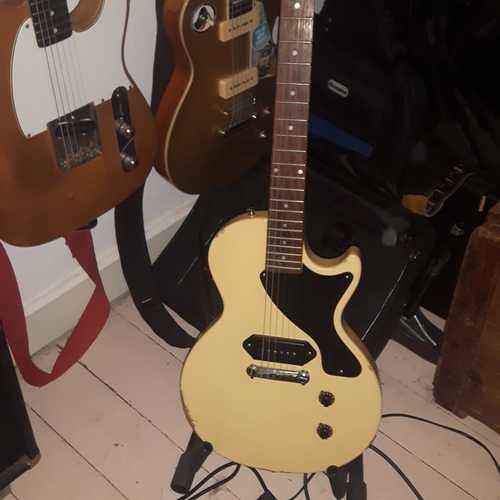
I got this one as a xmas gift and I am pretty happy with it. It's not as good as a Gibson, but I'd rather buy some Seymour Duncan P90 to improve the sound than buy an original Gibson. The china-made P90 sound pretty good if you remind that this guitar has a 130€(150$?)-price tag. That said, it was little surprise that I had to do some setup-changes and think about changing some parts(nut, bridge, PU). It plays very well, there were no sharp edges on the neck and you have to do some really brutal bendings for it to become off-tune. I'd really recommend this guitar for beginners because its exceptional good price/quality ratio, as well as a reasonable alternative to epiphone products for intermediate players.

I bought this amp in 2010 and if you want to play Blues, Rock'n'Roll or heavy metal this is an amp you should think about. There is one reason why I only give 4/5 and it's the fact that this amp eats tubes(pre-amp) when playing on a high-gain setting constantly. Especially the built-in china-manufactured tubes cannot cope with what this amp does to them when there's a lot of gain in the game. If you use good quality tubes and a moderate gain setting, there's nothing to worry about. Sound, handling and craftmanship are what you expect when you see the name Orange, very good quality.

This one is a classic and has been praised in many reviews as classic, legendary, etc. and I could join this chant easily, because it really is a very good pedal. So I will rather focus on the things that could be better in my humble opinion. First I like to mention that I used this as stand-alone in front of my amp first, now using it to have a dirty boost in front of the ST-2 in my drive/distortion section, with the right settings it's pretty close to the SD-1 -> JCM800 sound of the 80's. I like it both ways, but what I really miss is more EQ-Options(like Treble, Mid, Bass) and a little bit more output. I am sure there are already some mods to cope with these problems, but they are minor issues and because I use it as a dirt boost anyway they don't matter that much to me. It's a 4.5/5

Sometimes you want to step out in the mix, but just a little bit for a little solo or something and there is not enough time or skill to do it by turning up your volume knob. That's where a booster typically comes into play. This one is a very versatile example of its art because you can dial it in as a clean boost, a mid-range or as a treble boost. There are also some nice in between spots to check out. It also has a function to generate feedback, from a soft low background drone to a high terrific scream, that's mainly a gimmick, but it can be useful if you want to have an instant feedback without the hustle in front of your amp. The problem with that is, that the decay of feedback is too harsh, when you leave the pedal it vanishes immedeatly and there is a short but recognisable drop in Volume right after that. That makes it a good 4/5 to me.
-m.webp?v=1784631618)
I got this for 40€ (50$?) and it is nice to have it for my drive/distortion section. It does it's job, I'm just not that glad with the settings in reduction mode now, but I only tested it at home and not in the rehearsal room with my bigger amps, maybe I'll find some good settings there after lockdown. It seems as if i had to decide between proper reduction and enough sustain, so that's something i need to figure out. The mute mode is working fine and hey, for that price it is still pretty good.

The description says that you can power up to 7 other 9V pedals via Daisy chain. At the moment I use this as a power supply only(i can validate it powers at least 4 other pedals without any issues), but I plan on using the FX Loop for the modulation/time segment of my board. It does it's job!

This pedal emulates tones of different Marshall amps. The most impressive perk to me is, that it is very responsive to the volume knob of your guitar. It fluidly switches from very smooth vintage crunch to high gain rock to modern ultra gain sounds. It is very versatile and is a good choice to add that marshall-like sound to your fenderish clean tube amp. Also the SD-1 -> JCM800 can be approached if you have a SD-1. I really dig this combination as a good choice to have these 100W Fullstack sounds while staying with your 15 or 30W tube combo. I bought it on the used market for 50€ (60$) which is a steal. Very glad I have it.

It's build like a tank and weighs almost as much. And it's sound? Usually Wah-Pedals focus more on the upper frequencies of the guitar, but this one goes all the way and works on the whole spectre of the guitar sound it gets. This makes it a bit more versatile, you could play some wobbly notes by just changing from 0 to 1/4 way quickly for example. It is also a volume pedal, nothing much to say about that other that it works and you can have nice swells from it. Given this, there are some issues with this pedal. First, it is photo-technique, it has a little lightbulb inside, like the ones that were in bicycle lamps. That's a bias, hence this part is easy to substitute, but because you stomp around on it a lot this needs to be done quite regularly. The second problem is noise, because this thing is from the 70s and has a built in power cable. I am going to try my NS-2 on it when shops are opening again after lockdown because i am short of lightbulbs and don't see the point in mailordering those for ecological and economical reasons (the toolstore is down the street).

Seriously, it's probably to loud to play it in your room, but the garage might be the proper place for it unless you use headphones which is not that great of a sound, but if your kid sleeps next door and you're in the urge of a riff it will do ok. This amp is very top end based and not in a good way so i recommend the treble to be set very low. The reverb is ok but mine adds a lot of hiss to the sound, the more reverb the more hiss. It has a clean and a crunch channel which both sound ok for a transistor amp. It was 50€ and for that price it's ok to have one, I use it for late night headphone sessions only, I once tried it in band context and it was clipping to hard before having a competetive volume -> Garage

This guitar has a late 70s/early 80s Fender American Telecaster-Body and a Rockinger neck (Maple with Rosewood fingerboard). It has an original Fender Singlecoil in the ashtray and a DiMarzio Humbucker on neck position. This guitar does what a Tele does and she does it really good. I love her.

You got it right, I assemled this guitar myself for about 100€. I bought a red no-name SG-style body with electrics, mechanics and PU's for about 30€, ditched the PU's, scratched off the paint and painted it again. A friend of mine gave me his Ibanez GAX Humbuckers for free and because LP/SG-style necks were too expensive i got a Tele-style neck with tuners for about 35€. It was a bit tricky to move the bridge to match the fender scale, but it worked out pretty well. It's my guitar with the best intonation and the bridge that came with the body is clearly better than that of the Harley Benton I own. It's not comparable to a real SG or sth like that, but it's my first partscaster and I am very proud of it.

It does it's job and has a bright display so daylight s no problem unless you happen to be a vampire.

I have played this in most of the bands I played bass in. It's a classic and even though it's made in Mexico I do not see nor hear any differences to an American JBass other than the price-tag. Maybe I was lucky with this one and other are worse, but for the 350€ (375$?) I payed to the first owner back in 2010 i am totally satisfied with what I got. Sounds and feels great and that is what makes great gear.

For me this is the best compromise between stiffness and flexibility. In my band I usually play chords so my plek shouldn't be too stiff, but I play singlenotes for soloing occasionally, so I need a pick that's not too flexible, too. I do play quite powerful and this plek helps me a lot with not messing too much with my strings while maintaining a good attack. They are quite durable, too, and the highlighted lettering provides enough grip to neither loose or turn the pick when in action.

which is playing Rhythm and Lead. The low strings give you this nice chug for powerchords while the high strings provide enough brilliance for nagging leads and squealing soli. The only problem that I have with these is that the E string has a lot of tension in standard tuning and occasionally snaps when I hit it too hard, but on the other hand that helped me to practice my strumming dynamics.

This is a selfbuild 3.5W Tube Amp based on the early fender champ circuit. It has an 8" Electroharmonix Musical Instrument Speaker and controls for Gain, Tone and Volume. You can switch to 2 slightly different bedroom distortion modes with much lower volumes compared to the clean channel. You can have very nice tube drive sound in that channel, too, and at fairly low volume thanks to the master volume. I love this amp!

They say they put one prototype in each of the voyager probes. You also find one being hatched by a penguin at the South Pole and are not surprised. It's everywhere for a reason: it is a very affordable and very good distortion pedal. You want to dial the tone down a little as it can wear out your tooth fillings. You can get a decent sound in front of a clean amp, but these were actually built to blow on large amps that have already reached saturation. You can also put it before a low gain OD and get some amazing results.

It does what you would expect from an analog delay. The repeats go darker but in a subtle mellow way. You can get it to oscillate. It's a clone of the Boss DM-2, I never played one of these, because I don't know why I should spend 200+€ when I can get the Behringer-clone for a tenth of the price. Definetly does the trick.

You can dial in some decent Reverb effects, they are not that great though. It's worth a try if your amp has no reverb and you don't want to spend a lot of money.
Wishlist 1
Gear Photos 2


Top artists 1
The artists florian_tennstedt has added the most gear to.
