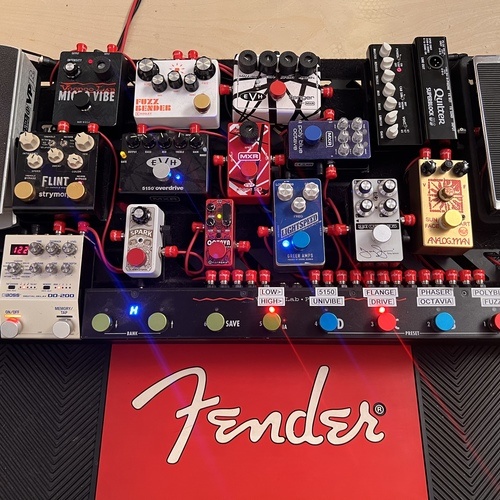
timebaby's Pedalboard

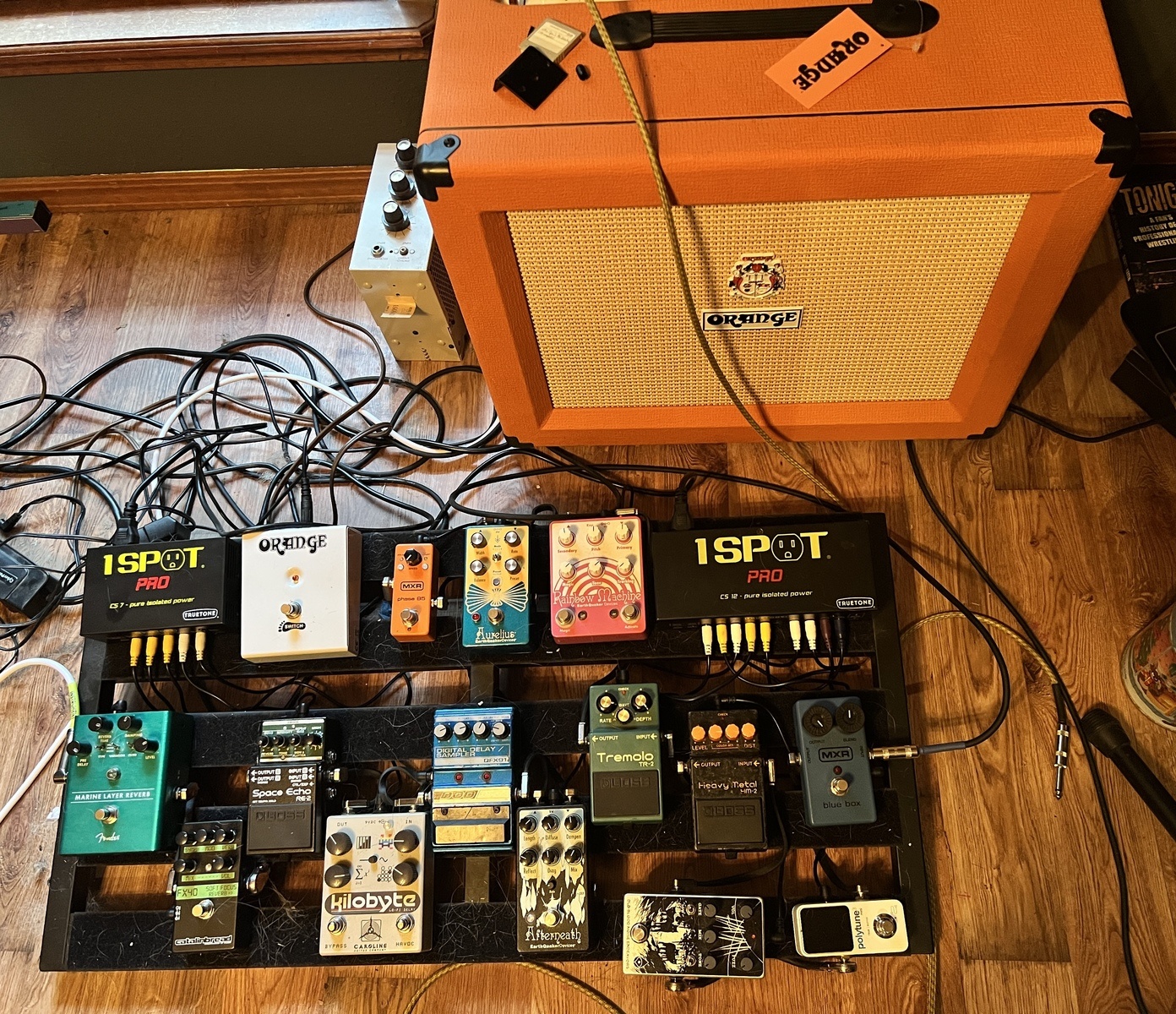
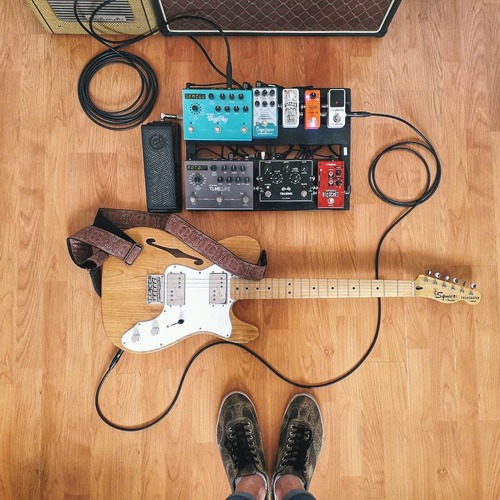
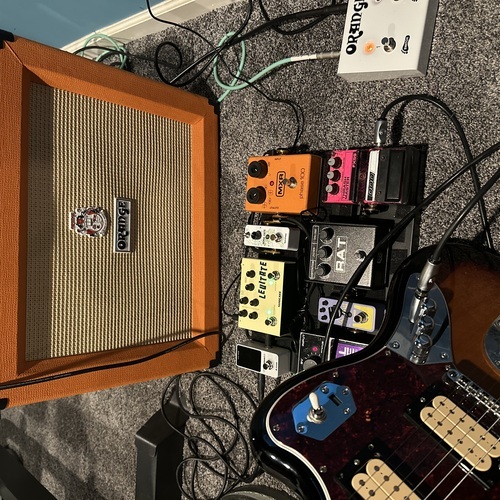
Primary amp and full pedal board.
More gear photos from timebaby


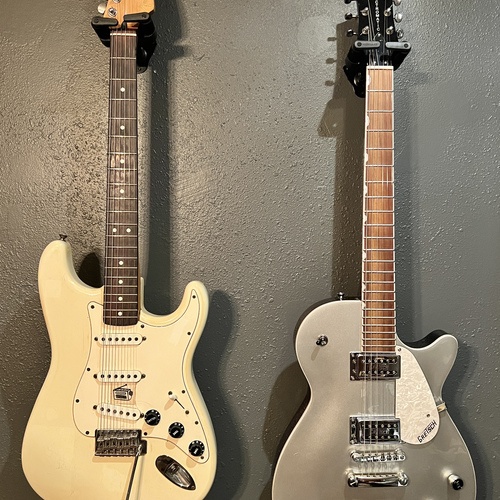
Gear in this photo
This rig
~$2,982
Value by category
- Effects Pedals 82.1%
- Amplifiers 17.9%
Price mix
Mostly standard

Boldest pick: Truetone 1 Spot Pro CS7
Only 10 pro artists on Equipboard own it, but it's ranked #17 in Effects Pedal Accessories.

Orange Amplifiers Crush Pro CR60C 60W Guitar Combo Amp
Avg price: $534.55


Hard to imagine a better solid state combo
I had always avoided Orange amps because I associated them with stoner metal, which is a genre I like but not one I play. I played this one for fun at Guitar Center, and was so impressed by both its clean and distortion sounds that I left with it that day.
For a solid state amp, the distortion is absolutely incredible. I love pedals, but this is my main distortion now. The only down side is that it's pretty saturated even at lower gain settings, and the mid frequency EQ doesn't get quite as biting as I'd like it to. Those are really minor complaints, though. Like I said, I love it so much it put me off of buying any more distortion pedals for the time being.
The clean channel is what really amazed me, though. I'm always looking for pedal platform amps, and running my board into the effects loop on the clean channel sounds gorgeous. Without the effects, it has a sparkle not unlike classic Fender amps, and I can't give a higher compliment than that.
For the money, I can't recommend this enough. Every bit as good as far more expensive combos.
-m.webp?v=1784845679)
Avg price: $94.18
Fun, but not very useable
When I started building a new pedalboard a few years back, I thought I’d be able to use this as a fuzz, and only kick in the octaves when I wanted something extra glitchy. I quickly found out it doesn’t work that way. To me the fuzz sounds like a pretty basic ‘70s distortion, and while the octaves are fun with their bad tracking, I’ve never found a way to incorporate it into a song.
None of that is to say this is a bad pedal. The distortion still sound pretty good even though it’s not the traditional messy fuzz sound I was hoping for. And the glitchy note tracking is extremely fun to play with even if it’s Rainbow Machine-like in the specificity of its practical uses. They come cheap so there’s no reason not to grab one if you’re interested, but don’t expect it to be your main fuzz.
-m.webp?v=1784818846)
Avg price: $106.00


Legendary for a reason
Despite being known as the sound of black metal, this pedal is incredibly versatile. Its EQ section can make some pretty bizarre tones aside from the Swedish Buzzsaw. Personally I love it as sort of a heavy overdrive, with Low EQ at 3:00, the high at 11:00 and the distortion at about 10:00. With those settings it makes a tremendous distortion for softer shoegaze tones.
Everyone knows how great this pedal sounds. What you might not know is that this is hands down the toughest pedal ever built. I bought mine back in 199x, the first distortion pedal I ever owned. Sometime in the early 2000s it was in a flood in my apartment. Despite being submerged for about 24 hours, I let it dry out for a couple of days, and it never lost a step. It’s the one pedal I can’t see ever coming off my board, both because I don’t think it will ever die, and because there’s no style of music it can’t handle.

Avg price: $123.50

Old Blood Noise Endeavors Haunt
Avg price: $168.52


Great Gated Sounds, But Not Versatile
This is a weird pedal that makes me feel like I don't know how to use it. It seems like everyone I watch play one gets all kinds of sounds out of it, but personally I find it hard to get anything but the gated "splatty" sound, even with the gate control all the way down. That's a great tone, but I was hoping for this to give me everything I wanted in a fuzz from the gated, power-starved sound to Big Muff-like tones, and it just doesn't. Or at least I haven't figured out how to make it.
So yeah, top notch at what it does, but I was expecting it to do more. Maybe I'm the problem.

Avg price: $93.13
It's a tremolo!
What can you say, it's a tremolo. Is there a bad one out there? Probably, but this one has Boss build quality and a waveform shaping knob that offers a little more variety over the standard depth and rate controls. Very much worth what you're likely to pay for it.

EarthQuaker Devices Afterneath V3
Avg price: $220.88
A Godsend for reverb freaks
Reverb is my favorite effect, and at times I want something that pushes all boundaries of good sense. In the past I had to chain several digital effects units together with cranked hall settings to get anything approaching what this pedal does in a Boss-sized footprint.
Like all Earthquaker pedals, it can be a bit cantankerous and unpredictable, but if you like borderline infinite reverb trails, this is the gold standard. Definitely not an always on background reverb; this is as in your face as it gets, and I can’t live without it.
Harmonizer & Octave Effects Pedals

EarthQuaker Devices Rainbow Machine v2
Avg price: $237.50
My Favorite Chorus
Everyone knows what this pedal is about, and you’re either amused by it, or hate it. Trying to describe how it actually sounds or even works is a fool’s errand. Just when I think I have my head around it, it starts making completely different sounds without me turning any knobs. As a pitch shifter, it’s like trying to steer a crashing airplane.
Here’s the beauty of Earthquaker Devices, though: they pack so much into their pedals that you’re just as likely to throw the manual away and find something completely unexpected to do with it as you are to use it the “right” way. With the Rainbow Machine, that’s turning it into the most unique and beautiful chorus pedal I’ve ever heard. Set the top 3 knobs just left or right of noon (it kind of doesn’t matter which side). Turn the Magic to about 2 and Tracking just barely on, and set Tone to taste, and suddenly you have an incredibly subtle, shifting chorus effect. Slight rising and falling pitches undulate just beneath the surface of the notes you’re playing, giving your sound a beautiful new dimension. It gets even better when played on single coil pickups through a massive reverb (I love combining it with Earthquaker’s Afterneath).
Is this a pedal you want on your board as anything other than a stunt? Who knows. It seems that everyone who actually takes the time to find a sound they like in it lands on something completely different. That’s the beauty of it to me, but if you like tried and true sounds or want a normal pitch shifter, this isn’t it.

EarthQuaker Devices Aurelius Tri-voice Chorus Pedal
Avg price: $188.36
A chorus pedal that’s better at everything else
This is a weird one for me. Earthquaker are easily my favorite pedal makers, particularly because of how often I find myself using one of their pedals for something different than what it’s intended for. With the Aurelius, this is the first time I see that as kind of a bad thing, but it’s going to be down to your individual taste.
Here’s the thing: on its chorus setting, the Aurelius is really more of a flanger. I know some people like that sort of chorus, but it’s very much not my thing. If that was all the Aurelius offered, I would have given it a pass. Where it really shines is in its other modes, Vibrato and Leslie speaker simulation. The Vibrato mode has become my new chorus sound, as it provides the shimmer of the Small Clone with a greater depth range (you can also crank the rate up to ridiculous speeds if you like, but that’s also not my thing). And with a clean guitar, the chorus sounds fine, but just that—fine.
What actually sold me on the Aurelius in the end is the rotating speaker simulation, which sounds heavenly. That’s not an effect I’ve ever really loved; I’ve always just used tremolo instead because it’s a more versatile effect. But you can do so much with this mode on the Aurelius, from gentle motion to a wild, warbling lead tone when combined with a nice noisy distortion. It’s added a new sound to my arsenal which I would never have gone looking for.
Another great feature is the really easy to use preset mode, which I quickly found to be indispensable. It’s something I hope Earthquaker starts adding to more pedals in the future, as I tend to hang out on one setting to avoid twiddling the huge number of knobs they often cram onto a box.
Ultimately I’m of two minds on this pedal. As a chorus, I’ve found it to be pretty substandard, and at first I was afraid I’d gotten too caught up in it at the store and wasn’t going to like it alongside my other pedals. Eventually I realized that the Vibrato setting gives me what I really want in a chorus, and I get the bonus of the great Leslie setting and the presets. So if you can get past the part where it’s a chorus pedal for people who don’t like chorus, it does offer some great sounds. Just not the one in its name.

Avg price: $106.78
Does its job
I love gear like this that saves those of us who don’t care about collecting from paying through the nose for basic effects that are just expensive because they’re “vintage.” I especially appreciate it in the case of this pedal which showed me that I would have been really unhappy shelling out for one of the vintage units it contains.
That’s not to talk down a classic. The Phase 90 is my favorite phaser ever, and I would actually give this five stars if it was just a mini version of that pedal. But it also contains the Phase 45 circuit, which I find to be tinny and underwhelming. Having never played the original, I can’t say if that’s it’s natural sound or if this is a bad re-release, but I set this to the Phase 90 Script setting and forget it. And used like that, it’s perfect.

Avg price: $192.75

A Great, Affordable Every Day Reverb
As I've mentioned in other reviews, reverb is my favorite effect, and I currently have 3 on my board--this, the Afterneath, and the Catalinbread Soft Focus. The selling point of this one for me was its shimmer feature along with all the standard room and hall settings. As it turned out, I wasn't a fan of the shimmer. I find the octave up on the trails to be way too pronounced, and once I got the Soft Focus, which has the best shimmer I've found, I switched off the shimmer on this pedal for good.
However, I still love this pedal and use it as a basic, subtle reverb for when I'm not trying to go wildly over the top. Whether you crank up the reverb level and time, or dial it down to something much more natural, it always sounds good. It doesn't murk up your clean tone, and it doesn't get too crispy when you hit it with distortion or fuzz.
That's the good. The bad (aside from the problems with the shimmer I mentioned) is that there isn't a great deal of difference between the settings as far as their character. That's fine for me and how I use it, but you probably don't want it as your only reverb. In the same vein, there are no spring or plate settings, which seems like an oversight. Again, not a huge problem for me as I rarely use spring reverb, and the Soft Focus has me covered for plate sounds, but another reason to look elsewhere if you only want one reverb on your board.
Still, the sound is high quality even if the options are somewhat lacking, and the price is right. If you don't mind tinkering with software, something like the HOF is probably a better choice, but I'm a fan of the sound I get from this, and anyway, I'm always looking for an excuse to cram another reverb onto my board.

DOD DFX91 Digital Delay/Sampler
Avg price: $150.00
Highly underrated—sort of
Ok, so this is an extremely basic digital delay, but it’s my favorite of all time. First off, the sampler function is useless, giving you barely enough time to play a single note or chord. If you really want to get down on the floor and twiddle some knobs, you can get a decent drone out of it, but there are hundreds of better options for that.
Where this pedal excels is in the tone of the delay. I’ve tried a lot of other digital delays, and none of them have the same ice cold tone this thing has. If you want a crystal-clear, Cocteau Twins-esque ethereal sound, you should definitely give this a try, especially with them being easily found for under $100 as I’m writing this.
Of course the pedal does come with the downside of DOD’s unreliable early ‘90s foot switches. Mine also developed a tendency over the years of turning itself on and off at random, and sometimes not activating when I would step on the switch even though the LED came on. I recently took it apart and gave it a good cleaning, tightened all the bolts, etc, and it’s as good as new now.
Of course there are digital delays out there with far more options, and if you’re not interested in a super sparkly dream pop tone it might turn you off. For me, though, it’s an absolute necessity.

Very cool not-quite-analog delay
This pedal is just fun, from its sounds to its Commodore 64 inspired graphics.
While it sounds on the analog side it’s actually a digital delay where the repeats get run through an adjustable preamp (the knob labeled with a rainbow Space Invader) to dirty them up on the way out. There’s also a modulation knob that creates a kind of wow and flutter effect. It’s the kind of pedal that can be very straightforward or pretty weird. I personally love cranking up the preamp and modulation in conjunction with a phaser for some nice psychedelic sounds.

Avg price: $218.00
Beautiful, versatile delay
Not much to say about this one. It’s a simulation of Roland’s famous tape delay unit, and it does that job well. It’s a very pretty delay that lands between analog and digital tonally, and seems to work with everything you pair it with. The only weak point is the spring reverb, but hey just don’t turn that on.

Avg price: $192.80
Great Sound, Could Play Better With Others
So I’m not a huge fan of pedals that are meant to make you sound like another band, but this one gets a pass for two reasons. First, it’s based on a preset on a rack unit rather than trying to specifically sound like a certain band (Slowdive). Second, Souvlaki is one of my favorite albums ever, so I’m not going to complain about a chance to cop some of its tones.
The pedal sounds fantastic overall, if you have an affinity for over the top ‘90s digital effects. The plate reverb is absolutely massive, so much so that it can easily get out of control (and this is coming from someone with 3 different reverb pedals on her board at all times). The modulation (chorus) on the other hand is quite subtle, and excellent for a clean input signal. Similarly, I love the shimmer setting. I tend to like shimmer reverbs a lot more in theory than in practice, but this one is subtle enough to avoid the cheesiness I generally associate with the octave up being too pronounced.
So what’s the downside? The pedal just doesn’t take other effects very well. I tried turning the modulation off so I could combine it with separate modulation pedals, and all of it just sounded muddy (weirdly, the similarly over the top Rainbow Machine played nicest with it). Moreover, I don’t find the reverb all that compelling when you strip it of the shimmer and modulation. For me, this is a box that you use mostly by itself (or with a distortion with a good high frequency range), and not one you mix with other pedals. The one exception I’ve found is that hitting it with a clean digital delay works out well, if you want to get that “Souvlaki Space Station” sound. With an analog delay, though, it’s a muddy mess.
If you’re a ‘90s shoegaze and dream pop fiend, or if you just want a really massive shimmer reverb and have been let down by other options, this is an easy recommendation. If not, you’ll probably find it way too specific and single-use.

Avg price: $205.20

Avg price: $150.01
About this setup
This gear photo by timebaby features 17 pieces of gear, including Orange Amplifiers Crush Pro CR60C 60W Guitar Combo Amp, MXR M103 Blue Box, and Boss HM-2 Heavy Metal. The setup spans Effects Pedals and Amplifiers, with mostly standard pieces. Artists with this kind of gear are most often found in the Rock, Pop, and Alternative rock scenes. Notable artists with overlapping gear include Frank Iero, Josh Klinghoffer, and Lee Ranaldo.
Similar Artist Setups
Pro artists whose gear list overlaps with this photo.