dorgsan's Metal Pedalboard

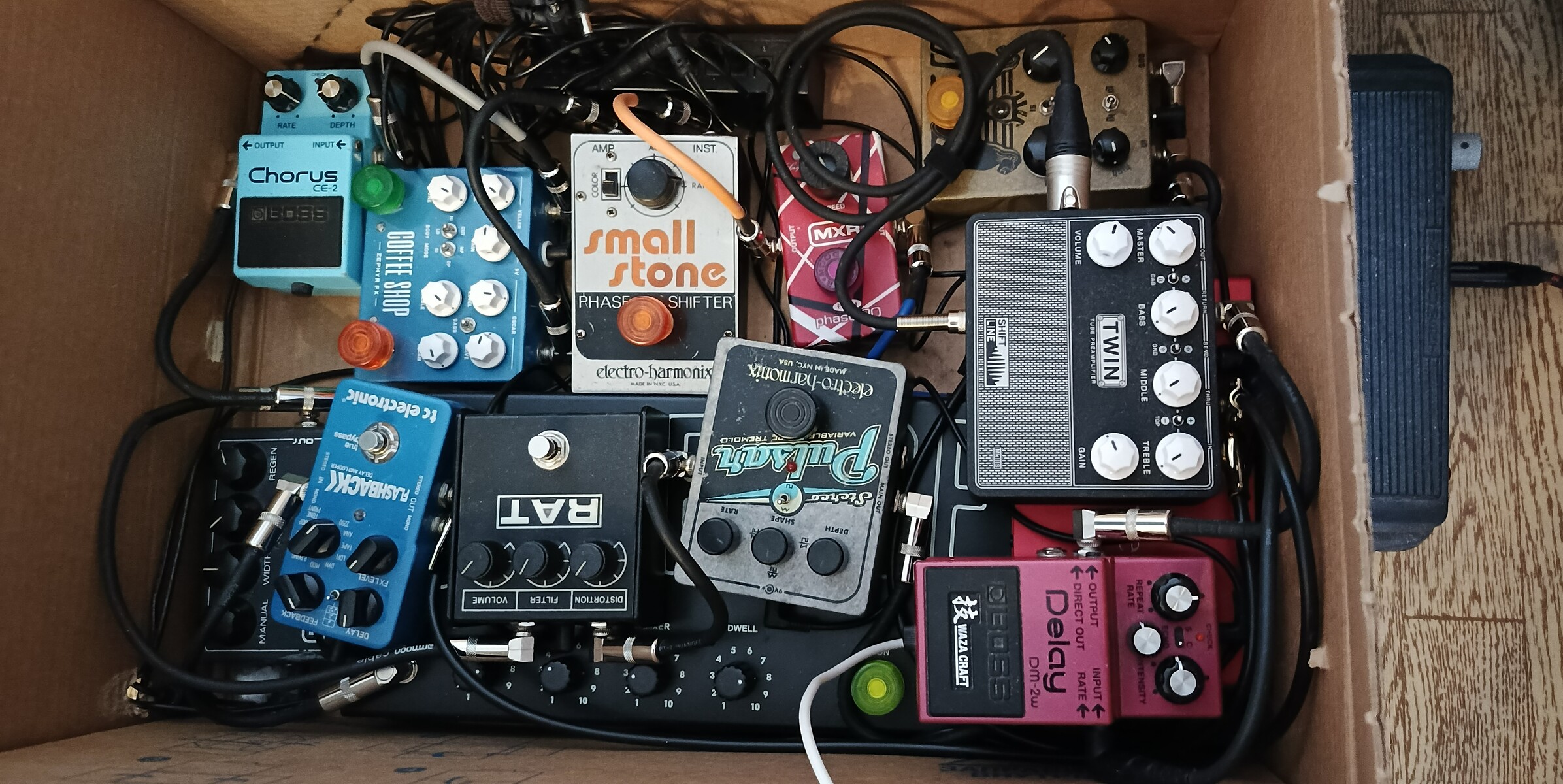
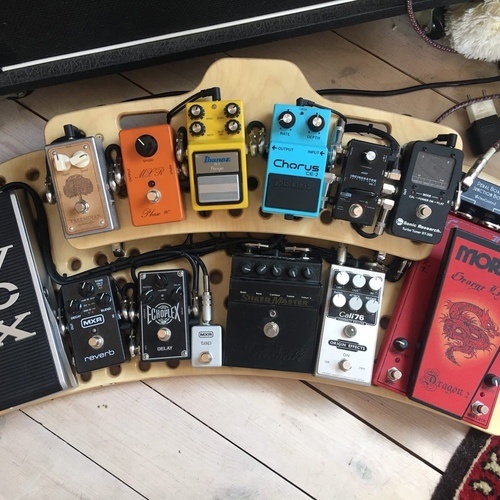
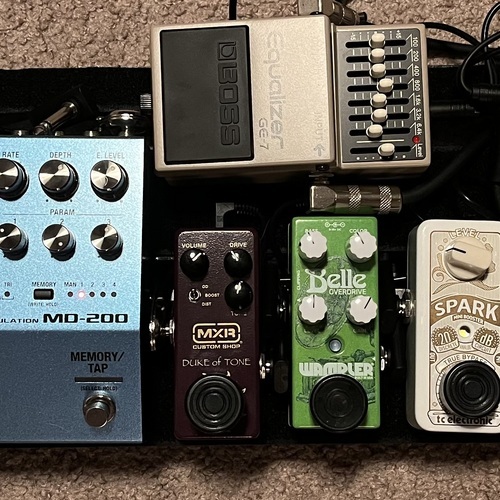
DIY home "pedalboard" from a cardboard box. All of my favorite and best sounds I could find (within reasonable financial limits) in every category of pedals that I need. Due to space constraints, some pedals are located on top of each other, but I press them with my hands so this doesn't create problems. An effect chain is connected to the input of the Shift Line Twin MkIIIS tube preamp. Under the preamp is the TC Electronic Spark Mini Booster (not visible in the photo). The delay is in the preamp’s effects loop. The preamp’s output is connected to an audio interface. The power amp and cabinet are simulated in the DAW - these are the only digital elements in my signal chain (I mainly use the TC Electronic Flashback Delay as an output buffer). I sometimes swap out some pedals. For example, instead of the Boss CE-2 Chorus, I sometimes use the LY-ROCK Stereo Chorus, and instead of the Black Arts Toneworks Pharaoh, I use the Way Huge Electronics Swollen Pickle MKII Jumbo Fuzz.
Gear in this photo
This rig
~$2,498
Value by category
- Effects Pedals 92.2%
- Studio Equipment 7.8%
Price mix
Mostly standard

Dunlop 535Q Cry Baby Multi-Wah
Avg price: $161.28


The Wah
The only wah I ever had and it works fine...

Avg price: $135.00

Majestic doom beast
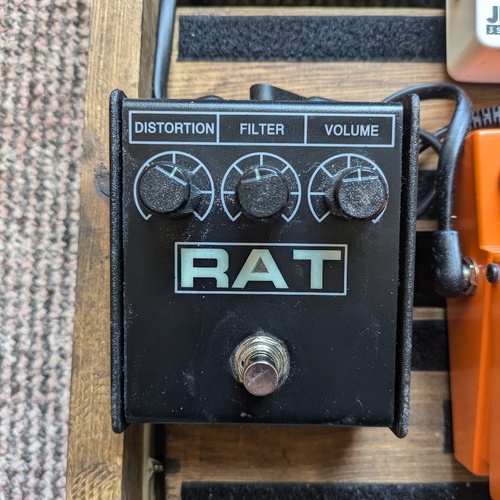
Majestic doom beast. Slow, not as agressive as RAT

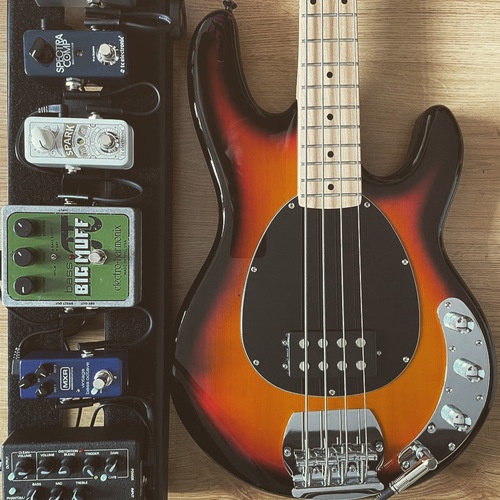
TC Electronic Spark Mini Booster
Avg price: $45.05

Booster + buffer
I keep this pedal always on at the start of the effects chain; in this setup, it functions as a high quality buffer. It also really helps push overdrive/distortion/fuzz pedals and the tube preamp when the volume is above 0.
When it's on, it also adds a little sparkle to the sound by boosting mid-high frequences. I generally like that, although, it would be better if I could choose. The same thing with the buffer: I wish I could switch to true bypass when I need it.

Avg price: $130.37
Two perfect phaser tones
Compared to EHX Small Stone this one is midrange-focused, which makes it ideal for guitar tones, but makes it sound duller for other applications. It's also more agressive, more funky. If you want your Phase 90 to be less agressive and funky, engage Script mode, which is a nice compromise between Block Phase 90 and Small Stone. As for negatives, the infamous Phase 90 volume boost. Also, why is it so rare for good phasers to have proper depth control? Overall, you can't substitute Phase 90 with Small Stone or vice versa. You need both pedals.

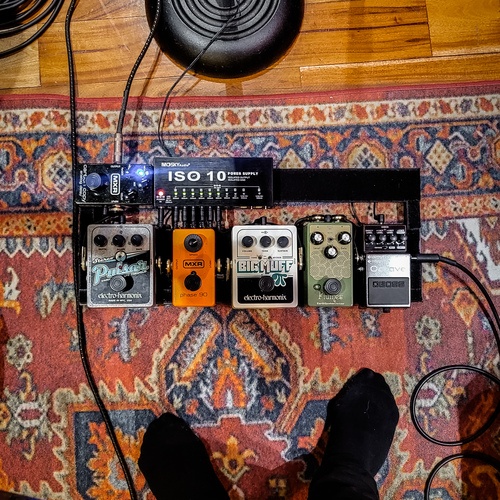
Electro-Harmonix Small Stone Phase Shifter V2
Avg price: $145.00

Best phaser
Compated to MXR Phase 90 this one is more gentle, dreamy, has a greater speed range, greater frequency range sweep, so a little bit at odds with the guitar tones, which are midrange-focused, but has great potential with other instruments. Have you heard Small Stone on Rhodes? (go watch it on YouTube). There is also a slight difference between vintage Small Stone like this one and the Nano one. The modulation in vintage pedal is more smooth and less noticeable (there are also YouTube videos with the comparison). As for negatives, the infamous Small Stone volume drop. Also, why is it so rare for good phasers to have proper depth control? Overall, you can't substitute Small Stone with Phase 90 or vice versa. You need both pedals.

TS + Klone
Tube Screamer and Klone with additional controls and ability to change the order of the effects. That's all overdrives that I need.

Avg price: $210.00
It's not a journey, it's destination
That lush, smooth, angelic reverby tone is what makes this pedal so good. Like asymptote, you can try to approach this tone, but you'll never fully recreate it.
Yes, it's not very tweakable pedal, but you don't need a journey, if you already where you should be.

Avg price: $266.95

Better version of the ultimate flanger
Compared to M117R the effect is a little bit less prominent, more mellow and more "lo fi". Sound in general is more pleasant for me. Also better distortion compatibility.
Preferred Settings + Usage:
My favorite setting: Manual 11, Width 9.5-11.5, Speed 11, Regen 1-3.5
-m.webp?v=1784844236)
Avg price: $84.73
A pedal with character
I have the one with LM308, and I love it's flat box and flat sound. It was made the same year I was born, so I should keep it.
-m.webp?v=1784818690)
Electro-Harmonix XO Stereo Pulsar
Avg price: $71.64

The king of tremolos
With this pedal you can do stereo, strange tremolo or even ring modulation. But more importantly, you can do that magical dreamy shimmering tremolo in the triangle waveform setting, that no other pedal or digital plugin can replicate (I tried). For example, triangle setting in Boss TR-2 is different, more mechanical. Also, even with the maxed setting Boss tremolo can't reach the depth of Pulsar's modulation.
Even though this is my favorite tremolo, it’s not without its flaws.
I’m not a big fan of the depth knob design, where you hit maximum depth at around 1 o’clock, and past that point, the tremolo goes into the signature EHX weird mode. I mean, I do like weird sounds, but it would be a lot more convenient if maximum depth was at the very end of the knob’s range.
There’s also another annoying drawback. I bought the second Pulsar, and both behave strangely. When I hit the strings hard and with a strong attack, in some settings sound artifacts appear.
Preferred Settings + Usage:
Depth 1 o'clock, Shape 12, Rate 9-9.5, Triangle shape

Surfy Industries Surfybear Metal Reverb 2.1 BK
Avg price: $219.00
THE DRIP
Probably the best available recreation of the Fender spring reverb. A lot of controls and a lot of that mythical surf-rock DRIP in this one. It's large, but you can use it as a pedalboard.
Preferred Settings + Usage:
Standard surf rock: T6-7, M6-7, D6-7; The drip insanity: T10, M10, D10; Background reverb: T5, M3, D9; Background drip: T9, M3, D9; Atmospheric reverb: T3, M6, D5; No drip setting: T0-4, M10, D2.5-3.5; A touch of reverb: T3, M3, D3.
-m.webp?v=1784818716)
Avg price: $190.33
Nice programmable digital delay machine
This pedal satisfies my looper, high quality buffer, digital delay (on 2290 setting), digital vibrato (TonePrint) and weird modulation (TonePrint) needs.
I don't use much any other settings apart from 2290, Looper and TonePrint. Analog setting doesn't really sound like analog delay (check out my Analog Delay vs Analog Delay Emulation video on YouTube). Lofi and Dynamic settings sound awful to my ears.
To my mind every setting should just be TonePrint.
I like that there's an option to switch between true bypass and buffered bypass, although I don’t really notice a difference during normal playing.
But there is one major downside: if there’s no buffered pedal placed before it, the pedal causes noticeable tone suck - even when it's off, and regardless of whether it's set to true bypass or buffered mode.

Avg price: $429.95
Tube preamp with power amp sim and cab sim
This is my first tube gear, so I can’t really compare it to other similar equipment. But I like what I’m getting. Besides the preamp itself, you get the ability to use either the built-in or third-party cabinet IRs, and you can even change the power amp section (there are 10 different power amp emulations you can download from the manufacturer’s website). So, in one box, you basically have a ready-made tube-digital combo amp.
I also really like the range of features: there are high-frequency boost/cut, ground lift and cab/power amp simulation switches, an effects loop, an input for external signal sources, and several outputs.
This unit goes into overdrive beautifully if you turn up the Gain, choose a more aggressive power amp model, or push it with a boost or Tube Screamer.
Since this is my first tube preamp, I want to say a few words about how the sound differs from the digital preamp emulators I’ve used before. Tube tone is all about that warm, natural distortion and compression. Once I got this preamp, I finally understood why I could never quite get the same compression and breakup that I hear on my favorite recordings with plugins. Now I can easily recognize that distinct tube tone.
Even pedals seem to sound better when played through this preamp, especially wah pedals.
But comparisons with digital emulations don’t always favor this device. Even if you max out the high frequencies on the EQ and turn on the bright switch, the preamp still isn’t bright enough compared to, say, Amplitube emulations using the same IR. And that brightness is really important if you want to get that signature Fender amp sound (and this preamp clearly tries to emulate it). In theory, different power amp models (which I mentioned earlier) could help here, but in practice, it’s very hard to notice any difference between them, aside from some being louder than others. They don’t really differ in EQ, and you can’t adjust the EQ for them.
So, if you want to get a bright Fender-like sound with this device, I’d recommend ignoring the digital part of this preamp and connecting the tube section directly to your computer. There you can use an EQ plugin to boost the highs, and then run it into a power amp emulator and an impulse loader.

Avg price: $164.44
Great pedal
It works. Sounds good. Delay range ("Repeat rate") is superb. Level range of wet sound ("Echo") is excellent. Has good buffer
Preferred Settings + Usage:
Pseudo-reverb: Custom mode, repeat rate 2.5, intensity 10, echo 8.5-9

Avg price: $50.30
Good
It works and I bought it super-cheap. It has 12V and 18V options. My version has seven 100 mA 9V outputs and one high currency (500 mA) 9V output.

Focusrite Scarlett 4i4 3rd Gen
Avg price: $194.39
About this setup
This gear photo by dorgsan features 16 pieces of gear, including Dunlop 535Q Cry Baby Multi-Wah, Black Arts Toneworks Pharaoh, and TC Electronic Spark Mini Booster. The setup spans Effects Pedals and Studio Equipment, with mostly standard pieces. Artists with this kind of gear are most often found in the Rock, Pop, and Metal scenes.