polonavarro

Polo Navarro

GearIQ 1201 Joined Aug 2016 0 Followers Contributed to 13 artists

I try to consolidate a leading sound, that kind of sound that flutters in my mind for a long time after I have heard it ... I like to experiment with all kinds of equipment when apears through my path

Every rig tells a story. Start yours.

Catalog your gear, wishlist what's next, and share the setups behind your sound — free.

Create your Equipboard

Guitars 20

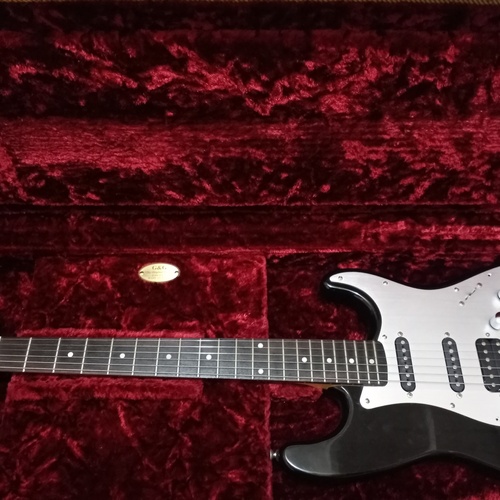
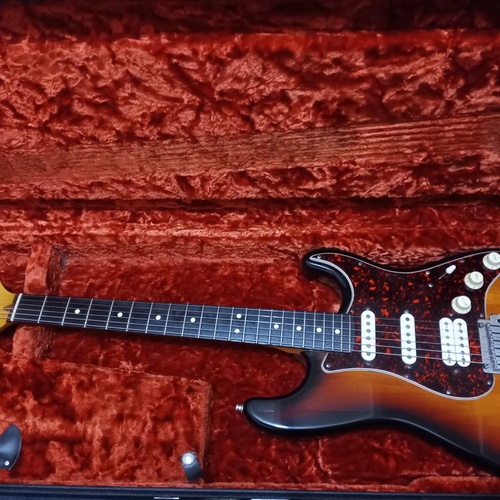
My first Stratocaster has been this 1997 American Fender Lonestar, which from the first day I used it and even today it sounds fantastic. Its natural sound projection (contrasted with other stratocasters varieties) is a bit "dark", however, this generates an excellent complement with the original pickups (Seinmour Duncan Hambucker in the bridge position; Texas Coils in the middle and neck). The tuning stability is superior to that of other stratocasters, except for slight discomfort with the third string (very characteristic of this type of guitar). practically the only modification that I have made in 18 years have been some "Tune Locker" Fender. This 1997 Stratocaster Lonestar USA really projects a great sound. It feels like a great guitar because that's what it is.
B.C. Rich ST-III 1987 made in Korea is a model stigmatized by a culture where the popular notion of quality / price prevails. In this case, since it is an accessible guitar, the idea of an erratic or failed instrument is immediately associated with this guitar. However, another truth is this: the neck is one of the finest you could ever have on a mid range guitars, and the stock pickups (probably a version custom made by dimarzio for BC Rich) have much more thrust even than some mid-range Ibanez and Fender, and maybe you can't belive it but this model don't make "hiss noise". The tuning stability depends a lot on the maintenance of the system (springs from 30 years ago do not fulfill their purpose as well as some of current technology just released on the market).
The Laguna LE-400 seems to come in 2009 and i can say it's a fairly balanced model, it feels well done, the arm is comfortable. However, it is not as thin as an Ibanez, Yamaha, or B.C. Rich, but its more like the feel of a PRS. In fact, the dynamic effect of the fingers on the fingerboard feels very similar. The sound of this instrument oscillates quite well between the high, mid and low frequencies. And last but not least, it is equipped with a "tap coils" system located on the tone button. The pickups project a good amount of volume. For some strange reason this guitar works better with amplifiers whose function is consolidated based on transistors (solid state), because with those based on bulbs (tube amps) it acquires a different personality. This last observation, regarding its sound projection, makes me consider the LE 400 as a guitar with a modern profile from 2000 to 2020. To get a retro 80s-90s sound it might work. Although, for a 60s-70s sound, in my opinion, it would be better to use another type of guitar. This is a leading guitar (soloist) so, with this type of guitar it is a good idea to take into account its nature (soloist) when setting up with a band, because with so much dynamic range of frequencies it can feel like an intrusive instrument.
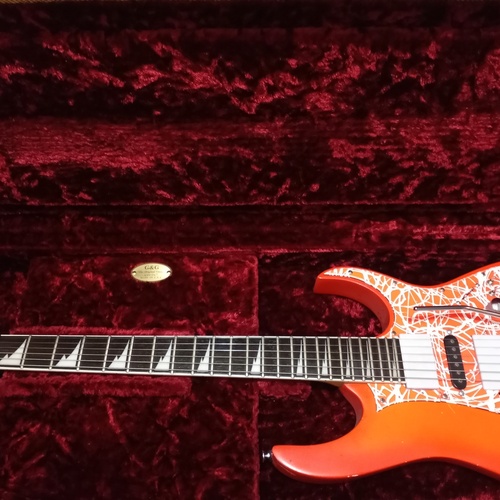
Since a few years I've been attracted to more aggressive range guitars (not for their aesthetics but for their components) and this **LTD KH202** is simply one that you should give yourself a chance to try. It's similar to the feeling of playing an **RG** type guitar, however the sound is different (probably because of the type of humbuckers: **EMG HZ** vs **POWERSOUND**). I like to keep playing with more than one guitar for a while because I feel that each one reflects me in a different way. About this **LTD KH202** must say I still can't feel complete. However, it has a very interesting sound. On a *Clean Channel* it maintains a balanced sound, but the reason I keep it is because when I move to *Dirty Channels* (Crunch / OverDrive), something seems to light up on this guitar and that's good. I don't know if it was designed to happen this way, but who cares. So I like it.
I acquired this 1987 guitar with the intention of working on it as an experimental project, and after disassembling it to find out what its inside this 3/4 toy, I found that it is an interesting piece: good quality wood, with a distinctive tone personality, and when you pluged into an amp [i try on a Blues Deluxe and a Hot Rod Deville] it gives a very interesting playability on the midly freq. I had replaced the pickups with some that I consider to be of higher quality, but the sound did not really improve, but rather, only was replicated a sound that already existed in other guitar that I have used before this one. I mean, i notice the new pickups was taking away essence from this YAMAHA RGX112 instead of giving it something more, so, I decided to leave the original coils and humbucker for a while. Its a well done vintage guitar and im glad to have one.
I am not sure of the production year of my S310, however everything seems to indicate that it is a 1989 model. Well, I think that this type of 80s guitar definitely attracts me, and this one in particular has some very peculiar pickups [they are not Ceramics] and to my good luck they are Alnico. Either way they throw a sound between Funky, Surf, and Retro. Although this sound characteristic is mainly attributed to the body wood that is Laminated Alder. It is a basic guitar, but with a enough level of potential to make it on some updates. After doing this your S310 will continue to be a low-profile guitar in the world, but... I don't regret taking a little risk with it.
The Ibanez RG120 is an excellent piece to experiment with. The size of the neck resists being lowered a little more (it is manufactured thin but we all know that data, I mean even a little more thinner than it comes from the stock). The humbuckers allow you to adapt a Split Coils Toggle and honestly the instrument in this case becomes another one with more rounded sound. By modifying the electronic circuit we can get a more dynamic improvement, i put a 50s Wiring on it and sound just great, keep the 250 pots (yes with those humbuckers) imitating the initiative of some Jazz Fusion guitarists. Nut function is acceptable ok but nothing like a nice custom-made piece of bone. The bridge is an exclusive Ibanez design, Fat20 seems to work well but little by little it gets ruined, this one it is not steel, it seems to be an alloy of some material that just does the job, so in this area the manufacturing material i most say lacks quality. Surprisingly it holds up the play. Even so, some day it will have to be changed.
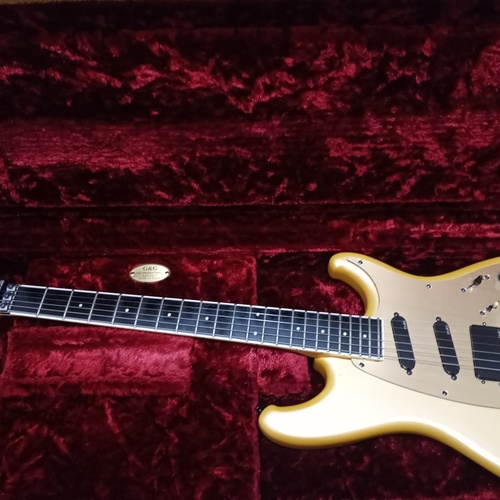
This is a low-range guitar, the pickups are to a certain extent unique, their dimensions are different from the generic Stratocaster on the market, and of course also very different from the original Fender. These pickups that come in the Guitar Research LG33 are wider in their anatomical structure and apparently have a more widing copper line. The sound of these pickups is not superior nor the most amazing, but yeah it is different from what we are used to hearing in a Stratocaster. But this low profile Stratocaster can be upgraded with a few tricks in a good way: I painted the body with a gold spray paint and changed the electronic part with Brian May type wiring style, installed a killer switch, and also I add a VariTone Switch with caps .1, .47, .33, .22, .15. This LG33 guitar comes shipped from the factory with space in the Nut to place a Locking System, but I have not yet installed it.
I am lucky to be able to talk about the **Yamaha EG112 "c"**, I mean the Japanese version of this guitar model, and the truth is this: it is an excellent "cheap alternative" to get a very "decent" guitar. I mean a guitar with a good sound and a comfortable structure. Obviously, it doesn't include anything glamorous, because we're talking about a guitar that was planned to be included in a *Starter Pack*. I am not forgetting that. However, it holds up quite well against any other brand. (I try between **Cort, LTD, Epiphone, Squier, SX, Gypsi Rose, Washburn** and **Peavey** ... Of course, those guitars in low end models, because I believe they are more or less fighting in the same comercial war.) So it seems cheap is not always crap. But the why I still keep this **Yamaha 1990 Japanese EG112c** is simply because, as I say, I find it quite comfortable with a very good feel/sound. So I can say that this **Yamaha EG112c** is a nice guitar with a more than acceptable performance. A guitar that never let me down, and also one that I will never take out of my gear.
It's a cheap guitar, no doubt, but... it is not a guitar for beginners. The sound is often clean, clear, but a bit dark, it lacks brightness (although this is not exactly a negative trait) and depends a lot of the sort of amp you're using. The feel of my left hand on the neck wood is (for me) a very quite good, better than in a lot of medium range price stratocasters. But... I sand the wood to get the feel that I need (super thin). However, obviously this is a guitar that requires so much attention and patience, specifically on all those aspects that naturally make this unit a budget guitar: 1. Needs calibration, 2. Single Coils and HB needs leveling, 3. A properly intonation, 4. Lubrication, 5. Interior lined with aluminum or copper foraje, 6. Replace cables for another better quality ones, 7. Check each one of the junction points on the electronic circuit, 8. Replace the nut, and screw to our liking. Obviously (for sure) "all this work is not for beginning guitarists". In summary, from my point of view and usefulness, the Metalien Behringer guitar is a good option for been a back up unit: it's solid, pretty, and with decent sound (even with the stock pickups). Definitely this "is not" the best starter option, because you gonna need to work a lot on it (the freets need all the love of the universe). But when you're done it gets another character and personality. I like it for play some fusion jazz and progressive styles.
It is a very good and beautiful guitar, it maintains an excellent quality despite being an initiation model. I'm more of a Fender or G&L type however based on my experience I feel that LTD is a brand with very remarkable characteristics.

Amplifiers 5

It is an amplifier that I can describe as versatile. You can get sounds for any musical genre you are wishing to interpret, and even better, you can customize your own sounds [although this is a bit complex]. As if that were not enough, you going to need read the manual maybe several times. However, it is worth the effort. In addition, it has high quality effects. Of course, the configuration requires spending time [months] to obtain a more natural / organic sound. In this follow all is about a test-based adjustment: success and error. Kick hard despite having 60 watts. It doesn't sound like bulbs in any way or form, but it really sounds very much better than other transistor amplifiers [even than does are more expensive]. Anyway, if you are not too picky about the sound you should know that the factory presets will work without any problem, especially the cleanest FX: Comprsor, Chorus, Reverb and Delay. It should be noted that it is also a bit complicated to operate the setting that simulates amplifiers and cabinets [especially those that operate in a dual function / mode of the main knob]. However, in my own experience this occurs with all amplifiers that have many functions. It is definitely an excellent quality device, a good price.
This CREATE GFX212 amplifier is a controversial creature, I can not consider it as something fantastic because its sound is actually somewhat bleak, [I hope my opinion is not misunderstood]. "I like its sound", I used with a "ST III BC Rich guitar", but however, it has something that In spite of the equalization, it makes that the guitar tone connected to him feels heavy, fat, [could be the speakers, the wood of the drawer, or the simple fact of avoiding problems at ground level]. I currently like the clean channel on it with 1/3 of Reverberation. It is definitely an amplifier made to play in open environments, becuose easily starts to providing too much volume. The effects included in general are not very good, although I use some times the Delay to add it a "cascade fallen sensation" with a Analog Delay [Short Configuration] and another Digital Delay [Long Configuration] and thus try to generate a Lead Tone for "jazz fusion" characteristic of 1980. By the way, some of these amplifiers over the years usually generate background noise [hum, crack, ziz] and it is very difficult to remove them by your own [require technical intervention]. Even if this happens, with a Noise Gate pedal the problem is done [but it is not solved with this trick, and if you don't hear it anymore, i can shure it is still there]. It is a good amplifier, to play live in medium places, open squares, kiosks, parks, theaters, or wooded terraces like Irish pubs. It needs some free space to optimally develop its sound.
It is basically the same as the **GFX 212**, but it has a digital tuner, and this is most likely due to the addition of the letter *"T"* in this model: **GFX 212T**. Inside the electronic circuit design is similar except for the power supply, the DSP FX's processor chip, and some components. Also, the effects on this *"T"* model sound better: sharper, and more prominent. Comparing the **GFX 212** and the **GFX 212T** side by side with respect to each other I notice that the volume power and the saturation of their distortion remain in exactly the same proportions. It maintains that 80's vibe that many of us like. And keeps plenty of headroom.
Nice chorus. If you like the tone of the 90's, this amp brings you closer to various bands from post punk, grunge, shoegaze, alternative rock, etc. It has a super strong and diaphanous clean. The distortion is very garage band, but, with the help of just one booster (like a Moog Minifooger for example) this amp is pretty good for experimenting with jazzy licks, progressive riffs, and even funky struts. If you like Radiohead, Blur, Suede, Morrisey, The Cure, and other similar bands this amp is a good starting point. Currently (2022) electronic parts for this model are still available. Important note: the technical revision of this circuit specifically requires knowledge and specialized tools, its design is quite complex.

Effects Pedals 53

The "Bad Horsey" [from my musical bubble] is one of the most fabulous devices that Morley has launched. From my point of view, it has great advantages over other mechanisms that emulate this same effect. "The wah" is not a noise or sound filter, but "it’s a frequency filter of those sound or noise produced by our instrument signal". And the game between the lowest range and the highest range that our pedal can offer is part of the key to being satisfied with its sound projection. In this case, the Bad Horsey is a pedal that has a good dynamic range of action. You can play quite well with the medium frequencies [which are the ones that usually give us notoriety and distinction at the time of the main arrangements]. Apparently, this particular effect, was designed to preserve the feelness contained in the amazing tone of "Steve Vai", and so, what I try to highlight is that, specifically, it is not a stuffing stompbox. So, the character of the "Bad Horsey" is absolutely leading: then, once you crush it, nobody will ignore what comes out of it, good or bad sea. And this aspect protagonic could represent a disadvantage at some point if you still have doubts about the configurations prior to this stompbox [especially: overdrives, distortion, fuzz, and booster]. This "Wah" is not dark, it is not clean, it is not environmental, I mean it is not an additional element that improves or worsens the original signal of your instrument. Only the project merged with the range game that we control with the foot, resulting in the sound we all know as "Wah Wah". This "Wah" is especially bright, crispy, vibrant. And once you press it the original signal of your guitar merges almost completely, although in a very interesting and attractive way, highlighting the loudness of the "Wha": even above other sounds in the chain of effects. There is no need to press an on or off switch. There is no signal loss in the chain. It is not exactly "true by pass", but it behaves as such. It is not damaged easily. It is a battle tank. There is no internal potentiometer to take care of. There is no potentiometer wear.
This Pickup Booster is the second best I have heard in a long time. For my taste, the first place still goes to the Morley Tel-Ray VBO (mojo), and the third place is a downloadable version of a Booster available in the Digitech iStomp. However, the Seymour Duncan sounds good with almost all types of pickups and amps, it's a real hit-and-miss.
It baffles me not to know what this pedal does internally, and I think it's better this way. When you activate it, it sounds and serves as a booster, enhancer, exciter, parametric band eq, tone shaper, fixed wah, and filter. There are many things happening at the same time in greater or lesser proportions and in a similar way to the Fuzz Factory the potentiometers seem to interact together, a small adjustment produces a significant and noticeable change.
This effect is one of those I had been trying to obtain for a long. Most of the demos on youtube are **just impressive.** Personally, I find this stompbox something unique: **doubling, sustain, swells, reverse, tremolo, glitch, fuzz.** But not like any all other brands effect we know, this EHX it just adds a vibe of all of those sounds. And have store banks, loop, and Exp input. Extremely complex to set up, but if you find a sweet spot, it's kind of amazing.
In my frustration at not being able to get a Fender Runaway Feedback I purchased this Digitech Freqout and it is honestly better than I expected. It is not exactly the same tone/sound as the Runaway because that one sounds more natural but it is monophonic and that limits the possibilities of use. On the other hand, Freqout is polyphonic but sounds unrealistic. Don't get me wrong, I like it and it serves me well. I don't need purism or reality, just good and better results. And Freqout achieves them.
This "TC Electronic" Sustain Parametric Equializer toy has very little time involved in my life, I bought it without expecting anything exceptional, I just needed a little hold for a Soloist LE 400Q guitar that has two humbucker pickups that supported based on *Alnico V Custom*, whose configuration eat off a part of the natural sharp of my instrument in exchange for offering my ear a better tone-to-volume ratio. But I have decide don't move the screws for any reason. So, that's "the why" I included it in my basic chain until I found an optimal site [which after several days in the experimentation phase, quickly began to claim its site after the gain pedals]. And from then I feel that when get "turning it on" everything in my sound vibes seems to be very different. I don't know exactly how to explain what this pedal does, because, on a technical level, too many things are happening. I know that we all probably need the function of an audio signal compressor, and this "TC Electronic" (SPE) is not promoted as a mere audio signal compressor, although it's and it does, and perhaps the reason for this is because [in its own way] this stompbox performs at least the *five stompbox* task: 1. Compressor/Sustainer 2. Parametric Equalizer 3. Noise Gate 4. Booster/Reinforcement 5. Signal Enhacer/Improvement It really surprised me, because with this toy I was able to approach the sound of some guitarists that I admire, and not so much for what can I use to mimic his lead tones, but yes because “now I can really enjoy some benefits that also all of them enjoy it in some moment in his musical career". **Compressor / Sustainer** to level the sound when doing "skip string" and project a better feeling of "legato" in the notes. **Parametric EQ** to give body to the sound of the instrument without changing the characteristics of its own nature [wood, strings, components]. **Noise Gate** to reduce the sound produced by the rubbing of the thick pick [almost inevitable in the leading guitar profile]. **Booster** to reinforce the signal in the important arrangements of our execution or give that extra little push to the most intense parts of our *solo* time. Signal **Enhancer** for those moments when it is not possible to have a premium amp, this device brings spirit and life to any modest amplifier. It's a very complex pedal, and it can take a long time to find a configuration that works correctly for your musical style. ** Warning ** If you do not adjust it well, you will have everything opposite to the benefits that I mentioned: lose down the tone of everything that is hooked before, low volume, robotize the signal of your guitar, channel noise, and could even generate interference [especially near an analog fuzz].
I'm not sure if it was designed to behave similarly to a Vox amp, but what I hear is something similar well made and of good quality.
This distortion is peculiar, its sound definitely encompasses the 90s more than any other generation, but it works well for everything. It is not an unforgettable sound but neither is it indifferent. Several asked me what distortion I was using when I had it on my pedalboard. I still have it and use it as my trusty second choice to go with whatever my first choice is at the time: PlimSoul, Daddy'O, Guv'nor2+, RAT.
**Plush Cerberus Overdrive Tri Mode** it's a tricky stompbox because it has an "*input signal*" and "*output signal*" control that affect the feel of the tone and the saturation of the effect. It's an Overdrive that allows three modes: **Marshall** type, **Doumble** type and **Fender** type. However, **none of the three manages to come close to these qualities on their own, because depending on where or what you plug it in, it will produce a vastly different feel**. The *first mode* (*Green Led*) tries to recreate an **English Amp Style** that feels light, like a little *Boosted Signal*, but not like an overdrive amp, and is somewhat sharp. The *second mode* (*Blue Led*) tries to do it like a **Californian Amp Stile**, saturated and with more bass. The *third mode* (*Red Led*) tests an **American Style Amp**, the typical **Tweed** sorth of sound, somewhat crisp and oscillating in the middle frequencies. So if we look closely at the behavior of this stompbox and the goal it is trying to achieve, we can hear that probably more than three overdrives are dealing with three available preamp modes (**English Classic, Californian, and American Classic**). Sorry, but it seems to me that none of the three ways achieves its purpose. In other words, it does not deliver what it promises, or just it promises something what it can't do. I have to say between the *three modes* the tone and volume sensation vary, i mean, it's necessary to readjust the controls. And it's a hard pain in a live situation if you know what I mean. Whatever the redeemable thing about this **Plush Cerberus** is that the hearing difference between each mode is distinguished. The quality of its sound is good enough. There is no doubt that this **Plush Cerberus** actually has three different audible personalities (**not the ones it advertises in its manual**) but all three quite useful with some patience and creativity. I'm convinced that the **Plush Cerberus Overdrove Tri Mode** is a good fit in various situations. I use it gratifyingly most of the time in *red led* mode.
I spent a lot of time hounting precisely this stompbox in the used market and now can say: thank you Vox and thank you Satriani. It really is a very nice and good quality distortion. Of course it's not high-end and it's not a boutique pedal either, but **the sound on it is definitely hard to forget**. At first the sound is somewhat familiar to some **Fulltone** and **Maxon** distortions, it also ranges from some **Boss** and **Ibanez** distortions. It is definitely not a copy of any of those, but a different Distortion that allows us all those parameters. **A very lot usefull and wonderfull sound.** It has a Foot Switch "More", i think it's like a Booster, and also has a manual "Toggle Switch" to go between a "Vintage Mode" or "Modern Mode". Must say both modes sound their own way pretty excellent. There is no doubt that this **Vox Ice 9** was very well designed. I just would prefer the "Foot Switch More" to be on the left side rather than the right side and that the Booster function could be activated without activating the Distortion. Maybe i will try to make do that with a mod. Anyway, it's a pedal with a very picturesque color. This one **Vox Ice9** and the **Fulltone PlimSoul** are my best choise to go giging with pleasent confident.

Strings 4

Studio Equipment 4

Software Plugins and VSTs 1

Music Accessories 0

Nothing in this list yet.

Other Gear 1

Had 2

The Ibanez GAX70 was my first guitar that I could buy, and it was a pleasure to support my learning on it. I think it is an instrument that allows the configuration of a "low action", have a very nice comfortable neck, and, its tone is versatile. I sold it because in those days I didn't really know what I needed and wanted for get in the music style that i like. However, compared to many other guitars (low-range price and thas include some mid-range price to) even after twenty years, i can say the Ibanez GAX70 its a good guitar to get start.

Wishlist 14

Gear Photos 5

polonavarro

polonavarro

GearIQ 1201

polonavarro

polonavarro

GearIQ 1201

polonavarro

polonavarro

GearIQ 1201

polonavarro

polonavarro

GearIQ 1201

polonavarro

polonavarro

GearIQ 1201

Top artists 13

The artists Polo Navarro has added the most gear to.

Showing the top 12 of 13 artists.