Table of Contents

Equipboard
Equipboard is the world's largest community of artists and their gear. Read our review process.
We are reader-supported. When you buy through links on our site, we may earn an affiliate commission. Learn more.
Our Picks


Stuck in the Scroll: Why Creative Blocks Feel Worse Than Ever
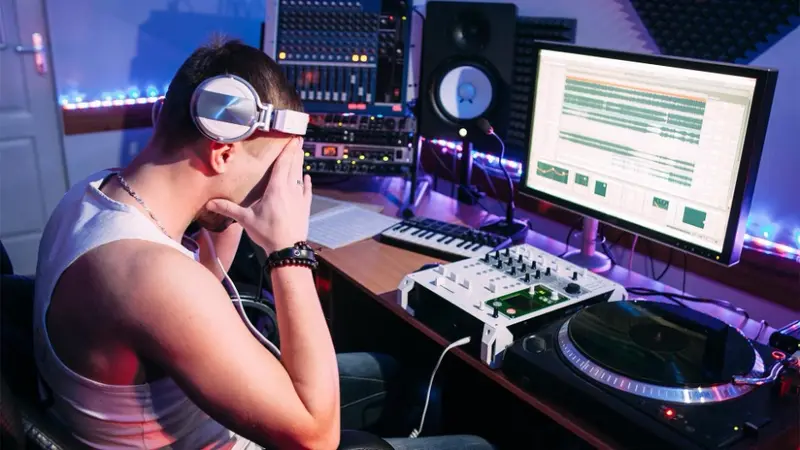
You sit down to make music, hands on your setup, ready to go – and nothing comes out. Your mind drifts, endlessly scrolling through playlists, plugin deals, and TikTok loops, hoping for that spark. The ideas feel like they’re out there, just out of reach, while your own track stays silent. It's a frustrating loop: more content, more comparison, but no progress.
In today’s hyper-saturated music world, creative blocks hit harder. Every scroll brings flawless mixes, viral sounds, and a constant feed of “how-to” advice that can swallow your confidence. The pressure to make something new, something good, can be paralyzing. And the usual fixes? More scrolling, more gear, more rabbit holes. They might give you ideas, but rarely ones you actually use. The problem isn’t lack of inspiration, it’s too much of the wrong kind. In this article, we’ll go over how some AI tools can help spark your creativity – not by replacing your ideas, but by getting you past the noise and back into your flow.
The Rise of AI in Music Creation
No single piece of software will fix a creative block on its own, but musicians across genres are turning to AI-powered tools as practical, everyday production aids. What once felt experimental or out of reach is now part of the average producer’s workflow.
As of this year, over 60% of musicians worldwide report having used an AI tool in their work, with more than a third now relying on artificial intelligence in their creative routines. LANDR, a platform for AI-powered mastering, lets you upload a mix and get a polished version that fits your style and genre. Its mastering tool adapts to loudness targets and genre variations, returns instant stems, integrates with plugins, and even offers musical prompts or sketches through the newer LANDR Composer.
LANDR isn’t alone. Suno AI offers multi-genre music generation, lyrics, and instrumental support using natural language prompts. Moises enables key shifting and stem separation, making it easy to experiment with arrangements or ideas. These tools are helping producers unlock new workflows, especially in remote collaboration and fast feedback loops across genres and skill levels.
AI’s Impact on the Industry and Artists
The larger music industry numbers are also instructive. This year, the value of AI in music cracked $2.9 billion, and projections through the end of the decade top $22 billion as adoption accelerates. Analysts expect a rise in music industry revenues of more than 17%, directly linked to faster production workflows and emerging musical genres supported by AI. Usage rates are highest in electronic and hip-hop music, with more than half of all producers in both segments using AI on a regular basis. Every major label has already integrated AI into parts of their workflow - whether it's for production, mixing, mastering, or writing - and indie artists are starting to do the same.
Research shows that most producers use AI at some point in their process, often for mastering, stem editing, or creating branded content prompts. The distinction between music made by a person and one partly shaped by a machine is blurring, with audience polls showing more than 80% of listeners unable to spot the difference in standard releases.
Using AI to Break Through Creative Blocks
Of course, not everyone agrees with the idea that AI is a good fit for all music. Listener surveys show that fans of styles rooted in raw, emotional performance - like folk or jazz - often prefer a more hands-on, human approach. Some artists worry about losing authenticity, or that too much AI could lead to over-processed or homogenized sounds.
Concerns about “robotic” music still pop up, even as AI-assisted tracks continue to rise. Ultimately, it comes down to how you use these tools: as creative assistants, not the main act.
If you are stuck on music, these AI-based options may move you forward faster, without any need for specialist tools:
- Start with regular mastering: Drag your mix or demo onto LANDR’s mastering interface and compare the AI output with your source. Adjust with a few easy-to-understand controls for loudness or balance, using the returned version as a new starting point.
- Split your songs: Use either LANDR or Moises to extract stems (separated vocals, bass, guitar, or drum lines) from recordings. This is very practical if you want to remix, try out alternate lyrics, or collaborate with someone remotely.
- Explore plugins: Try Suno AI plugins for lyric prompting, generative beats, or new chord progressions. These are simple to run and have built-in options for direct export.
- Use composition prompts: LANDR Composer can create new melodic and accompaniment ideas based on a sample track, text description, or mood reference. This is useful if you are stuck on the start of a verse or chorus and need a nudge.
- Try custom genre mixing: Suno AI responds to prompts such as “make this an industrial trap beat with heavy retro drops,” so you can set a genre or style, then fine-tune.
Here is one practical hack: Use a stem generator to split out elements from your favorite track, then piece them back together with new arrangements or instrument choices. This is a fast way to study arrangement without copying, and helps build completely fresh grooves off existing material.
Let the Tools Suggest, You Make the Call
There’s no perfect fix for a creative block, and AI won’t write your breakthrough track or define your taste. Sometimes, it outputs strange genre blends, over-trained sounds, or polished templates that lack the human factor you want. Treat these tools as assistants that offer extra ideas, not as workers that replace your own judgment. The best results come from working back and forth between algorithm output and manual edits, adapting each idea to fit your own intent.
Creative blocks make music feel harder than it should. AI won’t cure every dry spell, but it can break up repetitive habits or spark ideas you would not get from more scrolling on social media. The goal isn’t to outsource your creativity, it’s to keep it moving. Use the tools, refine the output, and shape it into something that’s fully yours. The most important part of producing music is keeping at it, no matter the source of your next idea.
LANDR


- User-friendly interface delivers great results with minimal effort
- Effective AI integration enhances mastering in specific situations
- Worth the price for casual mastering needs
- Not suitable for mastering metal genres
- Consumes excessive CPU resources
- Tends to create a high treble distorted sound
- Requires a learning curve for optimal use
- See 2 more


LANDR Composer Plug-in

About the authors

S. Jino is an accomplished multi-instrumentalist and music producer based in Kolkata, India, distinguished by his self-taught mastery and unique blend of technical acumen and musical performance. His extensive experience was forged through hands-on dedication, starting with the full restoration of a broken guitar. Jino's capabilities span keyboards, pedals, and advanced digital production, reflecting a comprehensive skill set developed independently. As a significant contributor to the music scene, Jino regularly performs with worship bands and college ensembles. He has also established himself as a reliable and authoritative professional in freelance mixing, mastering, and original music creation. Inspired by the innovative sounds of Brian May and David Gilmour, and influenced by Kolkata's vibrant metal community, Jino is committed to the intricate art of vintage gear restoration and the continuous exploration of music and technology fusion. His current professional setup, featuring a meticulously restored nameless guitar, a Fender Player Strat, and a Boss Katana 50. Read more



.webp)