Table of Contents

Equipboard
Equipboard is the world's largest community of artists and their gear. Read our review process.
We are reader-supported. When you buy through links on our site, we may earn an affiliate commission. Learn more.
Our Picks
-l.webp?v=1780112600)


Picture this: a scrawny kid from working-class California, barely tall enough to reach the fretboard, unwrapping his first electric guitar. Little did young Billie Joe Armstrong know that this modest Fernandes Stratocaster copy (possibly the Revival RST-50 '57 model from the mid to late 70s) would become the stuff of guitar legend. Fast forward a few decades, and that same guitar - now affectionately known as "Blue" - has racked up more stage time than most rock stars, leaving an indelible mark on punk music history.
Blue isn't just any old six-string. It's the guitar that launched a thousand power chords, the weapon of choice for one of punk rock's most influential frontmen. From the grimy clubs of Berkeley to sold-out stadiums worldwide, this battle-scarred instrument has been Armstrong's faithful companion, helping to craft the unmistakable sound that catapulted Green Day from local misfits to global superstars.
But what's the real story behind this iconic axe? How did a knock-off Strat become one of the most recognizable guitars in rock? And what is it about Blue that's kept it in Armstrong's hands for all these years?
The Origins of Blue

Every legendary guitar has a story, and Blue's tale is no different. Before it became an icon of punk rock, before it graced world stages, it began with a simple act of love. Let's rewind to where it all began.
A Childhood Gift
In 1982 or 1983, when Billie Joe Armstrong was 10 or 11 years old, his mother gave him a gift that would change his life: a Fernandes Stratocaster copy that would soon be known as "Blue". This guitar would go on to define Armstrong's tone and playing style, ultimately helping him achieve worldwide fame with Green Day.
Armstrong's mother purchased it for $180 from George Cole, who was Billie's guitar teacher at the time. Allegedly, she had to work extra graveyard shifts to afford it.
Interestingly, there's a claim about the guitar's history that adds to its mystique. Reportedly, the instrument was previously owned by former Santana bassist David Margen, who played with the legendary musician in the late 1970s and early 1980s. However, some sources indicate that Cole bought the guitar new from David Margen, rather than it being previously used by him.
The First Electric Connection
For Billie Joe, Blue was a game-changer. It was his first electric guitar, opening up a whole new world of sound. Compared to his previous acoustic, this electric Fernandes was a significant step forward. Its classic shape and tone were well-suited to the punk rock style Billie Joe was developing.
From the first strum, Billie Joe was hooked. The guitar's versatility allowed him to explore various styles, from catchy punk melodies to hard-hitting power chords. It wasn't long before the guitar felt like an extension of himself.
Blue became a constant companion in Armstrong's musical journey. As his first electric guitar, it played a crucial role in shaping his playing style and sound. This Fernandes Stratocaster copy would go on to be an integral part of Green Day's early career and sound development.
The story of Blue is about the beginning of a musical journey, the development of a distinctive sound, and the role a single instrument can play in shaping a musician's career.
Modifications and Musical Evolution
As any guitarist will tell you, a great instrument is like a living thing - it grows and changes with its player. Blue was no exception. Over the years, Billie Joe Armstrong transformed this off-the-shelf Fernandes into a unique powerhouse that perfectly matched his evolving style and the needs of Green Day's music. Let's dive into the changes that turned Blue from a standard guitar into a punk rock icon.
Transforming Stock to Signature
When Billie Joe first got his hands on Blue, it was a pretty standard Fernandes Stratocaster copy with three alnico single-coils. But as his playing style evolved, so did the guitar. Billie Joe made it his own.
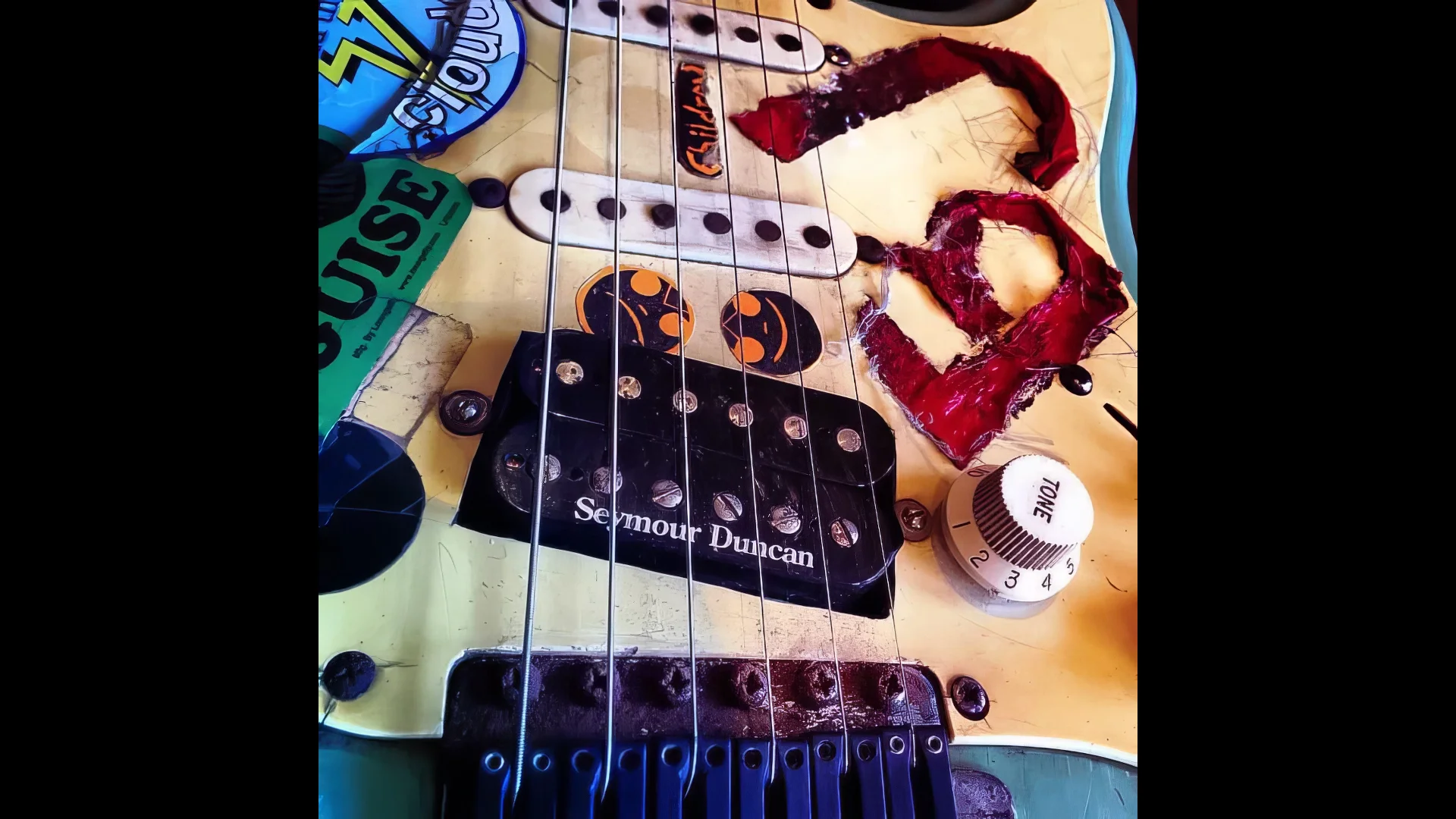
The most significant change to Blue's sound came from replacing the bridge pickup. Initially, Billie Joe swapped the stock pickup for a Bill Lawrence LX500XL humbucker. Later, he replaced it again with a Seymour Duncan SH-4 JB. This pickup replacement transformed Blue's tone, giving it a thicker, punchier sound that cut through the mix like a knife.
But Billie Joe didn't stop there. He replaced the original tremolo with something more robust, which helped keep the guitar in tune during his aggressive playing. The original tuning pegs were swapped out as well.
Punk Rock Customizations
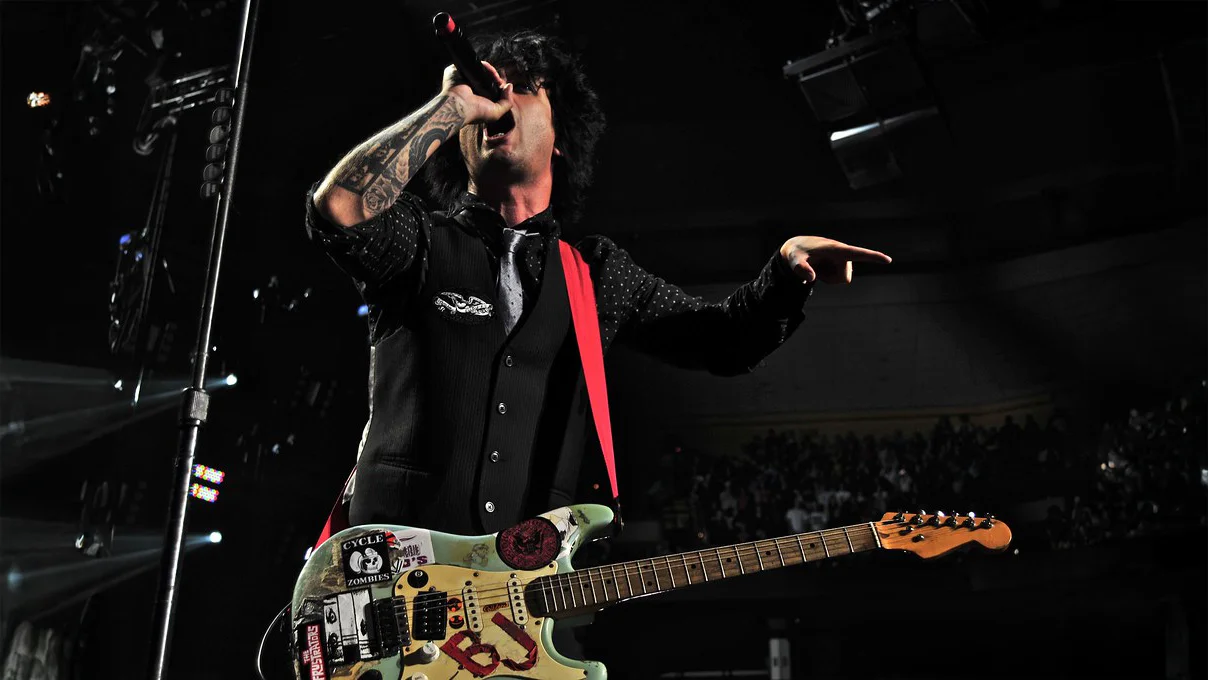
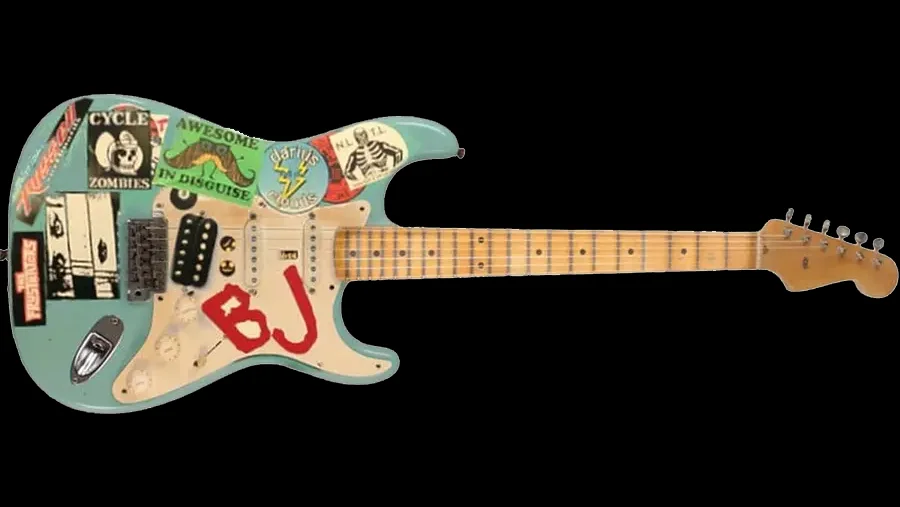
Blue's modifications weren't just limited to sound; they were also about style. Over the years, Billie Joe plastered the guitar with stickers, each one telling a part of his story. The most famous of these is the "BJ" possibly made from tape, which became almost as iconic as the guitar itself.
This and the other stickers represented Billie Joe's DIY punk ethos, turning Blue into a visual representation of his musical journey. Each scratch, dent, and worn spot on the guitar became a badge of honor, a testament to the countless shows and recording sessions it had been through.
The wear and tear on Blue wasn't something Billie Joe tried to hide either. Instead, he embraced it. The chipped paint, the worn fretboard, the dings and dents - they all added to Blue's character.
Blue in Green Day's Musical Journey

Billie Joe Armstrong's iconic "Blue" guitar has been a crucial part of Green Day's sound since the early days of the band.
Dookie: The Breakthrough Album
"Blue" was prominently featured on Green Day's major-label debut album, Dookie, released in 1994. The guitar's unique sound, driven by its modified pickup configuration, can be heard on tracks like "Basket Case," "When I Come Around," and "Welcome to Paradise".
Key Live Performances
"Blue" has been a constant presence in Green Day's live performances:
- Woodstock '94: The guitar was famously used during Green Day's mud-covered performance.
- MTV Video Music Awards 1994: "Blue" was featured in the band's breakout TV performance of "Basket Case".
- Various tours: The guitar has been used extensively for performing Green Day's earlier material.
Recording Highlights
Beyond Dookie, "Blue" has been used on several Green Day albums:
- Insomniac (1995): The guitar appears on the album cover and was used in recording.
- Nimrod (1997): While specific tracks are not confirmed, the guitar was likely used during this period.
Technical Specifications
For guitar enthusiasts and gear heads, the nitty-gritty details of Blue are just as fascinating as its history. Let's take a closer look at what makes this iconic instrument tick.
Fernandes Stratocaster Details
As mentioned earlier, Blue started life as a Fernandes Stratocaster copy. Fernandes, a Japanese guitar manufacturer, was known for producing high-quality replicas of popular guitar models. The body style closely mimics that of a Fender Stratocaster, with its double-cutaway design allowing easy access to the upper frets.
The guitar's body is most probably made of "silver heart" wood or mahogany or even hard maple. The neck is maple, topped with a rosewood fretboard, a classic combination that provides both stability and a smooth playing surface. The neck was refretted at some point.
Originally, Blue came equipped with a standard tremolo system and a set of single-coil pickups, typical for Stratocaster-style guitars. However, as we saw, these stock components didn't stick around for long once the guitar was in Billie Joe's hands.
The Pickup & Hardware
Blue's first major upgrade came when Armstrong installed a Bill Lawrence L500XL humbucker in the bridge position supposedly at the suggestion of his guitar teacher Cole. This pickup, known for its high output and suitability for heavy gain, was used during the recording of Green Day's breakthrough album, Dookie. This humbucker was installed in the same angular fashion as a traditional Strat single coil resulting in a unique aesthetic as well as sound.
However, the L500XL's tenure was relatively short-lived. Around the time of Woodstock '94, Armstrong switched to a white humbucker pickup, presumed to be a Seymour Duncan SH-4. This pickup was damaged during the infamous mud-filled performance, leading Armstrong to temporarily reinstall the L500XL for the recording of Insomniac.
In 1995, Armstrong made what would become a long-term change, installing a Seymour Duncan SH-4 JB humbucker. This pickup, known for its versatility and ability to deliver both chunky power chords and articulate lead lines, has remained in Blue ever since.
Armstrong never really used the middle and neck pickups and at some point, these were disconnected, with the pickup selector was locked in the bridge position.
To complement this pickup arrangment, Billie Joe replaced the stock tremolo with a different tremolo system but the exact make and model is unknown. The same applies for the original tuners which were changed, most probably, to improve tuning stability during spirited performances.
Cultural Impact and Legacy
Blue has become a cultural icon in its own right. Its impact extends far beyond the music it's helped create, influencing everything from guitar manufacturing to fan culture. Let's explore how this humble Fernandes copy has left its mark on the world of rock music.
Influence on Punk Rock Gear
Blue's success story has had a significant impact on how punk rockers approach their gear. Before Blue, there was often a notion that punk rock required cheap, disposable instruments. But Billie Joe showed that you could have a long-term relationship with a guitar, modifying and improving it over time, without losing that raw punk edge.
This shift in mindset influenced many up-and-coming punk guitarists. Suddenly, it was cool to have a beat-up but well-loved instrument. The idea of modifying guitars to get the perfect sound also gained traction. Many punk guitarists started experimenting with pickup swaps and other modifications, following in Billie Joe's footsteps.
Guitar manufacturers took notice too. The popularity of Blue led to an increased demand for guitars with high-output pickups. Seymour Duncan saw a surge in sales of their pickups, and other manufacturers rushed to create similar products.
Fan Tributes and Replicas
Blue's iconic status has inspired countless fans to create their own tributes. Walk into any Green Day concert, and you're likely to see several fans wielding blue Stratocaster-style guitars, complete with stickers mimicking Billie Joe's.
Fender even made a few replicas of Blue for Billie. If you have seen videos of Billie smashing up what looks like Blue, it is one of these replicas that you saw meeting an early end.
Beyond official replicas, there's a thriving community of fans who build their own Blue-inspired guitars. They share tips on forums and social media about how to get the right shade of blue, where to find the perfect stickers, and how to achieve that worn, battle-scarred look.
Current Status and Preservation
As Blue approaches its fourth decade of rocking, many fans wonder about its current condition and role in Billie Joe's arsenal. Let's take a look at where this iconic guitar stands today and how it's being preserved for the future.
Where is Blue Now?
Despite its age and countless shows, Blue remains part of Billie Joe's guitar lineup, albeit no longer his primary guitar.
In recent years, Billie Joe has been more selective about when he brings Blue out. It's often reserved for very special occasions or particularly meaningful songs. Blue is probably stored carefully and maintained somewhere safe given its significance to Billie Joe.
Billie Joe's Relationship with the Guitar
Even as Green Day's sound has evolved and Billie Joe has experimented with different guitars, his connection to Blue remains strong. In interviews, he still speaks of the guitar with great affection.
However, Billie Joe is possibly aware of Blue's historical significance. He's become more cautious about exposing it to the rigors of constant touring. There's been some speculation among fans about whether Blue has been retired completely. So far, Billie Joe has neither confirmed or denied these rumors.
Either way, the story of Blue is far from over. For Billie Joe Armstrong, Green Day, and countless fans around the world, Blue remains a symbol of punk rock spirit, musical evolution, and the enduring power of a simple guitar to shape the sound of a generation.
Conclusion
The story of Billie Joe Armstrong's Blue guitar is more than just a tale about a musical instrument. It's a narrative that encapsulates the spirit of punk rock, the evolution of a band, and the deep connection between a musician and his tool of creation.
From its humble beginnings as a gift from a mother to her son, Blue has been on an incredible journey. It's been a constant companion through Green Day's rise from local punk favorites to international rock stars. The modifications made to Blue over the years mirror the band's own musical evolution, each change reflecting a new chapter in their sound.
But perhaps what's most remarkable about Blue is its longevity. In a world where musicians often switch instruments with each album or tour, Billie Joe's dedication to this one guitar stands out. It's a testament to the emotional connection he has with the instrument, and to the idea that sometimes, the most powerful music comes from a place of familiarity and history.
Blue has become more than just Billie Joe's guitar - it's a cultural icon in its own right. It has inspired countless replicas, influenced guitar manufacturers, and become a symbol of punk rock authenticity. For many fans, seeing Blue on stage is as exciting as seeing the band members themselves.
As we look to the future, it's clear that Blue's story is far from over. While it may not be used as frequently as it once was, its importance in Green Day's history and Billie Joe's musical journey ensures that it will always have a special place in rock and roll lore.
Fernandes Stratocaster "Blue"
5.0 (17)
-s.webp?v=1780112600)




See how artists use this


.png?v=1785070563)



About the authors

S. Jino is an accomplished multi-instrumentalist and music producer based in Kolkata, India, distinguished by his self-taught mastery and unique blend of technical acumen and musical performance. His extensive experience was forged through hands-on dedication, starting with the full restoration of a broken guitar. Jino's capabilities span keyboards, pedals, and advanced digital production, reflecting a comprehensive skill set developed independently. As a significant contributor to the music scene, Jino regularly performs with worship bands and college ensembles. He has also established himself as a reliable and authoritative professional in freelance mixing, mastering, and original music creation. Inspired by the innovative sounds of Brian May and David Gilmour, and influenced by Kolkata's vibrant metal community, Jino is committed to the intricate art of vintage gear restoration and the continuous exploration of music and technology fusion. His current professional setup, featuring a meticulously restored nameless guitar, a Fender Player Strat, and a Boss Katana 50. Read more




.webp)

.webp)