
By Gear Experts
Table of Contents

Equipboard
Equipboard is the world's largest community of artists and their gear. Read our review process.
We are reader-supported. When you buy through links on our site, we may earn an affiliate commission. Learn more.
Introduction
In this episode of the series "The Genius Of" I'm going to discuss the guitar abilities of Russell Lissack.
Russell Lissack is known for being a lead guitarist in Bloc Party, as well as lead guitarist in project Pin Me Down. He also briefly joined Irish rock band "Ash" for live performances. In my opinion, he is one of the most innovative and experimental guitarists of the 2000's. In the further paragraphs, I'm going to try and defend my opinion.
Creative Evolution
Early days/pre-Silent Alarm
Before becoming Bloc Party, the band went through some changes. Their names before Bloc Party were Union, Angel Range, and Diet. Not much of their early musical scores exist, however, there is a video online, which shows band performing as the Angel Range back in 2002. In the video, they play six songs, "We Fear Change," "Rivulet," "The Answer," "Life Of The Party" and "Lead by Example." Demos of some of the early songs also exist, which used to be on the band's old website. However, those were only minute short demos, full versions of them could be bought.
Considering the video is pretty blurry, it's almost impossible to identify the gear Lissack was using. A zoom reveals that he uses Squier Jagmaster, a Marshall combo amplifier, and a few pedals.

The 2002 show of Bloc Party, performing as the Angel Range. Lissack can be seen on the right with Squier Jagmaster, stepping on the wah pedal.
Lissack's sound can be seen evolving in this video - combining wah, delay, and reverb to create spacey tones, with the example being "Lead By Example," which is the most interesting song in the video. The chord progression in the chorus of the song is the same chord progression that goes on in the chorus of "Helicopter," one of their most famous songs. Also, the drumming intro for the same song closely resembles the intro of "Banquet." "Life Of The Party" was used for their song "Lean."
Most of Lissack's playing strongly resembles Johnny Marr's arpeggios to fulfill the guitar sound. If we take a look at his setup then, it was pretty minimalistic, and it was like that during the Silent Alarm.
Their first recorded track was "The Marshals Are Dead," which was featured on the compilation "The New Cross" back in 2003. The song is kind of interesting in many ways. From dueling guitars, which culminated later in the "Banquet." The song starts off marching drum pattern, and with intro chords being as follows:
B minor – Bsus4 – B minor – A# major
The song builds up progressively and ends with the bombastic, explosive and energetic solo. The solo incorporates the tremolo picking. After the solo, instrumental jam is heard. The idea of energetic solos at the end was incorporated into another one of their first songs, "She's Hearing Voices." This song is significant for the band because frontman Kele Okereke gave this exact song to Alex Kapranos (frontman of the band Franz Ferdinand), and BBC Radio 1 DJ, Steve Lamacq. The song was labeled as "genius," and received much airplay. The song was featured on the "Silent Alarm" album, but because of the love it brought to the band, I thought that the place of the song would be here.
In this song, the build-up pattern continues. The song begins with drumming and a D note (played on tenth fret, first string), which is looped via delay pedal. Kele Okereke uses this technique. Before the build-up, he ends the loop and incorporates pedal synthesizer (likely a Boss SYB-3). At the build-up, he continues to play the guitar regularly, joining Lissack during the guitar solo.
The arpeggio idea in this song is also visible. During last verses, Lissack briefly uses arpeggio on following the chord progression.
Dmadd2 – A# - C – Dm
The idea of the solo is just like "The Marshals Are Dead" one - explosive and bombastic. Using tremolo picking, bending, hammer-ons and pull-offs, the solo stands out from rest of the solos at that time.
Silent Alarm
The breakthrough of the band has always been "Silent Alarm," their first studio album. In 13 songs, the band was singing about topics such as maturing, corruption, political criticism and life in general.
Lissack incorporated many different techniques, yet using the pretty minimalistic setup for that time. His pedalboard included pedals such as Boss DD-5, Boss TR-2, and Dunlop Cry Baby wah pedal. His amps of choice were always Fender Deluxe amplifiers, sometimes used with power attenuators. During "Silent Alarm" era, those were Marshall 80/20 power attenuators and later switched with THD Hot Plates (8-ohm versions).
The minimalism of his pedalboard can be seen at Bloc Party’s performance live on Conan O’Brien’s show, where he only used three Boss pedals for “Banquet”! The pedals were distortion (or even overdrive), delay and tuner pedal.
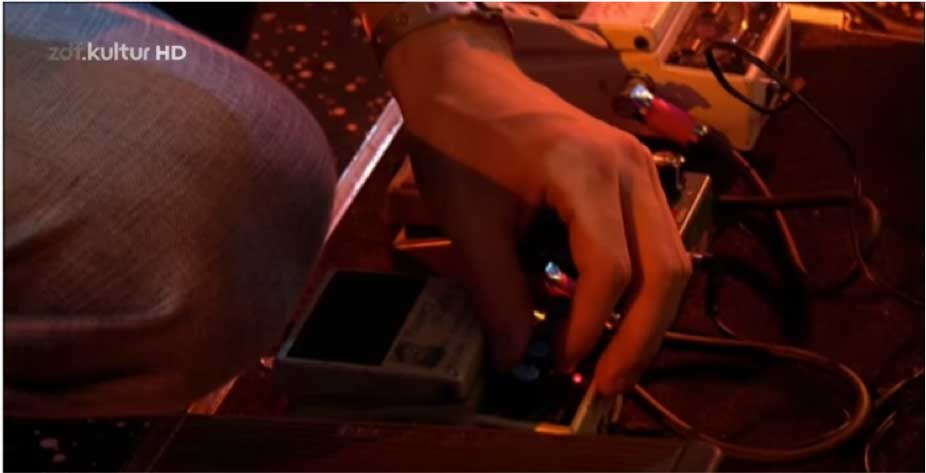
Snap from Bloc Party's performance at "Live...with Jools Holland" back in 2004. The "Silent Alarm" pedalboard apparently contained Boss DD-5, Dunlop Cry Baby Wah, and a Boss Tuner, which can be seen in this photo.
Some say that the opening of "Silent Alarm" himself is fantastic. The opening primarily consists of an open high E string being tremolo picked and ran through Boss DD-5 delay pedals, set on reverse delay settings. The dive-bomb sounds are produced slowing down the delay time. A fellow Bloc Party lover has managed to replicate the sound.
Of course, the bass is also heard in the intro of the song, picking the E note along with the guitar.
The next song on the album is "Helicopter," which has the interesting intro, with two guitars rocking the riff in B minor. The song is wild, fast-paced and energetic in any way. In the verses, Lissack is playing interesting fills, with a lot of distortion incorporated. Fills are mostly in B minor pentatonic scale.
Pre-chorus contains major and minor thirds, and in live performances of the song, Lissack also adds pinch harmonics to the song, making the pre-chorus more fulfilled. Also, the odd stop during the pre-chorus is also something that wasn't used back then.
The riff on end is one of the most unusual things in this song. It is entirely composed of natural harmonics on 12th and 7th fret. Only in this part, some delay was heard. Effect-wise, "Helicopter" is a pretty simple song, with only distortion and delay used. Also, there is a little build-up at the end, with Kele Okereke playing harmonics outside the fretboard, which culminates to another chorus.
The idea of build-up is also heard in "Positive Tension." It starts off with drums and G#, F and C notes played by Kele Okereke. Those notes are then manipulated with the synth pedal. Lissack uses delay and reverb in the song, especially before the build-up, where he uses C minor pentatonic scale for riffs. The build-up is a chord progression which goes as follows:
C5 G5 G#5 F5 D5
C5 G5 G#5 F5 C#5
The solo at the end is the first solo we hear from Lissack in the song. Very interestingly made, with the boogie-like pattern at the ending of it, it is the perfect way to bring the song to an end. Also, the glitched note can be heard in the studio version. Live, Lissack uses Boss PS-5 super shifter and drops the note octave down instead of glitching it. The end is just another fill in C minor pentatonic scale, this time an octave up from the fill before the build-up. Also, the reverse delay can be heard on that fill.
My personal favorite is the song that comes after it. "Banquet," which is possibly the finest guitar work, both by Okereke and Lissack. Lissack plays fills, while Okereke plays the following power chords. Guitars play in syncopation.
A#5 D#5 C#5 F#5
A#5 D#5 C#5 G#5
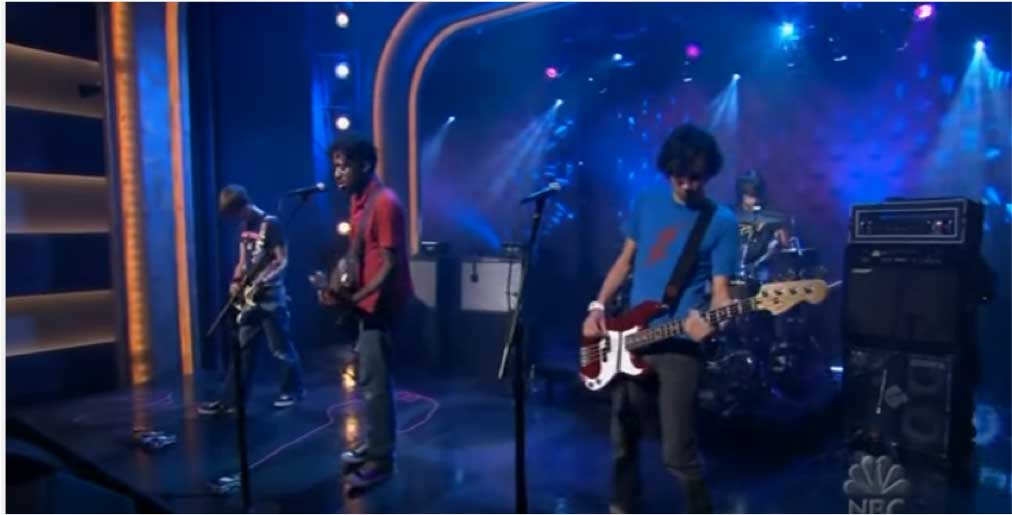
Bloc Party's performance of "Banquet" live at Conan O' Brien back in 2005. Note that Lissack has only three pedals, while Kele only has a tuner. Also, look at the Marshall Powerbrake power attenuators on top of Deluxes.
On the chorus of the song, guitars play entirely different things, with Lissack messing with octave chords. Also, the riff from the third guitar can be heard after the "To feel her underneath" part. Lissack manages to incorporate that riff, along with the rhythm part, in live versions. This is not the first time Lissack successfully plays what two guitars would usually play. Check out the KEXP version of "This Modern Love," where he manages to play parts for Kele and himself - only on one guitar! And the guitar is the Fender acoustic! (Oh, and the ending is lovely!)
Live, some songs, such as "Helicopter" and "Banquet" were played much faster. However, this doesn't happen all the time. When Bloc Party played "Banquet," back in 2005 live at Conan O'Brien, they did it much slower. However, on Glastonbury 2009, they played it much faster.
Chords, although that is usually attributed to Kele Okereke, are mostly power chords, although more unusual chords can be seen in songs such as "Blue Light" and "So Here We Are." "So Here We Are" is a fascinating song, because it's one of their first songs where they drown their guitars in reverb, creating more of a wall of sound sound than usual, dueling guitars like on "Banquet." Also, reverb on vocal is also featured. The vocal experimentation would become much more widespread in future works.
The Weekend in The City/Another Weekend In The City
After After Silent Alarm, the band released their second album called "A Weekend In The City." The album was darker in sound, and also in song thematics. Songs were about terrorist attacks (specifically about the 2005 London bombing), racial attacks and sexuality.
If we take a look at the sound of the record, one can tell that band matured a lot when making that record. Songs feature multi-layered guitars, harmonization, electronic elements and a lot of experimentation.
Influences for the record were various compositors, such as Polish composer Krzysztof Penderecki, Hungarian composer Gyorgy Ligeti, but also more commonly heard music, such as Amerie and Missy Elliott.
Disillusioned with popular guitar music made at that time, Okereke and Lissack went back and forth with melodic-aggressive guitar playing, which can be heard on the record. One of the most important techniques for this album is the guitar harmonization. Although it was most commonly used in the 80’s by artists such as Paul Gilbert and Yngwie Malmsteen, it was utilized in an entirely different way.
“Song For Clay” is the first song on the record. It starts out with a couple of chords strummed, then a drum fill and the explosive riff. The riff is played in unison by two guitars, then Lissack goes on to harmonize the riff, and then the riff is played in unison back again. Also, the song is probably one of the darkest songs on the record.
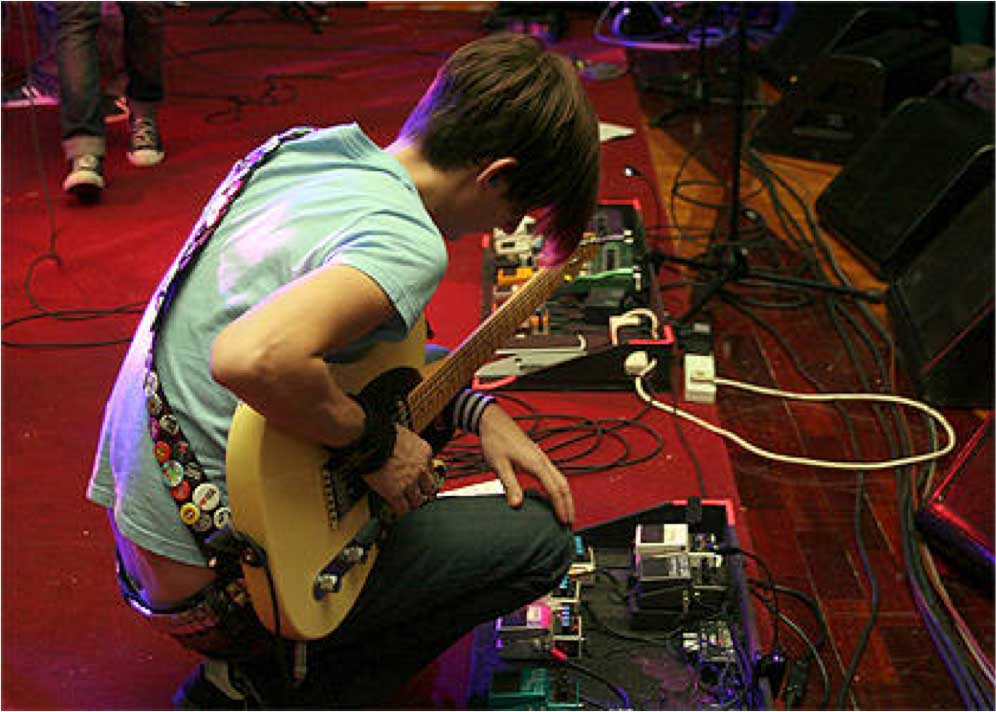
Lissack checking his pedalboard, live at Maida Vale back in 2007. The pedalboard is pretty minimalistic- three Boss Digital Delays (two DD-6's and DD-5), Boss Digital Reverb, Boss PS-5, Boss tuner and Dunlop DC-Brick power supply.
Lissack, specifically, does amazing fills on the chorus, adding major thirds and melodic soloing to the song. After the chorus, he incorporates wah pedal and tremolo picking for the fill. He slowly bends the string, and after bending and hammering on the 8th fret, he goes on to play a small lick created in A# harmonic minor scale. Also, the bridge part is interesting. He switches to clean sound, plays the riff, and right after the riff, he does the glitch via delay pedal, messing with the delay time knobs.
Also, “Hunting For Witches” brought another wave of creativity in his guitar playing. He starts off with the riff in the key of F# minor, but before that, he does the weird, spooky sounding lick.
I have been wondering a lot how he does it. The answer (no pun intended) is following. He plucks the strings with the pick used sideways. Also, keep in mind that he does that around 7th fret, and is ran through delay and reverb pedals.
The riff is played using octave pedal, although I don’t know which. Looking back at the “A Weekend In The City” days, it could be either achieved using Electro-Harmonix POG pedal or Boss PS-5 super shifter pedal.
Octave chords are used in the chorus, and after the chorus, tremolo picking using wah pedal occurs. The same technique was used on “Disappear Here.” Also, harmonization occurs right at the part after. The song ends with the same sideways pick method which happens at the start of the song.
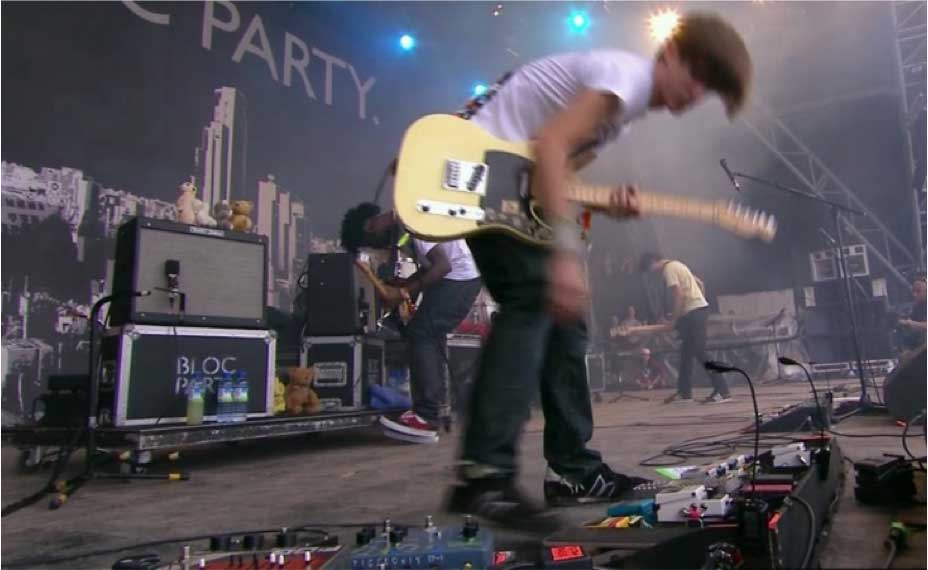
Snapshot of Russell Lissack performing at the Glastonbury 2007. Besides the usual pedals, check out the Pigtronix EP-1 Envelope Phaser, which is seen next to the Electro-Harmonix POG.
“Waiting for the 7:18” is also pretty impressive, it starts out with glockenspiel and volume swells. Volume swells are also common in Lissack’s playing. However, volume swells were also used on the “Blue Light.” From the “Silent Alarm” era to present, he always used either Ernie Ball 6165 or Ernie Ball VP JR.

Snap from Bloc Party's "Waiting For The 7:18" performance live at the Glastobury 2009. Note that Lissack's foot is on volume pedal, and that the tuner is on, for some reason.
The song explodes into glorious “wall of sound” extravaganza through the song, which incorporates tremolo picking, as well as layered guitars and vocals. At some point, the synth is also in the song, making it almost impossible to distinguish guitar parts. The ending of the song is similar to the “I Still Remember”- guitar feedback and a little riff.
“I Still Remember” is the next song that is vital on the album. The riff, in the beginning, is mostly in F major pentatonic scale. However, this song doesn’t revolve much around Lissack’s fills, but on Okereke’s chord progression. In this song, the chord progression is quite similar to their song, “Two More Years.”
“I Still Remember” chorus chords:
D5 A#5 F5 G5 A5
“Two More Years” chorus chords:
D5 C5 F5 G5
The end of the song also becomes a wall of sound at some point. Locomotive noises can be heard at some point of the song, but those are just unison bends on the guitar, with a lot of fuzz added (I would suggest the fuzz being the Electro-Harmonix Big Muff Pi).
Although the album is pretty wild and features a lot of distortion, fuzz, and overdrive, not all of the songs are composed that way. The perfect example of the song is “Kreuzberg.” A little bit of trivia, Kreuzberg is a district in the German capital city, Berlin. Also, the song mentions Berlin locations and public transportations, such as German railway system “U-Bahn,” and Berlin’s central train station, the Hauptbahnhof.
Lissack plays the chord, which could be simplified as A minor. The same chord is the beginning chord of “The Zephyr Song” by Red Hot Chilli Peppers. The song doesn’t include much effects - only delay and reverb are ones to note.
The song achieves its spacey and dreamy background both by guitars, but also by backing vocals, provided by bassist Gordon Moakes and drummer Matt Tong.
Also, approximately at the same time, Bloc Party released many B-sides and select songs. Those songs were later compiled into an unofficial album called “Another Weekend In The City.” This album has its artwork as well!
Songs on the album were more experimental than the “A Weekend In The City” ones. The sound of the album depends on the songs. Considering there isn’t proper track listing for this album, it is an emotional guitared roller coaster. “Version 2.0” includes guitar with effects such as fuzz and ring modulator, with the punkish riff which later evolves into harmonized guitar fest. “Cain Said To Abel,” which, when looked at the chords, sounds like the hyped version of “This Modern Love.” Harmonization is also heard at some point.
“Vision of Heaven” starts off with the riff which is characteristic for summer songs, such as “Waves” by Mr. Probz. But, considering the album was done somewhere in 2006/2007, Lissack did it before it was mainstream! Nice! Also, the same “summer hit” riff can be heard in another song from the album, “England.”
Equipment Lissack used for both albums is undocumented. However, there is a webcast which briefly shows the process behind “A Weekend In The City.” However, not much gear can be determined from the video, because of the low-quality shot. At one point, there is Lissack with his pedalboard, but what the pedalboard contains is only a subject to discuss. It certainly has a lot of Boss pedals, mainly delay pedals.
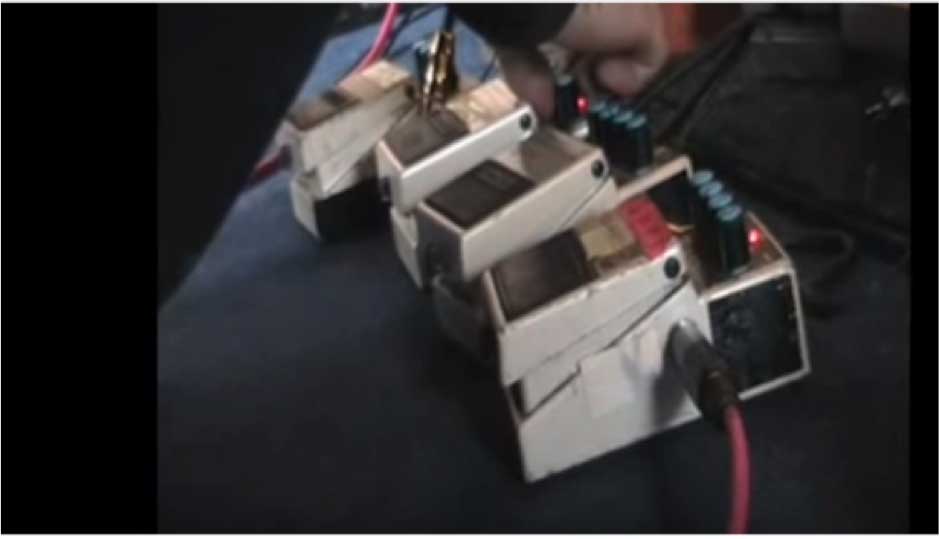
Four Boss digital delay pedals, used for recording "A Weekend In The City." Either used by Kele or Russell, but I would rather attribute delay tricks to Russell.
At one point of the video, we can see that there are four (!) Boss DD-5(?) pedals chained, but for an unknown use. Amps used were probably classic Fender Deluxes, but the Vox AC-30 is also visible in the video, as well as another combo amp of unknown making.
Intimacy
Following album was even more experimental. “Intimacy” is the third studio album by the band. Inspired by Kele Okereke’s broken relationship, “Intimacy” is a mess. But, also, it’s possibly one of the most experimental albums of the 2000’s. It features everything from extensive pitch-shifting, choir, samples, loops, and trumpets!
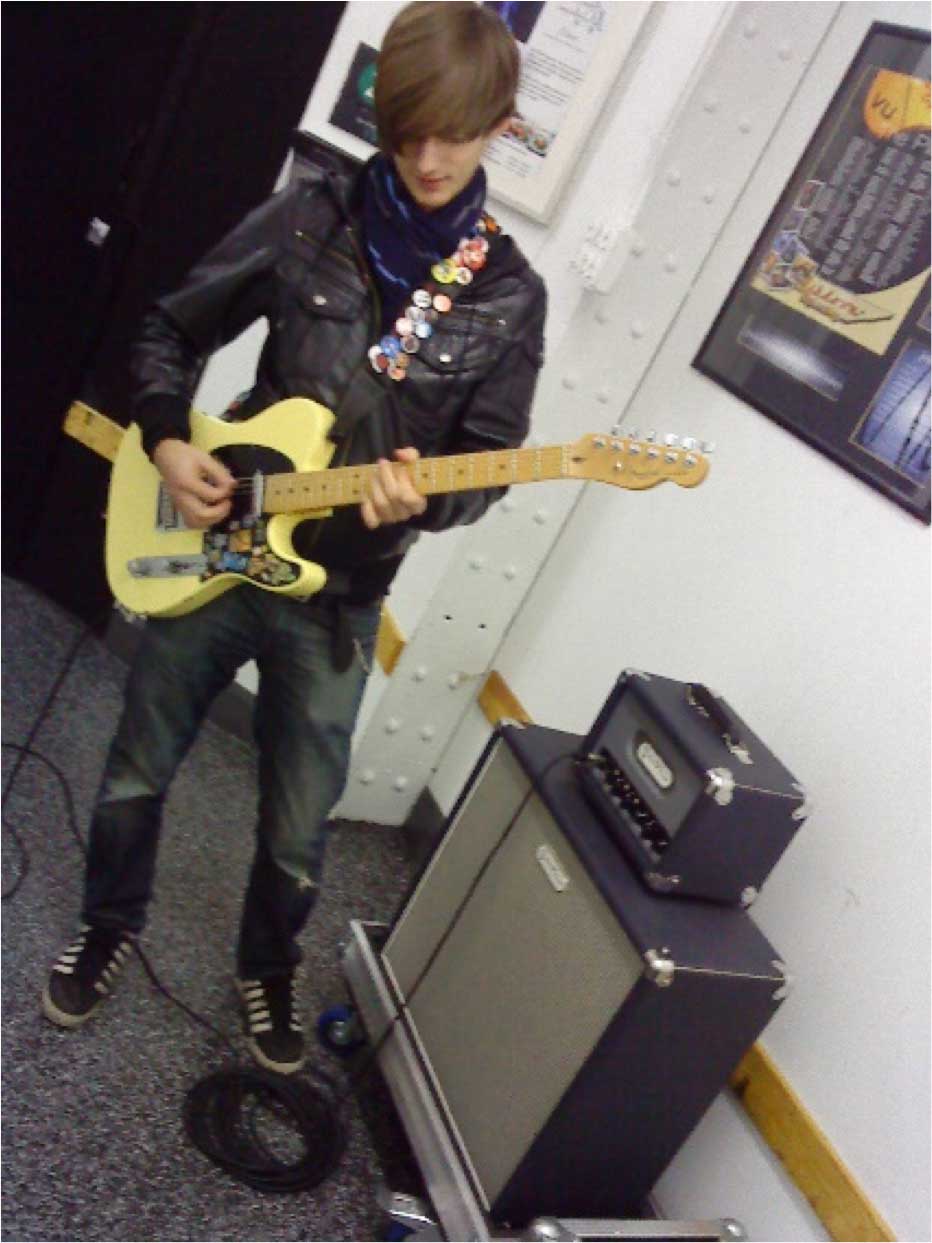
Russell Lissack with Audio Kitchen Little Chopper back in 2009. He would later use this amp for touring.
“Ares,” the first song on the album epitomizes everything I think about “Intimacy.” It starts out with an open D string pitch-shifted an octave up, and then octave down. Live, Lissack doesn’t play open D string, but uses pinch harmonics and pitch-shifts them an octave up and down. Pitch-shifters utilized in the live versions are a couple of Boss PS-5 super shifters. “Mercury” is also a fascinating song, but guitar parts here are mostly composed of tremolo picking and a couple of licks and riffs. The most recognizable part of the song are vocals, which are looped by Okereke at the start of the song, using his Boss looper pedal.
Electronic characteristics took such proportions, that guitar was omitted in “Signs,” which is the next song I am going to talk about. “Signs,” although minimalist works heavily influence it and only incorporates synth pulses and glockenspiel, live versions are much more mesmerizing, with Lissack and Okereke’s guitar interplay contributing a lot to the song. “Signs” is one of the most minimalistic songs Bloc Party has ever made. It was an oddity to see this song on the album which is full of experimentation and crazy noises.
Also, there is “One Month Off,” which is possibly one of the most aggressive songs on the record. Power chords played in a punk rock fashion are heard. Although only power chords at the beginning and the middle of the song, Lissack also manages to do crazy fills on guitar, which perfectly suit with the synth, which starts to get more intense as the song goes. Also, something unusual happens here at the end.
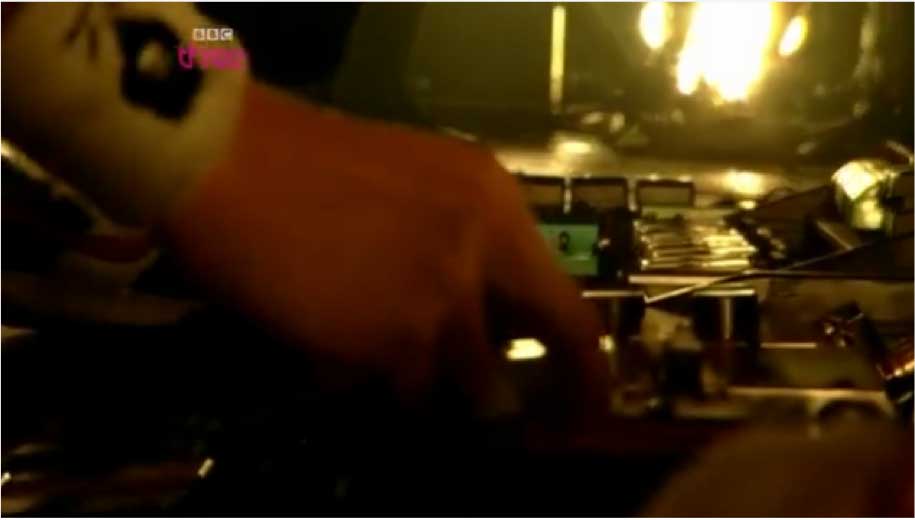
Snapshot from the performance of "One Month Off" live at Glastonbury 2009. For weird synthy parts, Lissack used Korg KAOSS Pad, which he is seen pressing in this photo.
It’s the modulation. The song modulates from A minor to B minor. Also, the synth fills live (and possibly in the studio) were done using the Korg KAOSS Pad, which was used during “Intimacy” and “Four” era, but omitted during the “Hymns” era.
Four/The Nextwave Sessions EP
After four years, the band released another record, called "Four." "Four" is the fourth album by the band, surprisingly. The record was made after band's longest hiatus, which lasted for four years. Lissack then joined Ash and found his Pin Me Down project.
"Four," although still as wild and as experimental as previous two albums, still brings us much different sound. Song thematics include New York's drug scene, reality television, as well as science fiction books.
Although Lissack is not a fan of alternate tunings, during "Four," he used drop D quite a lot. Although that is a tuning where only one string is tuned down, that is still an alternate tuning, right?
Some songs were so odd for Bloc Party's style that people would never think that they have done such songs. For example, "Kettling" includes guitar solo and distorted guitars, which quite resemble Blink-182's work on their self-titled album. "Four" brings more brusquely sound to Bloc Party. However, songs like "V.A.L.I.S." and "Leaf Skeleton" heavily remind of band's previous works on "Silent Alarm."
"Coliseum" starts out with acoustic blues jam, which is another new thing for the band. The band didn't use acoustic guitars much during their career, so this is an oddity. However, "Octopus" is the song I want to talk about. "Octopus" starts out with the weird delayed riff. The riff incorporates two delay pedals. There have been many discussions about how the delay riff was made. The answer is custom-made delay pedal.
Lissack has a pedal in which there are two Boss digital delay boxes. Each of them has different delay time set. The pedal also has a controller. In Premier Guitar rig rundown, it is revealed that the controller is Boss DD-3 digital delay pedal, with knobs removed. The pedal is triggered when two switches on the pedal are pressed and is controlled by the controller. Riff starts out with A string being played on the 12th fret, and the A minor chord played as (xx75xx). Song also incorporates a guitar solo in A minor, which includes wah pedal, although there has been a discussion of the pedal being a phaser.
One of the most famous songs on the album, although not included in the standard tracklist, on the deluxe version on the album, is "Leaf Skeleton." Praised for the drum work, "Skeleton" also reminds of band's early guitar work, when Lissack and Okereke's guitars contemplated each other. It is also one of the darkest and most depressing songs Bloc Party has ever made.
"Skeleton" didn't receive much live performance, but it was played live at the Roundhouse, which was one of their more recent performances.
Melodic style returned in the song, with many arpeggios heard during the chorus. We can say that the melodic guitar style has been a bit lost in all of those experiments and electronic music band has created on their previous two records. Chorus is pretty much made of major and minor thirds.
Two versions of "Skeleton" exist. One of them is about 3.5 minutes long and appears as the bonus song on "Four," while the 5 minute one features instrumental jam and hasn't appeared anywhere. Apparently, that is just an unofficial extended remix.
A year later, an extended play was released by Bloc Party, called "The Nextwave Sessions." The EP contained seven songs, with one of them being "Ratchet," which is also the song in which Lissack shows more of his pitch-shifting abilities. The song is in Drop D, and the song is more known by the bass lines than guitar parts. End of the song contains an impressive lick, which reminds of chord changes in "Kettling."
Hymns
After the bassist Gordon Moakes and drummer Matt Tong left, the band got two new members: bassist Justin Harris (also known as the frontman of Menomena), and Louise Bartle as the drummer. Bartle hasn't recorded any drum parts on "Hymns" - they were done by Alex Thomas instead.
"Hymns," their fifth studio album, is much brighter and spiritual, perhaps a bit religious. Personally, best of Lissack's guitar works were on this record. For the upcoming album, he decided not to use traditional synths, but utilize his pedalboard instead. Most of the songs on the album are tuned to Drop D.
"Virtue" - which is also one of the most important songs on the record, starts off with the A minor chord, manipulated through Electro-Harmonix POG, which was on the shelf for some time, allowing Lissack to manipulate the pedal, not spending the whole song kneeling down. Later, the „POG remote“ was utilized, which is a switch that tapes on the guitar, allowing Lissack to change element with general ease.
Also, "Virtue" incorporates Line 6 M5 stompbox modeler and Boss SL-20 slicer tremolo pedal for the lush chorus sounds. The heavenly riff is achieved by gradually adding more and more notes to the A minor chord.
"Love Within" includes the same POG trick as on „Virtue,“ holding one chord, then manipulating it via POG pedal. The chorus includes many pedals, but those are just used for playing chord progression Bm-G-A-D.
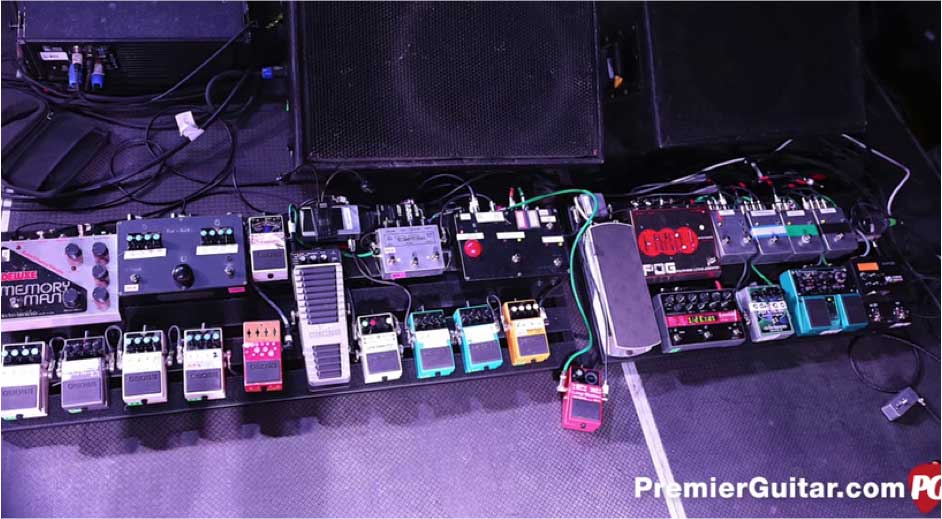
Russell Lissack's "Hymns" pedalboard, published in Premier Guitar's Rig Rundown with John Bohlinger.
"Exes" is also an interesting song, not because of Lissack, but because of Okereke's chord changes. Song starts off with F#m, then he plays Dmaj7, and then he plays A and Aadd4/D. I've managed to create chords for "Exes" on the Ultimate Guitar page, so it would be much easier to explain those messy chords.
Lissack doesn't do extensive guitar work here- at the second part of the song; he uses Eventide Pitchfactor. He has a preset on the pedal, called "Exes," according to rig rundown. Gospel vibes can be seen on another song, called "The Good News," which starts with bluesy electric guitar heard. It sounds like a typical blues/gospel, yet there is something much more about the song. This song also utilizes slide playing, something that Lissack hasn't done much previously.
Also, the rendition of the song was done acoustically on "Sunday Brunch," which is a cooking show broadcast on Channel 4.
Equipment
Guitars
Over the years, Lissack didn't switch many guitars. His main guitar is the 2003 Fender American Ash Telecaster. I'm going to talk about guitars used in the video briefly.
Fender American Ash Telecaster - his main guitar which dates back to 2003. In the Premier Guitar interview, Lissack discusses the guitar. The guitar was bought back at the time the band got signed. The guitar is stock, but the bridge pickup is replaced with Seymour Duncan single-coil pickup (possibly the SSL-1). The guitar's pickguard is decorated with various stickers, and the guitar strap also has different badges attached to it, mostly anime characters. Used for basically everything Bloc Party has ever created.
Fender Classic Series 60's Telecaster - used in early days, unknown for which particular songs. This guitar is seen in the music video for "Little Thoughts." Also, seen in some early videos of the band, such as "Chinese Burn" and "An Act Of Contrition" performances.
Fender Classic Series '72 Custom Telecaster - dates somewhere around 2002 or 2003. This guitar has a sticker on it from some anime (I'm horrible at identifying anime characters). This guitar has a toy inside it, which then creates noises which are combined with effects to create usual live-show madness. Used for songs such as "Only He Can Heal Me," music video for "Octopus" and "Uniform."
Gibson Les Paul Standard - seen in Audio Kitchen's video, where Lissack demonstrates the Little Chopper amplifier. It is unsure whether that is a Gibson because the logo on the headstock is not visible. He plays a couple of licks, including the "Johnny B. Goode."
Fender Telecaster - another Telecaster, in blue burst finish. Used for "Two More Years," and tuned down to C standard. Can be seen in the Glastonbury performance. Possibly a custom-made guitar.
Squier Jagmaster - used in 2002, when Bloc Party still performed as the Angel Range.
Fender USA Standard Stratocaster - white finish, used for Audio Kitchen's promotional video, as well as BBC Maida Vale performances, specifically for "This Modern Love" and "Exes." Received as a gift from Fender back in 2008.
Takamine EF341C - one-off guitar, used for the performance of "I Still Remember," "This Modern Love" and "So Here We Are" live at The Interface.
Gibson SG Standard - guitar utilized during "Hymns" tour for slide work on "The Good News."
Fender Billy Corgan Stratocaster- used during "Four" era, for "Octopus" and "Kettling."
Fender CD-60CE - one of the guitar, used during Bloc Party's acoustic KEXP set.
Unknown Takamine acoustic - used at "The Good News" performance live at Channel 4's "Sunday Brunch."
Amplifiers
Fender Hot Rod Deluxe 1x12 - his main amplifiers since the "Silent Alarm" era. Mostly used because of their consistency and ease to rent it if he is unable to bring his amp.
Peavey Classic 50 - not sure whether the amp was used anywhere, but it was seen during music video of "Octopus."
Audio Kitchen Big Chopper - Lissack used those amplifiers during "Four" era, in conjunction with Fender Hot Rod Deluxe.
Audio Kitchen Little Chopper - possibly used only for practice, used only in promotional Audio Kitchen video.
Marshall Valvestate 120W - used in very early band videos along with the Marshall 4x12 cabinet. Seen in the "Chinese Burn" video right behind Lissack.
Pedals
Boss LS-2 Line Selector - used for triggering his Boss PW-10 wah pedal.
Truetone 1-Spot Pro - main power supply used to power his pedalboard during "Hymns" tour.
Boss DD-5 Digital Delay - his main delay pedals, used from the "Silent Alarm" era. Used on "Like Eating Glass." Lissack uses this pedal because of reverse delay function. Also, used on "A Weekend In The City" and probably every Bloc Party record.
Boss DD-6 Digital Delay - mentioned in the Boss interview, but mostly used for loops. In Premier Guitar's rig rundown, Lissack's pedalboard contains two of those delay pedals.
Boss DD-3 Digital Delay - possibly used in the studio; one of those pedals serves as the controller for his custom-made delay pedal.
Boss PW-10 - his main wah pedal, used ever since the "Intimacy." Wah is very important for Lissack's tone. Used for the song such as "Song For Clay" and "Hunting For Witches."
Boss OS-2 Overdrive/Distortion - briefly seen in the "Octopus" music video. The OS-2 has been omitted from the pedalboard later but returned according to Louise Bartle (Bloc Party's drummer)'s snapshots of his pedalboard; the OS-2 has returned.
Boss DS-1 Distortion pedal - classic distortion pedal, mentioned in the Boss interview, but also visible in the Premier Guitar's rig rundown. Possibly used for "Hunting For Witches."
Boss PS-5 SUPER Shifter - his main pitch-shifting pedal. He has 2 of those in his pedalboard, one for shifting the pitch an octave up, and one for shifting the pitch an octave down. Used on "Ares" and "Positive Tension." The beginning of "Hunting For Witches" is played using this pedal, according to the interview done with The Guitar Magazine.
Boss TR-2 Tremolo - used during "Silent Alarm" and featured in Boss interview with Lissack. Possibly used for "Helicopter."
Boss TU-3 Tuner - classic tuner pedal, used throughout the Bloc Party career
Boss RV-5 Digital Reverb - Lissack uses reverb both from the amplifier, as well as from the pedal. Pedal used is the Boss RV-5. According to the pedal settings in Premier Guitar's rig rundown, he prefers the hall reverb.
Boss RE-20 Space Echo- used during "Four" era, removed during "Hymns" tour. Quite possibly replaced by Electro Harmonix Memory Man.
Electro-Harmonix Big Muff Pi - used during "Intimacy" and "Four," for aggressive fuzz tone, heard on songs such as "Kettling." He stated in an interview with The Guitar Magazine that he uses this pedal for creating heavy riffs.
Electro-Harmonix Deluxe Memory Man - classic Memory Man, used for "Hymns" tour. The Memory Man is the classic one because Lissack prefers the analog tone. This pedal possibly replaced the Boss RE-20 space echo pedal. However, this doesn't make sense, because it was on his pedalboard along with the RE-20.
Electro-Harmonix POG - although Lissack has been using this pedal before "Hymns," it was "Hymns" where this pedal started to be a staple of his sound. Used for songs such as "Love Within" and "Virtue." He manipulates low-pass filter element on the pedal, creating the organ-like, rich sound on songs he uses it on.
Ernie Ball 6165 Volume/Pan Pedal - this pedal is used for creating ambient volume swells. According to Premier Guitar's rig rundown, this pedal is first in his signal chain. Possibly used at the beginning of "Waiting For The 7:18".
Eventide TimeFactor- its use is unknown, but Lissack posted box of the pedal on Twitter. Possibly used during 2015.
Dunlop Cry Baby Wah- although preferring the Boss PW-10 wah pedal, during "Silent Alarm," Lissack used the Dunlop Cry Baby wah. It can be briefly seen during Jools Holland performances. During early days, he also appears to be using wah pedal, which, if looked at the housing, reminds of the Cry Baby housing.
Eventide TimeFactor- pedal acquired around the "Hymns" recordings. The synthy tones for the pedal are used for "Exes." One of the preset in his pedal is called "Exes," which is used for the song.
Boss SL-20 Slicer- another new pedal used for "Hymns," used with Line 6 M5 modeler to create the "Virtue" lush and melodic chorus sounds.
DigiTech Whammy - in Premier Guitar's rig rundowns, he mentioned that he has the DigiTech Whammy and loves it because of the distinctive sound, but uses Boss PS-5 pitch-shifters instead.
Electro-Harmonix Superego- another pedal acquired around the "Hymns" recording time. Used for chord-like sustain.
Line 6 M5 Stompbox Modeler- pedal acquired around the "Hymns" era. Although it has many different options, Lissack only uses a couple of them. "Octo Reverb" preset is used with Boss SL-20 for "Virtue," and particle reverb is used for "Eden" and "Different Drugs."
Roland AF-100 BeeBaa Fuzz - his fuzz of choice, it has replaced the Electro Harmonix Big Muff Pi pedal. The original is kept by Lissack at home. On tour, he uses the replica of BeeBaa fuzz.
Custom-made Roland AF-100 BeeBaa Fuzz - a fuzz built by his friend, now used on "Hymns" live tour. A friend of his managed to get blueprints for the pedal and created the clone for him.
Boss RC-1 Loop Station - looper, which is outside of his pedalboard, is used for stuff such as "Only He Can Heal Me" and "Stunt Queen."
Dunlop DC-Brick Power Supply - used during "Silent Alarm" as his main power supply.
Strymon Mobius Modulation Pedal - this pedal was used during the recording of "Hymns," for unknown purposes. This came from a photo from Point Blank Music Academy student, Luca Rella. In one photo, he can be seen setting up the pedalboard, which, according to the rest of the pedals, is Russell's.
Way Huge Swollen Pickle Fuzz - this pedal was used during his tenure with Ash.
Electro-Harmonix Freeze - used during "Four" era, possibly as a killswitch pedal.
Custom-made delay pedal - this delay pedal is famous for his use on "Octopus." The pedal was custom-made for Lissack. The pedal has two Boss digital delay pedals with different delay times set in it and is controlled via Boss DD-3, which has knobs removed and serves as a controller.
Walrus Descent - Lissack received this pedal as a gift from Walrus. He posted a box of the pedal on his Twitter profile.
RayGun FX Super Fuzz Boy - received sometime in 2015. Lissack praised the pedal for its looks, and for some time, he included it on his pedalboard!
Electro-Harmonix SYNTH9 - this pedal was included in his relatively small pedalboard, according to his Twitter post in 2017.
Korg Miku - this slightly bizarre pedal is also one of those pedals included in his small 2017 pedalboard.
Walrus Julia - another pedal possibly received by Walrus Effects, included in his 2017 pedalboard.
Boss TE-2 Terra Echo pedal - probably used for recordings, the only connection between him and the pedal is his Instagram post, in which he just said "New sounds."
Custom-made A/B Box - built by Steve Crow, the name behind Audio Kitchen. The A/B box contains dual outputs, panic switch (which was the function of EHX freeze before), kill switch, and a footswitch that moves the signal from Loop A to Loop B.
Custom-built channel selectors - used since "Four." Lissack uses four channel selectors for different pedals, such as Electro-Harmonix POG and Superego.
Pigtronix EP-1 Envelope Phaser - used during 2009.
Software, Synths, Accessories
Native Instruments Guitar Rig 5 - Native Instruments endorsed Lissack for some time. He briefly used the Guitar Rig 5 and is featured as an artist who uses it on his website.
Korg KP3 KAOSS pad - this pad was used during "Intimacy" and "Four" era, as well as for the "Hymns" recordings, but is not found on the new pedalboard. Used for crazy synthy sounds, on songs like "One Month Off."
EBow - used more frequently in the present. Utilized for the intro of "Song For Clay," and it was used on the "Heroes" cover as well.
Ernie Ball Super Slinky (9.-42.) - most standard guitar strings used by him, regularly used during "Hymns" era.
Ernie Ball Slinky (10.-46.) - Pack of those strings has been seen on the Instagram photo posted by him. Used possibly for stringing his Gibson SG Standard.
Clavia Nord Rack - the purpose of it is unknown, posted with Boss Terra Echo pedal and Fender Stratocaster on his Instagram photo.
POG Remote - used for manipulating the low-pass filter on Electro-Harmonix POG.
The picks he uses are unknown, but some say that he uses Dunlop Nylon Guitar Picks, 0.60 mm thickness.
Conclusion
So, there you have it. I think that this comprehensive review shows the genius of Russell Lissack and his guitar work. I focused on the Bloc Party work because his career in Bloc Party is epitomizing his guitar skills.
Special thanks to Alexi Garcia for all the great Bloc Party videos that made this article possible.
Thanks for reading and I hope to see you soon in the next "The genius of." Are there any artists we should do next? Sound off in the comments!





.webp)

.webp)